| ||
| ||
| ||
| ||
| ||
|
NPI Technical Specification
Description: OpenSS7 Project Library Transport NPI
A PDF version of this document is available here.
Network Link Provider Interface
Network Provider Interface Specification
About This Manual
This is Edition 7.20141001, last updated 2014-10-25, of The Network Provider Interface Specification, for Version 1.1 release 7.20141001 of the OpenSS7 package.
1 Introduction
This document specifies a STREAMS-based kernel-level instantiation of the ISO/CCITT network service definition. The Network Provider Interface (NPI) enables the user of a network layer service to access and use any of a variety of conforming network layer service providers without specific knowledge of the provider’s protocol. The service interface is designed to support any connection-mode network protocol and connectionless network protocol. This interface only specifies access to network layer service providers, and does not address issues concerning network layer management,protocol performance, and performance analysis tools.
The specification assumes that the reader is familiar with the OSI reference model terminology, ISO/CCITT Network Layer Service, and STREAMS.
1.1 Related Documentation
- — 1986 CCITT X.213 Recommendation (see X.213)
- — ISO 8348 (see ISO8348)
- — ISO 8348/AD1 (see ISO8348/AD1)
- — ISO 8473 (see ISO8473)
- — ISO 8208 (see ISO8208)
- — ISO 8878 (see ISO8878)
- — System V Interface Definition, Issue 2 - Volume 3 (see SVID)
1.1.1 Role
This document specifies an interface that supports the service provided by the Network Services Definition for Open Systems Interconnection for CCITT Applications as described in CCITT Recommendation X.213 (see X.213) and ISO 8348 (for CONS) (see ISO8348) and ISO8348/Addendum 1 (for CLNS) (see ISO8348/AD1). These specifications are targeted for use by) and ISO 8348 (for CONS) (see ISO8348) and ISO8348/Addendum 1 (for CLNS) (see ISO8348/AD1). These specifications are targeted for use by developers and testers of protocol modules that require network layer service.
1.2 Definitions, Acronyms, and Abbreviations
- Calling NS user
-
An NS user that initiates a Network Connection (NC).
- Called NS User
-
An NS user with whom a calling NS user wishes to establish a network connection (NC).
- CLNP
-
Connection-less Network Protocol
- CLNS
-
Connection-less Network Service
- CONP
-
Connection Oriented Network Protocol
- CONS
-
Connection Oriented Network Service
- DLSAP
-
Data Link Service Access Point
- ISO
-
International Organization for Standardization
- NC
-
Network Connection
- Network User
-
Kernel level protocol or user level application that is accessing the services of the network layer.
- Network Provider
-
Network layer entity/entities that provide/s the services of the network interface.
- NPI
-
Network Provider Interface
- NS
-
Network Service
- NIDU
-
Network Interface Data Unit
- NSAP
-
Network Service Access Point
- NSDU
-
Network Service Data Unit
- OSI
-
Open Systems Interconnection
- QOS
-
Quality of Service
- STREAMS
-
A communication services development facility first available with UNIX® System V Release 3
2 The Network Layer
The Network Layer provides the means to manage the operation of the network. It is responsible for the routing and management of data exchange between network-user entities.
2.1 Model of the NPI
The NPI defines the services provided by the network layer to the network-user at the boundary between the network layer and the network layer user entity. The interface consists of a set of primitives defined as STREAMS messages that provide access to the network layer services, and are transferred between the NS user entity and the NS provider. These primitives are of two types; ones that originate from the NS user, and others that originate from the NS provider. The primitives that originate from the NS user make requests to the NS provider, or respond to an event of the NS provider. The primitives that originate from the NS provider are either confirmations of a request or are indications to the NS user that the event has occurred. Figure 1 shows the model of the NPI.
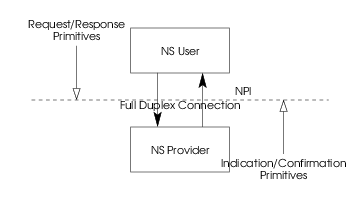
The NPI allows the NS provider to be configured with any NS user
(such as the OSI Transport Layer) that also conforms to the NPI. A network layer user
can also be a user program that conforms to the NPI and accesses the NS
provider via putmsg(2s) and getmsg(2s) system calls.
2.2 NPI Services
The features of the NPI are defined in terms of the services provided by the NS provider, and the individual primitives that may flow between the NS user and the NS provider.
The services supported by the NPI are based on two distinct modes of communication, connection (CONS) and connectionless (CLNS). In addition, the NPI supports services for local management.
2.2.1 CONS
The main features of the connection mode communication are:
- It is virtual circuit oriented;
- It provides transfer of data via a pre-established path;
- It provides reliable data transfer.
There are three phases to each instance of communication: Connection Establishment, Data Transfer; and Connection Termination. Units of data arrive at their destination in the same order as they departed their source and the data is protected against duplication or loss of data units within some specified quality of service.
2.2.2 CLNS
The main features of the connectionless mode communication are:
- It is datagram oriented;
- It provides transfer of data in self contained units;
- There is no logical relationship between these units of data;
- It is unreliable.
Connectionless mode communication has no separate phases. Each unit of data is transmitted from source to destination independently, appropriate addressing information is included with each unit of data. As the units of data are transmitted independently from source to destination, there are, in general, no guarantees of proper sequence and completeness of the data Stream.
2.2.3 Local Management
The NPI specifications also define a set of local management functions that apply to both CONS and CLNS modes of communication. These services have local significance only.
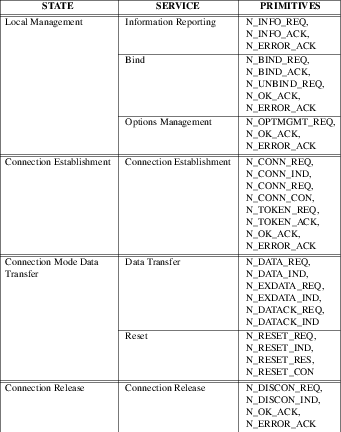
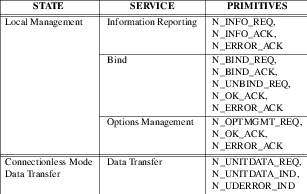
Table 1 and Table 2 summarizes the NPI service primitives by their state and service.
3 NPI Services Definition
This section describes the services of the NPI primitives. Time-sequence diagrams that illustrate the sequence of primitives are included.1
3.1 Local Management Services Definition
The services defined in this section are outside the scope of the international standards. These services apply to both connection-mode as well as the connection-less modes of communication. They are invoked for the initialization/de-initialization of a Stream connected to the NS provider. They are also used to manage options supported by the NS provider and to report information on the supported parameter values.
3.1.1 Network Information Reporting Service
This service provides information on the options supported by the NS provider.
-
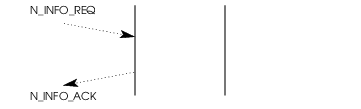
N_INFO_REQ: This primitive requests that the NS provider return the values of all the supported protocol parameters. This request may be invoked during any phase. -
N_INFO_ACK: This primitive is in response to theN_INFO_REQprimitive and returns the values of the supported protocol parameters to the NS user.
The sequence of primitives for network information management is shown in Figure 2.
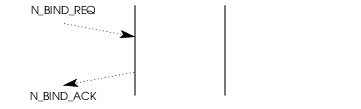
3.1.2 NS User Bind Service
This service allows a network address to be associated with a Stream. It allows the NS user to negotiate the number of connect indications that can remain unacknowledged for that NS user (a connect indication is considered unacknowledged while it is awaiting a corresponding connect response or disconnect request from the NS user). This service also defines a mechanism that allows a Stream (bound to a network address of the NS user) to be reserved to handle incoming calls only. This Stream is referred to as the listener Stream.
-
N_BIND_REQ: This primitive requests that the NS user be bound to a particular network address, and negotiate the number of allowable outstanding connect indications for that address. -
N_BIND_ACK: This primitive is in response to theN_BIND_REQprimitive and indicates to the user that the specified NS user has been bound to a network address.
The sequence of primitives for NS user bind service is shown in Figure 3.
3.1.3 NS User Unbind Service
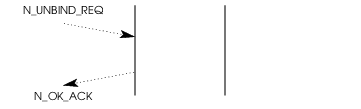
This service allows the NS user to be unbound from a network address.
-
N_UNBIND_REQ: This primitive requests that the NS user be unbound from the network address that it had previously been bound to.
The sequence of primitives for NS user unbind service is shown in Figure 4.
3.1.4 Receipt Acknowledgement Service
-
N_OK_ACK: This primitive indicates to the NS user that the previous NS user originated primitive was received successfully by the NS provider.
An example showing the sequence of primitives for successful receipt acknowledgement is depicted in Figure 4.
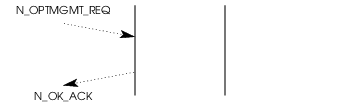
3.1.5 Options Management Service
This service allows the NS user to manage the QOS parameter values associated with the NS provider.
-
N_OPTMGMT_REQ: This primitive allows the NS user to select default values for QOS parameters within the range supported by the NS provider, and to indicate the default selection of receipt confirmation.
Figure 5 shows the sequence of primitives for network options management.
3.1.6 Error Acknowledgement Service
-
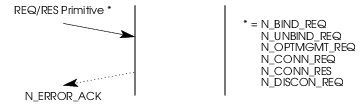
N_ERROR_ACK: This primitive indicates to the NS user that a non-fatal error has occurred in the last NS user originated request or response primitive (listed in Figure 6), on the Stream.
Figure 6 shows the sequence of primitives for the error management primitive.
3.2 Connection-Mode Network Services Definition
This section describes the required network service primitives that define the CONS interface.
The queue model for CONS is discussed in more detail in CCITT X.213 (see X.213) section 9.2. The queue model represents the operation of a network connection in the abstract by a pair of queues linking the two network addresses. There is one queue for each direction of information flow. Each queue represents a flow control function in one direction of transfer. The ability of a user to add objects to a queue will be determined by the behaviour of the user removing objects from that queue, and the state of the queue. The pair of queues is considered to be available for each potential NC. Objects that are entered or removed from the queue are either as a result of interactions at the two network addresses, or as the result of NS provider initiatives.
- A queue is empty until a connect object has been entered and can be returned to this state, with loss of its contents, by the NS provider.
- Objects may be entered into a queue as a result of the actions of the source NS user, subject to control by the NS provider;
- Objects may also be entered into a queue by the NS provider.
- Objects are removed from the queue under the control of the receiving NS user.
- Objects are normally removed under the control of the NS user in the same order as they were
entered except:
- — if the object is of a type defined to be able to advance ahead of the preceding object (however, no object is defined to be able to advance ahead of another object of the same type), or
- — if the following object is defined to be destructive with respect to the preceding object on the queue. If necessary, the last object on the queue will be deleted to allow a destructive object to be entered - they will therefore always be added to the queue. For example, “disconnect” objects are defined to be destructive with respect to all other objects. “Reset” objects are defined to be destructive with respect to all other objects except “connect”, “disconnect”, and other “reset” objects.
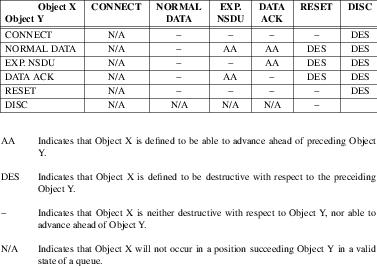
Table 3 shows the ordering relationships among the queue model objects.
3.2.1 Connection Establishment Phase
A pair of queues is associated with an NC between two network addresses when the NS provider
receives an N_CONN_REQ primitive at one of the network addresses resulting in a connect
object being entered into the queue. The queues will remain associated with the NC until a
N_DISCON_REQ primitive (resulting in a disconnect object) is either entered or removed from a
queue. Similarly, in the queue from the called NS user, objects can be entered into the queue only
after the connect object associated with the N_CONN_RES has been entered into the queue.
Alternatively, the called NS user can enter a disconnect object into the queue instead of the
connect object to terminate the NC. The NC establishment procedure will fail if the NS provider is
unable to establish an NC,or if the destination NS user is unable to accept the N_CONN_IND
(see NC Release primitive definition).
3.2.1.1 User Primitives for Successful Network Connection Establishment
-
N_CONN_REQ: This primitive requests that the NS provider make a connection to the specified destination. -
N_CONN_RES: This primitive requests that the NS provider accept a previous connection indication.
3.2.1.2 Provider Primitives for Successful Network Connection Establishment
-
N_CONN_IND: This primitive indicates to the NS user that a connect request has been made by a user at the specified source address. -
N_CONN_CON: This primitive indicates to the NS user that a connect request has been confirmed on the specified responding address.
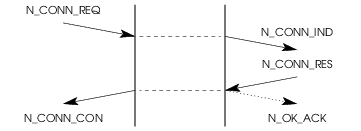
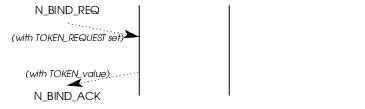
The sequence of primitives in a successful NC establishment is defined by the time sequence diagram as shown in Figure 7. The sequence of primitives for the NC response token value determination is shown in Figure 8 (procedures for NC response token value determination are discussed in sections 4.1.3 and 4.1.4.).
3.2.2 Data Transfer Phase
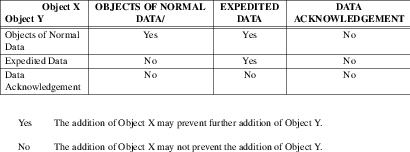
Flow control on the NC is done by management of the queue capacity, and by allowing objects of certain types to be inserted to the queues, as shown in Table 4.
3.2.2.1 User Primitives for Data Transfer
-
N_DATA_REQ: This primitive requests that the NS provider transfer the specified data. -
N_DATACK_REQ: This primitive requests that the NS provider acknowledge the data that had previously been received with receipt confirmation requested. -
N_EXDATA_REQ: This primitive requests that the NS provider transfer the specified expedited network service data unit.
3.2.2.2 Provider Primitives for Data Transfer
-
N_DATA_IND: This primitive indicates to the NS user that this message contains data. -
N_DATACK_IND: This primitive indicates to the NS user that the remote NS user has acknowledged the data that had previously been sent with receipt confirmation requested. -
N_EXDATA_IND: This primitive indicates to the NS user that this message unit contains expedited data.
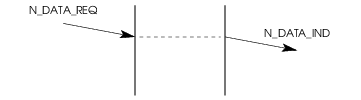
Figure 9 shows the sequence of primitives for successful normal data transfer. The sequence of
primitives may remain incomplete if a N_RESET or N_DISCON primitive occurs.
The sequence of primitives in a successful confirmation of receipt is defined in the time sequence diagram as shown in Figure 10.
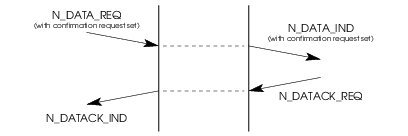
The sequence of primitives as shown above may remain incomplete if an N_RESET or an
N_DISCON primitive occurs (see Table 3). A NS user
must not issue an N_DATACK_REQ primitive if no N_DATA_IND with confirmation request
set has been received, or if all such N_DATA_IND
have been previously acknowledged. Following a reset procedure (N_RESET_REQ or
N_RESET_IND), a NS user may not issue
aN_DATACK_REQ to acknowledge an outstanding N_DATA_IND received before the reset procedure
was signalled.
Note—The withholding of confirmation of receipt by a NS user can have an effect on the attainable throughput on the NC.
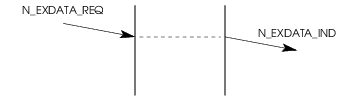
The sequence of primitives for expedited data transfer is shown in the time
sequence diagram in Figure 11. This sequence of primitives may remain
incomplete if a N_RESET or N_DISCON primitive is issued.
3.2.3 Reset Operation Primitives
The reset service is used by the NS user to resynchronize the use of the NC, or by the NS provider to report detected loss of unrecoverable data.
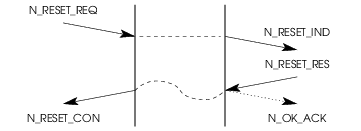
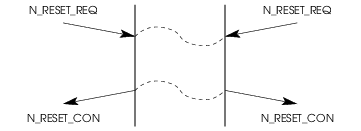
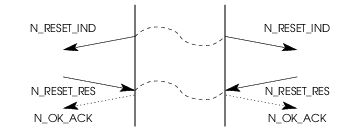
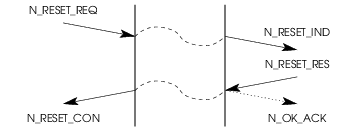
The reset procedure involves the following interactions:
- a
N_RESET_REQfrom the NS user, followed by aN_RESET_CONfrom the NS provider; or - a
N_RESET_INDfrom the NS provider, followed by aN_RESET_RESfrom the NS user.
The complete sequence of primitives depends upon the origin/s of the reset action. The reset service may be:
- invoked by one NS user, leading to interaction (A) with that NS user and interaction (B) with the peer NS user;
- invoked by both NS users, leading to interaction (A) with both NS users;
- invoked by the NS provider, leading to interaction (B) with both NS users;
- invoked by one NS user and the NS provider, leading to interaction (A) with the originating NS user and (B) with the peer NS user.
The N_RESET_REQ acts as a synchronization mark in the flow of N_DATA, N_EXDATA,
and N_DATACK primitives transmitted by the issuing NS user; the N_RESET_IND acts as a
synchronization mark in the flow of N_DATA, N_EXDATA, and N_DATACK primitives
received by the receiving NS user. Similarly, N_RESET_RES acts as a synchronization mark in
the flow of N_DATA, N_EXDATA, and N_DATACK primitives transmitted by the
responding NS user, while the N_RESET_CON acts as a synchronization mark in the flow of
N_DATA, N_EXDATA, and N_DATACK primitives received by the NS user that
originally issued the reset. The resynchronizing properties of the reset service are the following:
- All
N_DATA,N_EXDATA, andN_DATACKprimitives issued before issuing theN_RESET_REQ/N_RESET_RESthat have not been delivered to the other NS user before theN_RESET_IND/N_RESET_CONare issued by the NS provider,should be discarded by the NS provider. - Any
N_DATA,N_EXDATA, andN_DATACKprimitives issued after the synchronization mark will not be delivered to the other NS user before the synchronization mark is received.
3.2.3.1 User Primitives for Reset Operations
-
N_RESET_REQ: This primitive requests that the NS provider reset the network connection. -
N_RESET_RES: This primitive indicates to the NS provider that the NS user has accepted a reset indication.
3.2.3.2 Provider Primitives for Reset Operations
-
N_RESET_IND: This primitive indicates to the NS user that the network connection has been reset. -
N_RESET_CON: This primitive indicates to the NS user that the reset request has been confirmed.
The sequence of primitives as shown in
Figure 12, Figure 13, Figure 14 and Figure 15
may remain in complete if a N_DISCON primitive occurs.
3.2.4 Connection Termination Phase
The NC release procedure is initialized by the insertion of a disconnect object
(associated with a N_DISCON_REQ) into the queue. As shown in Table 3,
the disconnect procedure is destructive with respect to other objects in the
queue, and eventually results in the emptying of queues and termination of the
NC connection.
The sequence of primitives depends on the origin of the release action. The sequence may be:
- invoked by one NS user, with a request from that NS user leading to an indication to the other;
- invoked by both NS users, with a request from each of the NS users;
- invoked by the NS provider, with an indication to each of the NS users;
- invoked independently by one NS user and the NS provider, with a request from the originating NS user and an indication to the other.
3.2.4.1 User Primitives for Connection Termination
-
N_DISCON_REQ: This primitive requests that the NS provider deny an outstanding request for a connection or disconnect an existing connection.
3.2.4.2 Provider Primitives for Connection Termination
-
N_DISCON_IND: This primitive indicates to the NS user that either a request for connection has been denied or an existing connection has been terminated.
The sequence of primitives are shown in the time sequence diagrams in Figure 16, Figure 17, Figure 18 and Figure 19.
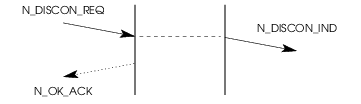
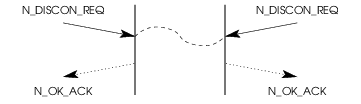
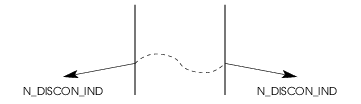
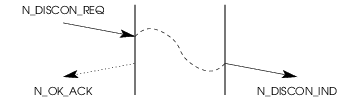
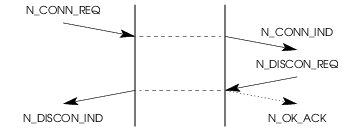
A NS user may reject an NC establishment attempt by issuing a
N_DISCON_REQ. The originator parameter in the N_DISCON primitives
will indicate NS user invoked release. The sequence of events is shown in
Figure 20.
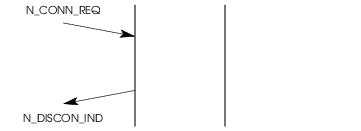
If the NS provider is unable to establish an NC, it indicates this to the
requester by an N_DISCON_IND. The originator in this primitive indicates
an NS provider invoked release. This is shown in Figure 21.
3.3 Connectionless Network Services Definition
The CLNS allows for the transfer of the NS user data in one or both directions simultaneously without establishing a network connection. A set of primitives are defined that carry user data and control information between the NS user and NS provider entities. The primitives are modelled as requests initiated by the NS user and indications initiated by the NS provider. Indications may be initiated by the NS provider independently from requests by the NS user.
The connectionless network service consists of one phase.
3.3.1 User Request Primitives
-
N_UNITDATA_REQ: This primitive requests that the NS provider send the data unit to the specified destination.
3.3.2 Provider Response Primitives
-
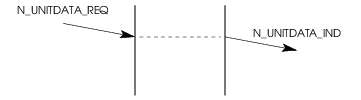
N_UNITDATA_IND: This primitive indicates to the NS user that a data unit has been received from the specified source address.
Figure 22 shows the sequence of primitives for the connectionless mode of data transfer.
-
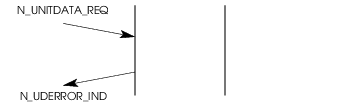
N_UDERROR_IND: This primitive indicates to the NS user that the data unit with the specified destination address and QOS parameters produced an error. This primitive is specific to CLNS.
Figure 23 shows the sequence of primitives for the CLNS error management primitive.
4 NPI Primitives
This section describes the format and parameters of the NPI primitives (Mapping NPI to ISO 8348 and CCITT X.213, shows the mapping of the NPI primitives to the primitives defined in ISO 8348 (see ISO8348) and CCITT X.213 (see X.213)). In addition, it discusses the states the primitive is valid in, the resulting state, and the acknowledgement that the primitive expects. (The state/event tables for these primitives are shown in State/Event Tables. The precedence tables for the NPI primitives are shown in Primitive Precedence Tables.) Rules for OSI conformance are described in Addendum for OSI Conformance, to this document.
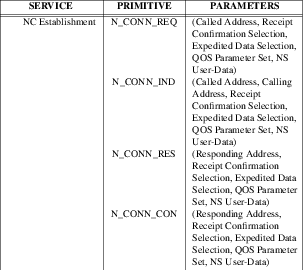
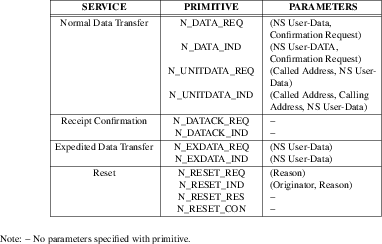
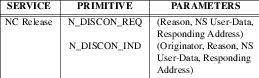
Table 5, Table 6 and Table 7 provide a summary of the NS primitives and their parameters.
4.1 Management Primitives
These primitives apply both to CONS as well as CLNS.
4.1.1 Network Information Request
N_INFO_REQ
This primitive requests the NS provider to return the values of all supported protocol parameters (see N_INFO_ACK), and also the current state of the NS provider (as defined in State/Event Tables). This primitive does not affect the state of the network provider and does not appear in the state tables.
Format
The format of the message is one M_PCPROTO message block and its structure is
as follows:
Parameters
- PRIM_type
Indicates the primitive type.
Valid States
This primitive is valid in any state where a local acknowledgement is not pending.
New State
The new state remains unchanged.
Acknowledgements
This primitive requires the NS provider to generate one of the following acknowledgements upon receipt of the primitive:
- — Successful:
Acknowledgement of the primitive via the
N_INFO_ACKprimitive. - — Unsuccessful (Non-fatal errors): There are no errors associated with the issuance of this primitive.
4.1.2 Network Information Acknowledgement
N_INFO_ACK
This primitive indicates to the NS user any relevant protocol-dependent parameters.2 It should be initiated in
response to the N_INFO_REQ primitive described above.
Format
This primitive consists of one M_PCPROTO message block, structured as follows:
typedef struct {
np_ulong PRIM_type; /* always N_INFO_ACK */
np_ulong NSDU_size; /* maximum NSDU size */
np_ulong ENSDU_size; /* maximum ENSDU size */
np_ulong CDATA_size; /* connect data size */
np_ulong DDATA_size; /* discon data size */
np_ulong ADDR_size; /* address size */
np_ulong ADDR_length; /* address length */
np_ulong ADDR_offset; /* address offset */
np_ulong QOS_length; /* QOS values length */
np_ulong QOS_offset; /* QOS values offset */
np_ulong QOS_range_length; /* length of QOS values' range */
np_ulong QOS_range_offset; /* offset of QOS values' range */
np_ulong OPTIONS_flags; /* bit masking for options supported */
np_ulong NIDU_size; /* network i/f data unit size */
np_long SERV_type; /* service type */
np_ulong CURRENT_state; /* current state */
np_ulong PROVIDER_type; /* type of NS provider */
np_ulong NODU_size; /* optimal NSDU size */
np_ulong PROTOID_length; /* length of bound protocol ids */
np_ulong PROTOID_offset; /* offset of bound protocol ids */
np_ulong NPI_version; /* version # of npi that is supported */
} N_info_ack_t;
/* Flags to indicate support of NS provider options */
#define REC_CONF_OPT 0x00000001L
#define EX_DATA_OPT 0x00000002L
#define DEFAULT_RC_SEL 0x00000004L
/* Service types supported by the NS provider */
#define N_CONS 1
#define N_CLNS 2
/* Valid provider types */
#define N_SNICFP 1
#define N_SUBNET 2
Parameters
The above fields have the following meaning:
| PRIM_type | Specifies the primitive type: always N_INFO_ACK. |
| NSDU_size | Specifies the maximum size (in octets) of a Network Service Data Unit (NSDU) supported by the NS provider. |
| ENSDU_size | Specifies the maximum size (in octets) of an Expedited Network Service Data Unit (ENSDU) supported by the NS provider. |
| CDATA_size | Specifies the maximum number of octets of data that may be associated with connection establishment primitives. |
| DDATA_size | Specifies the maximum number of octets of data that may be associated with the disconnect primitives. |
| ADDR_size | Specifies the maximum size (in decimal digits) of a network address. |
| ADDR_length | Specifies the length in bytes of the network address bound on the Stream on which the
N_INFO_REQ primitive was issued (a network address is bound to a Stream with the
N_BIND_REQ primitive). |
| ADDR_offset | Specifies the offset of the bound network address from the beginning of the M_PCPROTO message
block (this field should be ignored if the ADDR_length field is zero). |
| QOS_length | In the connection-mode environment, when this primitive is invoked before the NC is established on
the Stream, the values returned specify the default values supported by the NS provider. When this
primitive is invoked after a NC has been established on the Stream, the values returned indicate the
negotiated values for the QOS parameters. In the connection-less environment, these values
represent the default or the selected QOS parameter values. In case a QOS parameter is not
supported by NS Provider, a value of QOS_UNKNOWN will be returned. In the case where no QOS
parameters are supported by the NS provider, this field will be zero. |
| QOS_offset | Indicates the offset of the QOS parameters from the beginning of the M_PCPROTO message block. |
| QOS_range_length | Indicates the length in bytes, of the available range of QOS parameters values supported by the NS
provider. These ranges are used by the NS user to select QOS parameter values that are valid with
the NS provider. QOS parameter values are selected, or the default values altered via the
N_OPTMGMT_REQ primitive. In the connection-mode environment, the values for end-to-end QOS
parameters may be specified with the N_CONN_REQ or N_CONN_RES primitives for
negotiation. If the NS provider does not support a certain QOS parameter, its value will be set to
QOS_UNKNOWN. In the case where no QOS parameters are supported by the NS provider, the
length of this field will be zero. |
| QOS_range_offset | Indicates the offset of the range of QOS parameter values from the beginning of the M_PCPROTO
message block. |
| OPTIONS_flags | Defines flags that indicate whether the options described below are supported by the NS provider. The possible options are receipt confirmation, expedited data and default selection for use of receipt confirmation. |
| NIDU_size | This indicates the amount of user data that may be present in an N_DATA_REQ or
N_DATA_IND primitive. The NIDU_size should not be larger than the NSDU_size
specification. |
| SERV_type | Indicates the service type supported by the NS provider. The possible values can be N_CONS,
N_CLNS, (or both as indicated by using N_CONS|N_CLNS). |
| CURRENT_state | Indicates the current state of the NS provider. |
| PROVIDER_type | Indicates the type of NS provider. The possible values can be N_SNICFP or N_SUBNET.
The value N_SNICFP indicates that the provider is the Subnetwork Independent Convergence
Function/Protocol sub-layer of the network layer. The value N_SUBNET indicates that the
provider is a subnetwork. |
| NODU_size | Indicates the optimal NSDU size (in octets) of an NSDU given the current routing information. |
| PROTOID_length | Indicates the length of the protocol identifiers that were bound using the N_BIND_REQ. |
| PROTOID_offset | Indicates the offset of the protocol identifiers that were bound using the N_BIND_REQ, from
the beginning of the M_PCPROTO message block. |
| NPI_version | Indicates the current version of NPI that is supported.
Always N_VERSION_2 for this specificaiton. |
Flags
REC_CONF_OPTWhen set, it indicates that the NS provider supports receipt confirmation.
This flag is used only in the connection-mode environment.
EX_DATA_OPTWhen set, it indicates that the NS provider supports expedited data transfer.
This flag is used only in the connection-mode environment.
DEFAULT_RC_SELWhen set, indicates that the default selection is for the use of receipt confirmation for every
N_DATA_REQprimitive. This flag is only applicable when use of receipt confirmation is successfully negotiated via theN_CONN_REQorN_CONN_RESprimitives. This flag is only used in the connection-mode environment.
Service Types
N_CONSWhen set, indicates that the NS provider supports connection-mode network services.
N_CLNSWhen set, indicates that the NS provider supports connection-less network services.
Valid States
This primitive is valid in any state in response to an N_INFO_REQ primitive.
New State
The state remains unchanged.
4.1.3 Bind Protocol Address Request
N_BIND_REQ
This primitive requests that the NS provider bind an NS user entity to a network address and negotiate the number of connect indications allowed to be outstanding by the NS provider for the specified NS user entity being bound.
Format
This primitive consists of one M_PROTO message block, structured as follows:
typedef struct {
np_ulong PRIM_type; /* always N_BIND_REQ */
np_ulong ADDR_length; /* length of address */
np_ulong ADDR_offset; /* offset of address */
np_ulong CONIND_number; /* req # of conn-indications to be queued */
np_ulong BIND_flags; /* flags associated with N_BIND_REQ */
np_ulong PROTOID_length; /* length of the protocol id */
np_ulong PROTOID_offset; /* offset of protocol id */
} N_bind_req_t;
/* Flags associated with N_BIND_REQ */
#define DEFAULT_LISTENER 0x00000001L
#define TOKEN_REQUEST 0x00000002L
#define DEFAULT_DEST 0x00000004L
Parameters
| PRIM_type | Specifies the primitive type: always N_BIND_REQ. |
| ADDR_length | Specifies the length of the protocol address to bind. |
| ADDR_offset | Specifies the offset of the protocol address to bind from the beginning of the M_PROTO message
block. |
| CONIND_number | Specifies the requested maximum number of outstanding connection indications to be issued.
This is the requested number of connection indications allowed to be outstanding by the NS provider for the specified protocol address. (If the number of outstanding connect indications equals CONIND_number, the NS provider need not discard further incoming connect indications, but may choose to queue them internally until the number of outstanding connect indications drops below the CONIND_number.) Only one Stream per network address is allowed to have a CONIND_number value greater than zero. This indicates to the network provider that this Stream is the listener Stream for the NS user. This Stream will be used by the NS provider for connect indications for that network address. If a Stream is bound as a listener Stream, it will not be able to initiate connect requests. If the
NS user attempts to send an This field should be ignored in CLNS. |
| BIND_flags | Specifies the bind option flags associated with the request. |
| PROTOID_length | Specifies the length of protocol identifiers to bind. |
| PROTOID_offset | Specifies the offset of protocol identifiers to bind from the beginning of the M_PROTO message
block. |
Flags
DEFAULT_LISTENERWhen set, this flag indicates that this Stream is the Default Listener Stream. This Stream is used to pass connect indications for all incoming calls that contain protocol identifiers that are not bound to any other listener, or when a listener Stream with CONIND_number value of greater than zero is not found. Also, the default listener will receive all incoming call indications that contain no user data.
Only one Default Listener Stream is allowed per occurrence of NPI. An attempt to bind a Default Listener Stream when one is already bound should result in an error (of type
[NBOUND]).The
DEFAULT_LISTENERflag is ignored in CLNS.TOKEN_REQUESTWhen set, this flag indicates to the NS provider that the NS user has requested that a token be assigned to the Stream (to be used in the NC response message), and the token value be returned to the NS user via the
N_BIND_ACKprimitive.The token assigned by the NS provider can then be used by the NS user in a subsequent
N_CONN_RESprimitive to identify the Stream on which the NC is to be established.The
TOKEN_REQUESTflag is ignored in CLNS.DEFAULT_DESTWhen set, this flag indicates that this Stream is the Default Destination Stream. This Stream will receive all packets destined for the NSAP specified in the bind request. If no NSAP is indicated in the bind request, then this Stream should receive all packets destined to an NSAP that is bound to no other Stream.
Only one Default Destination Stream per NSAP is allowed per occurrence of NPI. An attempt to bind a Default Destination Stream to an NSAP when one is already bound should result in an error of type
[NBOUND].The
DEFAULT_DESTflag is ignored in the CONS.
Valid States
This primitive is valid in state NS_UNBND (see State/Event Tables).
New State
The new state is NS_WACK_BREQ.
Acknowledgements
The NS provider will generate one of the following acknowledgements upon receipt of the
N_BIND_REQ primitive:
- — Successful:
Correct acknowledgement of the primitive is indicated using the
N_BIND_ACKprimitive. - — Unsuccessful (Non-fatal errors):
These errors will be indicated using the
N_ERROR_ACKprimitive. The applicable non-fatal errors are as follows:[NBADADDR]The network address was in an incorrect format or the address contained illegal information. It is not intended to indicate protocol errors. [NBOUND]The NS user attempted to bind a second Stream to a network address with the CONIND_number set to a non-zero value, or attempted to bind a second Stream with the DEFAULT_LISTENERflag value set to non-zero.[NNOADDR]The NS provider could not allocate an address. [NACCESS]The NS user did not have proper permissions for the use of the requested address. [NOUTSTATE]The primitive was issued from an invalid state. [NSYSERR]A system error has occurred and the UNIX® system error is indicated in the primitive. [NNOPROTOID]Protocol identifier could not be allocated.
4.1.4 Bind Protocol Address Acknowledgement
N_BIND_ACK
This primitive indicates to the NS user that the specified network user entity has been bound to the requested network address and that the specified number of connect indications are allowed to be queued by the NS provider for the specified network address.
Format
This primitives consists of one M_PCPROTO message block, structured as follows:
typedef struct {
np_ulong PRIM_type; /* always N_BIND_ACK */
np_ulong ADDR_length; /* address length */
np_ulong ADDR_offset; /* offset of address */
np_ulong CONIND_number; /* connection indications */
np_ulong TOKEN_value; /* NC response token value */
np_ulong PROTOID_length; /* length of protocol id */
np_ulong PROTOID_offset; /* offset from beg. of block */
} N_bind_ack_t;
Parameters
| PRIM_type | Indicates the primitive type: always N_BIND_ACK. |
| ADDR_length | Indicates the length of the network address that was bound. |
| ADDR_offset | Indicates the offset of the network address that was bound, from the beginning of the
M_PCPROTO message block. |
| CONIND_number | Indicates the accepted number of connection indications allowed to be outstanding by the NS provider
for the specified network address. If its value is zero, this Stream cannot accept
N_CONN_IND primitives. If its value is greater than zero, then the NS user can accept
N_CONN_IND primitives up to the value specified in this parameter before having to respond
with an N_CONN_RES or an N_DISCON_REQ primitive.
This field should be ignored for CLNS. |
| TOKEN_value | Indicates the value of the token assigned to this Stream that can be used by the NS user in a
N_CONN_RES primitive to accept an NC on this Stream. It is a non-zero value, and is unique
to all Streams bound to the NS provider.
This field should be ignored for CLNS. |
| PROTOID_length | Indicates the length of the protocol identifiers that were bound. |
| PROTOID_offset | Indicates the offset of the protocol identifiers that were bound, from the beginning of the
M_PCPROTO message block. |
Note that the proper alignment of the address in the M_PCPROTO message block is not
guaranteed.
Bind Rules:
The following rules apply to the binding of the specified network address to the Stream:
- — If the ADDR_length field in the
N_BIND_REQprimitive is zero, then the NS provider is to assign a network address to the user. - — The NS provider is to bind the network address as specified in the
N_BIND_REQprimitive. If the NS provider cannot bind the specified address, it may assign another network address to the user. It is the network user’s responsibility to check the network address returned in theN_BIND_ACKprimitive to see if it is the same as the one requested.
The following rules apply to negotiating CONIND_number argument:
- — The CONIND_number in the
N_BIND_ACKprimitive must be less than or equal to the corresponding requested number as indicated in theN_BIND_REQprimitive. - — Only one Stream that is bound to the indicated network address may have a negotiated accepted number
of maximum connect requests greater than zero. If a
N_BIND_REQprimitive specifies a value greater than zero, but another Stream has already bound itself to the given network address with a value greater than zero, the NS provider should assign another protocol address to the user. - — If a Stream with CONIND_number greater than zero is used to accept a connection, the Stream will be found busy during the duration of that connection and no other Streams may be bound to that network address with a CONIND_number greater than zero. This will prevent more than one Stream bound to the identical network address from accepting connect indications.
- — A Stream requesting a CONIND_number of zero should always be legal. This indicates to the NS provider that the Stream is to be used to request connections only.
- — A Stream with a negotiated CONIND_number greater than zero may generate connect requests or accept connect indications.
If the above rules result in an error condition, then the NS provider must issue an
N_ERROR_ACK primitive to the NS user specifying the error as defined in the description of
the N_BIND_REQ primitive, see N_BIND_REQ.
Valid States
This primitive is valid in response to an N_BIND_REQ primitive and is valid in the state
NS_WACK_BREQ (see State/Event Tables.)
New State
The new state is NS_IDLE.
4.1.5 Unbind Protocol Address Request
N_UNBIND_REQ
This primitive requests that the NS provider unbind the NS user entity that was previously bound to the network address.
Format
This primitives consists of one M_PROTO message block, structured as follows:
Parameters
| PRIM_type | Specifies the primitive type: always N_UNBIND_REQ. |
Valid States
This primitive is valid in the NS_IDLE state.
New State
The new state is NS_WACK_UREQ.
Acknowledgements
This primitive requires the NS provider to generate the following acknowledgements upon receipt of the primitive:
- — Successful:
Correct acknowledgement of the primitive is indicated via the
N_OK_ACKprimitive, see N_OK_ACK. - — Unsuccessful (Non-fatal errors):
These errors will be indicated via the
N_ERROR_ACKprimitive. The applicable non-fatal errors are as follows:[NOUTSTATE]The primitive was issued from an invalid state. [NSYSERR]A system error has occurred and the UNIX® system error is indicated in the primitive.
4.1.6 Network Options Management Request
N_OPTMGMT_REQ
This primitive allows the NS user to manage QOS parameter values associated with the Stream.
Format
These primitives consists of one M_PROTO message block, structured as follows:
typedef struct {
np_ulong PRIM_type; /* always N_OPTMGMT_REQ */
np_ulong QOS_length; /* length of QOS values */
np_ulong QOS_offset; /* offset of QOS values */
np_ulong OPTMGMT_flags; /* default receipt conf. selection */
} N_optmgmt_req_t;
Parameters
| PRIM_type | Specifies the primitive type: always N_OPTMGMT_REQ. |
| QOS_length | Specifies the length of the Quality of Service parameters. Specifies the length of the default
values of the QOS parameters as selected by the NS user. In the connection-mode environment these
values will be used in subsequent N_CONN_REQ primitives on the Stream that do not specify
values for these QOS parameters. In the connection-less environment, these values represent the
selected QOS values that would apply to each unit data transmission. If the NS user cannot
determine the value of a QOS parameter, its value should be set to QOS_UNKNOWN. If the NS
user does not specify any QOS parameter values, the length of this field should be set to zero. |
| QOS_offset | Specifies the offset of the Quality of Service parameters, from the beginning of the M_PROTO
message block. |
| OPTMGMT_flags | Specifies the options management flags associated with the request. (See “Flags” below.) |
Flags
DEFAULT_RC_SELWhen set, it indicates to the NS provider that the NS user’s default selection is for the use of receipt confirmation with every
N_DATA_REQmessage (applicable only when its use is successfully negotiated via theN_CONN_REQorN_CONN_RESprimitives). This default indication is used only when theM_PROTOmessage block is not present in theN_DATA_REQ(i.e. the primitive only containsM_DATAmessage blocks).This flag should be ignored in the connection-less environment.
Valid States
This primitive is valid in the NS_IDLE state.
New State
The new state is NS_WACK_OPTREQ.
Acknowledgements
The N_OPTMGMT_REQ primitive requires the NS provider to generate one of the following
acknowledgements upon receipt of the primitive:
- — Successful:
Acknowledgement is via the
N_OK_ACKprimitive. At successful completion, the resulting state isNS_IDLE. - — Unsuccessful (Non-fatal errors):
These errors are indicated in the
N_ERROR_ACKprimitive. The resulting state remains unchanged. The applicable non-fatal errors are defined as follows:[NOUTSTATE]The primitive was issued from an invalid state. [NBADQOSPARAM]The QOS parameter values specified are outside the range supported by the NS provider. [NBADQOSTYPE]The QOS structure type is not supported by the NS provider. [NSYSERR]A system error has occurred and the UNIX® system error is indicated in the primitive.
4.1.7 Error Acknowledgement
N_ERROR_ACK
This primitive indicates to the NS user that a non-fatal error has occurred in the last network-user-originated primitive. This may only be initiated as an acknowledgement for those primitives that require one. It also indicates to the user that no action was taken on the primitive that caused the error.
Format
This primitives consists of one M_PCPROTO message block, structured as follows:
typedef struct {
np_ulong PRIM_type; /* always N_ERROR_ACK */
np_ulong ERROR_prim; /* primitive in error */
np_ulong NPI_error; /* NPI error code */
np_ulong UNIX_error; /* UNIX system error code */
} N_error_ack_t;
Parameters
| PRIM_type | Indicates the primitive type: always N_ERROR_ACK. |
| ERROR_prim | Indicates the primitive type that caused the error. |
| NPI_error | Indicates the Network Provider Interface error code. |
| UNIX_error | Indicates the UNIX® system error code. This may only be non-zero when the
NPI_error is equal to [NSYSERR]. |
Error Primitives
One of the following error primitive types are allowed to be returned in the ERROR_prim field:
N_BIND_REQ | Bind Request. |
N_OPTMGMT_REQ | Options Management Request. |
N_CONN_REQ | Connect Request. |
N_CONN_RES | Connect Response. |
N_RESET_REQ | Reset Request. |
N_RESET_RES | Reset Response. |
N_DISCON_REQ | Disconnect Request. |
N_UNBIND_REQ | Unbind Request. |
N_INFORM_REQ | Inform Request. |
N_STATE_REQ | State Request (SCCPI only). |
N_COORD_REQ | Coordination Request (SCCPI only). |
N_COORD_RES | Coordination Response (SCCPI only). |
Also, any unrecognized primitive type may also be returned in conjunction with the
[NNOTSUPPORT] error code.
Valid Error Codes
The following error codes are allowed to be returned in the NPI_error field:
[NBADADDR] | The network address as specified in the primitive was in an incorrect format, or the address contained illegal information. |
[NBADOPT] | The options values as specified in the primitive were in an incorrect format, or they contained illegal information. |
[NBADQOSPARAM] | The QOS values specified are outside the range supported by the NS provider. |
[NBADQOSTYPE] | The QOS structure type is not supported by the NS provider. |
[NBADTOKEN] | Token used is not associated with an open Stream. |
[NNOADDR] | The NS provider could not allocate an address. |
[NACCESS] | The user did not have proper permissions. |
[NOUTSTATE] | The primitive was issued from an invalid state. |
[NBADSEQ] | The sequence number specified in the primitive was incorrect or illegal. |
[NBADFLAG] | The flags specified in the primitive were incorrect or illegal. |
[NBADDATA] | The amount of user data specified was outside the range supported by the NS provider. |
[NSYSERR] | A system error has occurred and the UNIX® system error is indicated in the primitive. |
[NNOTSUPPORT] | Specified primitive type is not known to the NS provider. |
Valid States
This primitive is valid in all states that have a pending acknowledgement or confirmation.
New State
The new state is the same as the one from which the acknowledged request or response was issued.
4.1.8 Successful Receipt Acknowledgement
N_OK_ACK
This primitive indicates to the NS user that the previous network-user-originated primitive was
received successfully by the network provider. It does not indicate to the NS user any network
protocol action taken due to the issuance of the last primitive. The N_OK_ACK primitive may
only be initiated as an acknowledgement for those user originated primitives that have no other
means of confirmation.
Format
This primitives consists of one M_PCPROTO message block, structured as follows:
typedef struct {
np_ulong PRIM_type; /* always N_OK_ACK */
np_ulong CORRECT_prim; /* primitive being acknowledged */
} N_ok_ack_t;
Parameters
| PRIM_type | Indicates the primitive type: always N_OK_ACK. |
| CORRECT_prim | Indicates the successfully received primitive type. |
Correct Primitives
N_OPTMGMT_REQ | Options Management Request. |
N_CONN_RES | Connection Response. |
N_RESET_RES | Reset Response. |
N_DISCON_REQ | Disconnect Request. |
N_UNBIND_REQ | Unbind Request. |
N_COORD_RES | Coordination Response (SCCPI only). |
N_INFORM_REQ | Inform Request (SCCPI only). |
Valid States
This primitive is issued in the following states:
NS_WACK_UREQ | Wait for acknowledgement of Unbind Request. |
NS_WACK_OPTREQ | Wait for acknowledgement of Options Management Request. |
NS_WACK_RRES | Wait for acknowledgement of Reset Response. |
NS_WACK_CRES | Wait for acknowledgement of Connection Response. |
NS_WACK_DREQ6 | Wait for acknowledgement of Disconnect Request. |
NS_WACK_DREQ7 | Wait for acknowledgement of Disconnect Request. |
NS_WACK_DREQ9 | Wait for acknowledgement of Disconnect Request. |
NS_WACK_DREQ10 | Wait for acknowledgement of Disconnect Request. |
NS_WACK_DREQ11 | Wait for acknowledgement of Disconnect Request. |
New State
The resulting state depends on the current state (see Table B-7, and Table B-8).
4.2 CONS Primitive Format and Rules
This section describes the format of the CONS primitives and the rules associated with these
primitives. The default values of the QOS parameters associated with an NC may be selected via the
N_OPTMGMT_REQ primitive.
4.2.1 Connection Establishment Primitives
The following network service primitives pertain to the establishment of an NC, provided the NS users exist, and are known to the NS provider.
4.2.1.1 Network Connection Request
N_CONN_REQ
This primitive requests that the NS provider make a network connection to the specified destination.
Format
The format of the message is one M_PROTO message block followed by one or more M_DATA
message blocks for the NS user data transfer. The specification of the NS user data is optional.
The NS user can send any integral number of octets of data within the range supported by the NS
provider (see N_INFO_ACK). If the user does not specify QOS parameter values, the default
values (specified via N_OPTMGMT_REQ) are used by the NS provider.
The structure of the M_PROTO message block is as follows:
typedef struct {
np_ulong PRIM_type; /* always N_CONN_REQ */
np_ulong DEST_length; /* destination address length */
np_ulong DEST_offset; /* destination address offset */
np_ulong CONN_flags; /* bit masking for options flags */
np_ulong QOS_length; /* length of QOS parameter values */
np_ulong QOS_offset; /* offset of QOS parameter values */
} N_conn_req_t;
/* Flags to indicate if options are requested */
#define REC_CONF_OPT 0x00000001L
#define EX_DATA_OPT 0x00000002L
Parameters
| PRIM_type | Specifies the primitive type: always N_CONN_REQ. |
| DEST_length | Specifies the length of the destination address to which to connect. Identifies the NS user to which the NC is to be established. This field will accommodate variable length addresses within a range supported by the NS provider. |
| DEST_offset | Specifies the offset of the destination address to which to connect, from the beginning of the
M_PROTO message block. |
| CONN_flags | Specifies the connection options flags. (See “Flags” below.) |
| QOS_length | Specifies the length of the Quality of Service parameters negotiated. Indicates the QOS parameter
values that apply to the NC being requested. If the NS user cannot determine the value of a QOS
parameter, its value should be set to QOS_UNKNOWN. If the NS user does not specify any QOS
parameter values, the length of this field should be set to zero (‘0’). |
| QOS_offset | Specifies the offset of the Quality of Service parameters negotiated, from the beginning of the
M_PROTO message block. |
Flags
REC_CONF_OPTThe receipt confirmation selection parameter indicates the use/availability of the receipt confirmation service on the NC. The receipt confirmation service must be supported by the NS provider to be used on the NC.
EX_DATA_OPTSpecifies the use of the expedited data transfer service on the NC. The expedited data transfer service must be provided by the NS provider for it to be used on the NC.
Valid States
This primitive is valid in state NS_IDLE.
New State
The new state is NS_WCON_CREQ.
Acknowledgements
The following acknowledgements are valid for this primitive:
- — Successful NC Establishment:
This is indicated using the
N_CONN_CONprimitive. This results in theNS_DATA_XFERstate. - — Unsuccessful NC Establishment:
This is indicated using the
N_DISCON_INDprimitive. For example, a connection may be rejected because either the called NS user cannot be reached, or the NS provider and/or the called NS user did not agree with the specified QOS. This results in theNS_IDLEstate. - — Unsuccessful (Non-fatal errors):
These are indicated using the
N_ERROR_ACKprimitive. The applicable non-fatal errors are defined as follows:[NACCESS]The user did not have proper permission for the user of the requested address or options. [NBADQOSPARAM]The QOS parameter values specified are outside the range supported by the NS provider. [NBADQOSTYPE]The QOS structure type is not supported by the NS provider. [NBADADDR]The network address was in an incorrect format or contained illegal information. It is not intended to indicate NC errors, such as an unreachable destination. These error types are included using the N_DISCON_INDprimitive.[NBADOPT]The options were in an incorrect format, or they contain illegal information. [NOUTSTATE]The primitive was issued from an invalid state. [NBADDATA]The amount of user data specified was outside the range supported by the NS provider. [NSYSERR]A system error occurred and the UNIX® system error is indicated in the primitive.
4.2.1.2 Network Connection Indication
N_CONN_IND
This primitive indicates to the destination NS user that a network connect request has been made by the user at the specified source address.
Format
The format of this message is one M_PROTO message block followed by one or more M_DATA
message blocks for NS user data. The specification of NS user data is optional. The NS user can
send any integral number of octets of data within the range supported by the NS provider. The NS
user data will only be present if the corresponding N_CONN_RES had an NS user data parameter
specified, and their data will be identical.
The structure of the M_PROTO message block is as follows:
typedef struct {
np_ulong PRIM_type; /* always N_CONN_IND */
np_ulong DEST_length; /* destination address length */
np_ulong DEST_offset; /* destination address offset */
np_ulong SRC_length; /* source address length */
np_ulong SRC_offset; /* source address offset */
np_ulong SEQ_number; /* sequence number */
np_ulong CONN_flags; /* bit masking for options flags */
np_ulong QOS_length; /* length of QOS parameter values */
np_ulong QOS_offset; /* offset of QOS parameter values */
} N_conn_ind_t;
Parameters
| PRIM_type | Indicates the primitive type: always N_CONN_IND. |
| DEST_length | Indicates the length of the destination address. This is the an address identifying the NS user to which the NC is to be established. |
| DEST_offset | Indicates the offset of the destination address, from the beginning of the M_PROTO message
block. |
| SRC_length | Indicates the length of the source address. The source address is the network address of the NS
user from which the NC has been requested. The semantics of the value in the N_CONN_IND
primitive is identical to the value associated with the Stream on which the N_CONN_REQ was
issued. |
| SRC_offset | Indicates the offset of the source address from the beginning of the M_PROTO message block. |
| SEQ_number | Indicates the sequence number that can be used by the NS user to associate this message with the
N_CONN_RES or N_DISCON_REQ primitive that is to follow. This value must be unique
among the outstanding N_CONN_IND messages. The use of this field allows the NS user to issue
the N_CONN_RES or the N_DISCON_REQ messages in any order. |
| CONN_flags | Indicates the connection options flags associated with the indication. |
| QOS_length | Indicates the length of the Quality of Service parameters. This is the QOS values that are
negotiated during NC establishment. If the destination NS user does not agree to the range of QOS
values specified by the source NS user in the N_CONN_REQ primitive, it will reject the NC
establishment by invoking a N_DISCON_REQ primitive (the originator parameter in the
N_DISCON_REQ primitive will indicate NS user initiated release). If the NS user does not
support or cannot determine the value of a QOS parameter, its value will be set to
QOS_UNKNOWN. If the NS user does not specify any QOS parameter values, the length of this
field should be set to zero. |
| QOS_offset | Indicates the offset of the Quality of Service parameters, from the beginning of the M_PROTO
message block. |
Flags
REC_CONF_OPTThe receipt confirmation selection parameter indicates the use/availability of the receipt confirmation service on the NC. The receipt confirmation service must be provided in the network service to be used on the NC.
EX_DATA_OPTThe expedited data selection parameter indicates the use/availability of the expedited data transfer service on the NC. The expedited data transfer service must be provided by the NS provider for it to be used on the NC.
Valid States
This primitive is valid in the states NS_IDLE and NS_WRES_CIND.
New State
In both cases the resulting state is NS_WRES_CIND (the number of connect indications waiting
for user response is incremented by one).
4.2.1.3 Network Connection Response
N_CONN_RES
This primitive allows the destination NS user to request that the network provider accept a previous connect request.
Format
The format of this primitive is one M_PROTO message block followed by one or more M_DATA
message blocks (for NS user data). The specification of the NS user data is optional.
The NS user can send any integral number of octets of data within the range supported by the NS provider.
The structure of the M_PROTO block is as follows:
typedef struct {
np_ulong PRIM_type; /* always N_CONN_RES */
np_ulong TOKEN_value; /* NC response token value */
np_ulong RES_length; /* responding address length */
np_ulong RES_offset; /* responding address offset */
np_ulong SEQ_number; /* sequence number */
np_ulong CONN_flags; /* bit masking for options flags */
np_ulong QOS_length; /* length of QOS parameter values */
np_ulong QOS_offset; /* offset of QOS parameter values */
} N_conn_res_t;
Parameters
| PRIM_type | Specifies the primitive type: always N_CONN_RES. |
| TOKEN_value | Specifies the response token value of the Stream upon which the connection is to be accepted, or
zero, if the connection is to be accepted on the issuing Stream. This value is used to identify the
Stream that the NS user want to establish the NC on. (Its value is determined by the NS user by
issuing a N_BIND_REQ primitive with the TOKEN_REQUEST flag set. The token value is
returned in the N_BIND_ACK). The value of this field should be non-zero when the NS user
wants to establish the NC on a Stream other than the Stream on which the N_CONN_IND arrived.
If the NS user wants to establish a NC on the same Stream that the N_CONN_IND arrived on,
then the value of this field should be zero (‘0’). |
| RES_length | Specifies the length of the responding address. This field conveys the network address of the NS
user to which the NC has been established. Under certain circumstances, such as call redirection,
generic addressing, etc., the value of this parameter may be different from the destination address
parameter specified in the corresponding N_CONN_REQ. |
| RES_offset | Specifies the offset of the responding address from the beginning of the M_PROTO message
block. |
| SEQ_number | Specifies the sequence number of the corresponding connection indication to which this primitive is
responding. This is the sequence number of the N_CONN_RES primitive. It is used by the NS
provider to associate the N_CONN_RES message with an outstanding N_CONN_IND message.
An invalid sequence number should result in an N_ERROR_ACK primitive with the error type
[NBADSEQ]. |
| CONN_flags | Specifies the connection options flags associated with the connection response. (See “Flags” below.) |
| QOS_length | Specifies the length of the Quality of Service parameters. This is the QOS parameter values that
are negotiated during NC establishment by invoking a N_DISCON_REQ primitive (the originator
parameter in the N_DISCON_REQ primitive will indicate NS user invoked release). If the NS
user cannot determine the value of a QOS parameter, its value should be set to QOS_UNKNOWN.
If the NS user does not specify any QOS parameter values, the length of this field should be set to
zero (‘0’). |
| QOS_offset | Specifies the offset of the Quality of Service parameters from the beginning of the M_PROTO
message block. |
Flags
REC_CONF_OPTThe receipt confirmation selection parameter indicates the use/availability of the receipt confirmation service on the NC. The receipt confirmation service must be provided in the network service to be used on the NC.
EX_DATA_OPTThe expedited data selection parameter indicates the use/availability of the expedited data transfer service on the NC. The expedited data transfer service must be provided by the NS provider for it to be used on the NC.
Valid States
This primitive is valid in state NS_WRES_CIND.
New State
The new state is NS_WACK_CRES.
Acknowledgements
The NS provider should generate one of the following acknowledgements upon receipt of this primitive:
- — Successful:
Successful completion is indicated via the
N_OK_ACKprimitive. The final state will beNS_DATA_XFERfor the accepting Stream andNS_IDLEorNS_WRES_CINDfor the listening Stream when the listening Stream is different than the accepting Stream and depending upon whether there are additional outstanding connection indications. - — Unsuccessful (Non-fatal errors):
Errors are indicated with the
N_ERROR_ACKprimitive. The applicable non-fatal errors are defined as follows:[NBADOPT]The options were in an incorrect format, or they contained illegal information. [NBADQOSPARAM]The QOS parameter values specified are outside the range supported by the NS provider. [NBADQOSTYPE]The QOS structure type is not supported by the NS provider. [NBADTOKEN]The token specified is not associated with an open Stream. [NACCESS]The user did not have proper permissions for the use of the options or the token or response identifier. [NOUTSTATE]The primitive was issued from an invalid state. [NBADDATA]The amount of user data specified was outside the range supported by the NS provider. [NBADSEQ]The sequence number specified in the primitive was incorrect or illegal. [NSYSERR]A system error has occurred and the UNIX® system error is indicated in the primitive.
4.2.1.4 Network Connection Confirm
N_CONN_CON
This primitive indicates to the source NS user that the network connect request has been confirmed on the specified responding address.
Format
The format of the N_CONN_CON primitive is one M_PROTO message block followed by one or
more M_DATA message blocks (for NS user data). The specification of the NS user data is optional.
The NS user can send any integral number of octets of NS user data within a range supported by the
NS provider (see N_INFO_ACK). The NS user data will only be present if the corresponding
N_CONN_RES had NS user data specified with it, and their data will always be identical.
The structure of the M_PROTO message block is as follows:
typedef struct {
np_ulong PRIM_type; /* always N_CONN_CON */
np_ulong RES_length; /* responding address length */
np_ulong RES_offset; /* responding address offset */
np_ulong CONN_flags; /* bit masking for options flags */
np_ulong QOS_length; /* length of QOS parameter values */
np_ulong QOS_offset; /* offset of QOS parameter values */
} N_conn_con_t;
Parameters
| PRIM_type | Indicates the primitive type: always N_CONN_CON. |
| RES_length | Indicates the length of the responding address. This field conveys the network address of the NS
user entity to which the NC has been established. The semantics of the values in the
N_CONN_CON is identical to the values in N_CONN_RES. Under certain circumstances,
such as call redirection, generic addressing, etc., the value of this parameter may be different
from the destination address parameter specification in the corresponding N_CONN_REQ. |
| RES_offset | Indicates the offset of the responding address from the beginning of the M_PROTO message
block. |
| CONN_flags | Indicates the connect options flags associated with the connect confirmation. (See “Flags” below.) |
| QOS_length | Indicates the length of the Quality of Service parameters. This field conveys the QOS parameter
values selected by the responding NS user. If the NS provider does not support or cannot determine
the selected value of the QOS parameter, its value will be set to QOS_UNKNOWN. If the NS
provider does not specify any QOS parameter values, the length of this field should be set to zero
(‘0’). |
| QOS_offset | Indicates the offset of the Quality of Service parameters from the beginning of the
M_PROTO message block. |
Flags
REC_CONF_OPTThe receipt confirmation selection parameter indicates the use/availability of the receipt confirmation service on the NC. The receipt confirmation service must be provided in the network service to be used on the NC.
EX_DATA_OPTThe expedited data selection parameter indicates the use/availability of the expedited data transfer service on the NC. The expedited data transfer service must be provided by the NS provider for it to be used on the NC.
Valid States
This primitive is valid in state NS_WCON_CREQ.
New State
The new state is NS_DATA_XFER.
4.2.2 Normal Data Transfer Phase
The data transfer service primitives provide for an exchange of NS user data known as NSDUs, in either direction or in both directions simultaneously on an NC. The network service preserves both the sequence and the boundaries of the NSDUs (when the NS provider supports NSDUs).
4.2.2.1 Normal Data Transfer Request
N_DATA_REQ
This user-originated primitive specifies to the NS provider that this message contains NS user data.
It allows the transfer of NS user data between NS users without modification by the NS provider.
The NS user must send any integral number of octets of data greater than zero. In a case where the
size of the NSDU exceeds the NIDU (as specified by the size of the NIDU_size parameter of the
N_INFO_ACK primitive), the NSDU may be broken up into more than one NIDU. When an NSDU is
broken up into more than one NIDU, the N_MORE_DATA_FLAG will be set on each NIDU except the
last one. The N_RC_FLAG may only be set on the last NIDU.
Format
The format of the message is one or more M_DATA message blocks. Use of a M_PROTO
message block is optional. The M_PROTO message block is used for two reasons:
- to indicate that the NSDU is broken into more than one NIDUs, and that the data carried in the
following
M_DATAmessage block constitutes one NIDU; - to indicate whether receipt confirmation is desired for the NSDU.
Guidelines for use of M_PROTO:
The following guidelines must be followed with respect to the use of the M_PROTO message
block:
- The
M_PROTOmessage block need not be present when the NSDU size is less than or equal to the NIDU size and one of the following is true:- — receipt confirmation has been negotiated for non-user (with the
N_CONN_REQandN_CONN_RESprimitives); or - — receipt confirmation has been successfully negotiated for use or non-use and the default
selection as specified with the
N_OPTMGMT_REQprimitive is to be used.
- — receipt confirmation has been negotiated for non-user (with the
- The
M_PROTOmessage block must be present when:- — the NSDU size is greater than the NIDU size;
- — receipt confirmation has been successfully negotiated for use and the default selection as
specified with the
N_OPTMGMT_REQprimitive needs to be overridden.
The structure of the M_PROTO message block, if present, is as follows:
typedef struct {
np_ulong PRIM_type; /* always N_DATA_REQ */
np_ulong DATA_xfer_flags; /* data transfer flags */
} N_data_req_t;
/* Data Transfer Flags */
#define N_MORE_DATA_FLAG 0x00000001L
#define N_RC_FLAG 0x00000002L
Parameters
| PRIM_type | Specifies the primitive type: always N_DATA_REQ. |
| DATA_xfer_flags | Specifies the data transfer flags associated with the data. (See “Flags” below.) |
Flags
N_MORE_DATA_FLAGWhen set, this flag indicates that the next
N_DATA_REQprimitive (NISDU) is also part of this NSDU.N_RC_FLAGBy setting this flag on the
N_DATA_REQ, the originating NS user can request confirmation of receipt of theN_DATA_REQprimitive. The receipt is provided by theN_DATACK_INDprimitive. The parameter may only be present if use of Receipt Confirmation was agreed by both NS users and the NS provider during NC establishment.
Valid States
This primitive is valid in the NS_DATA_XFER state.
New State
The resulting state remains the same (NS_DATA_XFER).
Acknowledgements
This primitive does not require any acknowledgements, although it may generate a fatal error. This
is indicated to the NS user with a M_ERROR STREAMS message type (specifying an error
number value of [EPROTO]) that results in the failure of all system calls on that Stream. The
applicable errors are defined as follows:
[EPROTO]This indicates one of the following unrecoverable protocol conditions:
- — The network interface was found to be in an incorrect state.
- — The amount of NS user data associated with the primitive is outside the range supported by the
NS provider (as specified by the NIDU_size parameter of the
N_INFO_ACKprimitive). - — The options requested are either not supported by the NS provider or its use not specified
with the
N_CONN_REQprimitive. - — The
M_PROTOmessage block was not followed by one or moreM_DATAmessage blocks. - — The amount of NS user data associated with the current NSDU is outside the range supported by
the NS provider (as specified by the NSDU_size parameter in the
N_INFO_ACKprimitive.) - — The
N_RC_FLAGandN_MORE_DATA_FLAGwere both set in the primitive, or the flags field contained an unknown value.
NOTE: If the interface is in the NS_IDLE or NS_WRES_RIND states when the
provider receives the N_DATA_REQ primitive, then the NS provider should discard the request
without generating a fatal error.
4.2.2.2 Normal Data Transfer Indication
N_DATA_IND
This network-provider-originated primitive indicates to the NS user that this message contains NS
user data. As in the N_DATA_REQ primitive, the NSDU can be segmented into more than one
NIDUs. The NIDUs are associated with the NSDU by using the N_MORE_DATA_FLAG. The
N_RC_FLAG is allowed to be set only on the last NIDU.
Format
The format of the message is one or more M_DATA message blocks. The value of the NS user data
field is always the same as that supplied in the corresponding N_DATA_REQ primitive at the
peer service access point. Use of M_PROTO message blocks is optional (see guidelines under
see N_DATA_REQ).
The structure of the M_PROTO message block, if present, is as follows:
typedef struct {
np_ulong PRIM_type; /* always N_DATA_IND */
np_ulong DATA_xfer_flags; /* data transfer flags */
} N_data_ind_t;
/* Data Transfer Flags */
#define N_MORE_DATA_FLAG 0x00000001L
#define N_RC_FLAG 0x00000002L
Parameters
| PRIM_type | Indicates the primitive type: always N_DATA_IND. |
| DATA_xfer_flags | Indicates the data transfer flags associated with the data. (See “Flags” below.) |
Flags
N_MORE_DATA_FLAGWhen set, indicates that the next
N_DATA_INDmessage (NIDU) is part of this NSDU.N_RC_FLAGThe value of the parameter may indicate either that confirmation is requested or that it is not requested. The parameter is allowed to be set only if use of Receipt Confirmation was agreed to between both the NS users and the NS provider during NC establishment. The value of this parameter is always identical to that supplied in the corresponding
N_DATA_REQprimitive.
Valid States
This primitive is valid in state NS_DATA_XFER.
New State
The resulting state remains the same (NS_DATA_XFER).
4.2.3 Receipt Confirmation Service Primitives
The receipt confirmation service is requested by the confirmation request parameter on the
N_DATA_REQ primitive. For each and every NSDU with the confirmation request parameter set,
the receiving NS user should return an N_DATACK_REQ primitive. Such acknowledgements should
be issued in the same sequence as the corresponding N_DATA_IND primitives are received, and
are to be conveyed by the NS provider in such a way so as to preserve them distinct from any
previous or subsequent acknowledgements. The NS user may thus correlate them with the original
requests by counting. When an NSDU has been segmented into more than one NIDUs, only the last NIDU
is allowed to request receipt confirmation. N_DATACK_REQ primitive will not be subject to
the flow control affecting N_DATA_REQ primitives at the same NC endpoint.
N_DATACK_IND primitives will not be subject to the flow control affecting N_DATA_IND
primitives at the same NC endpoint.
The use of the receipt confirmation service must be agreed to by the two NS users of the NC and the
NS provider during the NC establishment by using the DEFAULT_RC parameter on the
N_CONN_REQ or N_CONN_RES primitive.
4.2.3.1 Data Acknowledgement Request
N_DATACK_REQ
This is a user-originated primitive that requests that the network provider acknowledge the
N_DATA_IND that had previously been received with the receipt confirmation parameter set.
Format
The format of the primitive is one M_PROTO message block, structured as follows:
Parameters
| PRIM_type | Indicates the primitive type: always N_DATACK_REQ. |
Valid States
This primitive is valid in state NS_DATA_XFER.
New State
The resulting state remains the same (NS_DATA_XFER).
Acknowledgements
This primitive does not require any acknowledgements, although it may generate a fatal
(unrecoverable) error. This is indicated via an M_ERROR STREAMS message type (issued
to the NS user specifying the error number value of [EPROTO]), which results in the failure of
all system calls on that Stream. The allowable errors are as follows:
[EPROTO] | This indicates the following unrecoverable protocol condition:
|
NOTE: If the interface is in the NS_IDLE state when the provider receives the
N_DATACK_REQ primitive, then the NS provider should discard the request without generating a
fatal error. If the NS provider had no knowledge of a previous N_DATA_IND with the receipt
confirmation flag set, then the NS provider should just ignore the request without generating a
fatal error.
4.2.3.2 Data Acknowledgement Indication
N_DATACK_IND
This is a NS provider originated primitive that indicates to the network service user that the remote network service user has acknowledged the data that had previously been sent with the receipt confirmation set.
Format
The format of the primitive is one M_PROTO message block, structured as follows:
Parameters
| PRIM_type | Indicates the primitive type: always N_DATACK_IND. |
Valid States
This primitive is valid in state NS_DATA_XFER.
New State
The resulting state remains the same (NS_DATA_XFER).
4.2.4 Expedited Data Transfer Service
The expedited data transfer service provides a further means of information exchange on an NC in
both directions simultaneously. The transfer of expedited network service data unit (ENSDU) is
subject to separate flow control from that applying to NS user data. (However, a separate
STREAMS message type for expedited data is not available with UNIX®
System V Release 3.1. Until a new STREAMS message type is provided, expedited data will be
implemented via queue manipulation). The NS provider should guarantee that an expedited-NSDU will
not be delivered after any subsequently issued NSDU or expedited-NSDU on that NC. The relationship
between normal and expedited data is shown in Table 2. Expedited data can still be delivered
when the receiving NS user is not accepting normal data (however this cannot be guaranteed if there
are blockages occurring in the lower layers). The expedited data transfer service is a NS provider
option, and its use must be agreed by the two NS users of the NC and the NS provider during NC
establishment by using the EX_DATA_OPT parameter on the N_CONN_REQ and
N_CONN_RES primitives.
4.2.4.1 Expedited Data Transfer Request
N_EXDATA_REQ
This is an NS user originated primitive and is used to indicate to the network provider that the message block contains an ENSDU.
Format
The format of the message is one M_PROTO message block, followed by one or more M_DATA
message blocks. The NS user must send an integral number of octets of data within the range
supported by the NS provider (see N_INFO_ACK).
The structure of the M_PROTO message block is as follows:
Parameters
| PRIM_type | Specifies the primitive type: always N_EXDATA_REQ. |
Valid States
This primitive is valid in state NS_DATA_XFER.
New State
The resulting state remains the same (NS_DATA_XFER).
Acknowledgements
This primitive does not require any acknowledgements, although it may generate a fatal
(unrecoverable) error. This is indicated with an M_ERROR STREAMS message type (issued
to the NS user with the error number value of [EPROTO]), which results in the failure of all
system calls on that Stream. The applicable errors are as follows:
[EPROTO] | This indicates one of the following unrecoverable protocol conditions:
|
NOTE: If the interface is in the NS_IDLE or NS_WRES_RIND states when the
provider receives the N_EXDATA_REQ primitive, then the NS provider should discard the request
without generating a fatal error.
4.2.4.2 Expedited Data Transfer Indication
N_EXDATA_IND
This is a NS provider originated primitive and is used to indicate to the NS user that this message contains an ENSDU.
Format
The format of the message is one M_PROTO message block, followed by one or more M_DATA
message blocks. The value of the data in the M_DATA message blocks is identical to that
supplied with the corresponding N_EXDATA_REQ primitive.
The structure of the M_PROTO message block is as follows:
Parameters
| PRIM_type | Indicates the primitive type: always N_EXDATA_IND. |
Valid States
This primitive is valid in the state NS_DATA_XFER.
New State
The resulting state remains the same (NS_DATA_XFER).
4.2.5 Reset Service
The reset service can be used by the NS user to resynchronize the use of the NC; or by the NS provider to report detected loss of data unrecoverable within the network service.
All loss of data that does not involve loss of the NC is reported in this way. Invocation of the reset service will unblock the flow of NSDUs and ENSDUs in case of congestion of the NC; it will cause the NS provider to discard NSDUs, ENSDUs, or confirmations of receipt associated with the NC (see Table 1), and to notify any NS user or users that did not invoke reset that a reset has occurred. The service will be completed in finite time irrespective of the acceptance of the NSDUs, ENSDUs, and confirmations of receipt by the NS users.
4.2.5.1 Reset Request
N_RESET_REQ
This user-originated primitive requests that the NS provider reset the network connection.
Format
The format of this primitive is one M_PROTO message block, structured as follows:
typedef struct {
np_ulong PRIM_type; /* always N_RESET_REQ */
np_ulong RESET_reason; /* reason for reset */
} N_reset_req_t;
Parameters
| PRIM_type | Specifies the primitive type: always N_RESET_REQ. |
| RESET_reason | Specifies the reason for the reset. (See “Reasons” below.) |
Valid States
This primitive is valid in the NS_DATA_XFER state.
New State
The resulting state is NS_WACK_RREQ.
Acknowledgements
The NS provider should generate one of the following acknowledgements upon receipt of this primitive:
- — Successful:
This primitive does not require an immediate acknowledgement, although when the resynchronization
completes successfully, an
N_RESET_CONprimitive is issued to the NS user that issued theN_RESET_REQ. - — Unsuccessful (Non-fatal errors):
A non-fatal error is acknowledged with the
N_ERROR_ACKprimitive. In this case the resulting state remains unchanged. The following non-fatal error codes are valid:[NOUTSTATE]The primitive was issued from an invalid state. [NSYSERR]A system error has occurred and the UNIX® system error is indicated with the N_ERROR_ACKprimitive.
NOTE: If the interface is in the NS_IDLE state when the provider receives the
N_RESET_REQ primitive, then the NS provider should discard the message without generating an
error.
4.2.5.2 Reset Indication
N_RESET_IND
This network-provider-originated primitive indicates to the NS user that the network connection has been reset.
Format
The format of the message is one M_PROTO message block, structured as follows:
typedef struct {
np_ulong PRIM_type; /* always N_RESET_IND */
np_ulong RESET_orig; /* reset originator */
np_ulong RESET_reason; /* reason for reset */
} N_reset_ind_t;
Parameters
| PRIM_type | Indicates the primitive type: always N_RESET_IND. |
| RESET_orig | Indicates the source of the reset. (See “Reasons” below.) |
| RESET_reason | Indicates the reason fro the reset. (See “Reasons” below.) |
Valid States
This primitive is valid in the NS_DATA_XFER state.
New State
The new state is NS_WRES_RIND.
4.2.5.3 Reset Response
N_RESET_RES
This user-originated primitive indicates that the NS user has accepted a reset request.
Format
The format of the primitive is one M_PROTO message block and is structured as follows:
Parameters
| PRIM_type | Specifies the primitive type: always N_RESET_RES. |
Valid States
This primitive is valid in state NS_WRES_RIND.
New State
The new state is NS_WACK_RRES.
Acknowledgements
The NS provider should generate one of the following acknowledgements upon receipt of this primitive:
- — Successful:
The successful completion of this primitive is indicated with the
N_OK_ACKprimitive. This results in the data transfer state (NS_DATA_XFER). - — Unsuccessful (Non-fatal errors):
An unsuccessful completion of this primitive is indicated with the
N_ERROR_ACKprimitive. The resulting state remains the same. The following non-fatal error codes are valid:[NOUTSTATE]The primitive was issued from an invalid state. [NSYSERR]A system error has occurred and the UNIX® system error is indicated in the N_ERROR_ACKprimitive.
NOTE: If the interface is in the NS_IDLE state when the provider receives the
N_RESET_RES primitive, then the NS provider should discard the message without generating an
error.
4.2.5.4 Reset Confirmation
N_RESET_CON
This NS provider-originated primitive indicates to the network user that initiated the reset, that
the reset request has been confirmed. The NS providers is allowed to issue the N_RESET_CON
primitive to the NS user that initiated the reset even before receiving a N_RESET_RES.
Format
The format of the primitive is one M_PROTO message block, structured as follows:
Parameters
| PRIM_type | Indicates the primitive type: always N_RESET_CON. |
Valid States
This primitive is valid in state NS_WCON_RREQ.
New State
The resulting state is NS_DATA_XFER.
4.2.6 Network Connection Release Phase
The NC release service primitives are used to release a NC. The release may be performed by:
- — either or both of the NS users to release an established NC;
- — the NS provider to release an established NC (all failures to maintain an NC are indicated in this manner);
- — the destination NS user to reject an
N_CONN_IND; - — by the NS provider to indicate its inability to establish a requested NC.
An NC release is permitted at any time regardless of the current phase of the NC. Once an NC release procedure has been invoked, the NC will be released; a request for release cannot be rejected. The network service does not guarantee delivery of any data once the NC release phase is entered (see Table 1).
4.2.6.1 Disconnect Request
N_DISCON_REQ
This user-originated primitive requests that the NS provider deny a request for a network connection, or disconnect an existing connection.
Format
The format of the primitive is one M_PROTO message block, followed by one or more M_DATA
message blocks (for NS user data). The NS user data may be lost if the NS provider initiates
release before the N_DISCON_IND is delivered. Therefore, the NS user data parameter is
present only if the originator parameters (see N_DISCON_IND) indicates that the release was
originated by an NS user. The NS user may send any integral number of octets of data within a range
supported by the NS provider (see N_INFO_ACK).
The structure of the M_PROTO message block is as follows:
typedef struct {
np_ulong PRIM_type; /* always N_DISCON_REQ */
np_ulong DISCON_reason; /* reason */
np_ulong RES_length; /* responding address length */
np_ulong RES_offset; /* responding address offset */
np_ulong SEQ_number; /* sequence number */
} N_discon_req_t;
Parameters
| PRIM_type | Specifies the primitive type: always N_DISCON_REQ. |
| DISCON_reason | Specifies the disconnect reason. (See “Reason” below.) |
| RES_length | Specifies the length of the responding address. The responding address parameter is an optional
parameter, and is present in the primitive only in the case where the primitive is used to indicate
rejection of an NC establishment attempt by an NS user. The responding address parameter conveys
the network address of the NS user entity from which the N_DISCON_REQ was issued and under
certain circumstances (e.g. call redirection, generic addressing, etc.) may be different from the
Destination Address in the corresponding N_CONN_REQ primitive. |
| RES_offset | Specifies the offset of the responding address from the beginning of the M_PROTO message
block. |
| SEQ_number | Specifies the connection indication being disconnected. When non-zero, it identifies the sequence
number of the N_CONN_IND message being rejected. This number is used by the NS provider to
associate the N_DISCON_REQ with an unacknowledged N_CONN_IND that is to be rejected.
If the N_DISCON_REQ is rejecting a NC that is already established (or rejecting a
N_CONN_REQ that the NS user had previously sent and has not yet been confirmed), then this
field should have a value of zero (‘0’). |
Valid States
This primitive is valid in states NS_WCON_CREQ, NS_WRES_CIND, NS_DATA_XFER,
NS_WCON_RREQ and NS_WRES_RIND.
New State
The new state depends on the original state (see Table B-8).
Acknowledgements
The NS provider should generate one of the following acknowledgements upon receipt of this primitive:
- — Successful:
Successful completion is indicated with the
N_OK_ACKprimitive. - — Unsuccessful (Non-fatal errors):
Errors are indicated with the
N_ERROR_ACKprimitive. The applicable non-fatal errors are as follows:[NOUTSTATE]The primitive was issued from an invalid state. [NBADDATA]The amount of user data specified was outside the range supported by the NS provider. [NSYSERR]A system error has occurred and the UNIX® system error is indicated in the primitive. [NBADSEQ]The specified sequence number referred to an invalid N_CONN_INDmessage, or theN_DISCON_REQis rejecting an NC that is already established (or rejecting anN_CONN_REQthat the NS user had previously sent and has not yet been confirmed) and the value of the sequence number is not ‘0’.
4.2.6.2 Disconnect Indication
N_DISCON_IND
This network-provider originated primitive indicates to the NS user that either a request for connection has been denied or an existing connection has been disconnected.
Format
The format of the message is one M_PROTO message block, followed by one or more M_DATA
blocks. The value of the NS user data parameter is identical to the value in the corresponding
N_DISCON_REQ primitive. The NS user data parameter is present only if the originator
parameter indicates that the release was initiated by the NS user.
The structure of the M_PROTO message block is as follows:
typedef struct {
np_ulong PRIM_type; /* always N_DISCON_IND */
np_ulong DISCON_orig; /* originator */
np_ulong DISCON_reason; /* reason */
np_ulong RES_length; /* address length */
np_ulong RES_offset; /* address offset */
np_ulong SEQ_number; /* sequence number */
} N_discon_ind_t;
Parameters
| PRIM_type | Indicates the primitive type: always N_DISCON_REQ. |
| DISCON_orig | Indicates the disconnect source. (See “Reason” below.) |
| DISCON_reason | Indicates the disconnect reason. (See “Reason” below.) |
| RES_length | Indicates the length of the responding address. The responding address parameter is an optional
parameter, and is present in the primitive only in the case where the primitive is used to indicate
rejection of an NC establishment attempt by an NS user. When not present, the value of this
parameter is zero. When present, the value of the disconnect address parameter is identical to that
supplied with the corresponding N_DISCON_REQ primitive. |
| RES_offset | Indicates the offset of the responding address from the beginning of the M_PROTO message
block. |
| SEQ_number | Indicates the connection indication being disconnected. When its value is non-zero, it identifies
the sequence number associated with the N_CONN_IND primitive that is being aborted.
The value of this parameter must be zero when:
When this field is non-zero and its value is the same as the sequence number assigned to an
unacknowledged |
Valid States
The valid states are as follows:
NS_WCON_CREQ | Waiting confirmation of connection request. |
NS_WRES_CIND | Waiting response of connection indication. |
NS_DATA_XFER | Waiting response of data transfer. |
NS_WCON_RREQ | Waiting confirmation of reset request. |
NS_WRES_RIND | Waiting response to reset indication. |
New State
The new state is NS_IDLE (except when number of outstanding connect indications is greater
than 1, in which case the resulting state is NS_WRES_CIND).
4.3 CLNS Primitive Format and Rules
This section describes the format of the CLNS primitives and the rules associated with these
primitives. The values of the QOS parameters associated with each unit data transmission are
selected with the N_OPTMGMT_REQ primitive.
4.3.1 Unit Data Transfer
4.3.1.1 Unit Data Request
N_UNITDATA_REQ
This primitive requests that the NS provider send the specified datagram to the specified destination.
Format
The format of the primitive is one M_PROTO message block followed by one or more M_DATA
message blocks. The M_PROTO message block is structured as followed:
typedef struct {
np_ulong PRIM_type; /* always N_UNITDATA_REQ */
np_ulong DEST_length; /* destination address length */
np_ulong DEST_offset; /* destination address offset */
np_ulong RESERVED_field[2]; /* reserved field for DLPI compatibility */
} N_unitdata_req_t;
Parameters
| PRIM_type | Specifies the primitive type: always N_UNITDATA_REQ. |
| DEST_length | Specifies the length of the destination address. |
| DEST_offset | Specifies the offset of the destination address from the beginning of the M_PROTO message
block. |
| RESERVED_field[0] | Specified the length of the Quality of Service parameters. |
| RESERVED_field[1] | Specified the offset of the Quality of Service parameters from the beginning of the M_PROTO
message block. |
Valid States
This primitive is valid in state NS_IDLE.
New State
The resulting state remains unchanged.
Acknowledgements
The NS provider should generate one of the following acknowledgements upon receipt of this primitive:
- — Successful: There is no acknowledgement for the successful completion of this primitive.
- — Unsuccessful (Non-fatal errors):
If a non-fatal error occurs, it is the responsibility of the NS provider to report it with the
N_UDERROR_INDprimitive. The following non-fatal error codes are allowed:[NBADADDR]The network address as specified in the primitive was in an incorrect format, or the address contained illegal information. [NBADDATA]The amount of user data specified was outside the range supported by the NS provider. [NOUTSTATE]The primitive was issued from an invalid state. - — Fatal Error:
Fatal errors are indicated with an
M_ERRORSTREAMS message type (issued to the NS user with the error number value of[EPROTO]), that results in the failure of all UNIX® system calls on the Stream. The fatal errors are as follows:[EPROTO]This indicates one of the following unrecoverable protocol conditions: - — The network service interface was found to be in an incorrect state.
- — The amount of NS user data associated with the primitive defines a network service data unit larger than that allowed by the NS provider.
4.3.1.2 Unit Data Indication
N_UNITDATA_IND
This primitive indicates to the NS user that a datagram has been received from the specified source address.
Format
The format of the message is one M_PROTO message block followed by one or more M_DATA
message blocks containing at least one byte of data. The format of the M_PROTO is as follows:
typedef struct {
np_ulong PRIM_type; /* always N_UNITDATA_IND */
np_ulong SRC_length; /* source address length */
np_ulong SRC_offset; /* source address offset */
np_ulong DEST_length; /* source address length */
np_ulong DEST_offset; /* source address offset */
np_ulong ERROR_type; /* reserved field for DLPI compatibility */
} N_unitdata_ind_t;
Parameters
| PRIM_type | Indicates the primitive type: always N_UNITDATA_IND. |
| SRC_length | Indicates the length of the source network address. This address is the same as the value
associated with the Stream on which the N_UNITDATA_REQ was issued. |
| SRC_offset | Indicates the offset of the source address from the beginning of the M_PROTO message block. |
| DEST_length | Indicates the length of the destination address. The address is the same as in the corresponding
N_UNITDATA_REQ primitive. |
| DEST_offset | Indicates the offset of the destination address from the beginning of the M_PROTO message
block. |
| ERROR_type | Specifies the reason for the error. The possible values are:
|
Valid States
This primitive is valid in state NS_IDLE.
New State
The resulting state remains unchanged.
4.3.2 Unit Data Error
4.3.2.1 Unit Data Error Indication
N_UDERROR_IND
This primitive indicates to the NS user that a datagram with the specified destination address and QOS parameters has resulted in an error condition.
Format
The format of the primitive is one M_PROTO message block, structured as follows:
typedef struct {
np_ulong PRIM_type; /* always N_UDERROR_IND */
np_ulong DEST_length; /* destination address length */
np_ulong DEST_offset; /* destination address offset */
np_ulong RESERVED_field; /* reserved field for DLPI compatibility */
np_ulong ERROR_type; /* error type */
} N_uderror_ind_t;
Parameters
| PRIM_type | Indicates the primitive type: always N_UDERROR_IND. |
| DEST_length | Indicates the length of the destination address. The address is the same as in the corresponding
N_UNITDATA_REQ primitive. |
| DEST_offset | Indicates the offset of the destination address from the beginning of the M_PROTO message
block. |
| RESERVED_field | This field is reserved whose value must be set to zero. |
| ERROR_type | Indicates the reason for the error. (See “Errors” below.) |
Valid States
This primitive is valid in state NS_IDLE.
New State
The resulting state remains unchanged.
5 Diagnostics Requirements
Two error handling facilities should be provided to the network service user: one to handle non-fatal errors, and the other to handle fatal errors.
5.1 Non-Fatal Error Handling Facility
These are errors that do not change the state of the network service interface as seen by the
network service user, and provide the user the option of reissuing the network service primitive
with the corrected options specification. The non-fatal error handling is provided only to those
primitives that require acknowledgements, and uses the N_ERROR_ACK to report these errors.
These errors retain the state of the network service interface the same as it was before the network
provider received the primitive that was in error. Syntax errors and rule violations are reported
via the non-fatal error handling facility.
5.2 Fatal Error Handling Facility
These errors are issued by the NS provider when it detects errors that are not correctable by the
network service user, or if it is unable to report a correctable error to the network service user.
Fatal errors are indicated via the STREAMS message type M_ERROR with the
UNIX® system error [EPROTO]. The M_ERROR STREAMS
message type will result in the failure of all the UNIX® system calls on
the Stream. The network service user can recover from a fatal error by having all the processes
close the files associated with the Stream, and then reopening them for processing.
Addendum for OSI Conformance
This section describes the formats and rules that are specific to OSI. The addendum must be used along with the generic NPI as defined in the main document when implementing a NS provider that will be configured with the OSI Transport Layer.
Quality of Service: Model & Description
The “Quality of Service” characteristics apply to both CONS as well as CLNS.
QOS Overview
QOS (Quality of Service) is described in terms of QOS parameters. There are two types of QOS parameters:
- Those that are “negotiated” on a per-connection basis during NC establishment. (CLNS does not support end-to-end QOS parameter negotiation).
- Those that are not negotiated and their values are selected/determined by local management methods.
Table 8 summarizes the supported parameters both for connection-mode and connectionless network service. For more details on the definition of the QOS parameters, refer to CCITT X.213 (see X.213) and ISO 8348 (see ISO8348).
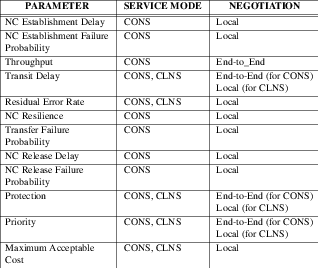
QOS Parameter Formats
This section describes the formats of the QOS parameters for CONS and/or CLNS services. The requested QOS parameter values apply to complete NSDUs.
NC Establishment Delay
This parameter applies to CONS only. It is defined as the maximum acceptable delay between a
N_CONN_REQ and the corresponding N_CONN_CON primitive. NC establishment delay is
measured in milliseconds.
Format:
long nc_estab_delay; /* maximum NC establishment delay */
- nc_estab_delay
Is the maximum acceptable delay value for NC establishment.
NC Establishment Failure Probability
This parameter applies to CONS only. NC Establishment Failure Probability is the percent ratio (rounded to the nearest integer) of total NC establishment failures to total NC establishment attempts in a measurement sample. A measurement sample consists of100 NC establishment attempts.
NC establishment failure occurs due to NS provider behaviour such as mis-connection, NC refusal, and excessive delay. NC establishment attempts that fail due to NS user behaviour such as error, NC refusal, or excessive delay are excluded in calculating NC establishment failure probability.
Format:
long nc_estab_fail_prob; /* maximum NC estab failure probability
*/
- nc_estab_fail_prob
Is the maximum acceptable percent value (rounded to the nearest integer) for the NC establishment failure probability.
Throughput
This parameter applies to CONS only, is specified separately for each direction of transfer, and has end-to-end significance. Throughput is defined in terms of at least two successfully transferred NSDUs presented continuously to the NS provider at the maximum rate the NS provider can continuously sustain, and unconstrained by flow control applied by the receiving NS user. Given a sequence of “n” NSDUs (where is greater than or equal to two; suggested value is 100), throughput is defined to be the smaller of:
- the number of NS user data octets contained in the last “n-1” NSDUs divided bythe time
between the first and the last
N_DATA_REQs in the sequence; and - the number of NS user data octets contained in the last “n-1” NSDUs divided bythe time
between the first and the last
N_DATA_INDs in the sequence.
Throughput should be measured and specified in bits per second.
Format:
- thru_targ_value
Specifies the requested QOS value for throughput for data transfer between the two NS users.
- thru_min_value
Specifies the requested lowest acceptable QOS value for throughput between the two NS users.
Transit Delay
This parameter applies to CONS as well as CLNS. Transit Delay is the elapsed time between a
N_DATA_REQ and the corresponding N_DATA_IND (calculated on successfully transferred
NSDUs only). The pair of values specified for an NC applies to both directions of transfer. The
specified values are averages (based on 100 samples using a NSDU size of 128 bytes). Transit Delay
should be measured in milliseconds.
Format:
- td_targ_value
Specifies the desired QOS value for transit delay between the two NS users.
- td_max_value
Specifies the maximum QOS value that the source NS user will agree for transit delay between the two NS users.
Residual Error Rate
This parameter applies to both CONS as well as CLNS. Residual Error Rate is the percent ratio (rounded to the nearest integer) of total incorrect, lost, and duplicate NSDUs to total NSDUs transferred across the NS boundary during a measurement period. The measurement period will be 3600 seconds.
Format:
long residual_error_rate; /* maximum acceptable residual error
rate */
- residual_error_rate
Specifies the maximum acceptable percent value (rounded to the nearest integer) of the residual error rate.
NC Resilience
This parameter applies to CONS only. NC Resilience specifies the percent probability (rounded to the nearest integer) of a NS provider invoked NC release or a NS provider invoked reset during a specified time interval on an established NC. The time interval will be 3600 seconds.
Format:
long nc_resilience; /* maximum acceptable nc resilience */
- nc_resilience
Specifies the maximum acceptable value for NC resilience.
Transfer Failure Probability
This parameter applies to CONS only. It is the percent ratio (rounded to the nearest integer) of total transfer failures to total transfer samples observed during a performance measurement. A transfer sample is a discrete observation of NS provider performance in transferring NSDUs between specified sending and receiving NS user. A transfer sample will last for the duration of the NC. A transfer failure is a transfer sample in which the observed performance is worse than the specified minimum acceptable level. A transfer failure is identified by comparing the measured values for the supported performance parameters with specified transfer failure thresholds. The three supported performance parameters are throughput, transit delay, and residual error rate.
Format:
long xfer_fail_prob; /* maximum xfer failure prob */
- xfer_fail_prob
Specifies the maximum acceptable percent value (rounded to the nearest integer) for transfer failure probability.
NC Release Delay
This parameter applies to CONS only. NC Release Delay is defined as the maximum acceptable delay
between a NS user invoked N_DISCON_REQ and the successful release of the NC at the peer NS
user. NC Release Delay is specified independently for each NS user. It does not apply in cases
where NC release is invoked by the NS provider. NC release delay should be measured in
milliseconds.
Format:
long nc_rel_delay; /* maximum nc release delay */
- nc_rel_delay
Is the maximum acceptable value for NC release delay.
NC Release Failure Probability
This parameter applies to CONS only. It is the percent ratio (rounded to the nearest integer) of total NC release requests resulting in release failure to total NC release requests included in a measurement sample. A measurement sample consists of a 100NC release requests. This parameter is specified independently for each NS user.
A release failure is defined to occur for a particular NS user, if that user does not receive a
N_DISCON_IND within a specified maximum NC release delay of the NS user issuing the
N_DISCON_REQ (given that the former NS user has not issued a N_DISCON_REQ).
Format:
long nc_rel_fail_prob; /* maximum nc rel fail probability */
- nc_rel_fail_prob
Is the maximum acceptable percent value (rounded to the nearest integer) of NC release failure probability.
Protection
This parameter applies to both CONS and CLNS. It specifies the extent to which the NS provider attempts to prevent unauthorized monitoring or manipulation of NS user originated information.
/* Types of protection */
#define N_NO_PROT 0x00000000L /* no protection */
#define N_PASSIVE_PROT 0x00000001L /* protection
against passive
monitoring */
#define N_ACTIVE_PROT 0x00000002L /* protection
against active
monitoring */
#define N_ACTIVE_PASSIVE_PROT 0x00000003L /* maximum
protection */
Four protection options are provided:
- No protection features;
- Protection against passive monitoring;
- Protection against modification, replay, addition, or deletion
- Both 2 and 3.
Format:
typedef struct {
long protect_targ_value; /* target protection */
long protect_min_value; /* minimum protection */
} protection_values_t;
- protect_targ_value
Specifies the target protection of the NS user originated information.
- protect_min_value
Specifies the lowest quality acceptable of protection of the NS user originated information.
Priority
This parameter applies to both CONS and CLNS.
It specifies the target priority of:
- an NSDU in relation to any other NSDUs (for CLNS);
- a NC (for CONS). The number of priority levels is limited to 15 (where level 1 is the highest priority and level 15 is the lowest priority).
Format:
typedef struct {
long priority_targ_value; /* target priority */
long priority_min_value; /* minimum priority */
} priority_values_t;
- priority_targ_value
Specifies the target NC priority level.
- priority_min_value
Specifies the lowest quality acceptable of the NC priority level.
Maximum Acceptable Cost
This parameter applies to both CONS and CLNS. It specifies the maximum acceptable cost in local currency (composed of communications and end-system resource costs), or indicates to the NS provider that it should choose the least expensive means available to it.
Format
long max_accept_cost; /* acceptable cost maximum */
/* Choose least expensive means */
#define N_LEAST_EXPENSIVE 0x00000000L /* choose least expensive
means */
- max_accept_cost
Specifies the maximum acceptable cost in local currency.
QOS Data Structures
The quality of services parameters are organized into six different structures for simplicity:
N_QOS_CO_RANGE1-
Quality of service range requested for connection-mode service as used with the
N_CONN_REQandN_CONN_INDprimitives. N_QOS_CO_SEL1-
Quality of service values selected for the connection-mode service as used with the
N_CONN_RESandN_CONN_CONprimitives. N_QOS_CL_RANGE1-
Range of quality of service values for connectionless-mode service as specified with the QOS_range_length and QOS_range_offset parameters of the
N_INFO_ACKprimitive. N_QOS_CL_SEL1-
Quality of service values supported/selected for connectionless-mode service as specified with the QOS_length and QOS_offset parameters of the
N_INFO_ACKand theN_OPTMGMT_REQprimitives. N_QOS_CO_OPT_RANGE1-
Range of quality of service values for connection-mode service as specified with the QOS_range_length and QOS_range_offset parameters of the
N_INFO_ACKprimitive. N_QOS_CO_OPT_SEL1-
Default quality of service values supported/selected for connection-mode service as specified with the QOS_length and QOS_offset parameters of the
N_INFO_ACKand theN_OPTMGMT_REQprimitives.
Structure N_QOS_CO_RANGE1
Structure N_qos_co_range1 defines the QOS parameters that are transferred between the source
and destination NS users for a NC. The format of this structure is as follows:
typedef struct {
ulong n_qos_type; /* always N_QOS_CO_RANGE */
thru_values_t src_throughput_range; /* source throughput range */
thru_values_t dest_throughput_range; /* dest throughput
range */
td_values_t transit_delay_range; /* transit delay range */
protection_values_t protection_range; /* protection range
*/
priority_values_t priority_range; /* priority target */
} N_qos_co_range1_t;
This structure should be used in the QOS_length and QOS_offset fields of the following NPI primitives:
-
N_CONN_REQ -
N_CONN_IND
Structure N_QOS_CO_SEL1
Structure N_qos_co_sel1 defines the QOS parameters that are transferred between the
destination and source NS users for a NC. The format of this structure is as follows:
typedef struct {
ulong n_qos_type; /* always N_QOS_CO_SEL */
long src_throughput_sel; /* source throughput selected */
long dest_throughput_sel; /* destination throughput selected */
long transit_delay_sel; /* transit delay selected */
long protection_sel; /* NC protection selected */
long priority_sel; /* NC priority selected */
} N_qos_co_sel1_t;
This structure should be used in the QOS_length and QOS_offset fields of the following NPI primitives:
-
N_CONN_RES -
N_CONN_CON
Structure N_QOS_CL_RANGE1
Structure N_qos_cl_range1 defines the range of QOS parameter values that are supported by the
NS provider. The format of the structure is as follows:
typedef struct {
ulong n_qos_type; /* always N_QOS_CL_RANGE */
td_values_t transit_delay_max; /* maximum transit delay */
long residual_error_rate; /* residual error rate */
protection_values_t protection_range; /* target
protection */
priority_values_t priority_range; /* target priority */
long max_accept_cost; /* maximum acceptable cost */
} N_qos_cl_range1_t;
This structure should be used in the:
- QOS_range_length and QOS_range_offset fields of the
N_INFO_ACKprimitive;
Structure N_QOS_CL_SEL1
Structure N_qos_cl_sel1 defines the QOS parameters values that will apply to each unitdata
transmission between the CLNS users. The format of the structure is as follows:
typedef struct {
ulong n_qos_type; /* always N_QOS_CL_sel */
long transit_delay_max; /* maximum transit delay */
long residual_error_rate; /* residual error rate */
long protection_sel; /* protection selected */
long priority_sel; /* priority selected */
long max_accept_cost; /* maximum acceptable cost */
} N_qos_cl_sel1_t;
This structure should be used in the:
- QOS_length and QOS_offset fields of the
N_INFO_ACKprimitive; - QOS_length and QOS_offset fields of the
N_OPTMGMT_REQprimitive.
Structure N_QOS_CO_OPT_RANGE1
Structure N_qos_opt_range1 defines the range of the default QOS parameter values that are
supported by the NS provider. This allows the NS user to select values within the range supported
by the NS provider. The format of the structure is as follows:
typedef struct {
ulong n_qos_type; /* always N_QOS_CO_OPT_RANGE */
thru_values_t src_throughput; /* source throughput values
*/
thru_values_t dest_throughput; /* dest throughput values */
td_values_t transit_delay; /* transit delay values */
long nc_estab_delay; /* NC establishment delay */
long nc_estab_fail_prob; /* NC estab failure probability */
long residual_error_rate; /* residual error rate */
long xfer_fail_prob; /* transfer failure probability */
long nc_resilience; /* NC resilience */
long nc_rel_delay; /* NC release delay */
long nc_rel_fail_prob; /* NC release fail probability */
protection_values_t protection_range; /* protection range
*/
priority_values_t priority_range; /* priority range */
long max_accept_cost; /* maximum acceptable cost */
} N_qos_co_opt_range1_t;
This structure should be used in the:
- QOS_range_length and QOS_range_offset fields of the
N_INFO_ACKprimitive;
Structure N_QOS_CO_OPT_SEL1
Structure N_qos_opt_sel1 defines the selected QOS parameter values. The format of the
structure is as follows:
typedef struct {
ulong n_qos_type; /* always N_QOS_CO_OPT_SEL */
thru_values_t src_throughput; /* source throughput values
*/
thru_values_t dest_throughput; /* dest throughput values */
td_values_t transit_delay; /* transit delay values */
long nc_estab_delay; /* NC establishment delay */
long nc_estab_fail_prob; /* NC estab failure probability */
long residual_error_rate; /* residual error rate */
long xfer_fail_prob; /* transfer failure probability */
long nc_resilience; /* NC resilience */
long nc_rel_delay; /* NC release delay */
long nc_rel_fail_prob; /* NC release failure probability */
long protection_sel; /* protection selected */
long priority_sel; /* priority selected */
long max_accept_cost; /* maximum acceptable cost */
} N_qos_co_opt_sel1_t;
This structure should be used in the:
- QOS_length and QOS_offset fields of the
N_INFO_ACKprimitive; - QOS_length and QOS_offset fields of the
N_OPTMGMT_REQprimitive.
NPI Primitives Rules for OSI Conformance
The following are the rules that apply to the NPI primitives for OSI compatibility.
Local Management Primitives
N_INFO_ACK
Parameters
- NSDU_size
A value greater than zero specifies the maximum size of a Network Service Data Unit (NSDU); a value of ‘0’ specifies that the transfer of normal data is not supported by the NS provider,and a value of ‘-1’ specifies that there is no limit on the size of a NSDU.
- ENSDU_size
A value between 1 and 32 inclusive specifies the maximum size of an Expedited Network Service Data Unit (ENSDU); a value of ‘0’ specifies that the transfer of expedited data is not supported by the NS provider.
- CDATA_size
A value between 1 and 128 inclusive specifies the maximum number of octets of data that may be associated with connection establishment primitives. A value of ‘0’ specifies that the NS provider does not allow data to be sent with connection establishment primitives. When used in an OSI conforming environment, CDATA_size shall always equal 128.
- DDATA_size
A value between 1 and 128 inclusive specifies the maximum number of octets of data that may be associated with the disconnect primitives; a value of ‘0’ specifies that the NS provider does not allow data to be sent with the disconnect primitives. When used in an OSI conforming environment, DDATA_size shall always equal 128.
- ADDR_size
A value between 1 and 40 indicates the maximum size of a network address in decimal digits. When used in an OSI conforming environment, ADDR_size shall always equal 40 in order to accommodate a full NSAP address.
- QOS_length
Indicates the length in bytes of the default/negotiated/selected values of the QOS parameters. The applicable QOS parameters are defined in the following structures:
-
N_QOS_CO_OPT_SEL1for CONS; and -
N_QOS_CL_SEL1for CLNS.
In the connection-mode environment, when this primitive is invoked before the NC is established on the Stream, the values returned specify the the default values supported by the NS provider. When this primitive is invoked after a NC has been established on the Stream, the values returned indicate the negotiated values for the QOS parameters. In the connectionless environment, these values represent the default or the selected QOS parameter values.
In case a QOS parameter is not supported by the NS Provider, a value of
QOS_UNKNOWNwill be returned. In the case where no QOS parameters are supported by the NS provider, the length of this field will be zero.-
- QOS_range_length
Indicates the length in bytes, of the available range of QOS parameters values supported by the NS provider. These ranges are used by the NS user to select QOS parameter values that are valid with the NS provider.
The applicable QOS parameters are defined in the following structures:
-
N_QOS_CO_OPT_RANGE1for CONS; and -
N_QOS_CL_RANGE1for CLNS.
QOS parameter values are selected, or the default values altered via the
N_OPTMGMT_REQprimitive. In the connection-mode environment, the values for end-to-end QOS parameters may be specified with theN_CONNprimitives for negotiation. If the NS provider does not support a certain QOS parameter, its value will be set toQOS_UNKNOWN. In the case where no QOS parameters are supported by the NS provider, the length of this field will be zero.-
- NIDU_size
This indicates the amount of user data that may be present in aN_DATA primitive. The NIDU_size should not be larger than the NSDU_size specification.
- SERV_type
Specifies the service type supported by the NS provider. The possible values can be
N_CONS,N_CLNS, (or both by usingN_CONS|N_CLNS). If the SERV_type isN_CLNS, the following rules will apply:- — The ENSDU_size, CDATA_size, DDATA_size, and DEFAULT_rc_sel fields are not used and their values should be set to ‘0’;
- — The NSDU_size should be the same as the NIDU_size.
- NODU_size
The NODU_size specifies the optimal NSDU size in octets of an NSDU given the current routing information.
- PROTOID_length
The length of the protocol identifiers to be bound.
- PROTOID_offset
The offset of the protocol identifiers to be bound, from the beginning of the block.
N_OPTMGMT_REQ
Parameters
- QOS_length
Indicates the length of the default values of the QOS parameters as selected by the NS user. In the connection-mode environment these values will be used in subsequent
N_CONN_REQprimitives on the Stream that do not specify values for these QOS parameters. In the connection-less environment, these values represent the selected QOS values that would apply to each unit data transmission. The applicable QOS parameters are defined in the following structures:-
N_QOS_CO_OPT_SEL1for CONS; and -
N_QOS_CL_SEL1for CLNS.
If the NS user cannot determine the value of a QOS parameter,its value should be set to
QOS_UNKNOWN. If the NS user does not specify any QOS parameter values, the length of this field should be set to zero.-
CONS Connection Establishment Phase Rules for QOS Parameter Negotiation
The negotiation for NC throughput and NC transit-delay QOS parameters are conducted as follows:
- in the
N_CONN_REQprimitive, the source NS user specifies two values for each negotiable QOS parameter:- a “target” which is the QOS value desired; and
- a “lowest acceptable” QOS value to which the source NS user will agree;
The value of each of these parameters must be within the limit of the allowable values defined for the network service. “Default” values for these parameters are supported by the NS provider. The default values may be selected by the NS user via the
N_OPTMGMT_REQprimitive. - if the NS provider agrees to provide a value of QOS which is in the range between the
“target” and the “lowest acceptable” QOS values, inclusive, of the
N_CONN_REQ, then the NS provider specifies two parameters in theN_CONN_INDissued to the destination NS user:- an “available” value which is the QOS value the NS provider is willing to provide; and
- a “lowest acceptable” QOS value which is identical to the “lowest acceptable” value
specified in the
N_CONN_REQ; (if the NS provider does not agree to provide QOS in the given range, then the NC establishment request is rejected);
- if the destination NS user agrees to a QOS value which is in the range between the
“available” and the “lowest acceptable” QOS values, inclusive, of the
N_CONN_IND, then the destination NS user specifies a single parameter, “selected” in theN_CONN_RES; this parameter is the QOS value the destination NS user agrees to; (if the destination NS user does not agree to a QOS in the given range, then the NC establishment request is rejected); - the NS provider adopts the QOS value for the NC which was specified by the destination NS user
and supplies this as a single parameter, “selected”, in the
N_CONN_CONprimitive.
- The negotiation for the NC protection parameter is conducted as follows:
- In the
N_CONN_REQprimitive, the calling NS user specifies values for the “Target” and “Lowest Quality Acceptable” sub-parameters; permitted value assignments are:- Case1:
both the “Target” and “Lowest Quality Acceptable” are “unspecified”;
- Case2:
values other than “unspecified” are specified for both “Target” and “Lowest Quality Acceptable”;
- Case3:
a value other than “unspecified” is specified for “Target” and the “Lowest Quality Acceptable” is “unspecified”.
NOTE: In case where “Target” is “unspecified”, the “Lowest Quality Acceptable” must also be “unspecified”.
- If the NS provider does not support a choice of NC protection levels, the value of the
“Target” parameter is conveyed by the NS provider and passed to the called NS user unchanged as
the “Available” sub-parameter in the
N_CONN_INDprimitive; - If the NS provider does support a choice of NC protection levels, then:
- In Case1, the NS provider determines the QOS value to be offered on the NC and specifies it in
the “Available” sub-parameter in the
N_CONN_INDprimitive; - In Case2 and Case3, if the NS provider does not agree to provide a QOS in the requested range,
then the NC establishment attempt is rejected as described in clause 13.5 of ISO 8348
(see ISO8348). If the NS provider does agree to provide a QOS in the requested range,
then in the
N_CONN_INDprimitive, the “Available” sub-parameter specifies the highest QOS value within the range which the NS provider is willing to provide.
- In Case1, the NS provider determines the QOS value to be offered on the NC and specifies it in
the “Available” sub-parameter in the
- The value of the “Lowest Quality Acceptable” sub-parameter in the
N_CONN_INDprimitive is identical to that in theN_CONN_REQprimitive; - If the value of the “Available” sub-parameter of the
N_CONN_INDprimitive is “unspecified” then:- if the called NS user does not agree to accept establishment of a NC with this unspecified quality, the NS user rejects the NC establishment attempt as described in clause 13.4 of ISO 8348 (see ISO8348);
- if the called NS user does agree, then the NS user specifies the value “unspecified” in the
“Selected” sub-parameter of the
N_CONN_RESprimitive.
- If the value of the “Available” sub-parameter in the
N_CONN_INDprimitive is not “unspecified” then:- if the called NS user does not agree to a QOS in the range identified by the “Available” and
“Lowest Quality Acceptable” sub-parameters of the
N_CONN_INDprimitive, then the NS user rejects the NC establishment attempt as described in clause 13.4 of ISO 8348 (see ISO8348); - if the called NS user does agree to a QOS in the identified range, then the NS user specifies
the agreed value in the “Selected” sub-parameter of the
N_CONN_RESprimitive.
- if the called NS user does not agree to a QOS in the range identified by the “Available” and
“Lowest Quality Acceptable” sub-parameters of the
- In the
N_CONN_CONprimitive, the “Selected” sub-parameter has a value identical to that of “Selected” in theN_CONN_RESprimitive.
- In the
- The negotiation of the NC priority parameter is conducted as follows:
- In the
N_CONN_REQprimitive, the calling NS user specifies values for the “Target” and “Lowest Quality Acceptable” sub-parameters; permitted value assignments are:- Case1:
both the “Target” and “Lowest Quality Acceptable” are “unspecified”;
- Case2:
values other than “unspecified” are specified for both “Target” and “Lowest Quality Acceptable”;
- Case3:
a value other than “unspecified” is specified for “Target” and the “Lowest Quality Acceptable” is “unspecified”.
NOTE: In case where “Target” is “unspecified”, the “Lowest Quality Acceptable” must also be “unspecified”.
- If the NS provider does not support a choice of NC priority levels, the value of the
“Target” parameter is conveyed by the NS provider and passed to the called NS user unchanged as
the “Available” sub-parameter in the
N_CONN_INDprimitive; - If the NS provider does support a choice of NC priority levels, then:
- In Case1, the NS provider determines the QOS value to be offered on the NC and specifies it in
the “Available” sub-parameter in the
N_CONN_INDprimitive; - In Case2 and Case3, if the NS provider does not agree to provide a QOS in the requested range,
then the NC establishment attempt is rejected as described in clause 13.5 of ISO 8348
(see ISO8348). If the NS provider does agree to provide a QOS in the requested range,
then in the
N_CONN_INDprimitive, the “Available” sub-parameter specifies the highest QOS value within the range which the NS provider is willing to provide.
- In Case1, the NS provider determines the QOS value to be offered on the NC and specifies it in
the “Available” sub-parameter in the
- The value of the “Lowest Quality Acceptable” sub-parameter in the
N_CONN_INDprimitive is identical to that in theN_CONN_REQprimitive; - If the value of the “Available” sub-parameter of the
N_CONN_INDprimitive is “unspecified” then:- if the called NS user does not agree to accept establishment of a NC with this unspecified quality, the NS user rejects the NC establishment attempt as described in clause 13.4 of ISO 8348 (see ISO8348);
- if the called NS user does agree, then the NS user specifies the value “unspecified” in the
“Selected” sub-parameter of the
N_CONN_RESprimitive.
- If the value of the “Available” sub-parameter in the
N_CONN_INDprimitive is not “unspecified” then:- if the called NS user does not agree to a QOS in the range identified by the “Available” and
“Lowest Quality Acceptable” sub-parameters of the
N_CONN_INDprimitive, then the NS user rejects the NC establishment attempt as described in clause 13.4 of ISO 8348 (see ISO8348); - if the called NS user does agree to a QOS in the identified range, then the NS user specifies
the agreed value in the “Selected” sub-parameter of the
N_CONN_RESprimitive.
- if the called NS user does not agree to a QOS in the range identified by the “Available” and
“Lowest Quality Acceptable” sub-parameters of the
- In the
N_CONN_CONprimitive, the “Selected” sub-parameter has a value identical to that of “Selected” in theN_CONN_RESprimitive.
- In the
Rules for QOS Parameter Selection
When a NS user/provider cannot determine the value of a QOS field, it should return a value of
QOS_UNKNOWN.
#define QOS_UNKNOWN -1
Rules for Receipt Confirmation Selection
- The receipt confirmation selection parameter values on the various primitives are related such
that:
- on the
N_CONN_REQ, either of the defined values may occur (namely, “use of receipt confirmation”, or “no use of receipt confirmation”). - on the
N_CONN_IND, the value is either equal to the value on the request primitive, or is “no use of receipt confirmation”. - on the
N_CONN_RES, the value is either equal to the value on the indication primitive or is “no use of receipt confirmation”. - on the
N_CONN_CON, the value is equal to the value on the response primitive.
- on the
- Since the NS users and the NS provider must agree to the use of receipt confirmation
selection, there are four possible cases of negotiation of receipt confirmation on an NC:
- if the source NS user does not request it—it is not used;
- if the source NS user requests it but the NS provider does not provide it — it is not used;
- if the source NS user requests it and the NS provider agrees to provide it,but the destination NS user does not agree to its use – it is not used;
- if the source NS user requests it, the NS provider agrees to provide it, and the destination NS user agrees to its use – it can be used. Rules for Expedited Data Selection
- The expedited data selection parameter values on the various primitives are related such that:
- on the
N_CONN_REQ, either of the defined values may occur, (namely “use of expedited data” or “no use of expedited data”); - on the
N_CONN_IND, the value is either equal to the value on the request primitive, or is “no use of expedited data”; - on the
N_CONN_RES, the value is either equal to the value on the indication primitive, or is “no use of expedited data”; - on the
N_CONN_CON, the value is equal to the value on the response primitive.
- on the
- Since the NS users and the NS provider must agree to the use of expedited data selection,
there are four possible cases of negotiation of expedited data on an NC:
- if the source NS user does not request it—it is not used;
- if the source NS user requests it but the NS provider does not provide it—it is not used;
- if the source NS user requests it and the NS provider agrees to provide it, but the destination NS user does not agree to its use—it is not used;
- if the source NS user requests it, the NS provider agrees to provide it, and the destination NS user agrees to its use—it can be used.
N_CONN_REQ
Parameters
- QOS_length
Indicates the length of the QOS parameters values that apply to the NC being requested.
The applicable QOS parameters are defined in the following structure:
- N_QOS_CO_RANGE1
If the NS user cannot determine the value of a QOS parameter, its value should be set to
QOS_UNKNOWN. If the NS user does not specify any QOS parameter values, the length of this field should be set to zero.
Flags
REC_CONF_OPTThe receipt confirmation selection parameter indicates whether receipt confirmation service is desired by the calling NS user on the NC. The receipt confirmation service must be provided in the network service to be used on the NC. When set, it indicates “use of receipt confirmation”, and when not set it indicates “no use of receipt confirmation”.
EX_DATA_OPTThe expedited data selection parameter indicates whether the expedited data service is desired by the calling NS user on the NC. The expedited data transfer service must be provided by the NS provider for it to be used on the NC. When set, it indicates “use of expedited data”, and when not set it indicates “no use of expedited data”.
N_CONN_IND
Parameters
- QOS_length
Indicates the length of the QOS parameters values that are negotiated during NC establishment.
The applicable QOS parameters are defined in the following structure:
- N_QOS_CO_RANGE1
If the NS provider does not support or cannot determine the value of a QOS parameter, its value will be set to
QOS_UNKNOWN. If the NS provider does not specify any QOS parameter values, the length of this field should be set to zero.- QOS_offset
Indicates the offset of the QOS parameters from the beginning of the
M_PROTOmessage block.
Flags
REC_CONF_OPTThe receipt confirmation selection parameter indicates whether the receipt confirmation service is available on the NC and the calling NS user desires its use. The receipt confirmation service must be provided in the network service to be used on the NC. When set, it indicates “use of receipt confirmation”, and when not set, it indicates “no use of receipt confirmation”. The value on the
N_CONN_INDis either equal to the value on the request primitive or is “no use of receipt confirmation”.EX_DATA_OPTThe expedited data selection parameter indicates whether the expedited data transfer service is available on the NC and the calling NS user desires its use. The expedited data transfer service must be provided by the NS provider for it to be used on the NC. When set, it indicates “use of expedited data” or “no use of expedited data”. The value on the
N_CONN_INDis either equal to the value on the request primitive or is “no use of expedited data”.
N_CONN_RES
Parameters
- QOS_length
Indicates the length of the QOS parameters values that are negotiated during NC establishment. The applicable QOS parameters are defined in the following structure:
- N_QOS_CO_SEL1
If the NS user does not agree to the QOS values, it will reject the NC establishment by invoking a
N_DISCON_REQprimitive (the originator parameter in theN_DISCON_REQprimitive will indicate NS user invoked release). If the NS user cannot determine the value of a QOS parameter, its value should be set toQOS_UNKNOWN. If the NS user does not specify any QOS parameter values, the length of this field should be set to zero.
Flags
REC_CONF_OPTThe receipt confirmation selection parameter indicates whether the receipt confirmation service can be used on the NC. The receipt confirmation service must be provided in the network service to be used on the NC. When set, it indicates “use of receipt confirmation”, and when not set it indicates “no use of receipt confirmation”. The value on the
N_CONN_RESis either equal to the value on the indication primitive or is “no use of receipt confirmation”.EX_DATA_OPTThe expedited data selection parameter indicates whether the expedited data transfer service can be used on the NC. The expedited data transfer service must be provided by the NS provider for it to be used on the NC. When set, it indicates “use of expedited data”, and when not set, it indicates “no use of expedited data”. The value on the
N_CONN_RESis either equal to the value on the indication primitive or is “no use of expedited data”.
N_CONN_CON
Parameters
- QOS_length
Indicates the length of the QOS parameters values selected by the responding NS user. The applicable QOS parameters are defined in the following structure:
- N_QOS_CO_SEL1
If the NS provider does not support or cannot determine the selected value of a QOS parameter, its value will be set to
QOS_UNKNOWN. If the NS provider does not specify any QOS parameter values, the length of this field should be set to zero.
Flags
REC_CONF_OPTThe receipt confirmation selection parameter indicates whether the receipt confirmation service can be used on the NC. The receipt confirmation service must be provided in the network service to be used on the NC. When set, it indicates “use of receipt confirmation”, and when not set it indicates “no use of receipt confirmation”. The value on the
N_CONN_CONis equal to the value on the response primitive.EX_DATA_OPTThe expedited data selection parameter indicates whether the expedited data transfer service can be used on the NC. The expedited data transfer service must be provided by the NS provider for it to be used on the NC. When set, it indicates “use of expedited data”, and when not set, it indicates “no use of expedited data”. The value on the
N_CONN_CONis equal to the value on the response primitive.
CONS Reset Service
N_RESET_REQ
Parameters
- RESET_reason
-
Gives information indicating the cause of the reset. Rules governing the value of the RESET_reason parameter For an
N_RESET_REQ, the reason shall always indicateN_USER_RESYNC.
N_RESET_IND
Parameters
- RESET_orig
This parameter indicates the source of the reset.
Reset Originator
N_PROVIDERNS provider originated reset
N_USERNS user originated reset
N_UNDEFINEDreset originator undefined
- RESET_reason
Gives information indicating the cause of the reset.
Rules governing the value of the RESET_reason parameter
The value conveyed in this parameter will be as follows:
- when the originator parameter indicates an NS provider invoked reset; the parameter is one of:
N_CONGESTIONreset due to congestion;
N_RESET_UNSPECIFIEDreset-reason unspecified.
- when the originator parameter indicates an NS user invoked reset, the value is:
N_USER_RESYNCuser resynchronization.
- when the originator parameter has the value “undefined”, then the value of the reason
parameter is:
N_REASON_UNDEFINEDreset reason undefined
CONS NC Release Phase
N_DISCON_REQ
Parameters:
- DISCON_reason
Gives information about the cause of the release.
Rules governing the value of the DISCON_reason parameter
The value conveyed in the parameter will be as follows:
N_DISC_NORMAL“disconnection-normal condition”
N_DISC_ABNORMAL“disconnection-abnormal condition”
N_REJ_P“connection rejection-permanent condition”
N_REJ_T“connection rejection-transient condition”
N_REJ_QOS_UNAVAIL_P“connection rejection-QOS not available/permanent condition”
N_REJ_QOS_UNAVAIL_T“connection rejection-QOS not available/transient condition”
N_REJ_INCOMPAT_INFO“connection rejection-incompatible information in NS user data”
N_REJ_UNSPECIFIED“connection rejection-reason unspecified”
N_DISCON_IND
Parameters
- DISCON_orig
Indicates the source of the NC release. Its value are as follows:
N_PROVIDERNS provider originated disconnect
N_USERNS user originated disconnect
N_UNDEFINEDdisconnect originator undefined
The value “undefined” is not permitted when an
N_DISCON_INDis issued by an NS user or the NS provider in order to reject an NC establishment attempt.- DISCON_reason
Gives information about the cause of the release.
Rules governing the value of the DISCON_reason parameter
The value conveyed in the parameter will be as follows:
- When the originator parameter indicates an NS provider invoked release, the value is one of:
N_DISC_P“disconnection-permanent condition”
N_DISC_T“disconnection-transient condition”
N_REJ_NSAP_UNKNOWN“connection rejection-NSAP address unknown (permanent condition)”
N_REJ_NSAP_UNREACH_P“connection rejection-NSAP unreachable(permanent condition)”
N_REJ_NSAP_UNREACH_T“connection rejection-NSAP unreachable(transient condition)”
N_REJ_QOS_UNAVAIL_P“connection rejection-QOS not available/permanent condition”
N_REJ_QOS_UNAVAIL_T“connection rejection-QOS not available/transient condition”
N_REJ_UNSPECIFIED“connection rejection-reason unspecified”
- When the originator parameter indicates an NS user invoked release, the value is one of:
N_DISC_NORMAL“disconnection-normal condition”
N_DISC_ABNORMAL“disconnection-abnormal condition”
N_REJ_P“connection rejection-permanent condition”
N_REJ_T“connection rejection-transient condition”
N_REJ_QOS_UNAVAIL_P“connection rejection-QOS not available/permanent condition”
N_REJ_QOS_UNAVAIL_T“connection rejection-QOS not available/transient condition”
N_REJ_INCOMPAT_INFO“connection rejection-incompatible information in NS user data”
N_REJ_UNSPECIFIED“connection rejection-reason unspecified”
- When the originator parameter value is undefined, then the value of the reason parameter shall
be:
N_REASON_UNDEFINEDdisconnect reason undefined
CLNS
N_UDERROR_IND
Parameters
- ERROR_type
Specifies the reason for the error. The possible values are:
N_UD_UNDEFINEDno reason specified;
N_UD_TD_EXCEEDEDtransit delay exceeded;
N_UD_CONGESTIONNS provider congestion;
N_UD_QOS_UNAVAILother requested QOS/service characteristic unavailable;
N_UD_LIFE_EXCEEDEDNSDU lifetime exceeded;
N_UD_ROUTE_UNAVAILsuitable route unavailable.
N_UD_SEG_REQUIREDsegmentation required where none permitted.
Appendix A Mapping NPI to ISO 8348 and CCITT X.213
Table A-1 shows a mapping of the NPI primitives to the OSI network service definition primitives.
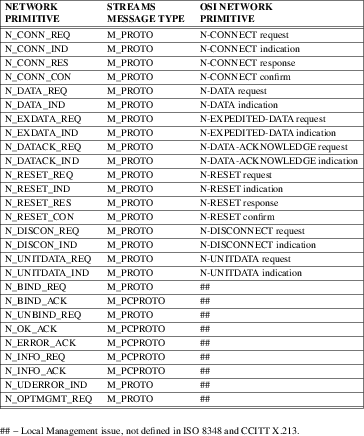
Appendix B State/Event Tables
This appendix contains tables showing the network-user’s view of the possible states that the NPI
may enter due to an event, and the possible events that may occur on the interface. The
N_INFO_REQ, N_INFO_ACK, N_TOKEN_REQ, and N_TOKEN_ACK primitives are
excluded from the state transition table because they can be issued from several states, and
secondly, they do not cause a state transition to occur. However, the N_INFO_REQ and the
N_TOKEN_REQ primitives may not be issued by the NS user when a local acknowledgement to a
previously issued primitive is pending.

Table B-2 and Table B-3 describe the variables and outputs used in the state tables.
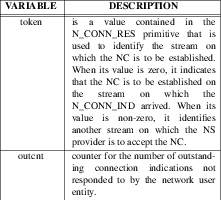
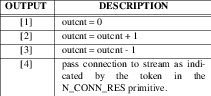
Table B-4 shows outgoing events that are initiated by the network-user entity. These events are either requests to the network provider or responses to an event of the network provider.
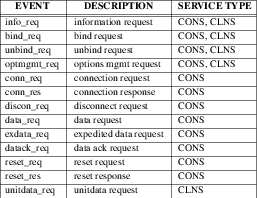
Table B-5 shows incoming events that are initiated by the network provider. These events are either confirmations of a request, or are indications to the NS user entity that an event has occurred.
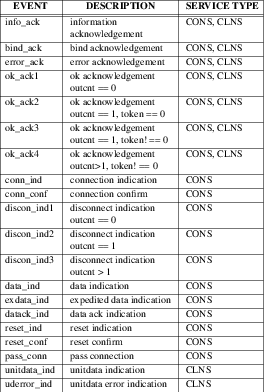
Table B-6 and Table B-7 describe the possible events the NPI may enter given a current state and event. The contents of each box represent the next state given the current state (column) and the current incoming or outgoing event (row). An empty box represents a state/event combination that is invalid. Along with the next state, each box may include an action. The network provider must take specific actions in the order specified in the state table.

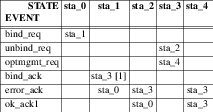
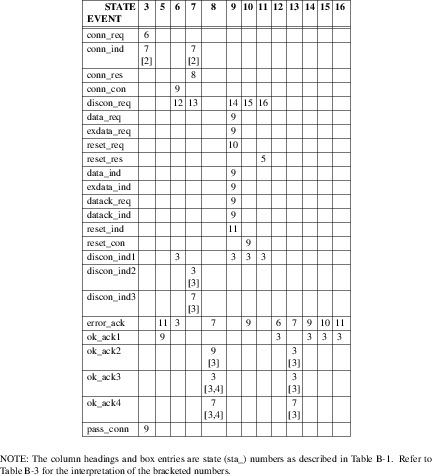
Appendix C Primitive Precedence Tables
Table C-1 and Table C-2 describe the precedence of the NPI primitives for both the Stream write and read queues. In both these tables, primitive Y is already on the queue and primitive X is about to be put on the queue. The Stream write queue contains network user initiated primitives and the Stream read queue contains network provider initiated primitives. The column headings are a shorthand notation for the row headings.
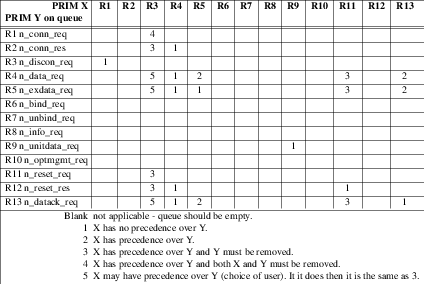
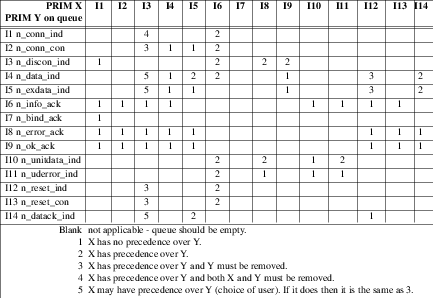
Appendix D NPI Header File Listing
This appendix contains a listing of the NPI header file needed by implementations.
/*
npi.h header for the Network Provider Interface (OSI Conforming)
*/
#ifndef SYS_NPI_H
#define SYS_NPI_H /* mark file as included */
typedef int32_t np_long;
typedef u_int32_t np_ulong;
typedef u_int16_t np_ushort;
#define N_CURRENT_VERSION 0x02 /* current version of NPI */
#define N_VERSION_2 0x02 /* version of npi, December 16, 1991 */
/*
Primitives that are initiated by the network user.
*/
#define N_CONN_REQ 0 /* NC request */
#define N_CONN_RES 1 /* Accept previous connection indication */
#define N_DISCON_REQ 2 /* NC disconnection request */
#define N_DATA_REQ 3 /* Connection-Mode data transfer request */
#define N_EXDATA_REQ 4 /* Expedited data request */
#define N_INFO_REQ 5 /* Information Request */
#define N_BIND_REQ 6 /* Bind a NS user to network address */
#define N_UNBIND_REQ 7 /* Unbind NS user from network address */
#define N_UNITDATA_REQ 8 /* Connection-less data send request */
#define N_OPTMGMT_REQ 9 /* Options Management request */
/*
Primitives that are initiated by the network provider.
*/
#define N_CONN_IND 11 /* Incoming connection indication */
#define N_CONN_CON 12 /* Connection established */
#define N_DISCON_IND 13 /* NC disconnected */
#define N_DATA_IND 14 /* Incoming connection-mode data indication */
#define N_EXDATA_IND 15 /* Incoming expedited data indication */
#define N_INFO_ACK 16 /* Information Acknowledgement */
#define N_BIND_ACK 17 /* NS User bound to network address */
#define N_ERROR_ACK 18 /* Error Acknowledgement */
#define N_OK_ACK 19 /* Success Acknowledgement */
#define N_UNITDATA_IND 20 /* Connection-less data receive indication */
#define N_UDERROR_IND 21 /* UNITDATA Error Indication */
/*
Additional NPI Primitivies
*/
#define N_DATACK_REQ 23 /* Data acknowledgement request */
#define N_DATACK_IND 24 /* Data acknowledgement indication */
#define N_RESET_REQ 25 /* NC reset request */
#define N_RESET_IND 26 /* Incoming NC reset request indication */
#define N_RESET_RES 27 /* Reset processing accepted */
#define N_RESET_CON 28 /* Reset processing complete */
/*
The following are the events that drive the state machine
*/
/*
Initialization events
*/
#define NE_BIND_REQ 0 /* bind request */
#define NE_UNBIND_REQ 1 /* unbind request */
#define NE_OPTMGMT_REQ 2 /* manage options request */
#define NE_BIND_ACK 3 /* bind acknowledgement */
#define NE_ERROR_ACK 5 /* error acknowledgement */
#define NE_OK_ACK1 6 /* ok ack, outcnt == 0 */
#define NE_OK_ACK2 7 /* ok ack, outcnt == 1, q == rq */
#define NE_OK_ACK3 8 /* ok ack, outcnt == 1, q! == rq */
#define NE_OK_ACK4 9 /* ok ack, outcnt > 1 */
/*
Connection-Mode events
*/
#define NE_CONN_REQ 10 /* connect request */
#define NE_CONN_RES 11 /* connect response */
#define NE_DISCON_REQ 12 /* disconnect request */
#define NE_DATA_REQ 13 /* data request */
#define NE_EXDATA_REQ 14 /* expedited data request */
#define NE_CONN_IND 16 /* connect indication */
#define NE_CONN_CON 17 /* connect confirm */
#define NE_DATA_IND 18 /* data indication */
#define NE_EXDATA_IND 19 /* expedited data indication */
#define NE_DISCON_IND1 21 /* disconnect indication, outcnt == 0 */
#define NE_DISCON_IND2 22 /* disconnect indication, outcnt == 1 */
#define NE_DISCON_IND3 23 /* disconnect indication, outcnt > 1 */
#define NE_PASS_CON 24 /* pass connection */
#define NE_RESET_REQ 28 /* reset request */
#define NE_RESET_RES 29 /* reset response */
#define NE_DATACK_REQ 30 /* data acknowledgement request */
#define NE_DATACK_IND 31 /* data acknowledgement indication */
#define NE_RESET_IND 32 /* reset indication */
#define NE_RESET_CON 33 /* reset confirm */
/*
Connection-less events
*/
#define NE_UNITDATA_REQ 25 /* unitdata request */
#define NE_UNITDATA_IND 26 /* unitdata indication */
#define NE_UDERROR_IND 27 /* unitdata error indication */
#define NE_NOEVENTS 36 /* no events */
/*
NPI interface states
*/
#define NS_UNBND 0 /* NS user not bound to network address */
#define NS_WACK_BREQ 1 /* Awaiting acknowledgement of N_BIND_REQ */
#define NS_WACK_UREQ 2 /* Pending acknowledgement for N_UNBIND_REQ */
#define NS_IDLE 3 /* Idle, no connection */
#define NS_WACK_OPTREQ 4 /* Pending acknowledgement of N_OPTMGMT_REQ */
#define NS_WACK_RRES 5 /* Pending acknowledgement of N_RESET_RES */
#define NS_WCON_CREQ 6 /* Pending confirmation of N_CONN_REQ */
#define NS_WRES_CIND 7 /* Pending response of N_CONN_REQ */
#define NS_WACK_CRES 8 /* Pending acknowledgement of N_CONN_RES */
#define NS_DATA_XFER 9 /* Connection-mode data transfer */
#define NS_WCON_RREQ 10 /* Pending confirmation of N_RESET_REQ */
#define NS_WRES_RIND 11 /* Pending response of N_RESET_IND */
#define NS_WACK_DREQ6 12 /* Waiting ack of N_DISCON_REQ */
#define NS_WACK_DREQ7 13 /* Waiting ack of N_DISCON_REQ */
#define NS_WACK_DREQ9 14 /* Waiting ack of N_DISCON_REQ */
#define NS_WACK_DREQ10 15 /* Waiting ack of N_DISCON_REQ */
#define NS_WACK_DREQ11 16 /* Waiting ack of N_DISCON_REQ */
#define NS_NOSTATES 18 /* No states */
/*
N_ERROR_ACK error return code values
*/
#define NBADADDR 1 /* Incorrect address format/illegal address information */
#define NBADOPT 2 /* Options in incorrect format or contain illegal
information */
#define NACCESS 3 /* User did not have proper permissions */
#define NNOADDR 5 /* NS Provider could not allocate address */
#define NOUTSTATE 6 /* Primitive was issues in wrong sequence */
#define NBADSEQ 7 /* Sequence number in primitive was incorrect/illegal */
#define NSYSERR 8 /* UNIX system error occurred */
#define NBADDATA 10 /* User data spec. outside range supported by NS provider */
#define NBADFLAG 16 /* Flags specified in primitive were illegal/incorrect */
#define NNOTSUPPORT 18 /* Primitive type not supported by the NS provider */
#define NBOUND 19 /* Illegal second attempt to bind listener or default
listener */
#define NBADQOSPARAM 20 /* QOS values specified are outside the range supported by
the NS provider */
#define NBADQOSTYPE 21 /* QOS structure type specified is not supported by the NS
provider */
#define NBADTOKEN 22 /* Token used is not associated with an open stream */
#define NNOPROTOID 23 /* Protocol id could not be allocated */
/*
N_UDERROR_IND reason codes
*/
#define N_UD_UNDEFINED 10 /* no reason specified */
#define N_UD_TD_EXCEEDED 11 /* Transit delay exceeded */
#define N_UD_CONGESTION 12 /* NS Provider congestion */
#define N_UD_QOS_UNAVAIL 13 /* Requested QOS/service characteristic unavailable */
#define N_UD_LIFE_EXCEEDED 14 /* NSDU Lifetime exceeded */
#define N_UD_ROUTE_UNAVAIL 15 /* Suitable route unavailable */
#define N_UD_SEG_REQUIRED 16 /* Segmentation reqd where none permitted */
/*
NPI Originator for Resets and Disconnects
*/
#define N_PROVIDER 0x0100 /* provider originated reset/disconnect */
#define N_USER 0x0101 /* user originated reset/disconnect */
#define N_UNDEFINED 0x0102 /* reset/disconnect originator undefined */
/*
NPI Disconnect & Reset reasons when the originator is the N_UNDEFINED
*/
#define N_REASON_UNDEFINED 0x0200
/*
NPI Disconnect reasons when the originator is the N_PROVIDER
*/
#define N_DISC_P 0x0300 /* Disconnection-permanent condition */
#define N_DISC_T 0x0301 /* Disconnection-transient condition */
#define N_REJ_NSAP_UNKNOWN 0x0302 /* Connection rejection-NSAP address unknown (permanent
condition) */
#define N_REJ_NSAP_UNREACH_P 0x0303 /* Connection rejection-NSAP unreachable (permanent
condition) */
#define N_REJ_NSAP_UNREACH_T 0x0304 /* Connection rejection-NSAP unreachable (transient
condition) */
/*
NPI Disconnect reasons when the originator is the N_USER
*/
#define N_DISC_NORMAL 0x0400 /* Disconnection-normal condition */
#define N_DISC_ABNORMAL 0x0401 /* Disconnection-abnormal condition */
#define N_REJ_P 0x0402 /* Connection rejection-permanent condition */
#define N_REJ_T 0x0403 /* Connection rejection-transient condition */
#define N_REJ_INCOMPAT_INFO 0x0406 /* Connection rejection-incompatible information in
NS-user-data */
/*
NPI Disconnect reasons when the originator is the N_USER or N_PROVIDER
*/
#define N_REJ_QOS_UNAVAIL_P 0x0305 /* Connection rejection-QOS unavailable (permanent
condition) */
#define N_REJ_QOS_UNAVAIL_T 0x0306 /* Connection rejection-QOS unavailable (transient
condition) */
#define N_REJ_UNSPECIFIED 0x0307 /* Connection rejection-reason unspecified */
/*
NPI Reset reasons when originator is N_PROVIDER
*/
#define N_CONGESTION 0x0500 /* Reset due to congestion */
#define N_RESET_UNSPECIFIED 0x0501 /* Reset-reason "unspecified" */
/*
NPI Reset reasons when originator is N_USER
*/
#define N_USER_RESYNC 0x0600 /* Reset due to user resynchronization */
/*
CONN_flags definition; (used in N_conn_req, N_conn_ind, N_conn_res, and N_conn_con primitives)
Flags to indicate support of network provider options; (used with the OPTIONS_flags field of
N_info_ack primitive)
*/
#define REC_CONF_OPT 0x00000001L /* Receipt Confirmation Selection and Support */
#define EX_DATA_OPT 0x00000002L /* Expedited Data Selection and Support */
/*
This flag is used with the OPTIONS_flags field of N_info_ack as well as the OPTMGMT_flags field
of the N_optmgmt_req primitive
*/
#define DEFAULT_RC_SEL 0x00000004L /* Indicates if default receipt confirmation is
selected */
/*
BIND_flags; (used with N_bind_req primitive)
*/
#define DEFAULT_LISTENER 0x00000001L /* indicates if this stream is the default listener
*/
#define TOKEN_REQUEST 0x00000002L /* indicates if "token" should be assigned to the
stream */
#define DEFAULT_DEST 0x00000004L /* indicates if default dest. stream */
/*
QOS Parameter Definitions
*/
/*
Throughput
This parameter is specified for both directions.
*/
typedef struct {
np_long thru_targ_value; /* target throughput values */
np_long thru_min_value; /* minimum acceptable throughput value */
} thru_values_t;
/*
Transit Delay
*/
typedef struct {
np_long td_targ_value; /* target transit delay */
np_long td_max_value; /* maximum acceptable transit delay */
} td_values_t;
/*
Protection Values
*/
typedef struct {
np_long protect_targ_value; /* target protection value */
np_long protect_min_value; /* minimum or available protection */
} protection_values_t;
/*
Priority Values
*/
typedef struct {
np_long priority_targ_value; /* target priority */
np_long priority_min_value; /* minimum acceptable priority */
} priority_values_t;
/*
Types of protection specifications
*/
#define N_NO_PROT 0x00000000L /* no protection */
#define N_PASSIVE_PROT 0x00000001L /* protection against passive monitoring */
#define N_ACTIVE_PROT 0x00000002L /* protection against active monitoring */
#define N_ACTIVE_PASSIVE_PROT 0x00000003L /* protection against active and passive monitoring
*/
/*
Cost Selection
*/
#define N_LEAST_EXPENSIVE 0x00000000L /* choose least expensive means */
/*
QOS STRUCTURE TYPES AND DEFINED VALUES
*/
#define N_QOS_CO_RANGE1 0x0101
#define N_QOS_CO_SEL1 0x0102
#define N_QOS_CL_RANGE1 0x0103
#define N_QOS_CL_SEL1 0x0104
#define N_QOS_CO_OPT_RANGE1 0x0105
#define N_QOS_CO_OPT_SEL1 0x0106
/*
When a NS user/provider cannot determine the value of a QOS field, it should return a value of
QOS_UNKNOWN.
*/
#define QOS_UNKNOWN -1
/*
QOS range for CONS. (Used with N_CONN_REQ and N_CONN_IND.)
*/
typedef struct {
np_ulong n_qos_type; /* always N_QOS_CO_RANGE */
thru_values_t src_throughput_range; /* source throughput range */
thru_values_t dest_throughput_range; /* destination throughput range */
td_values_t transit_delay_range; /* transit delay range */
protection_values_t protection_range; /* protection range */
priority_values_t priority_range; /* priority range */
} N_qos_co_range_t;
/*
QOS selected for CONS. (Used with N_CONN_RES and N_CONN_CON.)
*/
typedef struct {
np_ulong n_qos_type; /* always N_QOS_CO_SEL */
np_long src_throughput_sel; /* source throughput selected */
np_long dest_throughput_sel; /* destination throughput selected */
np_long transit_delay_sel; /* transit delay selected */
np_long protection_sel; /* NC protection selected */
np_long priority_sel; /* NC priority selected */
} N_qos_co_sel_t;
/*
QOS range for CLNS options management. (Used with N_INFO_ACK.)
*/
typedef struct {
np_ulong n_qos_type; /* always N_QOS_CL_RANGE */
td_values_t transit_delay_max; /* maximum transit delay */
np_ulong residual_error_rate; /* residual error rate */
protection_values_t protection_range; /* protection range */
priority_values_t priority_range; /* priority range */
np_long max_accept_cost; /* maximum acceptable cost */
} N_qos_cl_range_t;
/*
QOS selection for CLNS options management. (Used with N_OPTMGMT_REQ and N_INFO_ACK.)
*/
typedef struct {
np_ulong n_qos_type; /* always N_QOS_CL_sel */
np_long transit_delay_max; /* maximum transit delay */
np_ulong residual_error_rate; /* residual error rate */
np_long protection_sel; /* protection selected */
np_long priority_sel; /* priority selected */
np_long max_accept_cost; /* maximum acceptable cost */
} N_qos_cl_sel_t;
/*
QOS range for CONS options management. (Used with N_OPTMGMT_REQ.)
*/
typedef struct {
np_ulong n_qos_type; /* always N_QOS_CO_OPT_RANGE */
thru_values_t src_throughput; /* source throughput values */
thru_values_t dest_throughput; /* dest throughput values */
td_values_t transit_delay_t; /* transit delay values */
np_long nc_estab_delay; /* NC establishment delay */
np_ulong nc_estab_fail_prob; /* NC estab failure probability */
np_ulong residual_error_rate; /* residual error rate */
np_ulong xfer_fail_prob; /* transfer failure probability */
np_ulong nc_resilience; /* NC resilience */
np_long nc_rel_delay; /* NC release delay */
np_ulong nc_rel_fail_prob; /* NC release failure probability */
protection_values_t protection_range; /* protection range */
priority_values_t priority_range; /* priority range */
np_long max_accept_cost; /* maximum acceptable cost */
} N_qos_co_opt_range_t;
/*
QOS values selected for CONS options management. (Used with N_OPTMGMT_REQ and N_INFO_ACK.)
*/
typedef struct {
np_ulong n_qos_type; /* always N_QOS_CO_OPT_SEL */
thru_values_t src_throughput; /* source throughput values */
thru_values_t dest_throughput; /* dest throughput values */
td_values_t transit_delay_t; /* transit delay values */
np_long nc_estab_delay; /* NC establishment delay */
np_ulong nc_estab_fail_prob; /* NC estab failure probability */
np_ulong residual_error_rate; /* residual error rate */
np_ulong xfer_fail_prob; /* transfer failure probability */
np_ulong nc_resilience; /* NC resilience */
np_long nc_rel_delay; /* NC release delay */
np_ulong nc_rel_fail_prob; /* NC release failure probability */
np_long protection_sel; /* protection selected */
np_long priority_sel; /* priority selected */
np_long max_accept_cost; /* maximum acceptable cost */
} N_qos_co_opt_sel_t;
/*
NPI Primitive Definitions
*/
/*
Local management service primitives
*/
/*
Information request
*/
typedef struct {
    np_ulong PRIM_type;        /* always N_INFO_REQ */
} N_info_req_t;
/*
Information acknowledgement
*/
typedef struct {
np_ulong PRIM_type; /* always N_INFO_ACK */
np_ulong NSDU_size; /* maximum NSDU size */
np_ulong ENSDU_size; /* maximum ENSDU size */
np_ulong CDATA_size; /* connect data size */
np_ulong DDATA_size; /* discon data size */
np_ulong ADDR_size; /* address size */
np_ulong ADDR_length; /* address length */
np_ulong ADDR_offset; /* address offset */
np_ulong QOS_length; /* QOS values length */
np_ulong QOS_offset; /* QOS values offset */
np_ulong QOS_range_length; /* length of QOS values' range */
np_ulong QOS_range_offset; /* offset of QOS values' range */
np_ulong OPTIONS_flags; /* bit masking for options supported */
np_ulong NIDU_size; /* network i/f data unit size */
np_long SERV_type; /* service type */
np_ulong CURRENT_state; /* current state */
np_ulong PROVIDER_type; /* type of NS provider */
np_ulong NODU_size; /* optimal NSDU size */
np_ulong PROTOID_length; /* length of bound protocol ids */
np_ulong PROTOID_offset; /* offset of bound protocol ids */
np_ulong NPI_version; /* version # of npi that is supported */
} N_info_ack_t;
/*
Service types supported by NS provider
*/
#define N_CONS 1 /* Connection-mode network service supported */
#define N_CLNS 2 /* Connection-less network service supported */
/*
Valid provider types
*/
#define N_SNICFP 1
#define N_SUBNET 2
/*
Bind request
*/
typedef struct {
np_ulong PRIM_type; /* always N_BIND_REQ */
np_ulong ADDR_length; /* length of address */
np_ulong ADDR_offset; /* offset of address */
np_ulong CONIND_number; /* requested # of connect-indications to be queued */
np_ulong BIND_flags; /* bind flags */
np_ulong PROTOID_length; /* length of bound protocol ids */
np_ulong PROTOID_offset; /* offset of bound protocol ids */
} N_bind_req_t;
/*
Bind acknowledgement
*/
typedef struct {
np_ulong PRIM_type; /* always N_BIND_ACK */
np_ulong ADDR_length; /* address length */
np_ulong ADDR_offset; /* offset of address */
np_ulong CONIND_number; /* connection indications */
np_ulong TOKEN_value; /* value of "token" assigned to stream */
np_ulong PROTOID_length; /* length of bound protocol ids */
np_ulong PROTOID_offset; /* offset of bound protocol ids */
} N_bind_ack_t;
/*
Unbind request
*/
typedef struct {
        np_ulong PRIM_type;             /* always N_UNBIND_REQ */
} N_unbind_req_t;
/*
Options management request
*/
typedef struct {
np_ulong PRIM_type; /* always N_OPTMGMT_REQ */
np_ulong QOS_length; /* length of QOS parameter values */
np_ulong QOS_offset; /* offset of QOS parameter values */
np_ulong OPTMGMT_flags; /* options management flags */
} N_optmgmt_req_t;
/*
Error acknowledgement for CONS services
*/
typedef struct {
np_ulong PRIM_type; /* always N_ERROR_ACK */
np_ulong ERROR_prim; /* primitive in error */
np_ulong NPI_error; /* NPI error code */
np_ulong UNIX_error; /* UNIX error code */
} N_error_ack_t;
/*
Successful completion acknowledgement
*/
typedef struct {
        np_ulong PRIM_type;             /* always N_OK_ACK */
        np_ulong CORRECT_prim;          /* primitive being acknowledged */
} N_ok_ack_t;
/*
CONS PRIMITIVES
*/
/*
Network connection request
*/
typedef struct {
np_ulong PRIM_type; /* always N_CONN_REQ */
np_ulong DEST_length; /* destination address length */
np_ulong DEST_offset; /* destination address offset */
np_ulong CONN_flags; /* bit masking for options flags */
np_ulong QOS_length; /* length of QOS parameter values */
np_ulong QOS_offset; /* offset of QOS parameter values */
} N_conn_req_t;
/*
Connection indication
*/
typedef struct {
        np_ulong PRIM_type;             /* always N_CONN_IND */
        np_ulong DEST_length;           /* destination address length */
        np_ulong DEST_offset;           /* destination address offset */
        np_ulong SRC_length;            /* source address length */
        np_ulong SRC_offset;            /* source address offset */
        np_ulong SEQ_number;            /* sequence number */
        np_ulong CONN_flags;            /* bit masking for options flags */
        np_ulong QOS_length;            /* length of QOS parameter values */
        np_ulong QOS_offset;            /* offset of QOS parameter values */
} N_conn_ind_t;
/*
Connection response
*/
typedef struct {
        np_ulong PRIM_type;             /* always N_CONN_RES */
        np_ulong TOKEN_value;           /* NC response token value */
        np_ulong RES_length;            /* responding address length */
        np_ulong RES_offset;            /* responding address offset */
        np_ulong SEQ_number;            /* sequence number */
        np_ulong CONN_flags;            /* bit masking for options flags */
        np_ulong QOS_length;            /* length of QOS parameter values */
        np_ulong QOS_offset;            /* offset of QOS parameter values */
} N_conn_res_t;
/*
Connection confirmation
*/
typedef struct {
        np_ulong PRIM_type;             /* always N_CONN_CON */
        np_ulong RES_length;            /* responding address length */
        np_ulong RES_offset;            /* responding address offset */
        np_ulong CONN_flags;            /* bit masking for options flags */
        np_ulong QOS_length;            /* length of QOS parameter values */
        np_ulong QOS_offset;            /* offset of QOS parameter values */
} N_conn_con_t;
/*
Connection mode data transfer request
*/
typedef struct {
np_ulong PRIM_type; /* always N_DATA_REQ */
np_ulong DATA_xfer_flags; /* data transfer flags */
} N_data_req_t;
/*
NPI MORE_DATA_FLAG for segmenting NSDU into more than 1 NIDUs
*/
#define N_MORE_DATA_FLAG 0x00000001L /* Indicates that the next NIDU is part of this
NSDU */
/*
NPI Receipt confirmation request set flag
*/
#define N_RC_FLAG 0x00000002L /* Indicates if receipt confirmation is required */
/*
Incoming data indication for an NC
*/
typedef struct {
np_ulong PRIM_type; /* always N_DATA_IND */
np_ulong DATA_xfer_flags; /* data transfer flags */
} N_data_ind_t;
/*
Data acknowledgement request
*/
typedef struct {
        np_ulong PRIM_type;             /* always N_DATACK_REQ */
} N_datack_req_t;
/*
Data acknowledgement indication
*/
typedef struct {
        np_ulong PRIM_type;             /* always N_DATACK_IND */
} N_datack_ind_t;
/*
Expedited data transfer request
*/
typedef struct {
        np_ulong PRIM_type;             /* always N_EXDATA_REQ */
} N_exdata_req_t;
/*
Expedited data transfer indication
*/
typedef struct {
        np_ulong PRIM_type;             /* always N_EXDATA_IND */
} N_exdata_ind_t;
/*
NC reset request
*/
typedef struct {
        np_ulong PRIM_type;             /* always N_RESET_REQ */
        np_ulong RESET_reason;          /* reason for reset */
} N_reset_req_t;
/*
NC reset indication
*/
typedef struct {
        np_ulong PRIM_type;             /* always N_RESET_IND */
        np_ulong RESET_orig;            /* reset originator */
        np_ulong RESET_reason;          /* reason for reset */
} N_reset_ind_t;
/*
NC reset response
*/
typedef struct {
        np_ulong PRIM_type;             /* always N_RESET_RES */
} N_reset_res_t;
/*
NC reset confirmed
*/
typedef struct {
        np_ulong PRIM_type;             /* always N_RESET_CON */
} N_reset_con_t;
/*
NC disconnection request
*/
typedef struct {
        np_ulong PRIM_type;             /* always N_DISCON_REQ */
        np_ulong DISCON_reason;         /* reason */
        np_ulong RES_length;            /* responding address length */
        np_ulong RES_offset;            /* responding address offset */
        np_ulong SEQ_number;            /* sequence number */
} N_discon_req_t;
/*
NC disconnection indication
*/
typedef struct {
        np_ulong PRIM_type;             /* always N_DISCON_IND */
        np_ulong DISCON_orig;           /* originator */
        np_ulong DISCON_reason;         /* reason */
        np_ulong RES_length;            /* address length */
        np_ulong RES_offset;            /* address offset */
        np_ulong SEQ_number;            /* sequence number */
} N_discon_ind_t;
/*
CLNS PRIMITIVES
*/
/*
Unitdata transfer request
*/
typedef struct {
        np_ulong PRIM_type;             /* always N_UNITDATA_REQ */
        np_ulong DEST_length;           /* destination address length */
        np_ulong DEST_offset;           /* destination address offset */
        np_ulong RESERVED_field[2];     /* reserved field for DLPI compatibility */
} N_unitdata_req_t;
/*
Unitdata transfer indication
*/
typedef struct {
        np_ulong PRIM_type;             /* always N_UNITDATA_IND */
        np_ulong SRC_length;            /* source address length */
        np_ulong SRC_offset;            /* source address offset */
        np_ulong DEST_length;           /* source address length */
        np_ulong DEST_offset;           /* source address offset */
        np_ulong ERROR_type;            /* reserved field for DLPI compatibility */
} N_unitdata_ind_t;
/*
Unitdata error indication for CLNS services
*/
typedef struct {
        np_ulong PRIM_type;             /* always N_UDERROR_IND */
        np_ulong DEST_length;           /* destination address length */
        np_ulong DEST_offset;           /* destination address offset */
        np_ulong RESERVED_field;        /* reserved field for DLPI compatibility */
        np_ulong ERROR_type;            /* error type */
} N_uderror_ind_t;
/*
The following represents a union of all the NPI primitives
*/
union N_primitives {
np_ulong type;
N_info_req_t info_req; /* information request */
N_info_ack_t info_ack; /* information acknowledgement */
N_bind_req_t bind_req; /* bind request */
N_bind_ack_t bind_ack; /* bind acknowledgement */
N_unbind_req_t unbind_req; /* unbind request */
N_optmgmt_req_t optmgmt_req; /* options management request */
N_error_ack_t error_ack; /* error acknowledgement */
N_uderror_ind_t uderror_ind; /* unitdata error indication */
N_ok_ack_t ok_ack; /* ok acknowledgement */
N_conn_req_t conn_req; /* connect request */
N_conn_ind_t conn_ind; /* connect indication */
N_conn_res_t conn_res; /* connect response */
N_conn_con_t conn_con; /* connect confirm */
N_data_req_t data_req; /* data request */
N_data_ind_t data_ind; /* data indication */
N_datack_req_t datack_req; /* data acknowledgement request */
N_datack_ind_t datack_ind; /* data acknowledgement indication */
N_exdata_req_t exdata_req; /* expedited data request */
N_exdata_ind_t exdata_ind; /* expedited data indication */
N_reset_req_t reset_req; /* reset request */
N_reset_ind_t reset_ind; /* reset indication */
N_reset_res_t reset_res; /* reset response */
N_reset_con_t reset_con; /* reset confirm */
N_discon_req_t discon_req; /* disconnect request */
N_discon_ind_t discon_ind; /* disconnect indication */
N_unitdata_req_t unitdata_req; /* unitdata request */
N_unitdata_ind_t unitdata_ind; /* unitdata indication */
};
#endif /* SYS_NPI_H */
Glossary
- Signalling Data Link Service Data Unit
A grouping of SDL user data whose boundaries are preserved from one end of the signalling data link connection to the other.
- Data transfer
The phase in connection and connectionless modes that supports the transfer of data between to signalling data link users.
- SDL provider
The signalling data link layer protocol that provides the services of the signalling data link interface.
- SDL user
The user-level application or user-level or kernel-level protocol that accesses the services of the signalling data link layer.
- Local management
The phase in connection and connectionless modes in which a SDL user initializes a Stream and attaches a PPA address to the Stream. Primitives in this phase generate local operations only.
- PPA
The point at which a system attaches itself to a physical communications medium.
- PPA identifier
An identifier of a particular physical medium over which communication transpires.
Acronyms
| ANSI | American National Standards Institute |
| CCITT | The International Telegraph and Telephone Consutative Committee, old name for ITU-T |
| CONS | Connection-Oriented Network Service |
| CUD | Call User Data |
| DCE | Data Circuit-terminating Equipment |
| DDN | Defence Data Network |
| DLPI | Data Link Provider Interface |
| DLSAP | Destination Link Service Access Point |
| DNIC | Data Network Identification Code |
| DSAP | Destination Service Access Point |
| DTE | Data Terminal Equipment |
| ENSDU | Expedited Network Service Data Unit |
| ETSI | European Telecommunications Standards Institute |
| HDLC | High-Level Data Link Control |
| IEEE | Institute of Electrical and Electronics Engineers |
| IP | Internet Protocol |
| ISDNI | ISDN Interface |
| ISDN | Integrated Services Digital Network |
| ISO | International Organization for Standardization |
| ISUPI | ISUP Interface |
| ISUP | ISDN User Part |
| ITU | International Telecommunications Union |
| ITU-T | ITU Telecom Sector |
| LAN | Local Area Network |
| LAPB | Link Access Procedure (Balanced), ISO/IEC 7776 |
| LAPD | Link Access Procedure D-Channel, Q.921 |
| LAPF | Link Access Procedure Frame Mode, Q.922 |
| LAP | Link Access Procedure |
| LCI | Logical Channel Identifier |
| LLC1 | Logical Link Control Type 1 |
| LLC2 | Logical Link Control Type 2 |
| LLC3 | Logical Link Control Type 3 |
| LLC | Logical Link Control |
| LLI | Logical Link Inteface |
| LSAP | Link Service Access Point |
| MAC | Media Access Control |
| MTPI | Message Transfer Part Interface |
| MTP | Message Transfer Part |
| NLI | Network Layer Interface |
| NPDU | Network Protocol Data Unit |
| NPI | Network Provider Interface |
| NPI | Numbering Plan Indicator |
| NSAP | Network Service Access Point |
| NSDU | Network Service Data Unit |
| NSP | Network Service Provider |
| NS | Network Service |
| NSU | Network Service User |
| NUI | Network User Information |
| PAD | Packet Assembler/Disassembler |
| PDN | Public Data Network |
| PDU | Protocol Data Unit |
| PLP | Packet Layer Protocol |
| PPA | Physical Point of Attachment |
| PSDN | Public Switched Data Network |
| PSTN | Public Switch Telephone Network |
| PVC | Permanent Virtual Circuit |
| QOS | Quality of Service |
| RPOA | Recognized Private Operating Agency |
| SAP | Service Access Point |
| SCCPI | Signalling Connection Control Part Interface |
| SCCP | Signalling Connection Control Part |
| SDLI | Signalling Data Link Interface |
| SDL | Signalling Data Link |
| SDTI | Signalling Data Terminal Interface |
| SDT | Signalling Data Terminal |
| SDU | Service Data Unit |
| SLI | Signalling Link Interface |
| SLSAP | Source Link Service Access Point |
| SL | Signalling Link |
| SNPA | Subnetwork Point of Attachment |
| SSAP | Source Service Access Point |
| SVC | Switched Virtual Circuit |
| TCAP | Transaction Capabilities Application Part |
| TCI | Transaction Component Interface |
| TC | Component Handling Sub-Layer |
| TLI | Transport Layer Interface |
| TOA/NPI | Type of Address/Numbering Plan Indicator |
| TOA | Type of Address |
| TPI | Transport Provider Interface |
| TRI | Transaction Interface |
| TR | Transaction Handling Sub-Layer |
| VC | Virtual Circuit |
| WAN | Wide Area Network |
| X.121 | ITU-T Recommendation X.121 |
| X.25 | ITU-T Recommendation X.25 |
| X.28 | ITU-T Recommendation X.28 |
| X.3 | ITU-T Recommendation X.3 |
| X.75 | ITU-T Recommendation X.75 |
| XX25 | X.25 Programming Inteface using XTI |
| XXX | X.3, X.28, X.29 |
References
- [X.213]
ITU-T Recommendation X.213 (1986), [ISO/IEC 8348], Network Service Definition for Open Systems Interconnection (OSI) for CCITT Applications, Blue Book, 1986, (Geneva), ITU, ITU-T Telecommunication Standardization Sector of ITU, (Previously “CCITT Recommendation”).
- [ISO8348]
ISO/IEC 8348 : 1987, [ITU-T Recommendation X.213], Information Processing Systems—Data Communications—Network Service Definition, April 15, 1987, (Geneva), ISO/IEC, International Organization for Standardization, International Engineering Consortium.
- [ISO8348/AD1]
ISO/IEC 8348/AD1 : 1987, [ITU-T Recommendation X.213, Amd. 1], Information Processing Systems—Data Communications—Network Service Definition—Addendum 1: Connectionless Mode Transmission, April 15, 1987, (Geneva), ISO/IEC, International Organization for Standardization, International Engineering Consortium.
- [ISO8473]
ISO/IEC 8473 : 1987, [ITU-T Recommendation X.233], [ITU-T Recommendation X.622], [ITU-T Recommendation X.623], Information Processing Systems—Data Communications Protocol for Providing the Connectionless Mode Network Service, SC6 N4542, (Geneva), ISO/IEC, International Organization for Standardization, International Engineering Consortium.
- [ISO8208]
ISO/IEC 8208 : 1987, [ITU-T Recommendation X.25], [ITU-T Recommendation X.75], Information Processing Systems—X.25 Packet Level Protocol for Data Terminal Equipment, September 15, 1987, (Geneva), ISO/IEC, International Organization for Standardization, International Engineering Consortium.
- [ISO8878]
ISO/IEC 8878 : 1987, [ITU-T Recommendation X.223], Information Processing Systems—Data Communications—Use of X.25 to Provide the OSI Connection-Mode Network Service, September 1, 1987, (Geneva), ISO/IEC, International Organization for Standardization, International Engineering Consortium.
- [SVID]
System V Interface Definition, Issue 2, Volume 3.
- [X.210]
ITU-T Recommendation X.210, [ISO/IEC 10731 : 1994], Information Technology—Open Systems Interconnection—Basic reference model: Conventions for the definition of OSI services, Red Book, 1984, (Geneva), ITU, ITU-T Telecommunication Standardization Sector of ITU. (Previously “CCITT Recommendation”).
Index
| Jump to: | C D I N O P Q S T |
|---|
| Jump to: | C D I N O P Q S T |
|---|
Short Table of Contents
- 1 Introduction
- 2 The Network Layer
- 3 NPI Services Definition
- 4 NPI Primitives
- 5 Diagnostics Requirements
- Addendum for OSI Conformance
- Appendix A Mapping NPI to ISO 8348 and CCITT X.213
- Appendix B State/Event Tables
- Appendix C Primitive Precedence Tables
- Appendix D NPI Header File Listing
- Glossary
- Acronyms
- References
- Index
Table of Contents
- 1 Introduction
- 2 The Network Layer
- 3 NPI Services Definition
- 4 NPI Primitives
- 4.1 Management Primitives
- 4.1.1 Network Information Request
- 4.1.2 Network Information Acknowledgement
- 4.1.3 Bind Protocol Address Request
- 4.1.4 Bind Protocol Address Acknowledgement
- 4.1.5 Unbind Protocol Address Request
- 4.1.6 Network Options Management Request
- 4.1.7 Error Acknowledgement
- 4.1.8 Successful Receipt Acknowledgement
- 4.2 CONS Primitive Format and Rules
- 4.3 CLNS Primitive Format and Rules
- 4.1 Management Primitives
- 5 Diagnostics Requirements
- Addendum for OSI Conformance
- Appendix A Mapping NPI to ISO 8348 and CCITT X.213
- Appendix B State/Event Tables
- Appendix C Primitive Precedence Tables
- Appendix D NPI Header File Listing
- Glossary
- Acronyms
- References
- Index
Footnotes
(1)
Conventions for the time-sequence diagrams are defined in CCITT X.210 (see X.210).) The format of the primitives will be defined later in this document.
(2)
In the future, this primitive will be modified such that it will allow the NPI to accept either sub-network point of attachment addresses or network addresses.
Copyright © 2014 OpenSS7 Corporation All Rights Reserved.