| ||
| ||
| ||
| ||
| ||
|
NLI Technical Specification
Description: OpenSS7 Project Library Transport NLI
A PDF version of this document is available here.
Network Layer Interface
Network Layer Interface Specification
About This Manual
This is Edition 7.20141001, last updated 2014-10-25, of The Network Layer Interface Specification, for Version 1.1 release 7.20141001 of the OpenSS7 package.
Preface
Notice
Software in this document and related software is released under the AGPL (see GNU Affero General Public License). Please note, however, that there are different licensing terms for some of the manual package and some of the documentation. Consult permission notices contained in the documentation of those components for more information.
This document is released under the FDL (see GNU Free Documentation License) with no invariant sections, no front-cover texts and no back-cover texts.
Abstract
This document is a Specification containing technical details concerning the implementation of the Network Layer Interface for OpenSS7. It contains recommendations on software architecture as well as platform and system applicability of the Network Layer Interface.
This document specifies a Network Layer Interface Specification in support of the OpenSS7 X.25 Packet Layer Protocol (PLP) protocol stacks. It provides abstraction of the X.25 Packet Layer interface to these components as well as providing a basis for X.25 Packet Layer control for other X.25 Packet Layer protocols.
Purpose
The purpose of this document is to provide technical documentation of the Network Layer Interface. This document is intended to be included with the OpenSS7 STREAMS software package released by OpenSS7 Corporation. It is intended to assist software developers, maintainers and users of the Network Layer Interface with understanding the software architecture and technical interfaces that are made available in the software package.
Intent
It is the intent of this document that it act as the primary source of information concerning the Network Layer Interface. This document is intended to provide information for writers of OpenSS7 Network Layer Interface applications as well as writers of OpenSS7 Network Layer Interface Users.
Audience
The audience for this document is software developers, maintainers and users and integrators of the Network Layer Interface. The target audience is developers and users of the OpenSS7 SS7 stack.
Revision History
Take care that you are working with a current version of this documentation: you will not be notified of updates. To ensure that you are working with a current version, check the OpenSS7 Project website for a current version.
A current version of this specification is normally distributed with the OpenSS7 package, openss7-1.1.7.20141001.1
Version Control
Although the author has attempted to ensure that the information in this document is complete and correct, neither the Author nor OpenSS7 Corporation will take any responsibility in it. OpenSS7 Corporation is making this documentation available as a reference point for the industry. While OpenSS7 Corporation believes that these interfaces are well defined in this release of the document, minor changes may be made prior to products conforming to the interfaces being made available. OpenSS7 Corporation reserves the right to revise this software and documentation for any reason, including but not limited to, conformity with standards promulgated by various agencies, utilization of advances in the state of the technical arts, or the reflection of changes in the design of any techniques, or procedures embodied, described, or referred to herein. OpenSS7 Corporation is under no obligation to provide any feature listed herein.
$Log: nli.texi,v $
Revision 1.1.2.2  2011-02-07 02:21:41  brian
- updated manuals

Revision 1.1.2.1  2009-06-21 10:54:48  brian
- added files to new distro
ISO 9000 Compliance
Only the TeX, texinfo, or roff source for this maual is controlled. An opaque (printed, postscript or portable document format) version of this manual is a UNCONTROLLED VERSION.
Disclaimer
OpenSS7 Corporation disclaims all warranties with regard to this documentation including all implied warranties of merchantability, fitness for a particular purpose, non-infrincement, or title; that the contents of the manual are suitable for any purpose, or that the implementation of such contents will not infringe on any third party patents, copyrights, trademarks or other rights. In no event shall OpenSS7 Corporation be liable for any direct, indirect, special or consequential damages or any damages whatsoever resulting from loss of use, data or profits, whether in an action or contract, negligence or other tortious action, arising out of or in connection with any use of this documentation or the performance or implementation of the contents thereof.
U.S. Government Restricted Rights
If you are licensing this Software on behalf of the U.S. Government ("Government"), the following provisions apply to you. If the Software is supplied by the Department of Defense ("DoD"), it is classified as "Commercial Computer Software" under paragraph 252.227-7014 of the DoD Supplement to the Federal Aquisition Regulations ("DFARS") (or any successor regulations) and the Government is acquiring only the license rights granded herein (the license rights customarily provided to non-Government users). If the Software is supplied to any unit or agency of the Government other than DoD, it is classified as "Restricted Computer Software" and the Government’s rights in the Software are defined in paragraph 52.227-19 of the Federal Acquisition Regulations ("FAR") (or any successor regulations) or, in the cases of NASA, in paragraph 18.52.227-86 of the NASA Supplerment to the FAR (or any successor regulations).
Acknowledgements
The OpenSS7 Project was funded in part by:
Thanks to the subscribers to and sponsors of The OpenSS7 Project. Without their support, open software like this would not be possible.
As with most open source projects, this project would not have been possible without the valiant efforts and productive software of the Free Software Foundation, the Linux Kernel Community, and the open source software movement at large.
1 Introduction
The Network Layer Interface (NLI) was developed by Spider Systems, Ltd., (now a division of Emerson Power), and is widely available on many platforms. For example, AIX AIXlink/X.25, HP-UX HP X.25/9000, Solaris Solstice X.25 and SunLink X.25, IRIX IRIS SX.25, PT X.25 and SBE X.25 implement the Network Layer Interface (NLI).
The Network Layer Interface (NLI) was designed to be used directly with standard STREAMS
system calls and does not require the use of a cooperating user space shared library. Applications
programs directly use the getmsg(2s), getpmsg(2s), putmsg(2s),
putpmsg(2s) and ioctl(2s) system calls.2
Nevertheless, user shared object libraries can easily be constructed using this STREAMS
service primitive interface.
The system header files that must be included when compiling user applications, or STREAMS drivers and modules that use the interface, are detailed in NLI Header Files.
A user library, libsx25, is provided, not for interfacing to the message primitive service interface, but for providing various helper functions when using the STREAMS service interface. This library is detailed in NLI Library.
1.1 History
The original UNIX® System V Release 3.2 with the Network Service Utilities (NSU) package, defined three levels of interface corresponding to boundaries of the OSI Model, as follows:
- Transport Layer Inteface
-
This interface later turned into the Transport Provider Interface (TPI) that was standardized by UNIX International and later standardized by the Open Group. Two libraries existed in SVR 4 and X/Open: the Transport Layer Interface (TLI) library from SVR 4 and the X/Open Transport Interface (XTI) library from the Open Group. The Open Group also standardized the XTI interface for X.25.
- Network Layer Interface
-
This interface later turned into the Network Provider Interface (NPI) that was standardized by UNIX International, but was not standardized by the Open Group. The NPI was used for X.25 as well as CONS in accordance with X.223. No library was provided by SVR 4 for this interface; however, GCOM specified an NPI API Library also provided by OpenSS7. For X.25, Spider Systems, Ltd. provided the Network Layer Interface (NLI) that is the subject of this specification.
- Link Layer Interface
-
This interface later tunred into the Data Link Provider Inteface (DLPI) that was standardized by UNIX International and later standardized by the Open Group. No library was provided by SVR 4 for this interface; however, GCOM specifies a DLPI API Library also provided by OpenSS7. For X.25, Spider Systems, Ltd. provided the Link Layer Interface (LLI) that is the subject of a companion specification. Sun Microsystems has recently specified a DLPI Library for Solaris 11 that is also provided by OpenSS7.
- Media Access Control
-
This interface was proposed by NCR Comten as the Communications Device Interface (CDI) that was not standardized. SVR 4 provided a Media Access Control (MAC) interface also supported by OpenSS7. Spider Systems, Ltd. X.25 does not directly use an interface at this level but, instead relies on access at the LLI.
- Wide Area Network
-
This interface was proposed by NCR Comten as the Communications Device Interface (CDI) that was not standardized. For X.25, Spider Systems, Ltd. provided the Wide Area Network (WAN) Interface that is the subject of a companion specification.
The Network Layer Interface (NLI) specified by Spider Systems, Ltd. was the most widespread implementation of X.25 found on UNIX® and Unix-like systems.
1.2 Development
Although the Spider Systems, Ltd. Network Layer Interface (NLI) that is the subject of this specification was and is still in widespread use for the implementation of X.25 on UNIX® and Unix-like systems, it must be stressed that this is a legacy interface. It is provided by The OpenSS7 Project only for the purpose of porting legacy applications, drivers and modules to Linux. The following principles should be adhered to:
- The only formal standard interface for X.25 was specified by the Open
Group using the X/Open Transport Interface
library, specified in reference XX25.
This interface is supported by OpenSS7 using the
XX25 module described in XX25 Module.
This interface alone should be used for new applications.
- For intermodule communications, the only industry standard interface for X.25
was specified by UNIX International as the Network Provider
Interface (NPI) specified in reference NPI. This interface is
supported by OpenSS7 directly and using the NPI
module described in NPI Conversion Module.
This interface alone should be used for new inter-module service interfaces.
- For applications interfaces and inter-module service interfaces for CONS
(X.223), the only industry standard interface was specified by UNIX
International as the Network Provider Interface (NPI) specified in
reference NPI. This interface is supported by
OpenSS7 directly and using the CON module
described in CONS Module.
This interface alone should be used by OSI applications, drivers and modules.
- When porting legacy applications, drivers and modules to Linux, the Network Layer Interface (NLI) as specified in this document may be used both for application interface and for inter-module service interfaces.
Note that when porting legacy NLI applications to Linux using the interface specified in this document, that there are many variations in implementation of the NLI as modified by licensors of the Spider Systems, Ltd. implementation. These modifications are ofter incompatible. Some of the incompatibilities are hidden by an X.25 utility library described in NLI Library.
2 Model of the X.25 Packet Layer
The X.25 Packet Layer provides the means to manage the operation of the X.25 network. It is responsible for the routing and management of data exchange between network-user entities.
The NLI defines the services provided by the X.25 packet layer to the X.25 user at the boundary between the X.25 packet layer and the X.25 user entity. The interface consists of a set of messages defined as STREAMS messages that provide access to the X.25 packet layer services, and are transferred between the X.25 user entity and the X.25 packet layer provider.
These messages are of two types: ones that originate from the X.25 user, and other that originate from the X.25 packet layer. The messages that originate from the X.25 user make requests to the X.25 packet layer, or respone to an event of the X.25 packet layer. The messages that originate from the X.25 packet layer, are either confirmations of a request or are indications to the X.25 user that the event has occured. Figure 1 shows the model of the NLI.
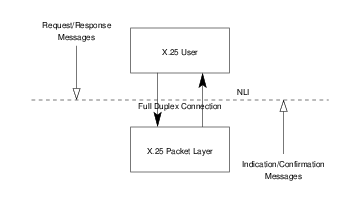
The NLI allows the X.25 packet layer (as a STREAMS driver) to be
configured with an X.25 user (as a STREAMS module) that conforms to the
NLI. An X.25 user can also be a user program that conforms to the NLI and
accesses the X.25 packet layer using putmsg(2s), putpmsg(2s),
getmsg(2s), getpmsg(2s), and ioctl(2s) system calls.
3 NLI Services Definition
The features of the NLI are defined in termsof the services provided by the X.25 packet layer, and the individual messages that may flow between the X.25 user and the X.25 packet layer.
The services supported by the NLI are based on three related modes of communication, X.25 mode, non-X.25 mode, and CONS mode.
3.1 NLI Modes
Packet Level Features
- permanent virtual circuits;
- extended packet sequence numbering;
- D-bit support;
- packet transmission;
- incoming calls barred;
- outgoing calls barred;
- one-way logical channel incoming;
- one-way logical channel outgoing;
- two-way logical channel;
- non-standard default packet sizes;
- non-standard default window sizes;
- default throughput class assignement;
- flow control parameter negotiation;
- throughput class negotiation;
- closed user group;
- bilateral closed user group;
- fast select;
- fast select acceptance;
- reverse charging;
- reverse charging acceptance;
- local charging prevention;
- network user identification selection;
- network user identification override;
- RPOA selection;
- called line address modification;
- call redirection;
- call deflection;
- transit delay;
- protection;
- priority;
- TOA/NPI addressing;
- programmable facilities.
X.25 Facilities
- fast select request;
- fast select with unrestricted response;
- fast select with restricted response;
- reverse charging;
- packet size negotiation;
- window size negotiation;
- closed user groups;
- bilateral closed user groups;
- network user identification;
- RPOA selection;
- called line address modification;
- call redirection;
- call charging;
- programmable facilities;
- DTE facility marker;
- extended address;
- throughput class;
- transit delay;
- expedited data;
- protection;
- priority;
- call user data;
- clear user data.
X.25 Operational Support
- Q-bit support for X.29 services;
- M-bit support for packet segmentation and reassembly;
- D-bit for data delivery confirmation;
- expedited data;
- call charging;
- called line address modification;
- call deflection;
- clear user data.
3.2 NLI Commands
| Command | Description | Section |
N_CI | xcallf | Connect Request/Indication. |
N_CC | xccnff | Connect Response/Confirmation. |
N_Data | xdataf | Data. |
N_DAck | xdatacf | Data Acknowledgement. |
N_EData | xeadataf | Expedited Data. |
N_EAck | xedatacf | Expedited Data Acknowledgement. |
N_RI | xrstf | Reset Request/Indication. |
N_RC | xrscf | Reset Response/Confirmation. |
N_DI | xdiscf | Disconnect Request/Indication. |
N_DC | xdcnff | Disconnect Confirmation. |
N_Abort | xabortf | Abort Indication. |
N_Xlisten | xlistenf | Listen Request/Response. |
N_Xelisten | xlistenf | Extended Listen Request/Response. |
N_Xcanlis | xcanlisf | Listen Cancel Request/Response. |
N_PVC_ATTACH | pvcattf | PVC Attach. |
N_PVC_DETACH | pvcdetf | PVC Detach. |
3.3 NLI Data Structures
3.3.1 Addresses
In call requests and responses, it is necessary to specify the X.25 addresses associated with the connection. These addresses consist of the called, calling and responding addresses. A common structure is used for these addresses. The addressing format used by this stricture provides the following information:
- the subnetwork (data link) on which outgoing Connect Requests are to be sent and on which incoming Connect Indications arrive;
- Network Service Access Points (NSAP) and Subnetwork Point of Attachments (SNPA), or Data Terminal Equipment (DTE) addresses and Link Service Access Points (LSAP); and,
- optional formats for the encoding of addresses (NSAP).
3.3.1.1 X.25 Address Format
Addresses are represent using an xaddrf structure. The xaddrf
structure is formatted as follows:
#define NSAPMAXSIZE 20

struct xaddrf {
    union {
        uint32_t link_id;
        uint32_t sn_id;
    };
    unsigned char aflags;
    struct lsapformat DTE_MAC;
    unsigned char nsap_len;
    unsigned char NSAP;
};
The xaddrf structure contains the following members:
- link_id
Holds the link number as a
uint32_t. By default, link_id has a valud of ‘0xFF’. When link_id is ‘0xFF’, Solstice X.25 attempts to match the valled address with an entry in a routing configuration file. If it cannot find a match, it routes the call over the lowest numbered WAN link.- sn_id
-
Note that in some implementations, the sn_id field is declared as
unsigned long; however, this causes complications for 32-bit applications running over a 64-bit kernel: i.e., it requires that the data model of the application be known to the kernel module and conversions be supported. Therefore, this field appears in the header file as the 32- vs. 64-bit agnosticuint32_t. - aflags
Specifies the options required (or used) by the subnetwork to encode and interpret addresses. It may have one of the following values:
NSAP_ADDR‘0x00’ NSAP is OSI-encoded NSAP address. EXT_ADDR‘0x01’ NSAP is non-OSI-encoded extended address. PVC_LCI‘0x02’ NSAP is a PVC number. PVC_LCI‘0x02’ DTE_MAC is the LCI of a PVC. When the NSAP field is empty, aflags takes the value zero (0).3
- DTE_MAC
The DTE address, or LSAP as two BCD digits per byte, right justified, or the
PVC_LCIas three BCD digits with two digits per byte, right justified. Holds the DTE address, the Medium Access Control plus Service Access Point (MAC+SAP) address or the LCI. This is binary. See lsapformat.- nsap_len
The length in semi-octets of the NSAP as two BCD digits per byte, right justified. This indicates the length of the NSAP, if any (and where appropriate), in semi-octets.
- NSAP
The NSAP or address extension (see aflags) as two BCD digitis per byte, right justified. This carries the NSAP or address extension (see field aflags) when present as indicated by nsap_len. This is binary.
3.3.1.2 LSAP Address Format
The lsapformat structure is formatted as follows:.
#define LSAPMAXSIZE

struct lsapformat {
    unsigned char lsap_len;
    unsigned char lsap_add[LSAPMAXSIZE];
};
The fields in this structure are defined as follows:
- lsap_len
This gives the length of the DTE address, the MAC+SAP address, or the LCI in semi-octets. For example for Ethernet, the length is always 14 to indicate the MAC (12) plush SAP (2). The SAP always follows the MAC address. The DTE can be up to 15 decimal digits unless X.25(88) and Type Of Address/Numbering Plan Identification (TOA/NPI) addressing is being used, in which case, it can be up to 17 decimal digits. For an LCI, the length is 3. The length of the DTE address or LSAP as two BCD digits per byte, right justified. An LSAP is always 14 digits long. A DTE address can be up to 15 decimal digtis unless X.25(88) and TOA/NPI addressing is used, in which case it can be up to 17 decimal digits. A
PVC_LCIis 3 digits long.- lsap_add
This holds the DTE, MAC+SAP or LCI, when present, as indicated by lsap_len. This is binary. The DTE address, LSAP or
PVC_LCIas two BCD digits per byte, right justified.
For TOA/NPI the TOA is:
| 0000 | 0 | Network-dependent number or unknown. |
| 0001 | 1 | International number. |
| 0010 | 2 | National number. |
| 0011 | 3 | Network specific number (for use in private networks). |
| 0100 | 4 | Complementary address without main address. |
| 0101 | 5 | Alternative address. |
NPI for other than Alternative address is:
| 0000 | 0 | Network-dependent number or unknown. |
| 0001 | 1 | ITU-T Recommendation E.164 (digital). |
| 0010 | 2 | ITU-T Recommendation E.164 (analog). |
| 0011 | 3 | ITU-T Recommendation X.121. |
| 0100 | 4 | ITU-T Recommendation F.69 (telex numbering plan). |
| 0101 | 5 | Private number plan (for private use only). |
NPI when TOA is Alternative Address is:
| 0000 | 0 | Character string coding to ISO/IEC 646. |
| 0001 | 1 | OSI NSAP address coded per X.213/ISO 8348. |
| 0010 | 2 | MAC address per IEEE 802.2/ISO/IEC 8802:1998. |
| 0011 | 3 | Internet Address per RFC 1166. (i.e. an IPv4 address). |
3.3.2 CONS Quality of Service Parameters
Negotiable X.25 facilities are supported by the PLP driver. This section describes the request and negotiation of these facilities, and the data structures used by the NLI primitives.
The facilities are broken down into two groups:
- those required for Connection-Oriented Network Service (CONS) support, and
- those requried for non-OSI procedures (X.29, for example).
The CONS quality of service (QOS) parameters supported are the following:
- Throughput Class
- Minimum Throughput Class
- Target Transit Delay
- Maximum Acceptable Transit Delay
- Use of Expedited Data
- Protection
- Receipt Acknolwedgement
CONS-related quality of service parameters are defined in the qosformat
structure. The qosformat structure is formatted as follows:
#define MAX_PROT 32

struct qosformat {
    unsigned char reqtclass;
    unsigned char locthroughput;
    unsigned char remthroughput;
    unsigned char reqminthruput;
    unsigned char locminthru;
    unsigned char remminthru;
    unsigned char reqtransitdelay;
    unsigned short transitdelay;
    unsigned char reqmaxtransitdelay;
    unsigned char acceptable;
    unsigned char reqpriority;
    unsigned char reqprtygain;
    unsigned char reqprtykeep;
    unsigned char prtydata;
    unsigned char prtygain;
    unsigned char prtykeep;
    unsigned char reqlowprtydata;
    unsigned char reqlowprtygain;
    unsigned char reqlowprtykeep;
    unsigned char lowprtydata;
    unsigned char lowprtygain;
    unsigned char lowprtykeep;
    unsigned char protection_type;
    unsigned char prot_len;
    unsigned char lowprot_len;
    unsigned char protection[MAX_PROT];
    unsigned char lowprotection[MAX_PROT];
    unsigned char reqexpedited;
    unsigned char reqackservice;
    struct extraformat xstras;
};
The qosformat structure has the following members:
- reqtclass
When non-zero, conveys that throughput negotiation is selected.
- locthroughput
Contains the four-bit throughput encoding for the local to remote direction.
- remthroughput
Contains the four-bit throughput encoding for the remote to local direction.
- reqminthruput
When non-zero, conveys that minimum throughput negotiation is selected.
- locminthru
When reqminthruput is non-zero, conveys the four-bit throughput encoding for the local to remote direction.
- remminthru
When reqminthruput is non-zero, conveys the four-bit throughput encoding for the remote to local direction.
- reqtransitdelay
When non-zero, conveys that target transit delay negotiation is selected.
- transitdelay
When reqtransitdelay is non-zero, conveys the 16-bit value. In a Connect Confirmation, the value of the selected transit delay is placed in this field and is non-zero.
- reqmaxtransitdelay
When non-zero, conveys that maximum acceptable transit delay negotiation is selected.
- acceptable
When reqmaxtransitdelay is non-zero, conveys the 16-bit value of the maximum acceptable transit delay.
Note: Transit delay selection applies only to Connect Requests. There is no transit dleay QOS parameter in a Connect Response. The correct response when the indicated QOS is unattainable is to make a Disconnect Request. In a Connect Confirmation, the value of the selected transit delay is placed in the transitdelay field when such negotiation takes place.
- reqpriority
When non-zero, conveys that data priority negotiation is selected.
- reqprtygain
When non-zero, conveys that gain priority negotiation is selected.
- reqprtykeep
When non-zero, conveys that keep priority negotiation is selected.
- prtydata
When reqpriority is non-zero, contains the 8-bit priority for sending data.
- prtygain
When reqprtygain is non-zero, contains the 8-bit priority for gaining a connection.
- prtykeep
When reqprtykeep is non-zero, contains the 8-bit priority for keeping a connection.
- reqlowprtydata
When non-zero, conveys that data low priority negotiation is selected. This field is only valid on Connect Requests/Indications.
- reqlowprtygain
When non-zero, conveys that gain low priority negotiation is selected. This field is only valid on Connect Requests/Indications.
- reqlowprtykeep
When non-zero, conveys that keep low priority negotiation is selected. This field is only valid on Connect Requests/Indications.
- lowprtydata
When reqlowprtydata is non-zero, contains the 8-bit priority for sending data. This field is only valid on Connect Requests/Indications.
- lowprtygain
When reqlowprtygain is non-zero, contains the 8-bit priority to gain a connection. This field is only valid on Connect Requests/Indications.
- lowprtykeep
When reqlowprtykeep is non-zero, contains the 8-bit priority to keep a connection. This field is only valid on Connect Requests/Indications.
- protection_type
When non-zero, conveys that protection negotiation is selected. The field can be one of the following valuse:
Value Name Meaning 1 PRT_SRCSource address specific. 2 PRT_DSTDestination address specific. 3 PRT_GLBGlobally unique. - prot_len
- lowprot_len
This field is only valid on Connect Requests/Indications.
- protection
- lowprotection
This field is only valid on Connect Requests/Indications.
- reqexpedited
When non-zero, conveys that expedited data negotiation is selected. For Connect Indications, a non-zero value implies that the Expedited Data negotiation facility was present in the incoming call packet, and that its use was requested.
Note: Negotiation is a CONS procedure. When the facility is present and indicates non-use, use cannot be negotiated by Connect Responses. For a description of the use of the CONS_call field in Connect Requests and Connect Responses, see Connect Request/Indication, and Connect Response/Confirmation.
For incoming or outgoing non-CONS calls (denoted by the CONS_call flag set to zero (0)), Expedited Data negotiation is not required: interrupt data is always available in X.25. This means that this field is ignored on Connect Requests and Responses for non-CONS calls.
- reqackservice
When non-zero, conveys that receipt confirmation negotiation is selected. For Connect Indications, a non-zero value implies that the Receipt Confirmation negotiation facility was present in the incoming call packet, and that its use was requested. This field can have one of the following values:
Constant Value Description - 0 No receipt confirmation. RC_CONF_DTE1 Confirmation by the remote terminal. RC_CONF_APP2 Confirmation by the remote application. In the case of receipt confirmation by the remote DTE, no acknowledgements are expected or given over the X.25 service interface. In the case of receipt confirmation by the remote application, there is a one-to-one corrrespondence between D-bit data and acknowledgements, with one data acknowlegement being received or sent for each D-bit data packet sent or received over the X.25 service interface.
- xstras
3.3.3 Non-OSI X.25 Facilities
Although these are non-OSI facilities, they are also negotiable with CONS. For those NLI applications that require them, the non-OSI facilities supported are as follows:
- non-OSI extended addressing;
- X.25 fast select request/indication with no restriction on response;
- X.25 fast select reqeust/indication with restriction on response;
- X.25 reverse charging;
- X.25 packet size negotiation;
- X.25 window size negotiation;
- X.25 network user identification;
- X.25 recognized private operating agency selection;
- X.25 closed user groups;
- X.25 call deflection; and,
- X.25 programmable facilities.
Non-OSI X.25 Facilities are defined in the extraformat structure. The
extraformat structure is formatted as follows:
#define MAX_NUI_LEN  64
#define MAX_RPOA_LEN  8
#define MAX_CUG_LEN   2
#define MAX_FAC_LEN  32
#define MAX_TARIFFS   4
#define MAX_CD_LEN   MAX_TARRIFS * 4
#define MAX_SC_LEN   MAX_TARRIFS * 4
#define MAX_MU_LEN   16
struct extraformat {
    unsigned char fastselreq;
    unsigned char restrictresponse;
    unsigned char reversecharges;
    unsigned char pwoptions;
    unsigned char locpacket;
    unsigned char rempacket;
    unsigned char locwsize;
    unsigned char remwsize;
    int nsdulimit;
    unsigned char nui_len;
    unsigned char nui_field[MAX_NUI_LEN];
    unsigned char rpoa_len;
    unsigned char rpoa_field[MAX_RPOA_LEN];
    unsigned char cug_type;
    unsigned char cug_field[MAX_CUG_LEN];
    unsigned char reqcharging;
    unsigned char chg_cd_len;
    unsigned char chg_cd_field[MAX_CD_LEN];
    unsigned char chg_sc_len;
    unsigned char chg_sc_field[MAX_SC_LEN];
    unsigned char chg_mu_len;
    unsigned char chg_mu_field[MAX_MU_LEN];
    unsigned char called_add_mod;
    unsigned char call_redirect;
    struct lsapformat called;
    unsigned char call_deflect;
    unsigned char x_fac_len;
    unsigned char cg_fac_len;
    unsigned char cd_fac_len;
    unsigned char fac_field[MAX_FAC_LEN];
};
The extraformat structure has the following members:
- fastselreq
For non-OSI services (e.g. X.29), if the X.25 facility fast select is to be requested or indicated, this field is non-zero. For CONS, the use of fast select is optional.
- restrictresponse
If the resonse to a Connect Request or Indication is to be a Diconnect Indiciation, this filed is non-zero.
- reversecharges
If reverse charging is requested or indicated for a connection, this field is non-zero. The configuration mod bit
SUB_REVCHARGEhas an impact on whether reverse charging is indicated, since it is possible to select a per-subnetwork policy for reciept of reverse charging.- pwoptions
This field is used to indicate per-circuit options. The field is a bitwise OR of zero or more of the following values:
Name Value Meaning when set. NEGOT_PKT0x01 Packet size negotiation permitted. NEGOT_WIN0x01 Window size negotiation permitted. ASSWERN_HWM0x01 Assert concatentaiton limit. The field is defined as follows:
#define NEGOT_PKT       0x01
#define NEGOT_WIN       0x02
#define ASSERT_HWM      0x04
The field is used for two reasons:
- The X.25 software always indicates the values of the window and packet sizes operating on the virtual circuit. The field pwoptions for an incoming call indicates whether these values are negotiable.
- In Connect Request/Response message, the NLI user can set nsdulimit, the limit value for packet concatentation by the X.25 level, to a value different from the limit in the subnetwork configuration database. It is not a negotiable option, so whatever the user requests is used.
- locpacket
When non-zero, contains the local to remote direction packet size. The default value,
DEF_X25_PKT, is seven (7).- rempacket
When non-zero, contains the remote to local direction packet size. The default value,
DEF_X25_PKT, is seven (7).- locwsize
When non-zero, contains the local to remote direction window size. The default value,
DEF_X25_WIN, is two (2).- remwsize
When non-zero, contains the remote to local direction window size. The default value,
DEF_X25_WIN, is two (2).- nsdulimit
When non-zero, and the appropriate bit is set in the pwoptions field, this field is used as the specified concatentaiton limit.
- nui_len
Valid in Connect Requests and Connect Responses, when non-zero, specifies the length of the nui_field in octets. The Network User Identification facility is not available on 1980 X.25 networks.
- nui_field
Contains the Network User Identification (NUI) octets of length nui_len.
- rpoa_len
Valid in Connect Requests only. When non-zero, the RPOA DNIC information is suppplied in the rpoa_field field and the semi-octets in the field are of this length.
- rpoa_field
Contains the Recognized Private Operating Agency (RPOA) semi-octets of length rpoa_len.
- cug_type
Valid in Connect Requests and Connect Indications only, this field, when non-zero, is 1 for Closed User Group (CUG) and 2 for Bilateral CUG (two members only).
Note: Incoming CUG facilities are assumed to have been validated by the network. No further cehcking is performed.
- cug_field
Contains the Closed User Group (CUG) semi-octets of length up to four (4) semi-octets for CUG and four semi-octets (4) for BCUG (Bilateral CUG).
- reqcharging
When non-zero in a Connect Request of Connect Indication, call charging is requested; in a Disconnect Indication of Disconnect Confirmation, the six fields below will give the charging information.
- chg_cd_len
When non-zero, conveys the length of the chg_cd_field field.
- chg_cd_field
Conveys the call duration.
- chg_sc_len
When non-zero, conveys the length of the chg_sc_field field.
- chg_sc_field
Conveys the segment count.
- chg_mu_len
When non-zero, conveys the length of the chg_mu_field field.
- chg_mu_field
Conveys the monetary unit.
- called_add_mod
When non-zero, conveys the reason value for call modification.
- call_redirect
When non-zero, conveys the reason for call redirection.
- called
When call_redirect is non-zero, conveys the orignalling called DTE address.
- call_deflect
Valid in the Disconnect Request and Disconnect Indication, when non-zero, conveys the reason for call deflection. The deflected field in the Disconnect Request or Indication conveys the DTE address, and if required, the NSAP address to which the call is to be deflected.
- x_fac_len
Valid in Connect Requests and Connect Indications only, when non-zero, provides the length of the explicit facility ecnoded strings for X.25 facilities.
- cg_fac_len
Valid in Connect Requests and Connect Indiciations only, when non-zero, provides the length of the explicit facility encoded strings for non-X.25 facilities for the calling network.
- cd_fac_len
Valid in Connect Requests and Connect Indiciations only, when non-zero, provides the length of the explicit facility encoded strings for non-X.25 facilities for the called network.
- fac_field
When x_fac_len, cg_fac_len or cd_fac_len are non-zero, contains the X.25 facilities, non-X.25 facilities for the calling network, and/or non-X.25 facilities for the called network.
Note: The contents of this field, if supplied, are not validated or acted upon by the code. The X.25 facilities are inserted at the end of any other X.25 facilities that are passed in the Connect Request/Indication (for example, packet or window sizes). If any non-X.25 facilities are supplied, the appropriate marker is inserted before the supplied facilities.
4 NLI Primitives
4.1 Connect Request/Indication
Format
The Connect Request and Connect Indication use the xcallf structure.
The control part of the message consists of one M_PROTO message block
containing the xcallf structure.
The data part of the message consists of zero or one M_DATA message blocks
containing the Call User Data (if any).
The xcallf structure is formatted as follows:
struct xcallf {
    unsigned char xl_type;
    unsigned char xl_command;
    int conn_id;
    unsigned char CONS_call;
    unsigned char negotiate_qos;
    struct xaddrf calledaddr;
    struct xaddrf callingaddr;
    struct qosformat qos;
};
Usage
The Connect Request or Indication message primitive, N_CI, is used by
the NS user to request a outgoing connection, or by the NS provider to indicate
an incoming connection.
The control part of the message consists of one M_PROTO message block, and
contains the xcallf structure.
The data part of the message consists of zero or one M_DATA message blocks
containing the Call User Data (CUD) when supplied.
Parameters
The xcallf structure contains the following members:
- xl_type
Always
XL_CTL.- xl_command
Always
N_CI, for both Connect Requests and Connect Indications.- conn_id
This field is used only for Connect Indications. When an NS user Stream is listening, multiple incoming Connect Indications can be pending. This field indicates the connection identifier for the current Connect Indication for use by the NS user when responding to this Connection Indication with either a Connect Response or a Disconnect Request message.
- CONS_call
Either X.25 or CONS procedures4 can be used for calls. When non-zero, this field indicates that CONS procedures are to be used. When zero, this field indicates that X.25 procedures are to be used.
- negotiate_qos
QOS parameters can be negotiated by the peer or left at default values. When non-zero, this field specifies or indicates that QOS parameters are being negotiated by the NS user or NS user peer and the pertinent ranges are provided in the qos member. When zero, this field specifies and indicates that default values are to be used for the NS user or were indicated by the NS user peer.
- calledaddr
Conveys the called address. For outgoing Connect Requests, this is the remote address to which the call is to be connected. For incoming Connect Indications, this is the local address to which the call was initiated.
- callingaddr
Conveys the calling address. For outgoing Connect Requests, this is the local address from which the call is to be connected. For incoming Connect Indications, this is the remote address from which the call was initiated.
- qos
Conveys the quality of service parameters and CONS an non-CONS facilities that are requested or indicated.
State
Response
When the Connect Request is issued by the NS user, the expected response from the NS provider is a Connect Conformation or a Disconnect Indication.
When the Connect Indication is issued by the NS provider, the expected response from the NS user is a Connect Response or a Disconnect Request.
Equivalence
The Connect Request message primitive is equivalent to the N_CONN_REQ
primitive of the NPI; the Connect Indication, the N_CONN_IND.
4.2 Connect Response/Confirmation
Format
The Connect Response and Connect Confirmation use the xccnff structure.
The control part of the message consists of one M_PROTO message block
containing the xccnff structure.
The data part of the message consists of zero or one M_DATA message blocks
containing the Call User Data (if any).
The xccnff structure is formatted as follows:
struct xccnff {
    unsigned char xl_type;
    unsigned char xl_command;
    int conn_id;
    unsigned char CONS_call;
    unsigned char negotiate_qos;
    struct xaddrf responder;
    struct qosformat rqos;
};
Usage
The Connect Response or Confirmation message primitive, N_CC, is used
by the NS user to response to an incoming connection, or by the NS provider to
confirm an outgoing connection.
The control part of the message consists of one M_PROTO message block, and
contains the xccnff structure.
The data part of the message consists of zero or one M_DATA message block
containing the Call User Data (CUD) when supplied.
Parameters
The xccnff structure contains the following members:
- xl_type
Always
XL_CTL.- xl_command
Always
N_CC, for both Connect Response and Connect Confirmation.- conn_id
This field is only used for Connect Responses. When an NS user Stream is listening, multiple incoming Connect Indications can be pending. This field specifies the connection identifier from the Connection Indication to which the NS user is responding.
- CONS_call
Either X.25 or CONS procedures5 can be used for calls. When non-zero, this field indicates that CONS procedures are to be used. When zero, this field indicates that X.25 procedures are to be used.
- negotiate_qos
QOS parameters can be negotiated by the peer or left at default values. When non-zero, this field specifies or indicates that QOS parameters are being negotiated by the NS user or NS user peer and the pertinent ranges are provided in the rqos member. When zero, this field specifies and indicates that default values are to be used for the NS user or were indicated by the NS user peer.
- responder
Conveys the responding address. For Connect Responses, this is the local address that is responding to the incoming call. For Connect Confirmations, this is the remote address that responded to the outgoing call.
- rqos
Conveys the negotiated quality of service parameters and CONS an non-CONS facilities in response or confirmation.
State
Response
No response is expected when either the NS user or NS provider issue this primitive.
Equivalence
The Connect Response message primitive is equivalent to the N_CONN_RES
primitive of the NPI; the Connect Confirmation, the N_CONN_CON.
4.3 Data
Format
The Data message uses the xdataf structure.
The control part of the message consists of one M_PROTO message block, and
contains the xdataf structure.
The data part of the message consists of one or more M_DATA message blocks
containing the local or remote NS user data (NSDU).
The xdataf structure is formatted as follows:
struct xdataf {
    unsigned char xl_type;
    unsigned char xl_command;
    unsigned char More;
    unsigned char setDbit;
    unsigned char setQbit;
};
Usage
The Data message primitive, N_Data, is used to transfer NS user data
to or from the NS user.
The control part of the message consists of one M_PROTO message block, and
contains the xdataf structure.
The data part of the message consists of one or more M_DATA message blocks
containing the local or remote NS user data (NSDU).
Parameters
The xdataf structure contains the following members:
- xl_type
Always
XL_DAT.- xl_command
Always
N_Data, for both Data Request and Data Indication.- More
When non-zero, this field conveys that a subsequent
N_Datamessage primitive will contain additional data belonging to the same NSDU. When zero, this field conveys that the data contained in the message primitive completes an NSDU.- setDbit
Conveys that the D-bit is to be (or was) associated with the NSDU. When the data portion represents part of an NSDU, the bit must be set or clear on each request or indication belonging to the same NSDU.
- setQbit
Conveys that the Q-bit is to be (or was) associated with the NSDU. When the data portion represents part of an NSDU, the bit must be set or clear on each request or indication belonging to the same NSDU.
State
This message primitive is only valid during the data transfer phase.
Response
No response is expected when either the NS user or NS provider issue this primitive, unless the D-bit is set, in which case a Data Acknowledgement response is expected from the NS provider or NS user, respectively.
Equivalence
The Data message primitive is equivalent to the N_DATA_REQ and
N_DATA_IND primitives of the NPI.
4.4 Data Acknowledgement
Format
The Data Acknowledgement message uses the xdatacf structure.
The control part of the message consists of one M_PROTO message block, and
contains the xdatacf structure.
There is no data part (M_DATA message blocks) associated with this message primitive.
The xdatacf structure is formatted as follows:
struct xdatacf {
    unsigned char xl_type;
    unsigned char xl_command;
};
Usage
The Data Acknowledgement message primitive, N_DAck, is used to
request or indicate acknolwedgement of data.
The control part of the message consists of one M_PROTO message block, and
contains the xdatacf structure.
There is no data part (M_DATA message blocks) associated with this message primitive.
Parameters
The xdatacf structure contains the following members:
- xl_type
Always
XL_DAT.- xl_command
Always
N_DAck.
State
This message primitive is only valid during the data transfer phase.
Response
When receipt confirmation from the remote application is active on a VC, this
message primitive is used to acknowledge a previous N_DAck request or
indication that had the D-bit set. There is a one-to-one correspondence between
D-bit data and acknowledgements, with one Data Acknowledgement being conveyed
for each Data message primitive conveyed. The Data message primitive
acknowledged is always the oldest outstanding Data message primitive that
requested acknowledgement.
For CONS calls, if receipt acknowledgement was negotiated on the connection, then an acknowledgement is pending for each Data primitive conveyed. However, to be compatible with previous releases of the NPI, the value of the reqackservice field in the qos structure can be set to request that the D-bit signifies receipt confirmation by the remote DTE only, thus ensuring that no acknowledgements are expected or given.
For non-CONS calls, only when the reqackservice field in the qos structure has been set to the appropriate value will the Data Acknolwedgement procedures apply for an D-bit Data requested or indicated. Otherwise, no acknowledgement is expected or given.
Equivalence
The Data Acknowledgement message primitive is equivalent to the
N_DATACK_REQ and N_DATACK_IND primitives of the NPI.
4.5 Expedited Data
Format
The Expedited Data message uses the xedataf structure.
The control part of the message consists of one M_PROTO message block, and
contains the xedataf structure.
The data part of the message consists of one or more M_DATA message blocks
containing the local or remote expedited NS user data (ENSDU).
The xedataf structure is formatted as follows:
struct xedataf {
    unsigned char xl_type;
    unsigned char xl_command;
};
Usage
The Expedited Data message primitive, N_EData, is used to transfer
expedited NS user data to or from the NS user.
The control part of the message consists of one M_PROTO message block, and
contains the xedataf structure.
The data part of the message consists of one or more M_DATA message blocks
containing the local or remote expedited NS user data (ENSDU).
The Expedited Data message primitive, N_EData, is used when expedited
data, carried by an X.25 interrupt packet, corsses the X.25 NLI service
interface from NS provider to user or NS user to provider.
The Expedited Data message is a confirmed primitive and must be acknowledged
before another expedited data unit can be requested or indicated.
Parameters
The xedataf structure contains the following members:
- xl_type
Always
XL_DAT.- xl_command
Always
N_EData.
State
This message primitive is only valid during the data transfer phase.
Response
When NS user or provider issues this primtive it expectes an Expedited Data Acknowledgement message primitive in reponse. The Expedited Data message is a confirmed primitive and must be acknowledged before another expedited data unit can be requested or indicated.
Equivalence
The Expedited Data message primitive is equivalent to the
N_EXDATA_REQ and N_EXDATA_IND primitives of the NPI.
4.6 Expedited Data Acknowledgement
Format
The Expedited Data Acknowledgement message uses the xedatacf structure.
The control part of the message consists of one M_PROTO message block, and
contains the xedatacf structure.
There is no data part (M_DATA message blocks) associated with this message primitive.
The xedatacf structure is formatted as follows:
struct xedatacf {
    unsigned char xl_type;
    unsigned char xl_command;
};
Usage
The Expedited Data Acknowledgement message primitive, N_EAck, is used to
request or indicate acknolwedgement of expedited data.
The control part of the message consists of one M_PROTO message block, and
contains the xedatacf structure.
There is no data part (M_DATA message blocks) associated with this message primitive.
Parameters
The xedatacf structure contains the following members:
- xl_type
Always
XL_DAT.- xl_command
Always
N_EAck.
State
This message primitive is only valid during the data transfer phase.
Response
The Expedited Data Acknolwedgement message primitive is issued only in confirmation to the Expedited Data message primitive. When an Expedited Data message primitive is delivered to the NS user or provider, the NS provider or user, respectively, must acknowledged the expedited data.
Equivalence
The Expedited Data Acknowledgement message primitive has no equivalent in the NPI.
4.7 Reset Request/Indication
Format
The Reset Request and Reset Indication use the xrstf structure.
The control part of the message consists of one M_PROTO message block
containing the xrstf structure.
There is no data part (M_DATA message blocks) associated with this message primitive.
The xrstf structure is formatted as follows:
struct xrstf {
    unsigned char xl_type;
    unsigned char xl_command;
    unsigned char originator;
    unsigned char reason;
    unsigned char cause;
    unsigned char diag;
};
Usage
The Reset Request or Indication message primitive, N_RI, is used by
the NS user to request reset of the connection, or by the NS provider to
indicate a remote reset.
The control part of the message consists of one M_PROTO message block, and
contains the xrstf structure.
There is no data part (M_DATA message blocks) associated with this message primitive.
The X.25 cause and diagnostic octets, cause and diag, are conveyrs, as well as the CONS originator and reason codes, which are mapped from the cause and diag. A Reset Request on a non-CONS call can specify a non-zero cause code. This has no effect for a CONS call.
Parameters
The xrstf structure contains the following members:
- xl_type
Always
XL_CTL.- xl_command
Always
N_RI.- originator
For a CONS call, contains the CONS originator mapped from the X.25 cause and diagnostic. This field can have one of the following values:
Constant Value Description NS_UNKNOWN0 Originator is unknown. NS_USER1 Originator is the NS user. NS_PROVIDER2 Originator is the NS provider. - reason
For a CONS call, contains the CONS reason, mapped from the X.25 cause and diagnostic. This field can have one of the following values when the originator is
NS_PROVIDER:Constant Value Description NS_RUNSPECIFIED233 Unspecified reason. NS_RCONGESTION234 Congestion. The field can have the following values when the originator is
NS_USER:Constant Value Description NS_RESYNC250 Resynchronization. The field can have the following values when the originator is
NS_UNKNOWN:Constant Value Description NS_UNKNOWN0 Unspecified reason. - cause
Conveys the X.25 cause octet associated with the reset.
- diag
Conveys the X.25 diagnostic octet associated with the reset.
State
This message primitive is valid in the data transfer phase.
Response
A Reset Request and Reset Indication message primitive is an acknowledged service. The NS user expects a Reset Confirmation primitive in response to a Reset Request; the NS provide, a Reset Response primitive in reesponse to a Reset Indication.
A collision between a Reset Indication and a Reset Request is taken to acknolwedge the Reset Request and no Reset Confirmation is then issued.
Equivalence
The Reset Request message primitive is equivalent to the N_RESET_REQ
of the NPI; the Reset Indication, N_RESET_IND.
4.8 Reset Response/Confirmation
Format
The Reset Response and Reset Confirmation use the xrscf structure.
The control part of the message consists of one M_PROTO message block
containing the xrscf structure.
There is no data part (M_DATA message blocks) associated with this message primitive.
The xrscf structure is formatted as follows:
struct xrscf {
    unsigned char xl_type;
    unsigned char xl_command;
};
Usage
The Reset Response or Confirmation message primitive, N_RC, is used
by the NS user to respond to a Reset Indication for the connection, or by the NS
provider to confirm a Reset Request.
The control part of the message consists of one M_PROTO message block, and
contains the xrscf structure.
There is no data part (M_DATA message blocks) associated with this message primitive.
Parameters
The xrscf structure contains the following members:
- xl_type
Always
XL_CTL.- xl_command
Always
N_RC.
State
This message primitive is valid in the data transfer phase.
Response
The Reset Response message primitive is used by the NS user to respond to and acknowledge a previous Reset Indication message primitive from the NS provider. The Reset Confirmation message primitive is used by the NS provider to respond to and acknowledge a previous Reset Request message primitive from the NS user.
Equivalence
The Reset Response message primitive is equivalent to the N_RESET_RES
of the NPI; the Reset Confirmation, N_RESET_CON.
4.9 Disconnect Request/Indication
Format
The Disconnect Request and Disconnect Indication use the xdiscf
structure.
The control part of the message consists of one M_PROTO message block
containing the xdiscf structure.
The data part of the message consists of zero or one M_DATA message blocks
containing the Clear User Data (if any).
The xdiscf structure is formatted as follows:
struct xdiscf {
    unsigned char xl_type;
    unsigned char xl_command;
    unsigned char originator;
    unsigned char reason;
    unsigned char cause;
    unsigned char diag;
    int conn_id;
    unsigned char indicated_qos;
    struct xaddrf responder;
    struct xaddrf deflected;
    struct qosformat qos;
};
Usage
The Disconnect Request or Indication message primitive, N_DI, is used
by the NS user to reject an incoming connection or disconnect an existing
connection, or by the NS provider to reject an outgoing connection or disconnect
an existing connection.
The control part of the message consists of one M_PROTO message block, and
contains the xdiscf structure.
The data part of the message consists of zero or one M_DATA message blocks
containing the Clear User Data (CUD) when supplied.
The X.25 cause and diagnostic octets, cause and diag, are presented, as well as the CONS originator and reason codes mapped from the X.25 cause and diagnostic. A Disconnect Request for a non-CONS call can specify a non-zero cause code. This has no effect for a CONS call.
Parameters
The xdiscf structure contains the following members:
- xl_type
Always
XL_CTL.- xl_command
Always
N_DI.- originator
For a CONS call, contains the CONS originator (NS user, NS provider, or unknown), mapped from the X.25 cause and diagnostic. This field can have one of the following values:
Constant Value Description NS_UNKNOWN0 Originator is unknown. NS_USER1 Originator is the NS user. NS_PROVIDER2 Originator is the NS provider. - reason
For a CONS call, contains the CONS reason, mapped from the X.25 cause and diagnostic. This field can have one of the following values when the originator is
NS_PROVIDER:Constant Value Description NS_GENERIC224 General. NS_DTRANSIENT225 Disconnect, transient. NS_DPERMANENT226 Disconnect, permanent. NS_TUNSPECIFIED227 Reject, unspecified, transient. NS_PUNSPECIFIED228 Reject, unspecified, permanent. NS_QOSNATRANSIENT229 Reject, QOS unavailable, transient. NS_QOSNAPERMANENT230 Reject, QOS unavailable, permanent. NS_NSAPTUNREACHABLE232 Reject, NSAP unreachable, transient. NS_NSAPPUNREAHCABLE235 Reject, NSAP unreachable, permanent. The field can have the following values when the originator is
NS_USER:Constant Value Description NU_GENERIC240 General. NU_DNORMAL241 Disconnect, normal. NU_DABNORMAL242 Disconnect, abnormal. NU_DINCOMPUSERDATA243 Disconnect, incomprehensible user data. NU_TRANSIENT244 Reject, transient. NU_PERMANENT245 Reject, permanent. NU_QOSNATRANSIENT246 Reject, QOS unavailable, transient. NU_QOSNAPERMANENT247 Reject, QOS unavailable, permanent. NU_INCOMPUSERDATA248 Reject, Call User Data facility. NU_BADPROTID249 Reject, Bad protocol identifier. - cause
Conveys the X.25 cause octet associated with the disconnect.
- diag
Conveys the X.25 diagnostic octet associated with the disconnect.
- conn_id
When a Disconnect Request is used to refuse and incoming connection, this field contains the conn_id from the corresponding Connect Indication message primitive.
- indicated_qos
When non-zero, conveys that facilities and quality of service paraemters are being indicated.
- responder
Conveys the responding address. This is the local responding address in a Disconnect Request used to refuse an incoming call, and a remote responding address in a Disconnect Indication refusing an outgoing call.
- deflected
When the call_deflect field of the associated qos structure is non-zero, this field conveys the deflected address. The deflected address is the address of the remote station to which the call is being deflected. This is set by the NS user when deflecting a call with a Disconnect Request refusing an incoming connection; and by the NS provider when an outgoing call has been deflected.
- qos
Conveys the CONS quality of service parameters and non-OSI facilities associated with the disconnect. This is used currently for the charging information when an existing connection is disconnected, and for the deflection facility when an incoming or outgoing call is being deflected.
State
This primitive is valid in the data transfer phase; it is also valid in the incoming or outgoing connecting phase. The call moves to the disconnect phase.
Response
This primitive is valid in response to a previously sent Connect Request or received Connect Indication message primitive; or, to simply request or indicate disconnection of an existing connection.
When an existing connection is disconnect with a Disconnect Request by the NS user, the NS user expects a Disconnect Confirmation to acknowledge the disconnect. All other message should be discarded from the Stream until the Disconnect Confirmation is received.
When a Disconnect Indication is issued by the NS provider, all messages sent downstream except Connect Request or Connect Response messages are silently discarded.
A disconnect collision can occur, where Disconnect Request and a Disconnect Indication messages collide. In this case, the Disconnect Indication messages is taken as a confirmation and no Disconnect Confirmation message should be expected by the NS user.
Equivalence
The Disconnect Request message primitive is equivalent to the
N_DISCON_REQ of the NPI; the Disconnect Indication,
N_DISCON_IND.
4.10 Disconnect Confirmation
Format
The Disconnect Confirmation uses the xdcnff structure.
The control part of the message consists of one M_PROTO message block,
containing the xdcnff structure.
There is no data part (M_DATA message blocks) associated with this message primitive.
The xdcnff structure is formatted as follows:
struct xdcnff {
    unsigned char xl_type;
    unsigned char xl_command;
    unsigned char indicated_qos;
    struct qosformat qos;
};
Usage
The Disconnect Confirmation message primitive, N_DC, is used to confirm a previous
Disconnect Request and provide charging information facilities associated with
a previously established call.
The control part of the message consists of one M_PROTO message block,
containing the xdcnff structure.
There is no data part (M_DATA message blocks) associated with this message primitive.
Parameters
The xdcnff structure contains the following members:
- xl_type
Always
XL_CTL.- xl_command
Always
N_DC.- indicated_qos
When non-zero, conveys that CONS quality of service parameters and non-OSI facilities are indicated.
- qos
Conveys the facilities indicated. This is only used on a Disconnect Confirmation to indicate the charging information facility.
State
This primitive is valid in the disconnecting phase.
Response
This message primitive is only issued by the NS provider. No response is expected when the NS provider issues this primitive.
Equivalence
The Disconnect Confirmation message primitive has no equivalent in NPI.
4.11 Abort Indication
Format
The Abort Indication uses the xabortf structure.
The control part of the message consists of one M_PROTO message block
containing the xabortf structure.
There is no data part (M_DATA message blocks) associated with this message primitive.
The xabortf structure is formatted as follows:
struct xabortf {
    unsigned char xl_type;
    unsigned char xl_command;
};
Usage
The Abort Indication message primtiive is used by the X.25 driver in lieue of a
Disconnect Indication, when there is insufficient resources to generate a
Disconnect Indication. Therefore, some NS providers may never issue this
message primitive.
Nevertheless, the NS user must be prepared to receive this message primitive in
liueue of a Disconnect Indication.
The control part of the message consists of one M_PROTO message block
containing the xabortf structure.
There is no data part (M_DATA message blocks) associated with this message primitive.
Parameters
The xabortf structure contains the following members:
- xl_type
Always
XL_CTL.- xl_command
Always
N_Abort.
State
This message primitive is only valid in the data transfer phase. The call moves to the disconnected phase.
Response
This message primitive is only issued by the NS provider. No response is expected when the NS provider issues this primitive.
Equivalence
The Abort Indication message primitive is equivalent to the
N_DISCON_IND of the NPI.
4.12 Listen Request/Response
Format
The Listen Request and Listen Response use the xlistenf structure.
The control part of the message consists of one M_PROTO or M_PCPROTO
message block, and contains the xlistenf structure.
The data part of the message consists of one or more M_DATA message blocks
containing the call user data and address of interest.
The xlistenf structure is formatted as follows:
struct xlistenf {
    unsigned char xl_type;
    unsigned char xl_command;
    int lmax;
    int l_result;
};
The M_DATA message blocks are formatted as follows:
struct lcud {
    unsigned char l_cumode;
    unsigned char l_culength; /* octets */
    unsigned char l_cubytes[0];
    /* followed by l_culength bytes */
};
struct ladd {
    unsigned char l_mode;
    unsigned char l_type;
    unsigned char l_length; /* semi-octets */
    unsigned char l_add[0];
    /* followed by ((l_length+1)>>1) bytes
       containing l_length semi-octets. */
};
Usage
The Listen Request or Response is used when an NS user wishes to register
interest in incoming calls and the NS provider acknowledges the request.
The control part of the message consists of one M_PROTO or M_PCPROTO
message block, and contains the xlistenf structure.
The data part of the message consists of one or more M_DATA message blocks
containing the call user data and address of interest.
The Listen Request queue is ordered in terms of the amount of listen data supplied. The more a Listen Request asks for, the higher its place in the queue. Connect Indications are sent to the listener whose listening criteria are best matched.
Privileged users can ask for a Listen Request to be placed at the front of the
queue, regardless of the amount of listen data supplied. To do this, the Listen
Request should be sent as a M_PCPROTO message. This is achieved by
setting the RS_HIPRI flag in putmsg(2s). Such requests are
searched in the order in which they arrive.
The system adminstrator controls whether or not listening for incoming calls is a privileged operation. If listening is privileged, incoming calls will be sent only to on listen streams opened by a user with superuser privilege. This prevents other users accepting calls that may contain private information, passwords, and so on.
In systems where privileged and non-privileged listens are allowed:
- Privileged listens have priority.
- A matching but busy privileged listen prevents a search of any non-privileged listens.
Parameters
The xlistenf structure contains the following members:
- xl_type
Always
XL_CTL.- xl_command
Always
N_Xlisten.- lmax
Conveys the maximum number of outstanding Connect Indications that the listening Stream is willing to accept, for the addresses conveyed in the attached
M_DATAmessage blocks.Listen requests are cummulated but this field is not. The maximum number of outstanding Connect Indications will be reflected by the value of this field for the last successful Listen Request issued by the NS user.
- l_result
Conveys the result of the Listen Request in a Listen Response message primitive. An error in the parameters or a lack of resources results in this flag being set to a non-zero value.
The M_DATA portion of the message contains the following members:
- l_cumode
Specifies the type of matching. This field can have one of the following values:
Constant Value Description X25_DONTCARE1 Represents a wildcard. X25_STARTSWITTH2 Contains a prefix. X25_IDENTITY3 Contains an identity match. Notes:
- When the l_cumode is set to
X25_DONTCARE, the l_culength and l_cubytes fields are ommitted from theM_DATAmessage block.
- When the l_cumode is set to
- l_culength
Specifies the length of the l_cubytes field in octets.
- l_cubytes
Contains the bytes to be matched against the Call User Data (CUD).
- l_mode
Specifies the type of matching. This field can have one of the following values:
Constant Value Description X25_DONTCARE1 Represents a wildcard. X25_STARTSWITTH2 Contains a prefix. X25_IDENTITY3 Contains an identity match. X25_PATTERN4 Contains a pattern.6 Notes:
- When the l_mode is set to
X25_DONTCARE, the l_type, l_length and l_add fields are ommitted from theM_DATAmessage block. - When the l_mode is set to
X25_PATTERN, the l_add field can contain the wilcard digits ‘*’ and ‘?’ that have the same effect as these characters in regular expressions: that is, ‘*’ represents zero or more characters of any value, and ‘?’ represents single character of any value. The ‘*’ character is represented by the BCD digit0xFand the ‘?’ character is represented by the BCD digit0xE.
- When the l_mode is set to
- l_type
This field can have one of the following values:
Constant Value Description X25_DTE1 Contains an X.25 DTE (X.121) address. X25_NSAP2 Contains a CONS NSAP address. - l_length
Specifies the length of the l_add field in semi-octets. That is, the length of the l_add field in octets is: ‘((l_length+1)>>1)’. The maximum length for a DTE address is 15 or 17 semi-octets (that is, 8 or 9 octets) depending upon whether TOA/NPI addressing is used. The maximum length for an NSAP address is 20 semi-octets (that is, 10 octets).
- l_add
Contains the bytes to be matched against the DTE address or the NSAP address.
Each semi-octet is a BCD representation. That is, digits in the range ‘0’ through ‘9’ are represented by
0x0through0x9in the semi-octet position. The first digit occupies the high order nibble of the first octet; the second digit, the low order nibble of the first octet; the third digit, the high order nibble of the second octet; and so on. If l_length is odd, the low order nibble of the last octet is ignored.When the l_mode field is
X25_PATTERN, a semi-octet of0xFrepresents a ‘*’ wildcard, and a semi-octet of0xErepresents a ‘?’ wildcard.
State
This message primitive is valid in the disconnected phase or during an incoming connecting phase.
Response
When an NS user issues a Listen Request, the NS user expects a Listen Response message primitive from the NS provider.
Equivalence
The Listen Request message primitive is equivalent to the
N_BIND_REQ of the NPI; the Listen Response, N_BIND_ACK.
4.13 Extended Listen Request/Response
Format
The Extended Listen Request and Extended Listen Response use the xlistenf
structure.
The control part of the message consists of one M_PROTO or M_PCPROTO
message block, and contains the xlistenf structure.
The data part of the message consists of one or more M_DATA message blocks
containing the call user data and address of interest.
The xlistenf structure is formatted as follows:
struct xlistenf {
    unsigned char xl_type;
    unsigned char xl_command;
    int lmax;
    int l_result;
};
The M_DATA message blocks are formatted as follows:
struct lcud {
    unsigned char l_cumode;
    unsigned char l_culength; /* octets */
    unsigned char l_cubytes[0];
    /* followed by l_culength bytes */
};
struct lsn {
    unsigned char l_snmode;
    unsigned char l_snlen;
    unsigned char l_snid[0];
    /* followed by l_snlen bytes */
};
struct ladd {
    unsigned char l_mode;
    unsigned char l_type;
    unsigned char l_length; /* semi-octets */
    unsigned char l_add[0];
    /* followed by ((l_length+1)>>1) bytes
       containing l_length semi-octets. */
};
Usage
The Extended Listen Request or Response is used when an NS user wishes to
register interest in incoming calls and the NS provider acknowledges the
request. The control part of the message consists of one M_PROTO or
M_PCPROTO message block, and contains the xlistenf structure.
The data part of the message consists of one or more M_DATA message blocks
containing the call user data and address of interest.
Parameters
The xlistenf structure contains the following members:
- xl_type
Always
XL_CTL.- xl_command
Always
N_Xelisten.- lmax
Conveys the maximum number of outstanding Connect Indications that the listening Stream is willing to accept, for the addresses conveyed in the attached
M_DATAmessage blocks.Listen requests are cummulated but this field is not. The maximum number of outstanding Connect Indications will be reflected by the value of this field for the last successful Listen Request issued by the NS user.
- l_result
Conveys the result of the Listen Request in a Listen Response message primitive. An error in the parameters or a lack of resources results in this flag being set to a non-zero value.
The M_DATA portion of the message contains the following members:
- l_cumode
Specifies the type of matching. This field can have one of the following values:
Constant Value Description X25_DONTCARE1 Represents a wildcard. X25_MATCH4 Contains a pattern match.7 Notes:
- When the l_cumode is set to
X25_DONTCARE, the l_culength and l_cubytes fields are ommitted from theM_DATAmessage block.
- When the l_cumode is set to
- l_culength
Specifies the length of the l_cubytes field in octets.
- l_cubytes
Contains the bytes to be matched against the Call User Data (CUD).
- l_snmode
Specifies the matching mode. This field can have one of the following values:
Constant Value Description X25_DONTCARE1 Represents a wildcard. X25_MATCH4 Contains a pattern match.8 Notes:
- When the l_mode is set to
X25_DONTCARE, the l_snlen and l_snid fields are ommitted from theM_DATAmessage block.
- When the l_mode is set to
- l_snlen
- l_snid
- l_mode
Specifies the type of matching. This field can have one of the following values:
Constant Value Description X25_DONTCARE1 Represents a wildcard. X25_MATCH4 Contains a pattern match.9 Notes:
- When the l_mode is set to
X25_DONTCARE, the l_type, l_length and l_add fields are ommitted from theM_DATAmessage block.
- When the l_mode is set to
- l_type
This field can have one of the following values:
Constant Value Description X25_DTE1 Contains an X.25 DTE (X.121) address. X25_NSAP2 Contains a CONS NSAP address. - l_length
Specifies the length of the l_add field in semi-octets. That is, the length of the l_add field in octets is: ‘((l_length+1)>>1)’. The maximum length for a DTE address is 15 or 17 semi-octets (that is, 8 or 9 octets) depending upon whether TOA/NPI addressing is used. The maximum length for an NSAP address is 20 semi-octets (that is, 10 octets).
- l_add
Contains the bytes to be matched against the DTE address or the NSAP address.
State
This message primitive is valid in the disconnected phase or during an incoming connecting phase.
Response
When an NS user issues a Listen Request, the NS user expects an Extended Listen Response message primitive from the NS provider.
Equivalence
The Extended Listen Request message primitive is equivalent to the
N_BIND_REQ of the NPI; the Extended Listen Response,
N_BIND_ACK.
4.14 Listen Cancel Request/Response
Format
The Listen Cancel Request and Listen Cancel Response use the xcanlisf
structure.
The control part of the message consists of one M_PROTO message block
containing the xcanlisf structure.
There is no data part (M_DATA message blocks) associated with this message primitive.
The xcanlisf structure is formatted as follows:
struct xcanlisf {
    unsigned char xl_type;
    unsigned char xl_command;
    int c_result;
};
Usage
The Listen Cancel Request message primitive is used by the NS user to cancel
listening on any address.
The Listen Cancel Request removes all listen addresses from the Stream. There
is no way of cancelling a Listen Request on a particular address; this message
is probably used when the use of the Stream is about to be changed by the NS
user.
The control part of the message consists of one M_PROTO message block
containing the xcanlisf structure.
There is no data part (M_DATA message blocks) associated with this message primitive.
Parameters
The xcanlisf structure contains the following members:
- xl_type
Always
XL_CTL.- xl_command
Always
N_Xcanlis.- c_result
Conveys the result of the Listen Cancel Request in a Listen Cancel Response message primitive. An failure to cancel a listen request results in this flag being set to a non-zero value. A Listen Cancel Request may fail because no listen was in effect, or a Connect Indication is outstanding.
State
This message primitive is valid in the disconnected phase.
Response
When an NS user issues a Listen Cancel Request, the NS user expects a Listen Cancel Response message primitive from the NS provider.
Equivalence
The Listen Cancel Request message primitive is equivalent to the
N_UNBIND_REQ of the NPI; the Listen Cancel Response,
N_OK_ACK.
4.15 PVC Attach
Format
The PVC Attach uses the pvcattf structure.
The control part of the message consists of one M_PROTO message block
containing the pvcattf structure.
There is no data part (M_DATA message blocks) associated with this message primitive.
The pvcattf structure is formatted as follows:
struct pvcattf {
    unsigned char xl_type;
    unsigned char xl_command;
    unsigned short lci;
    union {
        uint32_t link_id;
        uint32_t sn_id;
    };
    unsigned char reqackservice;
    unsigned char reqnsdulimit;
    int nsdulimit;
    int result_code;
};
Usage
The PVC Attach message primitive is used by the NS user when requesting an
attachment of the Stream to a PVC. The NS provider uses the PVC Attach message
primitive to acknolwedge a previous PVC Attach message primitive issued by the
NS user.
The control part of the message consists of one M_PROTO message block
containing the pvcattf structure.
There is no data part (M_DATA message blocks) associated with this message primitive.
Parameters
The pvcattf structure contains the following members:
- xl_type
Always
XL_CTL.- xl_command
Always
N_PVC_ATTACH.- lci
Conveys the logical channel identifier (LCI) of the PVC.
- link_id
Conveys the link identifier for the PVC. This is a Solstice X.25 specific field.
The link_id and sn_id fields are equivalent, with a slightly different name and format for Solstice X.25.
- sn_id
Conveys the subnetwork identifier for the PVC. This is the non-Solstice X.25 specific field.
This field is sometimes specified as a
unsigned long. It has been declared as anuint32_tto support compatibility of 32-bit applications running over a 64-bit kernel.- reqackservice
When non-zero, conveys that the receipt confirmation service is requested by the use of the D-bit. This field can have one of the following values:
Constant Value Description - 0 No receipt confirmation. RC_CONF_DTE1 Confirmation by the remote terminal. RC_CONF_APP2 Confirmation by the remote application. In the case of receipt confirmation by the remote station, no acknowledgements are expected or given over the X.25 NLI service interface. For receipt confirmation by the remote application, there is a one-to-one correspondence between D-bit data and acknolwedgements passing in opposite directions. One data acknowledgement is received or sent for each D-bit data packet sent or received over the X.25 NLI service interface.
- reqnsdulimit
When non-zero, conveys that an NSDU concantenation limit is asserted and the nsdulimit field is valid.
- nsdulimit
When non-zero, conveys the packet concatenation limit for NSDUs when the reqnsdulimit field is also non-zero.
- result_code
When the PVC Attach message primitive is used by the NS provider to acknowledge a previous PVC Attach message primitive issued by the NS user, this field is non-zero when an error has been encountered that prevents the attachment of the PVC.
This field can have one of the following values:
Constant Value Description PVC_SUCCESS0 Operation was successful. PVC_NOSUCHSUBNET1 Subnetwork not configured. PVC_CFGERROR2 LCI not in range, no PVCs. PVC_NODBELEMENTS3 No database available. PVC_PARERROR4 Error in request parameters. PVC_BUSY6 PVC in non-attach state. PVC_CONGESTION7 Resources unavailable. PVC_WRONGSTATE8 State wrong for function. PVC_NOPERMISSION9 Inadequate permissions. PVC_LINKDOWN10 The link has gone down. PVC_RMTERROR11 No reponse from remote. PVC_USRERROR12 User interface error detected. PVC_INTERROR13 Internal error. PVC_NOATTACH14 Not attached yet. PVC_WAIT15 Wait code, not to user.
State
This message primitive is valid in the disconnected phase.
Response
When an NS user issues a PVC Attach, the NS user expects a PVC Attach message primitive from the NS provider in response.
Equivalence
The PVC Attach message primitive is equivalent to the
N_CONN_REQ and N_CONN_CON of the NPI.
4.16 PVC Detach
Format
The PVC Detach uses the pvcdetf structure.
The control part of the message primitive consists of one M_PROTO message
block containing the pvcdetf structure.
There is no data part (M_DATA message blocks) associated with this message primitive.
The pvcdetf structure is formatted as follows:
struct pvcdetf {
    unsigned char xl_type;
    unsigned char xl_command;
    int reason_code;
};
Usage
The PVC Detach message primitive, N_PVC_DETACH, is used when an NS
user wishes to detach from a currently attached PVC.
The control part of the message primitive consists of one M_PROTO message
block containing the pvcdetf structure.
There is no data part (M_DATA message blocks) associated with this message primitive.
Parameters
The pvcdetf structure contains the following members:
- xl_type
Always
XL_CTL.- xl_command
Always
N_PVC_DETACH.- reason_code
When the PVC Detach message primitive is used by the NS provider to acknowledge a previous PVC Detach message primitive issued by the NS user, this field is non-zero when an error has been encountered that prevents detaching the PVC.
This field can have one of the following values:
Constant Value Description PVC_SUCCESS0 Operation was successful. PVC_NOSUCHSUBNET1 Subnetwork not configured. PVC_CFGERROR2 LCI not in range, no PVCs. PVC_NODBELEMENTS3 No database available. PVC_PARERROR4 Error in request parameters. PVC_BUSY6 PVC in non-attach state. PVC_CONGESTION7 Resources unavailable. PVC_WRONGSTATE8 State wrong for function. PVC_NOPERMISSION9 Inadequate permissions. PVC_LINKDOWN10 The link has gone down. PVC_RMTERROR11 No reponse from remote. PVC_USRERROR12 User interface error detected. PVC_INTERROR13 Internal error. PVC_NOATTACH14 Not attached yet. PVC_WAIT15 Wait code, not to user.
State
This message primitive is valid in the PVC attached phase.
Response
When an NS user issues a PVC Detach, the NS user expects a PVC Detach message primitive from the NS provider in response.
Equivalence
The PVC Detach message primitive is equivalent to the
N_DISCON_REQ of the NPI.
5 NLI Input-Output Controls
5.1 Input-Output Control Data Structures
5.2 Input-Output Control Commands
N_snident | - Configure a newly linked driver. Also N_linkent on Sun. |
N_snmode | - |
N_snconfig | - Configure wlcfg database for a subnetwork. Also N_linkconfig on Sun. |
N_snread | - Also N_linkread on Sun. |
N_getstats | - read X.25 global (multiplexer) statistics. |
N_zerostats | - reset X.25 global (multiplexer) statistics. |
N_putpvcmap | - change per VC packet and window sizes. |
N_getpvcmap | - get default packet and window sizes. |
N_getVCstatus | - get per VC state and statistics. |
N_getVCstats | - get per VC statistics. Sun only. |
N_getnliversion | - |
N_getoneVCstats | - get status and statisics for VC associated with the current stream. Sun only. |
N_traceon | - start packet level tracing. |
N_traceoff | - stop packet level tracing. |
N_nuimsg | - |
N_nuiput | - store a set of NUI mappings. |
N_nuidel | - delete specific NUI mapping. |
N_nuiget | - read specific NUI mapping. |
N_nuimget | - read all NUI mappings. |
N_nuireset | - delete all NUI mappings. |
N_zeroVCstats | - reset per VC statistics. |
N_putx32map | - |
N_getx32map | - |
N_getSNIDstats | - retrieve per subnetwork statistics. Also N_getlinkstats on Sun. |
N_zeroSNIDstats | - reset per subnetwork statistics. |
N_setQOSDATPRI | - |
N_resetQOSDATPRI | - |
N_X25_ADD_ROUTE | - add a new route or update an existing route. Sun only. |
N_X25_FLUSH_ROUTE | - clear all entries from the routing table. Sun only. |
N_X25_GET_ROUTE | - obtain routing information for a specific address. Sun only. |
N_GET_NEXT_ROUTE | - obtain routing information for next route in the routing table. Sun only. |
N_RM_ROUTE | - remove a specific route. Sun only. |
5.2.1 N_snident
The N_snident input-output control identifies the subnetwork. This is
performed by indicating the lower multiplex identifier returned from the
I_LINK STREAMS operation and assigning a subnetwork identifier and
a dl_sap and dl_max_conind to bind.
Format
The argument to the N_snident input-output control is a pointer to a
xll_reg structure, formatted as follows:
struct xll_reg {
    uint32_t snid;
    uint32_t lmuxid;
    uint16_t dl_sap;
    uint16_t dl_max_conind;
};
Parameters
The xll_reg structure contains the following members:
- snid
Specifies the subnetwork identifier to assign to the data link.
- lmuxid
Identifies the data link as a linked Stream beneath the lower multiplex.
- dl_sap
Specifies the DLSAP to bind the Stream.
- dl_max_conind
Specifies the maximum number of connection indications to bind to the Stream.
5.2.2 N_snmode
The N_snmode input-output control adjusts only the subscription mode
bits. When rd_wr is set to read, the subscription mode bits (see the
SUB_MODES member in the wlcfg structure) are read; when set to
write, the mode bits are written.
Format
The argument to the N_snmode input-output control is a pointer to a
snoptformat structure, formatted as follows:
struct snoptformat {
    uint32_t U_SN_ID;
    uint16_t newSUB_MODES;
    uint8_t rd_wr;
};
Parameters
The snoptformat structure contains the following members:
- U_SN_ID
Specifies the subnetwork identifier of the data link whose modes are to be read or written.
- newSUB_MODES
Contains the read or written subnetwork modes. This can contain a bitmask of zero or more of the following bits:
0 SUB_EXTENDEDSubscribe extended facilities. 1 BAR_EXTENDEDBar extended facilities. 2 SUB_FSELECTSubscribe fast select. 3 BAR_FSELECTBar fast select. 4 SUB_FSRRESPSubscribe fast select with restriction on response. 5 SUB_REVCHARGESubscribe reverse charging. 6 SUB_LOC_CHG_PREVSubscribe local charge prevention. 7 BAR_INCALLBar incoming calls. 8 BAR_OUTCALLBar ougoing calls. 9 SUB_TOA_NPI_FMTSubscribe TOA/NPI address extensions. 10 BAR_TOA_NPI_FMTBar TOA/NPI address extensions. 11 SUB_NUI_OVERRIDESubscribe NUI override. 12 BAR_CALL_X32_REGBar calls while X.32 registration in progress. - rd_wr
Specifies whether to read or write the subnetwork modes.
5.2.3 N_snconfig
The N_snconfig input-output control is used to configure a data link
connected to a subnetwork, but subnetwork identifier.
Format
The argument to the N_snconfig input-output control is a pointer to a
wlcfg structure, formatted as follows:
struct wlcfg {
    uint32_t U_SN_ID;
    uint8_t NET_MODE;
    uint8_t X25_VSN;
    uint8_t L3PLPMODE;
    uint16_t LPC;
    uint16_t HPC;
    uint16_t LIC;
    uint16_t HIC;
    uint16_t HTC;
    uint16_t LOC;
    uint16_t HOC;
    uint16_t NPCchannels;
    uint16_t NICchannels;
    uint16_t NTCchannels;
    uint16_t NOCchannels;
    uint16_t Nochnls;
    uint8_t THISGFI;
    uint8_t LOCMAXPKTSIZE;
    uint8_t REMMAXPKTSIZE;
    uint8_t LOCDEFPKTSIZE;
    uint8_t REMDEFPKTSIZE;
    uint8_t LOCMAXWSIZE;
    uint8_t REMMAXWSIZE;
    uint8_t LOCDEFWSIZE;
    uint8_t REMDEFWSIZE;
    uint16_t MAXNSDULEN;
    int16_t ACKDELAY;
    int16_t T20value;
    int16_t T21value;
    int16_t T22value;
    int16_t T23value;
    int16_t Tvalue;
    int16_t T25value;
    int16_t T26value;
    int16_t T28value;
    int16_t idlevalue;
    int16_t connectvalue;
    uint8_t R20value;
    uint8_t R22value;
    uint8_t R23value;
    uint8_t R28value;
    uint16_t localdelay;
    uint16_t accessdelay;
    uint8_t locmaxthclass;
    uint8_t remmaxthclass;
    uint8_t locdefthclass;
    uint8_t remdefthclass;
    uint8_t locminthclass;
    uint8_t remminthclass;
    uint8_t CUG_CONTROL;
    uint16_t SUB_MODES;
    struct {
        uint16_t SNMODES;
        uint8_t intl_addr_recogn;
        uint8_t intl_prioritised;
        uint8_t dnic1;
        uint8_t dnic2;
        uint8_t prty_encode_control;
        uint8_t prty_pkt_forced_value;
        uint8_t src_addr_control;
        uint8_t dbit_control;
        uint8_t thclass_neg_to_def;
        uint8_t thclass_type;
        uint8_t thclass_wmap[16];
        uint8_t thclass_pmap[16];
    } psdn_local;
    struct lsapformat local_address;
};
Parameters
The wlcfg structure contains the following members:
- U_SN_ID
- NET_MODE
- X25_VSN
- L3PLPMODE
- LPC
- HPC
- LIC
- HIC
- HTC
- LOC
- HOC
- NPCchannels
- NICchannels
- NTCchannels
- NOCchannels
- Nochnls
- THISGFI
- LOCMAXPKTSIZE
- REMMAXPKTSIZE
- LOCDEFPKTSIZE
- REMDEFPKTSIZE
- LOCMAXWSIZE
- REMMAXWSIZE
- LOCDEFWSIZE
- REMDEFWSIZE
- MAXNSDULEN
- ACKDELAY
- T20value
- T21value
- T22value
- T23value
- Tvalue
- T25value
- T26value
- T28value
- idlevalue
- connectvalue
- R20value
- R22value
- R23value
- R28value
- localdelay
- accessdelay
- locmaxthclass
- remmaxthclass
- locdefthclass
- remdefthclass
- locminthclass
- remminthclass
- CUG_CONTROL
- SUB_MODES
- psdn_local
- SNMODES
- intl_addr_recogn
- intl_prioritised
- dnic1
- dnic2
- prty_encode_control
- prty_pkt_forced_value
- src_addr_control
- dbit_control
- thclass_neg_to_def
- thclass_type
- thclass_wmap
- thclass_pmap
- local_address
5.2.4 N_snread
The N_snread input-output control is used to read the configuration
information for a specified subnetwork identifier.
Format
The argument to the N_snread input-output control is a pointer to a
wlcfg structure, see N_snconfig.
Parameters
See N_snconfig.
5.2.5 N_getstats
The N_getstats input-output control is used to collect the global
statistics.
Format
The argument to the N_getstats input-output control is a pointer to a
buffer aread containing 101 32-bit unsigned integer values.
Parameters
The buffer area contains 101 32-bit unsigned integer values as follows:
| 0 | cll_in_g | Calls received and indicated. |
| 1 | cll_out_g | Calls sent. |
| 2 | caa_in_g | Calls established outgoing. |
| 3 | caa_out_g | Calls established incoming. |
| 4 | ed_in_g | Interrupts received. |
| 5 | ed_out_g | Interrupts sent. |
| 6 | rnr_in_g | Receiver not ready received. |
| 7 | rnr_out_g | Receiver not ready sent. |
| 8 | rr_in_g | Receiver ready received. |
| 9 | rr_out_g | Receiver ready sent. |
| 10 | rst_in_g | Resets received. |
| 11 | rst_out_g | Resets sent. |
| 12 | rsc_in_g | Reset confirms received. |
| 13 | rsc_out_g | Reset confirms sent. |
| 14 | clr_in_g | Clears received. |
| 15 | clr_out_g | Clears sent. |
| 16 | clc_in_g | Clear confirms received. |
| 17 | clc_out_g | Clear confirms sent. |
| 18 | cll_coll_g | Call collision count, not rejected. |
| 19 | cll_uabort_g | Calls aborted by user before sent. |
| 20 | rjc_buflow_g | Calls rejected no buffers before sent. |
| 21 | rjc_coll_g | Calls rejected collision DCE mode. |
| 22 | rjc_failNRS_g | Calls rejected negative NRS response. |
| 23 | rjc_lstate_g | Calls rejected link disconnecting. |
| 24 | rjc_nochnl_g | Calls rejected no local channels left. |
| 25 | rjc_nouser_g | Calls rejected no user on NSAP. |
| 26 | rjc_remote_g | Calls rejected by remote responder. |
| 27 | rjc_u_g | Calls rejected by NS user. |
| 28 | dg_in_g | Diagnostic packets received. |
| 29 | dg_out_g | Diagnostic packets sent. |
| 30 | p4_ferr_g | Format errors in P4. |
| 31 | rem_perr_g | Remote protocol errors. |
| 32 | res_ferr_g | Restart format errors. |
| 33 | res_in_g | Restarts received (including DTE/DXE). |
| 34 | res_out_g | Restarts sent (including DTE/DXE). |
| 35 | vcs_labort_g | Circuits aborted by link event. |
| 36 | r23exp_g | Circuits hung by R23 expiry. |
| 37 | l2conin_g | Link level connection established. |
| 38 | l2conok_g | LLC connections accepted. |
| 39 | l2conrej_g | LLC connections rejected. |
| 40 | l2refusal_g | LLC connect requests refused. |
| 41 | l2lzap_g | Operator requests to kill link. |
| 42 | l2r20exp_g | R20 retransmission expiry. |
| 43 | l2dxeexp_g | DXE connect expiry. |
| 44 | l2dxebuf_g | DXE resolve abort, no buffers. |
| 45 | l2noconfig_g | No configuration base. |
| 46 | xiffnerror_g | Upper interface bad M_PROTO type. |
| 47 | xintdisc_g | Internal disconnecte events. |
| 48 | xifaborts_g | Upper interface abort_vc called. |
| 49 | PVCusergone_g | Count of non-user interactions. |
| 50 | max_opens_g | Highest number of simultaneous opens. |
| 51 | vcs_est_g | Virtual circuits established since reset. |
| 52 | bytes_in_g | Bytes received. |
| 53 | bytes_out_g | Bytes sent. |
| 54 | dt_in_g | Data packets received. |
| 55 | dt_out_g | Data packets sent. |
| 56 | res_conf_in_g | Restart confirms received. |
| 57 | res_conf_out_g | Restart confirms sent. |
| 58 | reg_in_g | Registration requests received. |
| 59 | reg_out_g | Registration requests sent. |
| 60 | reg_conf_in_g | Registration confirms received. |
| 61 | reg_conf_out_g | Registration confirms sent. |
| 62 | l2r28exp_g | R28 retransmission expiries. |
| 63 | Cantlzap_g | Operator link reset refused. |
| 64 | L2badcc_g | - |
| 65 | L2baddcnf_g | - |
| 66 | L3T25timeouts_g | - |
| 67 | L3badAE_g | - |
| 68 | L3badT20_g | - |
| 69 | L3badT24_g | - |
| 70 | L3badT25_g | - |
| 71 | L3badT28_g | - |
| 72 | L3badevent_g | - |
| 73 | L3badgfi_g | - |
| 74 | L3badlstate_g | - |
| 75 | L3badltock2_g | - |
| 76 | L3badrandom_g | - |
| 77 | L3badxtock0_g | - |
| 78 | L3clrbadstate_g | - |
| 79 | L3conlt0_g | - |
| 80 | L3deqfailed_g | - |
| 81 | L3indnodata_g | - |
| 82 | L3matrixcall_g | - |
| 83 | L3nodb_g | - |
| 84 | L3qoscheck_g | - |
| 85 | L3outbad_g | - |
| 86 | L3shortframe_g | - |
| 87 | L3tabfault_g | - |
| 88 | L3usererror_g | - |
| 89 | L3usergone_g | - |
| 90 | LNeednotneeded_g | - |
| 91 | NSUbadref_g | - |
| 92 | NSUdtnull_g | - |
| 93 | NSUednull_g | - |
| 94 | NSUrefrange_g | - |
| 95 | NeednotNeeded_g | - |
| 96 | NoNRSrequest_t | - |
| 97 | UDRbad_g | - |
| 98 | Ubadint_g | - |
| 99 | Unoint_g | - |
| 100 | L3baddiag_g | - |
5.2.6 N_zerostats
The N_zerostats input-output control is used to zero the global
statistics. The same statistics buffer as is provided for N_getstats is
provided so that the statistics immediately before the reset can be collected.
Format
The format of the buffer area of the N_zerostats input-output control is
identical to that of N_getstats.
Parameters
The parameters of the buffer contain the statistics that were collected immediately before resetting the statistics to zero.
5.2.7 N_putpvcmap
Format
struct pvcmapf {
    int first_ent;
    int num_ent;
    struct pvcconf entries[0];
};
struct pvcconf {
    uint32_t sn_id;
    uint16_t lci;
    uint8_t locpacket;
    uint8_t rempacket;
    uint8_t locwsize;
    uint8_t remwsize;
};
Parameters
- first_ent
- num_ent
- entries
- sn_id
- lci
- locpacket
- rempacket
- locwsize
- remwsize
5.2.8 N_getpvcmap
5.2.9 N_getVCstatus
Format
struct vcstatusf {
    int first_ent;
    int num_ent;
    struct vcinfo vc;
};
struct vcinfo {
    struct xaddrf rem_addr;
    struct xaddrf loc_addr;
    uint32_t xu_ident;
    uint32_t process_id;
    uint16_t lci;
    uint8_t xstate;
    uint8_t xtag;
    uint8_t ampvc;
    uint8_t call_direction;
    uint8_t vctype;
    uint32_t perVC_stats[27];
};
Parameters
- first_ent
- num_ent
- vc
- rem_addr
- loc_addr
- xu_ident
- process_id
- lci
- xstate
- xtag
- ampvc
- call_direction
- vctype
- perVC_stats
0 cll_in_v Calls received and indicated. 1 cll_out_v Calls sent. 2 caa_in_v Calls established outgoing. 3 caa_out_v Calls established incoming. 4 dt_in_v Data packets received. 5 dt_out_v Data packets sent. 6 ed_in_v Interrupts received. 7 ed_out_v Interrupts sent. 8 rnr_in_v Receiver not ready received. 9 rnr_out_v Receiver not ready sent. 10 rr_in_v Receiver ready received. 11 rr_out_v Receiver ready sent. 12 rst_in_v Resets received. 13 rst_out_v Resets sent. 14 rsc_in_v Restart confirms received. 15 rsc_out_v Restart confirms sent. 16 clr_in_v Clears received. 17 clr_out_v Clears sent. 18 clc_in_v Clear confirms received. 19 clc_out_v Clear confirms sent. 20 octets_in_v Octets received. 21 octets_out_v Octets sent. 22 rst_timeouts_v Reset timeouts. 23 ed_timeouts_v Interrupt timeouts. 24 prov_rst_in_v Provider initiated resets. 25 rem_rst_in_v Remote initiated resets.
5.2.10 N_getnliversion
Format
struct nliformat {
    unsigned char version;
};
Parameters
- version
5.2.11 N_traceon
5.2.12 N_traceoff
5.2.13 NUI_MSG Input-Output Controls
5.2.13.1 N_nuimsg
5.2.13.2 N_nuiput
Format
struct nui_put {
    char prim_class;
    char op;
    struct nuiformat nuid;
    struct facformat nuifacility;
};
Parameters
- prim_class
Always
NUI_MSG.- op
Always
NUI_PUT.- nuid
- nuifacility
5.2.13.3 N_nuidel
Format
struct nui_del {
    char prim_class;
    char op;
    struct nuiformat nuid;
};
Parameters
- prim_class
Always
NUI_MSG.- op
Always
NUI_DEL.- nuid
5.2.13.4 N_nuiget
Format
struct nui_get {
    char prim_class;
    char op;
    struct nuiformat nuid;
    struct facformat nuifacility;
};
Parameters
- prim_class
Always
NUI_MSG.- op
Always
NUI_GET.- nuid
- nuifacility
5.2.13.5 N_nuimget
Format
struct nui_mget {
    char prim_class;
    char op;
    unsigned int first_ent;
    unsigned int last_ent;
    unsigned int num_ent;
    union {
        char buf[0];
        struct nui_addr entries[0];
    };
};
Parameters
- prim_class
Always
NUI_MSG.- op
Always
NUI_MGET.- first_ent
- last_ent
- num_ent
- buf
- entries
5.2.13.6 N_nuireset
Format
struct nui_reset {
    char prim_class;
    char op;
};
Parameters
- prim_class
Always
NUI_MSG.- op
Always
NUI_RESET.
5.2.14 N_zeroVCstats
5.2.15 N_putx32map
5.2.16 N_getx32map
5.2.17 N_getSNIDstats
Format
struct persnidstats {
    uint32_t snid;
    int32_t network_state;
    uint32_t mon_array[59];
};
Parameters
- snid
- network_state
- mon_array
0 cll_in_s Calls received. 1 cll_out_s Calls sent. 2 caa_in_s Calls established outgoing. 3 caa_out_s Calls established incoming. 4 dt_in_s Data packets received. 5 dt_out_s Data packets sent. 6 ed_in_s Interrupts received. 7 ed_out_s Interrupts sent. 8 rnr_in_s Receiver not ready received. 9 rnr_out_s Receiver not ready sent. 10 rr_in_s Receiver ready received. 11 rr_out_s Receiver ready sent. 12 prov_rst_in_s Provider initiated resets received. 13 rem_rst_in_s Remote initiated resets received. 14 rsc_in_s Reset confirms received. 15 rsc_out_s Reset confirms sent. 16 prov_clr_in_s Provider initiated clears received. 17 clc_in_s Clear confirms received. 18 clc_out_s Clear confirms sent. 19 perr_in_s Packets with protocol errors received. 20 out_vcs_s Outgoing circuits. 21 in_vcs_s Incoming circuits. 22 twoway_vcs_s Two-way circuits. 23 res_in_s Restarts received. 24 res_out_s Restarts sent. 25 res_timeouts_s Restart timeouts. 26 cll_timeouts_s Call timeouts. 27 rst_timeouts_s Reset timeouts. 28 clr_timeouts_s Clear timeouts. 29 ed_timeouts_s Interrupt timeouts. 30 retry_exceed_s Retry count exceeded. 31 clear_exceed_s Clear count exceeded. 32 octets_in_s Octets received. 33 octets_out_s Octets sent. 34 rec_in_s Restart confirms received. 35 rec_out_s Restart confirms sent. 36 rst_in_s Reset confirms received. 37 rst_out_s Reset confirms sent. 38 dg_in_s Diagnostic packets received. 39 dg_out_s Diagnostic packets sent. 40 res_in_conn_s Restarts in connected state. 41 clr_in_s Clears received. 42 clr_out_s Clears sent. 43 pkts_in_s Packets received. 44 pkts_out_s Packets sent. 45 vcs_est_s SVCs established. 46 max_svcs_s Maximum number of SVCs opened. 47 svcs_s SVCs currently open. 48 pvcs_s PVCs currently attached. 49 max_pvcs_s Maximum number of PVCs ever attached. 50 rjc_coll_s Call rejects overload. 51 rjc_failNRS_s Call rejects failed no resource. 52 rjc_nouser_s Call rejects failed no user. 53 rjc_buflow_s Call rejects buffers low. 54 reg_in_s Registration requests received. 55 reg_out_s Registration requests sent. 56 reg_conf_in_s Registration confirms received. 57 reg_conf_out_s Registration confirms sent.
5.2.18 N_zeroSNIDstats
5.2.19 N_setQOSDATPRI
Format
struct qosdatpri {
    int32_t band;
    uint32_t tx_window;
};
Parameters
- band
- tx_window;
5.2.20 N_resetQOSDATPRI
6 NLI Management Information Base
The OPENSS7-X25-MIB provides the following tables:
| x25PLEConfigTable: | X.25 Packet Layer Entity (PLE) Configuration Table |
| x25PLEProfileTable: | X.25 Packet Layer Entity (PLE) Profile Table |
| x25PLEStateTable: | X.25 Packet Layer Entity (PLE) State Table |
| x25PLEStatsTable: | X.25 Packet Layer Entity (PLE) Statistics Table |
| x25VCConfigTable: | X.25 Virtual Circuit (VC) Configuration Table |
| x25VCProfileTable: | X.25 Virtual Circuit (VC) Profile Table |
| x25VCStatsTable: | X.25 Virtual Circuit (VC) Statistics Table |
| x25PVCConfigTable: | X.25 Permanent Virtual Circuit (PVC) Configuration Table |
| x25SVCConfigTable: | X.25 Switched Virtual Circuit (SVC) Configuration Table |
6.1 X.25 Packet Layer Entity (PLE) Configuration Table
The X.25 Packet Layer Entity (PLE) Configuration Table,
x25PLEConfigTable, is a table that provides specific configuration
information for various X.25 Packet Layer Entities.
Provides a table of X.25 Packet Layer Protocol (PLP) Entities. Each X.25 Packet Layer Entity corresponds to an X.25 DTE or DCE over which permanent virtual circuits exist or virtual calls can be placed. ITU-T Rec. X.283 | ISO/IEC 10733. Each entry corresponds to an instance of an x25PLE managed object, which represents a DTE, DCE or DXE X.25 packet layer entity, from which permanent virtual circuits are formed or virtual calls are established. ITU-T Rec. X.283 | ISO/IEC 10733.
x25PLEConfigIndexProvides and index for the PLE configuration entry.
x25PLEConfigProtocolVersionSupportedThe protocol versions of ISO8208 available on the PLE interface.
x25PLEConfigLocalDTEAddressThe full DTE address of this PLE expressed as an X.121, X.31, etc. address.
x25PLEConfigInterfaceModeThe DCE/DTE mode in which the interface is currently operating.
dTE(0) - Data Terminal Equiment dCE(1) - Data Circuit-terminating Equipment dXE(2) - Data eXchange Equipment (DTE/DCE) x25PLEConfigDefaultThroughputClassThe default throughput class value currently agreed with the DCE. This may be the normal default, or may have been changed as a result of the use of the defaultThroughputClassAssignment facility.
x25PLEConfigFlowControlNegotiationPermittedIndicates whether flow control parameter negotiation is permitted. When this has the value ‘true(1)’, the use of flow control parameter negotiation (by specifying values for the window and packet size in call request and accept packets) is permitted. When it has the value ‘false(2)’, no such values shall be specified in call request and accept packets, and any values specified in a Profile or via an internal interface shall be ignored.
x25PLEConfigCallDeflectionSubscriptionIndicates whether call deflection has been subscribed to. When this has value ‘true(1)’, call deflection has been subscribed to. Otherwise it has the value ‘false(2)’.
x25PLEConfigMaxActiveCallsThe maximum number of active circuits permitted on this PLE. When the NULL value (zero (0)) is specified, the maximum number of active circuits shall be limited only by the resources available to the entity.
x25PLEConfigRestartTimeValue for Timer T20 (Restart Request Response Timer) in centiseconds. Note that the default timer is ultimately dependent upon the underlying data link provider type.
x25PLEConfigDefaultPacketSizeIncomingThe default value of the packet size parameter for this DTE. A value of NULL (zero (0)) indicates the ISO/IEC 8208 or ITU-T Rec. X.25 default value of ‘128’. Any other value indicates the value agreed by the nonstandard default packet size facility.
x25PLEConfigDefaultPacketSizeOutgoingThe default value of the packet size parameter for this DTE. A value of NULL (zero (0)) indicates the ISO/IEC 8208 or ITU-T Rec. X.25 default value of ‘128’. Any other value indicates the value agreed by the nonstandard default packet size facility.
x25PLEConfigDefaultWindowSizeIncomingThe default value of the window size parameter for this DTE. A value of NULL (zero (0)) indicates the ISO/IEC 8208 or ITU-T Rec X.25 default value of ‘2’. Any other value indicates the value agreed by the nonstandard default window sizes facility.
x25PLEConfigDefaultWindowSizeOutgoingThe default value of the window size parameter for this DTE. A value of NULL (zero (0)) indicates the ISO/IEC 8208 or ITU-T Rec X.25 default value of ‘2’. Any other value indicates the value agreed by the nonstandard default window sizes facility.
x25PLEConfigMinimumRecallTimerMinimum time in centiseconds before recall permitted. This timer determines the minimum interval (in centiseconds) which shall elapse following an unsuccessful first call attempt before a subsequent call attempt is permitted.
x25PLEConfigRestartCountValue for Count R20 (Restart Request Retransmission Count).
x25PLEConfigSN-ServiceProviderDistinguished name of the subnetwork (SN) service provider Managed Object. This attribute identifies the subnetwork entity to be used to support the linkage, when enabled. The subnetwork service provider may be in the data link layer, or it may be in the network layer (for example when operating ISO 8473 over the ISO 8208 SNDCF).10
x25PLEConfigSN-SA-PDistinguished name of the service provider SA-P Managed Object (if present). This is obtained via an internal interface when the linkage is enabled. The sN-SA-P may be a relationship to a SA-P Managed Object in the data link layer, or it may be a relationship to another Managed Object within the network layer which is not a SA-P Managed Object. For example, when operating ISO 8473 over the ISO 8208 SNDCF, it is a relationship to the same x25PLE Managed Object which is pointed to by the sN-ServiceProvider Attribute.11
x25PLEConfigLogicalChannelAssignmentsPVCRepresents the logical channel assignments of this PLE, expressed as a four-tuple where the values represent the set (with maximum permitted cardinality (
LIC - 1), minimum required cardinality of zero) of PVC channels (with a maximum value (LIC - 1), and minimum value 1) assigned, the incoming channel range, the two-way channel range, the outgoing channel range, respectively.The presence of each of the ranges shall be optional. Absence of a particular range shall signify that there are no channels of that type assigned. Within each range, the low value shall be less than or equal to the high value, and there shall be no value in any set or range which is greater than or equal to a value in a subsequent range when ordered as above.
This attribute is subject to the rules for logical assignments described in ISO/IEC 8208 clause 3.7. it is understood that the Highest Permanent Channel (HPC) is defined by the Lowest Incoming Channel (LIC) value minus one.
The
OCTET STRINGis encoded as two octets, most significant octet followed by least significant octet, where each pair of octets represents another channel number from ‘1..4095’ (but less than LIC), the logical channel number to which a Permanent Virtual Circuit (PVC) has been assigned.12x25PLEConfigLogicalChannelAssignmentsLICThe lowest incoming logical channel in the incoming logical channel range. When set to zero (0), or the same value as the highest incoming logical channel, it indicates that there is no incoming logical channel range and the highest incoming logical channel is ignored.
This value is subject to the rules for logical channel assignments described in ISO/IEC 8208 clause 3.7.13
x25PLEConfigLogicalChannelAssignmentsHICThe highest incoming logical channel in the incoming logical channel range. When set to zero (0), or the same value as the lowest incoming logical channel, it indicates that there is no incoming logical channel range and the lowest incoming logical channel is ignored.
This value is subject to the rules for logical channel assignments described in ISO/IEC 8208 clause 3.7.14
x25PLEConfigLogicalChannelAssignmentsL2WThe lowest two-way logical channel in the two-way logical channel range. When set to zero (0), or to the same value as the highest two-way logical channel, it indicates that there is no two-way logical channel range and the highest two-way logical channel is ignored.
This value is subject to the rules for logical channel assignments described in ISO/IEC 8208 clause 3.7.15
x25PLEConfigLogicalChannelAssignmentsH2WThe highest two-way logical channel in the two-way logical channel range. When set to zero (0), or to the same value as the lowest two-way logical channel, it indicates that there is no two-way logical channel range and the lowest two-way logical channel is ignored.
This value is subject to the rules for logical channel assignments described in ISO/IEC 8208 clause 3.7.16
x25PLEConfigLogicalChannelAssignmentsLOGThe lowest outgoing logical channel in the outgoing logical channel range. When set to zero (0), or to the same value as the highest outgoing logical channel, it indicates that there is no outgoing channel range and the highest outgoing logical channel is ignored.
This value is subject to the rules for logical channel assignments described in ISO/IEC 8208 clause 3.7.17
x25PLEConfigLogicalChannelAssignmentsHOGThe highest outgoing logical channel in the outgoing logical channel range. When set to zero (0), or to the same value as the lowest outgoing logical channel, it indicates that there is no outgoing logical channel range and the lowest outgoing logical channel is otherwise ignored.
This value is subject to the rules for logical channel assignments described in ISO/IEC 8208 clause 3.7.18
x25PLEConfigPacketSequencing-
The modulo of the packet sequence number space. Expressed as an integer. ISO/IEC 8208 only requires support for at least one of the two values ‘8’ and ‘128’, but it is possible that some future revision may extend the range.19 A system is only required to support the setting of values which are also required by the protocol standard. A system shall return an error when an attempt is made to set the value to a value which is not supported by that system.20
8 - Modulo 8 3 bits 128 - Modulo 128 7 bits 32768 - Modulo 32768 15 bits x25PLEConfigPLEClientMONameThe Distinguished name of the client Managed Object. Note that this will either be a Transport Layer Managed Object or a CLNS Managed Object.21
x25PLEConfigRegistrationRequestTimeValue for Timer T28 (Registration Request Timer) in centiseconds.22
x25PLEConfigRegistrationRequestCountValue for Count R28 (Registration Request Count).23
x25PLEConfigRegistrationPermittedWhen ‘true(1)’, the use of on-line facility registration is permitted. Otherwise, the value is ‘false(2)’.24
6.2 X.25 Packet Layer Entity (PLE) Profile Table
The Packet Layer Entity (PLE) Profile Table,
x25PLEProfileTable, is a table that provides a common set of
X.25 packet layer entity (PLE) configuration parameters organized into a
referencable profile.
This table provides profiles for the x25PLE. These profiles are not created nor
deleted by management stations; however, their values may be altered. Each
entry in the table consists of a separate profile. The managed element may
choose to use profile values when creating instances of x25PLEs (entries in the
x25PLEConfig table.25
Each entry in the table provides a separate profile identified by the
x25PLEProfileName which consists of a DisplayString used to
identify the profile. The agent or implementation may used specific profiles to
create instances of x25PLEs. Management stations may not create nor delete
entries in this table, however, the values associated with a given profile may
be altered.26
x25PLEProfileNamex25PLEProfileLocalDTEAddressx25PLEProfileInterfaceModeThe DCE/DTE mode in which the interface is currently operating.27
dTE(0) - Data Terminating Equipment (DTE) dCE(1) - Data Circuit-terminating Equipment (DCE) dXE(2) - Data eXchange Equipment (DTE/DCE) x25PLEProfileDefaultThroughputClassThe default throughput class value currently agreed with the DCE. This may be the normal default, or may have been changed as a result of the use of the defaultThroughputClassAssignment facility.
x25PLEProfileFlowControlNegotiationPermittedIndicates whether flow control parameter negotiation is permitted. When this has the value ‘true(1)’, the use of flow control parameter negotiation (by specifying values for the window and packet size in call request and accept packets) is permitted. When it has the value ‘false(2)’, no such values shall be specified in call request and accept packets, and any values specified in a Profile or via an internal interface shall be ignored.28
x25PLEProfileCallDeflectionSubscriptionIndicates whether call deflection has been subscribed to. When this has value ‘true(1)’, call deflection has been subscribed to.29
x25PLEProfileMaxActiveCircuitsThe maximum number of active circuits permitted on this PLE. When the NULL value (zero (0)) is specified, the maximum number of active circuits shall be limited only by the resources available to the entity.30
x25PLEProfileRestartTimeValue for Timer T20 (Restart Request Response Timer) in centiseconds. Note that the default timer is ultimately dependent upon the underlying data link provider type.31
x25PLEProfileDefaulPacketSizeIncomingThe default value of the packet size parameter for this DTE. A value of NULL (zero (0)) indicates the ISO 8208 default value of 128. Any other value indicates the value agreed by the nonstandard default packet size facility.32
x25PLEProfileDefaulPacketSizeOutgoingThe default value of the packet size parameter for this DTE. A value of NULL (zero (0)) indicates the ISO/IEC 8208 or ITU-T Rec. X.25 default value of 128. Any other value indicates the value agreed by the nonstandard default packet size facility.33
x25PLEProfileDefaultWindowSizeIncomingThe default value of the window size parameter for this DTE. A value of NULL (zero (0)) indicates the ISO/IEC 8208 or ITU-T Rec X.25 default value of 2. Any other value indicates the value agreed by the nonstandard default window sizes facility.34
x25PLEProfileDefaultWindowSizeOutgoingThe default value of the window size parameter for this DTE. A value of NULL (zero (0)) indicates the ISO/IEC 8208 or ITU-T Rec X.25 default value of 2. Any other value indicates the value agreed by the nonstandard default window sizes facility.35
x25PLEProfileMinimumRecallTimerMinimum time in centiseconds before recall permitted. This timer determines the minimum interval (in centiseconds) which shall elapse following an unsuccessful first call attempt before a subsequent call attempt is permitted.36
x25PLEProfileRestartCountValue for Count R20 (Restart Request Retransmission Count).37
x25PLEProfileSN-ServiceProviderDistinguished name of the subnetwork (SN) service provider Managed Object. This attribute identifies the subnetwork entity to be used to support the linkage, when enabled. The subnetwork service provider may be in the data link layer, or it may be in the network layer (for example when operating ISO 8473 over the ISO 8208 SNDCF).38
x25PLEProfileSN-SA-PDistinguished name of the service provider SA-P Managed Object (if present). This is obtained via an internal interface when the linkage is enabled. The sN-SA-P may be a relationship to a SA-P Managed Object in the data link layer, or it may be a relationship to another Managed Object within the network layer which is not a SA-P Managed Object. For example, when operating ISO 8473 over the ISO 8208 SNDCF, it is a relationship to the same x25PLE Managed Object which is pointed to by the sN-ServiceProvider Attribute.39
x25PLEProfileLogicalChannelAssignementsPVCRepresents the logical channel assignments of this PLE, expressed as a four-tuple where the values represent the set (with maximum permitted cardinality (LIC - 1), minimum required cardinality of zero) of PVC channels (with a maximum value (LIC - 1), and minimum value 1) assigned, the incoming channel range, the two-way channel range, the outgoing channel range, respectively.
The presence of each of the ranges shall be optional. Absence of a particular range shall signify that there are no channels of that type assigned. Within each range, the low value shall be less than or equal to the high value, and there shall be no value in any set or range which is greater than or equal to a value in a subsequent range when ordered as above.
This attribute is subject to the rules for logical assignments described in ISO/IEC 8208 clause 3.7. it is understood that the Highest Permanent Channel (HPC) is defined by the Lowest Incoming Channel (LIC) value minus one.
The OCTET STRING is encoded as two octets, most significant octet followed by least significant octet, where each pair of octets represents another channel number from 1..4095 (but less than LIC), the logical channel number to which a Permanent Virtual Circuit (PVC) has been assigned.40
x25PLEProfileLogicalChannelAssignementsLICThe lowest incoming logical channel in the incoming logical channel range. When set to zero (0), or the same value as the highest incoming logical channel, it indicates that there is no incoming logical channel range and the highest incoming logical channel is ignored.
This value is subject to the rules for logical channel assignments described in ISO/IEC 8208 clause 3.7.41
x25PLEProfileLogicalChannelAssignementsHICThe highest incoming logical channel in the incoming logical channel range. When set to zero (0), or the same value as the lowest incoming logical channel, it indicates that there is no incoming logical channel range and the lowest incoming logical channel is ignored.
This value is subject to the rules for logical channel assignments described in ISO/IEC 8208 clause 3.7.42
x25PLEProfileLogicalChannelAssignementsL2WThe lowest two-way logical channel in the two-way logical channel range. When set to zero (0), or to the same value as the highest two-way logical channel, it indicates that there is no two-way logical channel range and the highest two-way logical channel is ignored.
This value is subject to the rules for logical channel assignments described in ISO/IEC 8208 clause 3.7.43
x25PLEProfileLogicalChannelAssignementsH2WThe highest two-way logical channel in the two-way logical channel range. When set to zero (0), or to the same value as the lowest two-way logical channel, it indicates that there is no two-way logical channel range and the lowest two-way logical channel is ignored.
This value is subject to the rules for logical channel assignments described in ISO/IEC 8208 clause 3.7.44
x25PLEProfileLogicalChannelAssignementsLOGThe lowest outgoing logical channel in the outgoing logical channel range. When set to zero (0), or to the same value as the highest outgoing logical channel, it indicates that there is no outgoing channel range and the highest outgoing logical channel is ignored.
This value is subject to the rules for logical channel assignments described in ISO/IEC 8208 clause 3.7.45
x25PLEProfileLogicalChannelAssignementsHOGThe highest outgoing logical channel in the outgoing logical channel range. When set to zero (0), or to the same value as the lowest outgoing logical channel, it indicates that there is no outgoing logical channel range and the lowest outgoing logical channel is otherwise ignored.
This value is subject to the rules for logical channel assignments described in ISO/IEC 8208 clause 3.7.46
x25PLEProfilePacketSequencingThe module of the packet sequence number space. Expressed as an integer. ISO/IEC 8208 only requires support for at least one of the two values 8 and 128, but it is possible that some future revision may extend the range. A system is only required to support the setting of values which are also required by the protocol standard. A system shall return an error when an attempt is made to set the value to a value which is not supported by that system.47
x25PLEProfileRegistrationRequestTimeValue for Timer T28 (Registration Request Timer) in centiseconds.48
x25PLEProfileRegistrationRequestCountValue for Count R28 (Registration Request Count).49
x25PLEProfileRegistrationPermittedWhen ‘true(1)’, the use of online facility registration is permitted.50
6.3 X.25 Packet Layer Entity (PLE) State Table
The X.25 Packet Layer Entity (PLE) State Table,
x25PLEStateTable, is a table that provides the current states for various
X.25 packet layer entities.
The x25PLEStateTable provides state information for each x25PLE object
which are represented by the rows in the table. Each row corresponds to an X.25
Packet Layer Entity.51
The x25PLEStateEntry provides an entry in the X.25 Packet Layer Entity
state table which provides the state information for a single packet layer
entity as indicated by the index into the table.52
x25PLEStateIndexProvides an index for the PLE state table.
x25PLEStateAdministrativeStateProvides the administrative state of the PLE following the AdministrativeState textual convention of the OPENSS7-SMI-MIB module.53
x25PLEStateOperationalStateProvides the operational state of the PLE following the OperationalState textual convention of the OPENSS7-SMI-MIB module.54
x25PLEStateUsageStateProvides the usage status of the PLE following the UsageStatus textual convention of the OPENSS7-SMI-MIB module.55
x25PLEStateProceduralStatusProvides the procedural status of the PLE following the ProceduralStatus textual convention of the OPENSS7-SMI-MIB module.56
x25PLEStateAlarmStatusProvides the alarm status of the PLE following the AlarmStatus textual convention of the OPENSS7-SMI-MIB module.57
6.4 X.25 Packet Layer Entity (PLE) Statistics Table
The X.25 Packet Layer Entity (PLE) Statistics Table,
x25PLEStatsTable, is a table that provides statistics for various X.25
packet layer entities.
The x25PLEStatsTable provides statistics and counts for each X25PLE
object which are represented by the rows in the table. Each row corresponds to
an X.25 Packet Layer Entity.58
An entry in the x25PLEStatsTable. Each row or entry provides statistics
for one X.25 Packet Layer Entity. Rows cannot be created or deleted by
management stations.59
x25PLEStatsIndexx25PLEStatsOctetsSentCounterThis corresponds to the ISO/IEC 8208 Octets Sent attribute. Note that the DMI definition is in terms of user data octets.60
x25PLEStatsOctetsReceivedCounterThis corresponds to the ISO/IEC 8208 Octets Received attribute. Note that the DMI definition is in terms of user data octets.61
x25PLEStatsDataPacketsSentCounter of the total number of data packets sent.62
x25PLEStatsDataPacketsReceivedx25PLEStatsCallAttemptsCounter of the total number of data packets received.63
x25PLEStatsCallsConnectedCounter of the total number of calls which have reached the open state.64
x25PLEStatsProviderInitiatedDisconnectsCounter for the provider initiated disconnect events which generate communications alarm notifications.65
x25PLEStatsCallTimeoutsCounter of the number of times timer T21 expiry is experienced by the PLE. 66
x25PLEStatsClearTimeoutsCounter of the number of times timer T23 expiry is experienced by the PLE. ISO/IEC 10733 : clearTimeouts.
x25PLEStatsRemotelyInitiatedResetsCounter associated with the remotely initiated reset event which generates a communications alarm notification.67
x25PLEStatsDataRetransmissionTimerExpiresCounter of the number of expires of timer T25. Returns zero if the option is not implemented.68
x25PLEStatsProviderInitiatedResetsCounter associated with the provider initiated reset event which generates a communication alarm notification.69
x25PLEStatsResetTimeoutsCounter of the number of timer T22 expires experienced by the PLE.70
x25PLEStatsRemotelyInitiatedRestartsCounter of the number of remotely initiated restarts. This is the total number of remotely initiated (including provider initiated) restarts experienced by the PLE, excluding the restart associated with bringing up the PLE interface. 71
x25PLEStatsRestartCountsExceededCounter associated with the restart count exceeded event which generate a communication alarm notification.72
x25PLEStatsProtocolErrorsDetectedLocallyCounter associated with the protocol error detected locally event which generates a communications alarm notification.73
x25PLEStatsProtocolErrorsAccusedOfCounter associated wtih the accused of protocol error event which generates communications alarm notification.74
x25PLEStatsCallEstablishmentRetryCountsExceededCounter associated with the call establishment retry count exceeded event which generates a communications alarm notification.75
x25PLEStatsClearCountsExceededCounter associated with the clear count exceeded event which generates a communications alarm notification.76
6.5 X.25 Virtual Circuit (VC) Configuration Table
The X.25 Virtual Circuit (VC) Configuration Table,
x25VCConfigTable, is a table that provides specific configuration
information for various virtual circuits (VC) belonging to the various X.25
packet layer entities (PLE).
x25VCConfigIdITU-T Rec. X.283 | ISO/IEC 10742.
x25VCConfigChannelITU-T Rec. X.283 | ISO/IEC 10742.
x25VCConfigPacketSizeIncomingThe incoming packet size for this VC. In the case of a profile entry, it is the proposed value of the incoming packet size to be used when establishing the virtual call, expressed in octets. The value NULL (or zero (0)) indicates that the default incoming packet size as indicated by the x25PLEConfigDefaultPacketSizeIncoming attribute of the containing x25PLE entry), is to be used. In the case of a non-profile entry, it is the actual packet size in use for the VC. ITU-T Rec. X.283 | ISO/IEC 10742.
x25VCConfigPacketSizeOutgoingThe outgoing packet size for this VC. In the case of a profile entry, it is the proposed value of the outgoing packet size to be used when establishing the virtual call, expressed in octets. The value NULL (or zero (0)) indicates that the default outgoing packet size as indicated by the x25PLEConfigDefaultPacketSizeOutgoing attribute of the containing x25PLE etnry), is to be used. Int he case of a non-profile entry, it is the actual packet size in used for the VC. ITU-T Rec. X.283 | ISO/IEC 10742.
x25VCConfigWindowSizeIncomingThe actual incoming window size in use for this VC. ITU-T Rec. X.283 | ISO/IEC 10742.
x25VCConfigWindowSizeOutgoingThe actual outgoing window size in use for this VC. ITU-T Rec. X.283 | ISO/IEC 10742.
x25VConfigThroughputClassIncomingThe incoming throughput class in use or to be used. For a profile, this is the throughput class to be proposed. For a non-profile it is the actual throughput class in use. For Virtual Calls this is the result of negotiation. ITU-T Rec. X.283 | ISO/IEC 10742.
x25VConfigThroughputClassOutgoingThe outgoing throughput class in use or to be used. For a profile, this is the throughput class to be proposed. For a non-profile it is the actual throughput class in use. For Virtual Calls this is the result of negotiation. ITU-T Rec. X.283 | ISO/IEC 10742.
6.6 X.25 Virtual Circuit (VC) Profile Table
The X.25 Virtual Circuit (VC) Profile Table
x25VCProfileTable, is a table that provides a common set of virtual
circuit (VC) configuration parameters organized into a referencable profile.
This managed object exists in order to permit the values of various parameters of a virtual call to be specified in advance by management. When a virtual call is to be established, the values of all the parameters to be used can be identified by specifying an instance of this Managed Object. However it is permitted for values specified by other means (for example, across and internal user interface) to override the values supplied in the profile. There may be multiple entries in this table. ISO/IEC 10733 : virtualCall.
x25VCProfileIdISO/IEC 10733.
x25VCProfileProposedPacketSizeIncomingThe proposed value of the packet size parameter to be used when establishing the virtual call, expressed in octets. The value of NULL (zero (0)) indicates that the default packet size (as indicated by the defaultPacketSize attribute of the containing X.25 PLE Managed Object), is to be used. ISO/IEC 10733.
x25VCProfileProposedPacketSizeOutgoingThe proposed value of the packet size parameter to be used when establishing the virtual call, expressed in octets. The value of NULL (zero (0)) indicates that the default packet size (as indicated by the defaultPacketSize attribute of the containing X.25 PLE Managed Object), is to be used. ISO/IEC 10733.
x25VCProfileProposedWindowSizeIncomingThe proposed value of the window size parameter to be used when establishing the virtual call. The value of NULL (zero (0)) indicates that the default window size (as indicated by the defaultWindowSize attribute of the containing X.25 PLE Managed Object), is to be used. ISO/IEC 10733.
x25VCProfileProposedWindowSizeOutgoingThe proposed value of the window size parameter to be used when establishing the virtual call. The value of NULL (zero (0)) indicates that the default window size (as indicated by the defaultWindowSize attribute of the containing X.25 PLE Managed Object), is to be used. ISO/IEC 10733.
x25VCProfileAcceptReverseChargingWhen ‘false(2)’, an incoming call requesting reverse charging shall not be accepted. ISO/IEC 10733.
x25VCProfileProposeReverseChargingWhen ‘true(1)’, an outgoing call shall be initiated requesting reverse charging. ISO/IEC 10733.
x25VCProfileFastSelectType of fast select to be used for the call. This specifies that one of ’fast select’, ’fast select with restricted response’, or no fast select facility is to be used for the call. Includes a value ’not specified’ which indicates that no preference is expressed. ISO/IEC 10733.
notSpecified(0) Unspecified or unknown. fastSelect(1) Fast Select with unrestricted response. fastSelectWithRestrictedResponse(2) Fast Select with restricted response. noFastSelect(3) No fast select. x25VCProfileCallTimeValue for Timer T21 (Call Request Response Timer) in centiseconds. ISO/IEC 10733.
x25VCProfileResetTimeThe value for Timer T22 (Reset Request Response Timer) in centiseconds. ISO/IEC 10733.
x25VCProfileClearTimeValue for Timer T23 (Clear Request Response Timer) in centiseconds. ISO/IEC 10733.
x25VCProfileInterruptTimeValue for Timer T26 (Interrupt Response Timer) in centiseconds. ISO/IEC 10733.
x25VCProfileResetCountValue for Count R22 (Reset Request Retransmission Count). ISO/IEC 10733.
x25VCProfileClearCountValue for Count R23 (Clear Request Retransmission Count). ISO/IEC 10733.
x25VCProfileWindowTimeValue for Timer 24 (Window Status Transmission Timer) in centiseconds.
Valid when implemented and using the optional window rotation recovery procedures at a receiving DTE as described in Clause 11.2.2 of ISO/IEC 8208 (2nd Edition). ISO/IEC 10733, ISO/IEC 8208 clause 11.2.2.
x25VCProfileDataRetransmissionTimeDefault for Timer T25 (Window Rotation Timer) in centiseconds.
Valid when implemented and using the operation transmitting window rotation recovery procedures at a transmitting DTE as described in Clause 11.2.1 of ISO/IEC 8208 (2nd Edition). ISO/IEC 10733.
x25VCProfileDataRetransmissionCountValue for Count R25 (Data Packet Retransmission Count).
Valid when implemented and using the operation transmitting window rotation recovery procedures at a transmitting DTE as described in Clause 11.2.1 of ISO/IEC 8208 (2nd Edition). ISO/IEC 10733.
x25VCProfileRejectTimeValue for Timer T27 (Reject Response Timer) in centiseconds.
Valid when the optional packet retransmission procedures are implemented and used. ISO/IEC 10733.
x25VCProfileRejectCountValue for Count R27 (Reject Retransmission Count).
Valid when the optional packet retransmission procedures are implemented and used. ISO/IEC 10733.
6.7 X.25 Virtual Circuit (VC) Statistics Table
The X.25 Virtual Circuit (VC) Statistics Table,
x25VCStatsTable, is a table that provides statistics for various virtual
circuits (VC) belonging to the various X.25 packet layer entities (PLE).
x25VCStatsIndexITU-T Rec. X.283 | ISO/IEC 10733.
x25VCStatsChannelITU-T Rec. X.283 | ISO/IEC 10733.
x25VCStatsOctetsSentCounterITU-T Rec. X.283 | ISO/IEC 10733.
x25VCStatsOctetsReceivedCounterITU-T Rec. X.283 | ISO/IEC 10733.
x25VCStatsDataPacketsSentCounter of the total number of data packets sent by the PLE or over the PVC/VC. ITU-T Rec. X.283 | ISO/IEC 10733 dataPacketsSent.
x25VCStatsDataPacketsReceivedCounter of the total number of data packets received by the PLE or over the PVC/VC. ITU-T Rec. X.283 | ISO/IEC 10733 dataPacketsReceived.
x25VCStatsProviderInitiatedDisconnectsCounter for the provider initiated disconnect events which generate communication alarm notifications. ITU-T Rec. X.283 | ISO/IEC 10733.
x25VCStatsRemotelyInitiatedResetsCounter associated with the remotely initiated reset event which generates a communication alarm notification. ITU-T Rec. X.283 | ISO/IEC 10733.
x25VCStatsDataRetranmissionTimerExpiriesCounter of the number of expires of timer T25. Returns zero if the option is not implemented. ITU-T Rec. X.283 | ISO/IEC 10733.
x25VCStatsProviderInitiatedResetsCounter associated with the provider initiated reset event which generates a communication alarm notification. ITU-T Rec. X.283 | ISO/IEC 10733.
x25VCStatsResetTimeoutsCounter of the number of timer T22 expiries experienced by the PLE or over the PVC/VC. ITU-T Rec. X.283 | ISO/IEC 10733.
x25VCStatsRemotelyInitiatedRestartsCounter of the number of remotely initiated restarts. This is the total number of remotely initiated (including provider initiated) restarts experienced by the PLE, including the restart associated with bringing up the PDE interface. ITU-T Rec. X.283 | ISO/IEC 10733.
x25VCStatsInterruptPacketsSentCounter of the number of interrupt packets sent by the PLE or over the PVC/VC. ITU-T Rec. X.283 | ISO/IEC 10733.
x25VCStatsInterruptPacketsReceivedCounter of the number of interrupt packets received by the PLE or over the PVC/VC. ITU-T Rec. X.283 | ISO/IEC 10733.
x25VCStatsInterruptTimerExpiriesCounter of the number of expiries of timer T26 experienced by the PLE or over the PVC/VC. ITU-T Rec. X.283 | ISO/IEC 10733.
x25VCStatsX25SegmentsSentValue for count of X.25 Segments Received. ITU-T Rec. X.283 | but not ISO/IEC 10733.
x25VCStatsX25SegmentsReceivedValue for count of X.25 Segments Sent. ITU-T Rec. X.283 | but not ISO/IEC 10733.
6.8 X.25 Permanent Virtual Circuit (PVC) Configuration Tableh
The X.25 Permanent Virtual Circuit (PVC) Configuration Table,
x25PVCConfigTable, is a table that provides specific configuration
information for permanent virtual circuits (PVC) belonging to the various X.25
packet layer entities (PLE).
An entry exists for each Permanent Virtual Circuit. It may be both created and deleted by management stations.
For DTEs, when an entry is created, the protocol machine shall be reinitialized and a reset PDU shall be transmitted with a cause code of DTE originated (encoded as 00000000) and a diagnostic code of DTE operational (161) shall be transmitted. When the entry is deleted, the protocol machine shall be reinitialized and a reset PDU with cause code of DTE originated (encoded as 00000000) and a diagnostic code of DTE not operational (162) shall be transmitted.
For DCEs, when an entry is created, the protocol machine shall be re-initialized and a reset PDU shall be transmitted. A cause code of remote DTE Operational (encoded as X000 1001) or Network Operational (encoded as X000 1111) may, for example, be included. When the entry is deleted the protocol machine shall be reinitialized and a reset PDU shall be transmitted. A cause code of Out of Order (encoded as X000 0001) or Network Out of Order (encoded as X001 1101) may, for example, be included.
ITU-T Rec. X.283 | ISO/IEC 10742.
- x25PVCConfigId
- x25PVCConfigChannel
- x25PVCConfigRowStatus
6.9 X.25 Switched Virtual Circuit (SVC) Configuration Table
The X.25 Switched Virtual Circuit (SVC) Configuration Table,
x25PVCConfigTable, is a table that provides specific configuration
information for switched virtual circuits (SVC) belonging to the various X.25
packet layer entities (PLE).
x25SVCConfigIdx25SVCConfigChannelx25SVCConfigDirectionThe direction (incoming(0) or outgoing(1)) of the call. ISO/IEC 10733 : direction.
x25SVCConfigRemoteDTEAddressThe DTE Address of the remote DTE. In the case of an outgoing call, this is the remote DTE address from the called address of the transmitted call request packet. In the case of an incoming call, it is the calling address from the received call request packet. ISO/IEC 10733 remoteDTEAddress.
x25SVCConfigThroughputClassThe actual through class in used for the call. For SVCs this is the result of negotiation. ISO/IEC 10733 : throughputClass.
x25SVCConfigRedirectReasonThe reason for call redirect. The zero value indicates that the call was not redirected. ISO/IEC 10733 : redirectReason.
x25SVCConfigOriginallyCalledAddressThe originally called address. ISO/IEC 10733 : originallyCalledAddress.
x25SVCConfigCallingAddressExtensionThe contents of the calling address extension field.
In the OSI context, this will always be an NSAP address but in other uses it may not. In any case, it may be null, for example, when used by ISO 8473.
x25SVCConfigCalledAddressExtensionThe contents of the called address extension field.
In the OSI context, this will always be an NSAP address but in other uses it may not. In any case, it may be null, for example, when used by ISO 8473.
7 Allowable Sequence of NLI Primitives
7.1 Opening a Connection
7.2 Data Transfer
7.3 Closing a Connection
7.4 Listening
7.5 PVC Operation
Appendix A NLI Header Files
Applications using the Network Layer Interface (NLI) need to include several system header files:
A.1 X.25 Protocol Primitive Header
- <errno.h>
- <sys/types.h>
- <sys/ioctl.h>
- <sys/stropts.h>
- <sys/snet/x25_proto.h>
Note that on IRIS SX.25 this file is located in <sys/snet/x25_proto.h>. Note that on Solaris X.25 this file is located in <sys/netx25/x25_proto.h>.
#ifndef __NETX25_X25_PROTO_H__
#define __NETX25_X25_PROTO_H__

#include <stdint.h>

/* From Solstice X.25 documentation:
 *
 * The LSAP is defined by the lsapformat structure.  The members of the
 * lsapformat structure are:
 *
 * lsap_len:    This gives the length of the DTE address, the MAC+SAP address,
 *              or the LCI in semi-octets.  For example, for Ethernet, the
 *              length is always 14 to indicate the MAC (12 semi-octets), plus
 *              SAP (2 semi-octets).  The SAP always follows the MAC address.
 *              The DTE can be up to 15 decimal digits unless X.25(88) and
 *              TO/NPI (Type Of Address/Numbering Plan Identification)
 *              addressing is being used, when it can be up to 17 decimal
 *              digits.  For an LCI the length is 3.
 *
 *              The length of the DTE address or LSAP as two BCD digits per
 *              byte, right justified.  An LSAP is always 14 digits long.  A
 *              DTE address can be up to 15 decimal digits unless X.25(88) and
 *              TOA/NPI addressing is used, in which case it can be up to 17
 *              decimal digits.  A PVC_LCI is 3 digits long (hexadecimal,
 *              0-4095).  For TOA/NPI the TOA is:
 *
 *              0000 0 Network-dependent number or unknown
 *              0001 1 International number
 *              0010 2 National number
 *              0011 3 Network specific number (for use in private networks)
 *              0100 4 Complementary address without main address.
 *              0101 5 Alernative address.
 *
 *              NPI for other than Alternative Address is:
 *
 *              0000 0 Network-dependent number or unknown
 *              0001 1 Rec. E.164 (digital)
 *              0010 2 Rec. E.164 (analog)
 *              0011 3 Rec. X.121
 *              0100 4 Rec. F.69 (telex numbering plan)
 *              0101 5 Private numbering plan (for private use only)
 *
 *              NPI when TOA is Alternative Address is:
 *
 *              0000 0 Character string coding to ISO/IEC 646.
 *              0001 1 OSI NSAP address coded per X.213/ISO 8348.
 *              0010 2 MAC address per IEEE 802.
 *              0011 3 Internet Address per RFC 1166. (i.e. an IPv4 address)
 *
 *
 * lsap_add:    The DTE address, LSAP or PVC_LCI as two BCD digtis per byte,
 *              right justified.
 */
#define LSAPMAXSIZE             9

struct lsapformat {
        uint8_t lsap_len;
        uint8_t lsap_add[LSAPMAXSIZE];
};

/* From Solstice X.25 documentation:
 *
 * Addressing is defined by the xaddrf structure.  The members of the xaddrf
 * structure are:
 *
 * link_id:     Holds the link number as a uint32_t.  By default, link_id has
 *              a value of 0xFF.  When link_id is 0xFF, X.25 attempts to match
 *              the called address with an entry in a routing configuration
 *              file.  If it cannot find a match, it routes the call over the
 *              lowest numbered WAN link.
 *
 *              Note that IRIS SX.25 uses sn_id here instead of link_id.
 *
 * aflags:      Specifies the options required or used by the subnetwork to
 *              encode and interpret addresses.  These take on of these values:
 *
 *              NSAP_ADDR   0x00    NSAP field contains OSI-encoded NSAP
 *                                  address.
 *              EXT_ADDR    0x01    NSAP field contains non-OSI-encoded
 *                                  extended address.
 *              PVC_LCI     0x02    NSAP field contains a PVC number.
 *
 *              When the NSAP field is empty, aflags has the value 0.
 *
 * DTE_MAC:     The DTE address or LSAP as two BCD digits per byte, right
 *              justified, or the PVC_LCI as three BCD digits with two digits
 *              per byte, right justified.
 *
 * nsap_len:    The length in semi-octets of the NSAP as two BCD digits per
 *              byte, right justified.
 *
 * NSAP:        The NSAP or address extension (see aflags) as two BCD digits
 *              per byte, right justified.
 */
#define NSAPMAXSIZE 20
struct xaddrf {
        uint32_t link_id;
        unsigned char aflags;
#define EXT_ADDR        0x00            /* X.121 subaddress */
#define NSAP_ADDR       0x01            /* NSAP address */
#define PVC_LCI         0x02            /* PVC LCI number 0-4095 3 semi-octets */
        struct lsapformat DTE_MAC;      /* X.121 DTE address or IEEE 802 MAC */
        unsigned char nsap_len;
        unsigned char NSAP[NSAPMAXSIZE];
};

#define MAX_NUI_LEN     64
#define MAX_RPOA_LEN     8
#define MAX_CUG_LEN      2
#if 1
#define MAX_FAC_LEN     32
#else
#define MAX_FAC_LEN     109
#endif
#define MAX_TARRIFS      4
#define MAX_CD_LEN      (MAX_TARRIFS * 4)
#define MAX_SC_LEN      (MAX_TARRIFS * 8)
#define MAX_MU_LEN      16

/*
 * Extra format (facilities) structure from Solstice X.25 and IRIS SX.25
 * documentation.
 */
struct extraformat {
        unsigned char fastselreq;
        unsigned char restrictresponse;
        unsigned char reversecharges;
        unsigned char pwoptions;
#define NEGOT_PKT       0x01    /* packet size negotiable */
#define NEGOT_WIN       0x02    /* window size negotiable */
#define ASSERT_HWM      0x04    /* concatenation limit assert */
        unsigned char locpacket;
        unsigned char rempacket;
#define DEF_X25_PKT     7       /* the standard default packet size */
        unsigned char locwsize;
        unsigned char remwsize;
#define DEF_X25_WIN     2       /* the standard default window size */
        int nsdulimit;
        unsigned char nui_len;
        unsigned char nui_field[MAX_NUI_LEN];
        unsigned char rpoa_len;
        unsigned char rpoa_field[MAX_RPOA_LEN];
        unsigned char cug_type;
#define CUG             1       /* closed user group, up to four semi-octets */
#define BCUG            2       /* bilateral CUG (two members only), for semi-octets */
        unsigned char cug_field[MAX_CUG_LEN];
        unsigned char reqcharging;
        unsigned char chg_cd_len;
        unsigned char chg_cd_field[MAX_CD_LEN];
        unsigned char chg_sc_len;
        unsigned char chg_sc_field[MAX_SC_LEN];
        unsigned char chg_mu_len;
        unsigned char chg_mu_field[MAX_MU_LEN];
        unsigned char called_add_mod;
        unsigned char call_redirect;
        struct lsapformat called;
        unsigned char call_deflect;
        unsigned char x_fac_len;
        unsigned char cq_fac_len;
        unsigned char cd_fac_len;
        unsigned char fac_field[MAX_FAC_LEN];
};

/*
 * QOS format structure: from Solstice X.25 and IRIS SX.25 documentation.
 */

#define MAX_PROT 32

struct qosformat {
        unsigned char reqtclass;
        unsigned char locthroughput;
        unsigned char remthroughput;
        unsigned char reqminthruput;
        unsigned char locminthru;
        unsigned char remminthru;
        unsigned char reqtransitdelay;
        unsigned short transitdelay;
        unsigned char reqmaxtransitdelay;
        unsigned short acceptable;
        unsigned char reqpriority;
        unsigned char reqprtygain;
        unsigned char reqprtykeep;
        unsigned char prtydata;
        unsigned char prtygain;
        unsigned char prtykeep;
        unsigned char reqlowprtydata;
        unsigned char reqlowprtygain;
        unsigned char reqlowprtykeep;
        unsigned char lowprtydata;
        unsigned char lowprtygain;
        unsigned char lowprtykeep;
        unsigned char protection_type;
#define PRT_SRC         1   /* source address specific */
#define PRT_DST         2   /* destination address specific */
#define PRT_GLB         3   /* globally unique */
        unsigned char prot_len;
        unsigned char lowprot_len;
        unsigned char protection[MAX_PROT];
        unsigned char lowprotection[MAX_PROT];
        unsigned char reqexpedited;
        unsigned char reqackservice;
#define RC_CONF_DTE     1
#define RC_CONF_APP     2
        struct extraformat xtras;
};

/*
 * Diagnostic codes from Solstice X.25 and IRIS SX.25 documentation.   Note
 * that the values themselves are from ISO/IEC 8208 and are mapped from X.25
 * cause and diagnostic codes as described in ISO/IEC 8878.
 */
/*
 * To identify the originator in N_RI and N_DI messages
 */
#define NS_USER                 0x01
#define NS_PROVIDER             0x02

/*
 * Reason when the originator is NS Provider
 */
#define NS_GENERIC              0xe0
#define NS_DTRANSIENT           0xe1
#define NS_DPERMENEN            0xe2
#define NS_TUNSPECIFIED         0xe3
#define NS_PUNSPECIFIED         0xe4
#define NS_QOSNATRANSIENT       0xe5
#define NS_QOSNAPERMENENT       0xe6
#define NS_NSAPTUNREACHABLE     0xe7
#define NS_NSAPPUNREACHABLE     0xe8
#define NS_NSAPPUNKNOWN         0xeb

/*
 * Reason when the originator is NS User
 */
#define NU_GENERIC              0xf0
#define NU_DNORMAL              0xf1
#define NU_DABNORMAL            0xf2
#define NU_DINCOMPUSERDATA      0xf3
#define NU_TRANSIENT            0xf4
#define NU_PERMANENT            0xf5
#define NU_QOSNATRANSIENT       0xf6
#define NU_QOSNAPERMENENT       0xf7
#define NU_INCOMPUSERDATA       0xf8
#define NU_BADPROTID            0xf9

/*
 * To specify the reason when the originator is NS Provider in N_RI messages
 */
#define NS_RUNSPECIFIED         0xe9
#define NS_RCONGESTION          0xea

/*
 * To specify the reason when the originator is NS User in N_RI messages
 */
#define NU_RESYNC               0xfa

/*
 * X.25 Primitive structures taken from Solstice X.25 documentation.
 */

#define XL_CTL      0
#define XL_DAT      1

#define N_CI        0

struct xcallf {
        unsigned char xl_type;          /* always XL_CTL */
        unsigned char xl_command;       /* always N_CI */
        int conn_id;                    /* The connection id returned in Connection Response or
                                           Disconnect */
        unsigned char CONS_call;        /* When set, indicates a CONS call */
        unsigned char negotiate_qos;    /* When set, negotiate facilities, etc., or else use
                                           defaults */
        struct xaddrf calledaddr;       /* called address */
        struct xaddrf callingaddr;      /* calling address */
        struct qosformat qos;           /* facilities and CONS qos: if negotiate qos is set */
        /* Note the data part of the message contains the Call User Data (CUD), if any. */
};

#define N_CC        1

struct xccnff {
        unsigned char xl_type;          /* always XL_CTL */
        unsigned char xl_command;       /* always N_CC */
        int conn_id;                    /* The connection id from the associated indication. */
        unsigned char CONS_call;        /* When set, indicate CONS call */
        unsigned char negotiate_qos;    /* When set, negotiate facilities, etc., else use indicated
                                           values. */
        struct xaddrf responder;        /* responding address */
        struct qosformat rqos;          /* Facilities and CONS qos if negotiate_qos is set. */
        /* Note the data part of the message contains the CUD, if any. */
};

#define N_Data      2

struct xdataf {
        unsigned char xl_type;          /* always XL_DAT */
        unsigned char xl_command;       /* always N_Data */
        unsigned char More;             /* set when more data is required to complete the nsdu */
        unsigned char setDbit;          /* set when data carries X.25 D-bit */
        unsigned char setQbit;          /* set when data carries X.25 Q-bit */
        /* Note the data part of the message contains user data */
};

#define N_DAck      3

struct xdatacf {
        unsigned char xl_type;          /* always XL_DAT */
        unsigned char xl_command;       /* always N_DAck */
        /* No data part */
};

#define N_EData     4

struct xedataf {
        unsigned char xl_type;          /* always XL_DAT */
        unsigned char xl_command;       /* always N_EData */
        /* Note the data part of the message contains user data */
};

#define N_EAck      5

struct xedatacf {
        unsigned char xl_type;          /* always XL_DAT */
        unsigned char xl_command;       /* always N_EAck */
        /* No data part */
};

#define N_RI        6

struct xrstf {
        unsigned char xl_type;          /* always XL_CTL */
        unsigned char xl_command;       /* always N_RI */
        unsigned char originator;       /* originator and reason mapped */
        unsigned char reason;           /* from X.25 cause/diag in indications */
        unsigned char cause;            /* X.25 cause byte */
        unsigned char diag;             /* X.25 diagnostic byte */
        /* No data part */
};

#define N_RC        7

struct xrscf {
        unsigned char xl_type;          /* always XL_CTL */
        unsigned char xl_command;       /* always N_RC */
        /* No data part */
};

#define N_DI        8

struct xdiscf {
        unsigned char xl_type;          /* always XL_CTL */
        unsigned char xl_command;       /* always N_DI */
        unsigned char originator;       /* originator and reason mapped */
        unsigned char reason;           /* from X.25 cause/diag in indications */
        unsigned char cause;            /* X.25 cause byte */
        unsigned char diag;             /* X.25 diagnostic byte */
        int conn_id;                    /* the connection id (for reject only) */
        unsigned char indicated_qos;    /* when set, facilities indicated */
        struct xaddrf responder;        /* CONS responder address */
        struct xaddrf deflected;        /* deflected address */
        struct qosformat qos;           /* if indicated_qos is set, holds facilities and CONS qos */
        /* The data part of the message contains the clear user data, if any. */
};

#define N_DC        9

struct xdcnff {
        unsigned char xl_type;          /* always XL_CTL */
        unsigned char xl_command;       /* always N_DC */
        unsigned char indicated_qos;    /* when set, facilities indicated */
        struct qosformat qos;           /* if indicated_qos is set, holds facilities and CONS qos */
        /* No data part */
};

#define N_Abort     10

struct xabortf {
        unsigned char xl_type;          /* always XL_CTL */
        unsigned char xl_command;       /* always N_Abort */
        /* No data part */
};

#define N_Xlisten   11

struct xlistenf {
        unsigned char xl_type;          /* always XL_CTL */
        unsigned char xl_command;       /* always N_Xlisten */
        int lmax;                       /* maximum number of CI's at a time */
        int l_result;                   /* result flag */
        /* Data part contains called user data. */
};

#define X25_DONTCARE    0       /* The listener ignores the CUD of Address, l_culength and
                                   l_cubytes, or l_type, l_length and l_add are ommited. */
#define X25_IDENTITY    1       /* The listener match is made only if all bytes of the CUD or
                                   Address field are the same as the supplied l_cubytes or l_add */
#define X25_STARTSWITH  2       /* The listener match is made only if the leading bytes of the CUD
                                   or Address field are the same as the supplied l_cubytes or l_add
                                 */
struct l_cu {
        unsigned char l_cumode;         /* CUD mode as above. */
        unsigned char l_culength;       /* This is the length of the CUD in octets for a field
                                           match.  If l_culength is zero, l_cubytes is omitted.
                                           Currently, the range for l_culength is zero to 16
                                           inclusive.  The application still has to check the full
                                           CUD field. */
        unsigned char l_cubytes[0];     /* Of length l_culength, this is the string of bytes sought
                                           in the CUD field when a matching mode is specified. */
};
struct l_add {
        unsigned char l_mode;           /* Address mode as above. */
        unsigned char l_type;           /* This is the type of the address entry, and it can have
                                           to values. */
#define X25_DTE         0
#define X25_NSAP        1
        unsigned char l_length;         /* This is the length of the address l_add in
                                           semi-octets--the common format for X.25 DTE addresses
                                           and NSAPs.  If l_length is zero, then l_add is omitted.
                                           The maximum values for l_length are 15 for X25_DTE and
                                           40 for X25_NSAP. */
        unsigned char l_add[0];         /* Of length l_length, this contains the address in
                                           semi-octets. */
};

#define N_Xcanlis   12

struct xcanlisf {
        unsigned char xl_type;          /* always XL_CTL */
        unsigned char xl_command;       /* always N_Xcanlis */
        int c_result;                   /* result flag */
        /* No data part */
};

#define N_PVC_ATTACH    13

struct pvcattf {
        unsigned char xl_type;          /* always XL_CTL */
        unsigned char xl_command;       /* always N_PVC_ATTACH */
        unsigned short lci;             /* logical channel */
#if 0
        unsigned long sn_id;            /* subnetwork identifier */
#else
        unsigned int sn_id;             /* subnetwork identifier */
#endif
        unsigned char reqackservice;    /* receipt acknowledgement 0 for next parameter implies use
                                           of default */
        unsigned char reqnsdulimit;
        int nsdulimit;
        int result_code;                /* Nonzero - error */
};

#define N_PVC_DETACH    14

struct pvcdetf {
        unsigned char xl_type;          /* always XL_CTL */
        unsigned char xl_command;       /* always N_PVC_DETACH */
        int reason_code;                /* reports why */
};

typedef struct xhdrf {
        unsigned char xl_type;          /* XL_CTL/XL_DAT */
        unsigned char xl_command;       /* Command */
} S_X25_HDR;

/*
 * X.25 primitives union from Solstice X.25 and IRIS SX.25 documentation.  Both
 * documetnation sources contain errors (maker with "[sic]" below).
 */
typedef union x25_primitives {
        struct xhdrf xhdr;              /* header */
        struct xcallf xcall;            /* connect request/indication */
        struct xccnff xccnf;            /* connect confirm/response */
        struct xdataf xdata;            /* normal, q-bit or d-bit data */
        struct xdatacf xdatac;          /* data ack */
        struct xedataf xedata;          /* expedited data */
        struct xedatacf xedatac;        /* expedited data ack */
        struct xrstf xrst;              /* reset request/indication */
        struct xrscf xrsc;              /* reset confirm/response */
        struct xrscf xrscf;             /* reset confirm/response [sic] */
        struct xdiscf xdisc;            /* disconnect request/indication */
        struct xdcnff xdcnf;            /* disconnect confirm */
        struct xabortf xabort;          /* abort indication */
        struct xabortf abort;           /* abort indication [sic] */
        struct xlistenf xlisten;        /* listen command/response */
        struct xcanlisf xcanlis;        /* cancel command/response */
        struct pvcattf pvcatt;          /* PVC attach */
        struct pvcdetf pvcdet;          /* PVC detach */
} x25_types;

#endif                          /* __NETX25_X25_PROTO_H__ */
A.2 X.25 Input-Output Control Header
- <errno.h>
- <sys/types.h>
- <sys/ioctl.h>
- <sys/stropts.h>
- <sys/snet/x25_proto.h>
- <sys/snet/x25_control.h>
Note that on IRIS SX.25 this file is located in <sys/snet/x25_control.h>. Note that on Solaris X.25 this file is located in <sys/netx25/x25_control.h>.
#ifndef __NETX25_X25_CONTROL_H__
#define __NETX25_X25_CONTROL_H__
/* linkid: the number of the link.
*
* network_state: a code fining the network state. The codes are as
* follows:
*
* 1 - connecting to DXE
* 2 - connecte resolving DXE
* 3 - random wait started
* 4 - connected and resolved DXE
* 5 - DTE restart request
* 6 - waiting link disconnect reply
* 7 - buffer to enter WtgRES
* 8 - buffer to enter L3 restarting
* 9 - buffer to enter L_disconnect
* 10 - registration request
*
* mon_array: the array containing the statistics mon_array is
* defined in the file x25_control.h
*/
struct perlinkstats {
uint32_t linkid; /**< link id (ppa) */
int network_state; /**< network state */
uint32_t mon_array[link_mon_size]; /**< L3 per link monitor array */
};
/* version: the version of NLI supported by the X.25 multiplexor.
*/
struct nliformat {
unsigned char version; /**< NLI version number */
};
enum {
cll_in_v = 1,
#define cll_in_v cll_in_v
cll_out_v,
#define cll_out_v cll_out_v
caa_in_v,
#define caa_in_v caa_in_v
caa_out_v,
#define caa_out_v caa_out_v
dt_in_v,
#define dt_in_v dt_in_v
dt_out_v,
#define dt_out_v dt_out_v
ed_in_v,
#define ed_in_v ed_in_v
ed_out_v,
#define ed_out_v ed_out_v
rnr_in_v,
#define rnr_in_v rnr_in_v
rnr_out_v,
#define rnr_out_v rnr_out_v
rr_in_v,
#define rr_in_v rr_in_v
rr_out_v,
#define rr_out_v rr_out_v
rst_in_v,
#define rst_in_v rst_in_v
rst_out_v,
#define rst_out_v rst_out_v
rsc_in_v,
#define rsc_in_v rsc_in_v
rsc_out_v,
#define rsc_out_v rsc_out_v
clr_in_v,
#define clr_in_v clr_in_v
clr_out_v,
#define clr_out_v clr_out_v
clc_in_v,
#define clc_in_v clc_in_v
clc_out_v,
#define clc_out_v clc_out_v
octets_in_v,
#define octetst_in_v octetst_in_v
octets_out_v,
#define octets_out_v octets_out_v
rst_timeouts_v,
#define rst_timeouts_v rst_timeouts_v
ed_timeouts_v,
#define ed_timeouts_v ed_timeouts_v
prov_rst_in_v,
#define prov_rst_in_v prov_rst_in_v
rem_rst_in_v,
#define rem_rst_in_v rem_rst_in_v
perVCmon_size
#define perVCmon_size perVCmon_size
};
/* rem_addr: the called address if its an outgoing call, or the
* calling address for incoming calls.
*
* xu_ident: the link identifier
*
* process_id: the relevant user id
*
* lci: the logical channel identifier
*
* xstate: the VC state
*
* xtag: the VC check record
*
* ampvc: set to 1 if this is a PVC
*
* call_direction: 0 indicates incoming call, 1 outgoing call
*
* perVC_stats: an array containing the per-virtual channel circuit
* statistics. The array is defined in the x25_control.h
* file.
*/
struct vcinfo {
struct xaddrf rem_addr;
/* struct xaddrf loc_addr; */
uint32_t xu_ident; /* link identifier */
uint32_t process_id; /* relevant user id */
unsigned short lci; /* logical channel id */
unsigned char xstate; /* VC state */
unsigned char xtag; /* VC check record */
unsigned char ampvc; /* true if is a PVC */
unsigned char call_direction; /* 0, incoming; 1, outgoing */
unsigned char domain; /* vctype */
int perVC_stats[perVCmon_size]; /* per-VC statistics */
};
/* entries: contains the structure for the returned mapping
* entries.
*
* first_ent: informs the X.25 multiplexor where to start or
* restart the table read. It should intially be set to
* zero 0, to indicate starting at the beginning of the
* table. On return, it points to the next entry.
*
* num_ent: indicate the number of mapping entries returned in the
* entries member. It should be set to 0 before maing
* the ioctl.
*/
struct pvcmapf {
struct pvcconff entries[MAX_PVC_ENTS]; /* data buffer */
int first_ent; /* where to start search */
unsigned char num_ent; /* number entries returned */
};
// int N_getstats[mon_size];
enum {
cll_in_g = 0,
caa_in_g,
caa_out_g,
ed_in_g,
ed_out_g,
rnr_in_g,
rnr_out_g,
rr_in_g,
rr_out_g,
rst_in_g,
rst_out_g,
rsc_in_g,
rsc_out_g,
clr_in_g,
clr_out_g,
clc_in_g,
clc_out_g,
cll_coll_g,
cll_uabort_g,
rjc_buflow_g,
rjc_coll_g,
rjc_failNRS_g,
rjc_lstate_g,
rjc_nochnl_g,
rjc_nouser_g,
rjc_remote_g,
rjc_u_g,
dg_in_g,
dg_out_g,
p4_ferr_g,
rem_perr_g,
rem_ferr_g,
res_in_g,
res_out_g,
vcs_labort_g,
r23exp_g,
l2conin_g,
l2conok_g,
l2conrej_g,
l2refusal_g,
l2lzap_g,
l2r20exp_g,
l2dxeexp_g,
l2dxebuf_g,
l2noconfig_g,
xiffnerror_g,
xintdisc_g,
xifaborts_g,
PVCusergone_g,
max_opens_g,
vcs_est_g,
bytes_in_g,
bytes_out_g,
dt_in_g,
dt_out_g,
res_conf_in_g,
res_conf_out_g,
reg_in_g,
reg_out_g,
reg_conf_in_g,
reg_conf_out_g,
l2r28exp_g,
mon_size
};
struct N_getstats {
int cll_in; /**< calls received and indicated */
int caa_in; /**< call established outgoing */
int caa_out; /**< call established incoming */
int ed_in; /**< interrupts recv */
int ed_out; /**< interrupts sent */
int rnr_in; /**< receiver not ready recv */
int rnr_out; /**< receiver not ready sent */
int rr_in; /**< receiver ready recv */
int rr_out; /**< receiver ready sent */
int rst_in; /**< resets recv */
int rst_out; /**< resets sent */
int rsc_in; /**< restart confirms recv */
int rsc_out; /**< restart confirms sent */
int clr_in; /**< clears recv */
int clr_out; /**< clears sent */
int clc_in; /**< clear confirms recv */
int clc_out; /**< clear confirms sent */
int cll_coll; /**< call collision count (not rjc) */
int cll_uabort; /**< calls aborted by user b4 sent */
int rjc_buflow; /**< calls rejected no buffs b4 sent */
int rjc_coll; /**< calls rejected collision DCE mode */
int rjc_failNRS; /**< calls rejected netative NRS response */
int rjc_lstate; /**< calls rejected link disconnecting */
int rjc_nochnl; /**< calls rejected no lcns left */
int rjc_nouser; /**< in call but no user on NSAP */
int rjc_remote; /**< call rejected by remote responder */
int rjc_u; /**< call rejected by NS user */
int dg_in; /**< DIAG packets recv */
int dg_out; /**< DIAG packets sent */
int p4_ferr; /**< format errors in P4 */
int rem_perr; /**< remote protocol errors */
int rem_ferr; /**< restart format errors */
int res_in; /**< restarts recv (inc DTE/DXE) */
int res_out; /**< restarts sent (inc DTE/DXE) */
int vcs_labort; /**< circtuis aborted via link event */
int r23exp; /**< circuits hung by r23 expiry */
int l2conin; /**< Link level connect established */
int l2conok; /**< LLC connections accepted */
int l2conrej; /**< LLC connections rejected */
int l2refusal; /**< LLC connect requests refused */
int l2lzap; /**< operator requests to kill link */
int l2r20exp; /**< R20 transmission expiry */
int l2dxeexp; /**< DXE connect expiry */
int l2dxebuf; /**< DXE resolv abort - no buffers */
int l2noconfig; /**< no config base - error */
int xiffnerror; /**< upper interface bad M_PROTO type */
int xintdisc; /**< internal disconnect events */
int xifaborts; /**< interface abort_vc called */
int PVCusergone; /**< count of non-user interactions */
int max_opens; /**< highest number of simultaneous opens */
int vcs_est; /**< VCs established since reset */
int bytes_in; /**< data bytes recv */
int bytes_out; /**< data bytes sent */
int dt_in; /**< data packets recv */
int dt_out; /**< data packets sent */
int res_conf_in; /**< restart confirms recv */
int res_conf_out; /**< restart confirms sent */
int reg_in; /**< registration requests recv */
int reg_out; /**< registration requests sent */
int reg_conf_in; /**< registration confirms recv */
int reg_conf_out; /**< registration confirms sent */
int l2r28exp; /**< R28 transmission expiries */
};
struct pervcinfo {
struct xaddrf rem_addr;
uint32_t xu_ident;
uint32_t process_id;
unsigned short lci;
unsigned char xstate;
unsigned char xtag;
unsigned char ampvc;
unsigned char call_direction;
unsigned char domain;
uint32_t perVC_stats[perVCstat_size];
/* compatibility */
unsigned char vctype;
struct xaddrf loc_addr;
uint32_t start_time;
};
struct vcstatsf {
int first_ent; /**< where to start search */
unsigned char num_ent; /**< number entries returned */
struct pervcinfo vc; /**< data buffer, extendable by malloc overlay */
};
struct vcstatusf {
struct vcinfo vcs[MAX_VC_ENTS];
int first_ent;
unsigned char num_ent;
};
#define X25_LLC 1 /**< X.25(84/88)/LLC2 */
#define X25_88 2 /**< X.25(88) */
#define X25_84 3 /**< X.25(84) */
#define X25_80 4 /**< X.25(80) */
#define GNS 5 /**< UK */
#define AUSTPAC 6 /**< Austrailia */
#define DATAPAC 7 /**< Canada */
#define DDN 8 /**< USA */
#define TELKNET 9 /**< USA */
#define TRANSPAC 10 /**< France */
#define TYMNET 11 /**< USA */
#define DATAEX_P 12 /**< Germany */
#define DDX_P 13 /**< Japan */
#define VENUS_P 14 /**< Japan */
#define ACCUNET 15 /**< USA */
#define ITAPAC 16 /**< Italy */
#define DATAPAK 17 /**< Sweden */
#define DATANET 18 /**< Holland */
#define DCS 19 /**< Belgium */
#define TELEPAC 20 /**< Switzerland */
#define F_DATAPAC 21 /**< Finland */
#define FINPAC 22 /**< Finland */
#define PACNET 23 /**< New Zeland */
#define LUXPAC 24 /**< Luxembourg */
#define x25_Circuit 25 /**< dialup call */
/* SUB_MODES */
#define SUB_EXTENDED
#define BAR_EXTENDED
#define SUB_FSELECT
#define SUB_FSRRESP
#define SUB_REVCHARGE
#define SUB_LOC_CHG_PREV
#define SUB_TOA_NPI_FMT
#define BAR_TOA_NPI_FMT
#define BAR_CALL_X32_REG
#define SUB_NUI_OVERRIDE
#define BAR_INCALL
#define BAR_OUTCALL
/* PSDN Modes */
#define ACC_NODIAG
#define USE_DIAG
#define CCITT_CLEAR_LEN
#define BAR_DIAG
#define DISC_NZ_DIAG
#define ACC_HEX_ADD
#define BAR_NONPRIV_LISTEN
#define INTL_PRIO
#define DATAPACK_PRIORITY
#define ISO_8882_MODE
#define X121_MAC_OUT
#define X121_MAC_IN
struct linkoptformat {
uint32_t U_LINK_ID;
unsigned short newSUB_MODES;
unsigned char rd_wr;
};
#define NUIMAXSIZE 64
#define NUIFACMAXSIZE 32
struct nuiformat {
unsigned char nui_len;
unsigned char nui_string[NUIMAXSIZE]; /**< Network User Identifier */
};
struct facformat {
unsigned short SUB_MODES; /**< Mode tuning bits for net */
unsigned char LOCDEFPKTSIZE; /**< loc default packet size */
unsigned char REMDEFPKTSIZE; /**< rem default packet size */
unsigned char LOCDEFWSIZE; /**< loc default window size */
unsigned char REMDEFWSIZE; /**< rem default window size */
unsigned char locadefthclass; /**< loc default class */
unsigned char remdeflthclass; /**< rem default class */
unsigned char CUG_CONTROL; /**< CUG facilities */
};
struct nui_del {
char prim_class; /**< always NUI_MSG */
char op; /**< always NUI_DEL */
struct nuiformat nuid; /**< NUI to delete */
};
struct nui_get {
char prim_class; /**< always NUI_MSG */
char op; /**< always NUI_GET */
struct nuiformat nuid; /**< NUI to get */
struct facformat nuifacility; /**< NUI facilities */
};
struct nui_mget {
unsigned int first_ent;
unsigned int last_ent;
unsigned int num_ent;
char buf[MGET_NBUFSIZE];
};
struct nui_put {
char prim_class; /**< always NUI_MSG */
char op; /**< always NUI_ENT */
struct nuiformat nuid; /**< NUI to put */
struct facformat nuifacility; /**< NUI facilities */
};
struct nui_reset {
char prim_class; /**< always NUI_MSG */
char op; /**< always NUI_RESET */
};
struct pvcconff {
uint32_t link_id; /**< link id */
unsigned short lci; /**< logical channel identifier */
unsigned char locpacket; /**< local packet size */
unsigned char rempacket; /**< remote packet size */
unsigned char locwsize; /**< local window size */
unsigned char remwsize; /**< remote window size */
};
struct trc_regioc {
uint8_t all_links; /**< trace on all links */
uint8_t spare[3]; /**< for alignment */
uint32_t linkid; /**< link id */
uint8_t level; /**< level for tracing required */
uint8_t space2[3]; /**< for alignment */
uint32_t active[MAX_LINES + 1]; /**< tracing actively on */
};
#define TR_CTL 100 /**< basic */
#define TR_LCLC2_DAT 101 /**< basic + LLC2 parameters */
#define TR_LAPB_DAT TR_CTL /**< basic for now */
#define TR_MLP_DAT TR_CTL /**< basic for now */
#define TR_X25_DAT TR_CTL /**< basic for now */
#define TR_DLPI 102 /**< type use for tracing DLPI primitives */
/* Format for control part of trace messages */
struct trc_ctl {
uint8_t trc_prim; /**< trace message identifier */
uint8_t trc_mid; /**< id of protocol module */
uint16_t trc_space; /**< for alignment */
uint32_t trc_linkid; /**< link id */
uint8_t trc_rcv; /**< message tx or rx */
uint8_t trc_space2[3]; /**< for alignment */
uint32_t trc_time; /**< time stamp */
uint16_t trc_seq; /**< message sequence number */
};
#define R_NONE 0
#define R_X121_HOST 1
#define R_X121_PREFIX 2
#define R_AEF_HOST 3
#define R_AEF_PREFIX 4
#define R_AEF_SOURCE 5
#define MAX_PID_LEN 4
typedef struct x25_route_s {
uint32_t index; /**< used for reading next route */
u_char r_type;
CONN_ADR x121;
u_char pid_len;
u_char pid[MAX_PID_LEN];
AEF aef;
int linkid;
X25_MAXADDR mac;
int use_count;
char pstn_number[16];
} X25_ROUTE;
#define SNIOC ('N'<<8)
#if 0
#define N_snident (SNIOC|0x01)
#define N_snmode (SNIOC|0x02)
#define N_snconfig (SNIOC|0x03)
#define N_snread (SNIOC|0x04)
#define N_getstats (SNIOC|0x05)
#define N_zerostats (SNIOC|0x06)
#define N_putpvcmap (SNIOC|0x07)
#define N_getpvcmap (SNIOC|0x08)
#define N_getVCstatus (SNIOC|0x09)
#define N_getnliversion (SNIOC|0x0a)
#define N_traceon (SNIOC|0x0b)
#define N_traceoff (SNIOC|0x0c)
#define N_nuimsg (SNIOC|0x0d)
#define N_nuiput (SNIOC|0x0e)
#define N_nuidel (SNIOC|0x0f)
#define N_nuiget (SNIOC|0x10)
#define N_nuimget (SNIOC|0x11)
#define N_nuireset (SNIOC|0x12)
#define N_zeroVCstats (SNIOC|0x13)
#define N_putx32map (SNIOC|0x14)
#define N_getx32map (SNIOC|0x15)
#define N_getNSNIDstats (SNIOC|0x16)
#define N_zeroSNIDstats (SNIOC|0x17)
#define N_setQOSDATPRI (SNIOC|0x18)
#define N_resetQOSDATPRI (SNIOC|0x19)
#endif
#define N_getnliversion (SNIOC|0x00) /**< read NLI version */
#define N_nuidel (SNIOC|0x01) /**< delete specified NUI mapping (root) */
#define N_nuiget (SNIOC|0x02) /**< read specified NUI mapping */
#define N_nuimget (SNIOC|0x03) /**< read all NUI mappings */
#define N_nuiput (SNIOC|0x04) /**< store a set of NUI mappings (root) */
#define N_nuireset (SNIOC|0x05) /**< delete all NUI mappings (root) */
#define N_getstats (SNIOC|0x06) /**< read X.25 multiplexor statistics */
#define N_zerostats (SNIOC|0x07) /**< reset X.25 multiplexor statistics to zero (root) */
#define N_getoneVCstats (SNIOC|0x08) /**< get status and statistics for VC associated with current stream */
#define N_getpvcmap (SNIOC|0x09) /**< get default packet and window sizes */
#define N_getVCstats (SNIOC|0x0a) /**< get per VC statistics */
#define N_getVCstatus (SNIOC|0x0b) /**< get per VC state and statistics */
#define N_putpvcmap (SNIOC|0x0c) /**< change per VC packet and window sizes */
#define N_traceon (SNIOC|0x0d) /**< start packet level tracing */
#define N_traceoff (SNIOC|0x0e) /**< stop packet level tracing */
#define N_X25_ADD_ROUTE (SNIOC|0x0f) /**< add a new route or update an existing route (root) */
#define N_X25_FLUSH_ROUTE (SNIOC|0x10) /**< clear all etnries from the routing table (root) */
#define N_X25_GET_ROUTE (SNIOC|0x11) /**< obtain routing information for specified address */
#define N_X25_NEXT_ROUTE (SNIOC|0x12) /**< obtain routine information for the next route in the routeing table */
#define N_X25_RM_ROUTE (SNIOC|0x13) /**< remove the specified route (root) */
#define N_linkconfig (SNIOC|0x14) /**< configure the wlcfg database */
#define N_linkent (SNIOC|0x15) /**< configure newly linked driver */
#define N_linkmode (SNIOC|0x16) /**< alter link characetistics */
#define N_linkread (SNIOC|0x17) /**< read the wlcfg database */
#endif /* __NETX25_X25_CONTROL_H__ */
Appendix B NLI Library
Appendix C NLI Drivers and Modules
The Network Layer Interface (NLI) is used to provide services to a number of STREAMS drivers and modules in addition to user-space applications. OpenSS7 provides a range of STREAMS multiplexing drivers, pseudo-device drivers, and pushable modules that complement the X.25 Packet Layer Protocol driver that provides the Network Layer Interface at it upper layer.
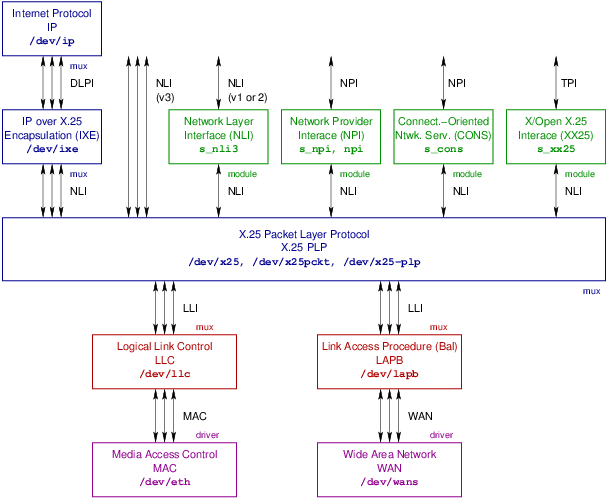
Figure C-1 illustrates the STREAMS multiplexing drivers, pseudo-device drivers, and pushable modules, and their organization.
C.1 NLI Multiplexing Driver
The NLI STREAMS multiplexing driver implements the X.25 Packet Layer Protocol (PLP) and provides the Network Layer Interface (NLI), Version 3, at it upper multiplex. Data links are linked beneath the driver at the lower multiplex. Linked Streams under OpenSS7 conform to the Data Link Provider Interface (DLPI),77 however, implemetnations based on SpiderX.25 might use some other interface at this level.78
Each Stream on the upper multiplex of the NLI multiplexing driver represents either a VC or a PVC. Each Stream on the lower multiplex of the NLI multiplexing driver represents a data link79 or subnetwork80 interface.81
Many Spider-based implementations of X.25 will call this multiplexing driver simply /dev/x25. AIXlink/X.25 calls the driver /dev/x25pckt.
The STREAMS /dev/x25-plp multiplexing pseudo-device driver is illustrated in Figure C-1.
C.2 NLI Conversion Module
Many Spider-based implementations of X.25 will call this multiplexing driver s_nli3.
The STREAMS s_nli3 pushable module is illustrated in Figure C-1.
C.3 NPI Conversion Module
Many Spider-based implementations of X.25 will call this pushable module s_npi. AIXlink/X.25 calls the module npi.
The STREAMS s_npi and npi pushable modules are illustrated in Figure C-1.
C.4 CONS Module
The STREAMS s_cons pushable module is illustrated in Figure C-1. 82
C.5 XX25 Module
The STREAMS s_xx25 pushable module is illustrated in Figure C-1.
C.6 IXE Multiplexing Driver
The IXE module provides Internet Protocol over X.25 Encapsulation (IXE) per
RFC 877 and RFC 1356. The protocol module provides an DL_IPX25 MAC
type DLPI Stream on the upper multiplex and a NLI Stream (or possibly an
NPI Stream) on the lower multiplex. Each lower multiplex Stream
represents an X.25 PVC or VC. Each upper multiiplex Stream represents a
DL_IPX25 connectionless data link Stream.
The STREAMS /dev/ixe multiplexing driver is illustrated in Figure C-1.
C.7 IP Multiplexing Driver
The STREAMS /dev/ip multiplexing pseudo-device driver is illustrated in Figure C-1.
Appendix D NLI Utilities
Most implementations of the NLI provides a number of utilities that are aimed at providing three or four capabilities as follows:
- Adjusting the tunable parameters associated with X.25 subnetwork attachments.
- Administating mapping data for PVC and NUI.
- Collecting and displaying statistics.
- Monitoring traffic flow on specific VCs.
nuimap(8) | Adjust the Network User Identity mapping in the X.25 packet layer. |
pvcmap(8) | Adjust the Permanent Virtual Circuit (PVC) mapping in the X.25 packet layer. |
vcstat(8) | Collect virtual circuit (VC) statistics from the X.25 packet layer. |
x25diags(8) | Convert X.25 diagnostics to messages and visa versa. |
x25file(8) | - |
x25info(8) | - |
x25netd(8) | The X.25 network daemon. |
x25route(8) | - |
x25stat(8) | Collect subnetwork and global X.25 statistics from the X.25 packet layer. |
x25trace(8) | Provide tracing on X.25 subnetworks. |
x25tune(8) | Adjust the tunable parameters associated with a subnetwork to the X.25 packet layer. |
D.1 nuimap - NUI mapping utility
The Network User Identity (NUI) mapping utility is responsible for
administration of the mapping of NUI values to the facilities that are
associated with a specific user value. The nuimap capability is
invoked when the call indicates that subcription to NUI override facility is
available and specifies a NUI for override. In this case, the NUI mapping table
is consulted to look up the specified NUI and determine the facilities to
override.
This utility is also described in the manual pages nuimap(8) and
nuimapconf(5). In this manual, see also NUI Mapping File.
Name
nuimap – NUI mapping utility
Synopsis
nuimap [options] [-G] -n netuid [-d device]
nuimap [options]  -D  -n netuid [-d device]
nuimap [options]  -M  [-d device] [-f filename]
nuimap [options]  -P  [-d device] [-f filename]
nuimap [options]  -Z  [-d device]
nuimap {-h|--help}
nuimap {-V|--version}
nuimap {-C|--copying}
Description
X.25 Packet Layer Protocol drivers supporting the NLI provide a mechanism for
mapping Network User Identities to a set of X.25 facilities that are subscribed
by the Network User Identity. nuimap provides a mechanism whereby the
user can modify these mappings, or system configuration scripts can load or dump
mappings to or from a file.
Facilities that can be subscribed on a network user basis are:
- Extended format packets.
- Local and remote packet sizes.
- Local and remote window sizes.
- Local and remote throughput classes.
- Subscription to closed user groups.
- Subscription to closed user groups with outgoing access.
- Subscription to basic format closed user groups.
- Subscription to extended format closed user groups.
The nuimap command can be used to retrieve or delete a specific
network user identity to facilities mapping (-G or -D
options, resp.); list or remove all network user identity to facilities mappings
(-M or -Z options); or load a set of network user identity to
facilities mappings from a file (-P option).
These capabilities of the nuimap command are supported by the
N_nuimsg, N_nuiput, N_nuidel, N_nuiget,
N_nuimget and N_nuireset input-output controls, see NUI_MSG Input-Output Controls.
See NUI Mapping File, for more information on supported facilities.
Options
The nuimap command accepts the following options:
Command Options
The following command options are mutually exclusive (except for -h, -V and -C which never cause an error when specified with another command option). If no command option is given, -G is assumed.
- -G, --get
Get the network user identity to facilities mapping belonging to the NUI having the same value as the argument to the -n option, netuid, for the specified or default device. The -n option and option argument, netuid, must be specified.
- -D, --delete
Delete the network user identity to facilities mapping belonging to the NUI having the same value as the argument to the -n option, netuid, for the specified or default device. The -n option and option argument, netuid, must be specified.
- -M, --list
List all the network user identity to facilities mappings for the specified or default device, and print them to stdout (or filename, when specified with the -f option), for the specified or default device.
- -P, --load
Load a set of network user identity to facilities mappings for the specified or default device, taking input from /etc/sysconfig/openss7/nuimapconf (or filename, when specified with the -f option), for the specified or default device.85
- -Z, --reset
Reset all network user identity to facilities mappings for the specified or default device.
- -h, --help
When this option is encountered, usage information is printed to stdout, option processing stops, and the program exists successfully without taking any further action.
- -V, --version
When this option is encountered, version information is printed to stdout, option processing stops, and the program exits successfully without taking any further action.
- -C, --copying
When this option is encountered, copying permissions are printed to stdout, option processing stops, and the program exits successfully without taking any further action.
Non-Command Options
The following non-command options cab be combined together and with any command option. Non-command options that are not necessary for the specified command option do not generate an error by mere combination.
- -f, --file filename
Specifies the filename from which to read (-P option) or write (-M option) configuration information.
This option and argument is optional. When the filename is not given and the -P option is specified, the values are read from /etc/sysconfig/openss7/nuimapconf;86 for the -M option, values are written to stdout.
If the filename is an absolute path (i.e. begins with ‘/’), then filename is assumed to be the exact path specified. Otherwise, the file required is assumed to be /etc/sysconfig/openss7/filename.87 See NUI Mapping File, for the format of the file.
- -n, --nui netuid
Specifies the specific Network User Identity, netnuid, that identifies a specific network user identity to faciltiies mapping to either be retrieved (option -G) or deleted (option -D). This option must be provided when the -G or -D command options are specified.
- -d, --device devname
Specifies the device, devname, to open when tuning. When unspecified, the default is /dev/x25. See also Devices, below.
- --dryrun
Execute the command (-G, -D, -M or -P) as a dry run. When this option is specified with the -D or -P option, the input is read and checked for validity, but the configuration is not written to the device when specified with the -G or -M option, information is read from the device, but configuration information is not output. The exit status and diagnostic output of the command still reflects the success or failure of the command.
- -q, --quiet
Suppresses normal output. This is the same as ‘--verbose=0’.
- --debug [level]
Increase or specify the debug verbosity level. The default debug level is zero (0). This option may be repeated. Level zero (0) corresponds to no debugging output.
- -v, --verbose [level]
Increase or specify the output verbosity level. The default output level is one (1). This option may be repeated. Level zero (0) corresponds to no normal output.
Diagnostics
An exit status of zero (0) indicates that the command was successful; one (1) indicates that an error occured and a diagnostic message is printed to stderr; two (2) indicates that the option or argument syntax was in error and a diagnostic message is printed to stderr.
The --quiet option suppresses the printing of normal output to stdout and diagnostic messages to stderr.
File Format
For the input file format, see NUI Mapping File.
Notices
On input, this implementation will handle fields that are separated by any whitespace (any number of blanks, horzontal tabs, new lines, carriage returns, vertical tabs, form feeds). On output, newlines are generated after fields.
Devices
- /dev/streams/clone/x25
- /dev/x25
The NPI device for X.25,
x25(4).
Files
- /etc/sysconfig/openss7/filename
The default directory location for configuration files used by this command.88
- /etc/sysconfig/openss7/nuimapconf
The default configuration file from which to read network user identity to facilities mappings for use with the -P option.
Bugs
nuimap has no known bugs.
See Also
Compatibility
The nuimap command is compatible with Spider X.25, and
implementations based on Spider X.25, such as AIXlink/X.25,
HP-UX, IRIS SX.25, PT X.25, RadiSys WAN, SBE
X.25, Solstice X.25, and others, with the following portability
considerations:
- A version of this command is provided by OpenSS7 for
compatibility with systems that require it. Neither this command nor the
xnetd(8)are recommended for configuration of the OpenSS7 subsystems. Use the SNMP agent instead. - Options -e, -n, -q, -v, -h,
-V, -C, and all long options, are specific to this
OpenSS7 implementation of
nuimapand will not be used by portable command scripts. - No other implementation documents printing the output to a file when a filename is specified with the -G command option. This is an enhancement of this implementation.
- No other implementation documents the -e, -n, -q, -v, -h, -V, and -C, options. They will not be used by portable command scripts.
- Options --help and --version are provided for compatibility with GNU coding standards (GNITS); --copying, OpenSS7 coding standards.
For additional compatibilty considerations, see NLI Compatibility and Porting.
Conformance
AIXlink/X.25, HP-UX, IRIS SX.25, PT X.25, RadiSys WAN, SBE X.25, Solstice X.25, documentation. See References.
History
nuimap first appeared in Spider X.25.
D.2 pvcmap - PVC mapping utility
The Permanent Virtual Circuit (PVC) mapping utility is responsible for administration of the mapping of PVC logical channel identifiers to the facilities that are associated with a specific channel that would normally be negotiated on call setup. These include: local and remote packet and window sizes.
This utility is also described in the manual pages pvcmap(8) and
pvcmapconf(5). In this manual, see also PVC Mapping File.
Name
pvcmap – PVC mapping utility
Synopsis
nuimap [options]  -G  [-s subnet] [-l lci] [-d device]
nuimap [options]  -D  [-s subnet] [-l lci] [-d device]
nuimap [options] [-M] [-d device] [-f filename]
nuimap [options]  -P  [-d device] [-f filename]
nuimap [options]  -Z  [-d device]
nuimap {-h|--help}
nuimap {-V|--version}
nuimap {-C|--copying}
Description
X.25 Packet Layer Protocol drivers upporting the NLI provide a mechanism for
attaching Permanent Virtual Circuits (PVC) for use by upper layer protocols.
pvcmap provides a mechanism whereby the administrator can modify the
local and remote packet and window sizes associated with PVC for each logical
channel and subnetwork. For each PVC logical channel on each subnetwork, the
following is specified:
- Local maximum packet size.
- Remote maximum packet size.
- Local maximum window size.
- Remote maximum window size.
The pvcmap command can be used to retrieve or delete the throughput
parameters specific to a logical channel within a subnetwork (-G or
-D options, resp.); list or remove all subnetwork and logical channel
mappings (-M or -Z options); or load a set of subnetwork and
logical channel mappings from a file (-P option).
The capabilities of the pvcmap command are supported by the
N_putpvcmap and N_getpvcmap intput-output controls,89 and provide an excellent example of
their use.
See PVC Mapping File, for more information on supported facilities.
Options
The pvcmap command accepts the following options:
Command Options
The following command options are mutually exclusive (except for -h, -V and -C which never cause an error when specified with another command option). If no command option is given, -G is assumed.
- -G, --get
Get the subnetwork and logical channel mapping belonging to the subnet having the same value as the argument to the -s option, and an lci the same value as the argument to the -l option, when provided, for the specified or default device. The -s option and option argument, subnet, must be specified.
- -D, --delete
Get the subnetwork and logical channel mapping belonging to the subnet having the same value as the argument to the -s option, and an lci the same value as the argument to the -l option, when provided, for the specified or default device. The -s option and option argument, subnet, must be specified.
- -M, --list
List all the subnetwork and logical channel mappings for the specified or default device, and print them to stdout (or filename, when specified with the -f option), for the specified or default device.
- -P, --load
Load a set of subnetwork and logical channel PVC mappings for the specified or default device, taking input from /etc/sysconfig/openss7/pvcmapconf (or filename, when specified with the -f option), for the specified or default device.90
- -Z, --reset
Reset all subnetwork and logical channel PVC mappings for the specified or default device.
- -h, --help
When this option is encountered, usage information is printed to stdout, option processing stops, and the program exists successfully without taking any further action.
- -V, --version
When this option is encountered, version information is printed to stdout, option processing stops, and the program exits successfully without taking any further action.
- -C, --copying
When this option is encountered, copying permissions are printed to stdout, option processing stops, and the program exits successfully without taking any further action.
Non-Command Options
The following non-command options cab be combined together and with any command option. Non-command options that are not necessary for the specified command option do not generate an error by mere combination.
- -f, --file filename
Specifies the filename from which to read (-P option) or write (-M option) configuration information.
This option and argument is optional. When the filename is not given and the -P option is specified, the values are read from /etc/sysconfig/openss7/pvcmapconf;91 for the -M option, values are written to stdout.
If the filename is an absolute path (i.e. begins with ‘/’), then filename is assumed to be the exact path specified. Otherwise, the file required is assumed to be /etc/sysconfig/openss7/filename.92 See PVC Mapping File, for the format of the file.
- -s, --subnet subnet
Specifies the subnetwork identifier, subnet, to which the PVC is attached. subnet is normally an alphabetical character starting at ‘A’ for the first subnetwork, ‘B’ for the second subnetwork, and so on. When not given, all subnetworks are assumed.
- -l, --lci lci
Specifies the logical channel identifier lci, to which the PVC corresponds. lci is normally an interger value between 1 and 4096. Zero (0) is not permitted. When not specified, any and all logical channels are assumed.
- -d, --device devname
Specifies the device, devname, to open when mapping. When unspecified, the default is /dev/x25. See also Devices, below.
- -n, --dryrun
Execute the command (-G, -D, -M or -P) as a dry run. When this option is specified with the -D or -P option, the input is read and checked for validity, but the configuration is not written to the device when specified with the -G or -M option, information is read from the device, but configuration information is not output. The exit status and diagnostic output of the command still reflects the success or failure of the command.
- -q, --quiet
Suppresses normal output. This is the same as ‘--verbose=0’.
- --debug [level]
Increase or specify the debug verbosity level. The default debug level is zero (0). This option may be repeated. Level zero (0) corresponds to no debugging output.
- -v, --verbose [level]
Increase or specify the output verbosity level. The default output level is one (1). This option may be repeated. Level zero (0) corresponds to no normal output.
Diagnostics
An exit status of zero (0) indicates that the command was successful; one (1) indicates that an error occured and a diagnostic message is printed to stderr; two (2) indicates that the option or argument syntax was in error and a diagnostic message is printed to stderr.
The --quiet option suppresses the printing of normal output to stdout and diagnostic messages to stderr.
File Format
For the input file format, see PVC Mapping File.
Notices
On input, this implementation will handle fields that are separated by any whitespace (any number of blanks, horzontal tabs, new lines, carriage returns, vertical tabs, form feeds). On output, newlines are generated after fields.
Devices
- /dev/streams/clone/x25
- /dev/x25
The NPI device for X.25,
x25(4).
Files
- /etc/sysconfig/openss7/filename
The default directory location for configuration files used by this command.93
- /etc/sysconfig/openss7/pvcmapconf
The default configuration file from which to read for subnetwork and logical channel PVC mappings for use with the -P option.
Bugs
pvcmap has no known bugs.
See Also
Compatibility
The nuimap command is compatible with Spider X.25, and
implementations based on Spider X.25, such as AIXlink/X.25,
HP-UX, IRIS SX.25, PT X.25, RadiSys WAN, SBE
X.25, Solstice X.25, and others, with the following portability
considerations:
- A version of this command is provided by OpenSS7 for
compatibility with systems that require it. Neither this command nor the
xnetd(8)are recommended for configuration of the OpenSS7 subsystems. Use the SNMP agent instead. - Options -e, -n, -q, -v, -h,
-V, -C, and all long options, are specific to this
OpenSS7 implementation of
nuimapand will not be used by portable command scripts. - No other implementation documents printing the output to a file when a filename is specified with the -G command option. This is an enhancement of this implementation.
- No other implementation documents the -e, -n, -q, -v, -h, -V, and -C, options. They will not be used by portable command scripts.
- Options --help and --version are provided for compatibility with GNU coding standards (GNITS); --copying, OpenSS7 coding standards.
For additional compatibilty considerations, see NLI Compatibility and Porting.
Conformance
AIXlink/X.25, HP-UX, IRIS SX.25, PT X.25, RadiSys WAN, SBE X.25, Solstice X.25, documentation. See References.
History
pvcmap first appeared in Spider X.25.
D.3 vcstat - VC statistics utility
Name
Synopsis
Description
Options
Usage
Diagnostics
Notices
Bugs
See Also
Compatibility
Conformance
History
D.4 x25diags - X.25 diagnostics utility
Name
Synopsis
Description
Options
Usage
Diagnostics
Notices
Bugs
See Also
Compatibility
Conformance
History
D.5 x25file - X.25 file utility
Name
Synopsis
Description
Options
Usage
Diagnostics
Notices
Bugs
See Also
Compatibility
Conformance
History
D.6 x25info - X.25 information untility
Name
Synopsis
Description
Options
Usage
Diagnostics
Notices
Bugs
See Also
Compatibility
Conformance
History
D.7 x25netd - X.25 network daemon
Name
Synopsis
Description
Options
Usage
Diagnostics
Notices
Bugs
See Also
Compatibility
Conformance
History
D.8 x25route - X.25 routing control
Name
Synopsis
Description
Options
Usage
Diagnostics
Notices
Bugs
See Also
Compatibility
Conformance
History
D.9 x25stat - X.25 statistics utility
Name
Synopsis
Description
Options
Usage
Diagnostics
Notices
Bugs
See Also
Compatibility
Conformance
History
D.10 x25trace - X.25 trace utility
Name
Synopsis
Description
Options
Usage
Diagnostics
Notices
Bugs
See Also
Compatibility
Conformance
History
D.11 x25tune - X.25 tuning utility
Name
Synopsis
Description
Options
Usage
Diagnostics
Notices
Bugs
See Also
Compatibility
Conformance
History
Appendix E NLI File Formats
E.1 LAPB Template File
Name
lapbtemplate — Link Access Protocol (Balanced) File Format
Description
The lapbtemplate describes the file format for input to the
lltune(8) command for LAPB class subnetworks. The file format
consists of a number of parameter values, one per line, formatted as described
below. Each parameter value is described using its line number in the file, a
parameter name, and a description of the format of the value. Only the value
appears in the file, each value on a line by itself, one value per line.
Each of the LAPB configuration parameters correspons to the member and values
of the lapb_tune structure, that is carried in a lapb_tnioc
structure by the L_LAPBTUNE input-output control.
These protocol parameters, and the default values that exist when tuning has not been applied to a newly created LAPB subnetwork, correspond directly to the protocol parameters and defaults in ISO/IEC 7776, ITU-T Rec. X.25 and X.75.
Format
The LAPB template consists of 16 to 18 lines containing the following configuration information:
- N2_VAL is the maximum number of times that a protocol data unit (PDU) is set following the expiry of the acknowlegement timer, the P-bit timer, or the reject timer. It also limits the number of times an RR with the P-bit set is sent when remote busy is true and the busy timer expires.
- T1_VAL is the time during which the LAPB expects to receive an acknowledgement to an outstanding I-PDU or an expected response to a sent UI-PDU. The value is in units of 0.1 seconds (deciseconds).
- TPF_VAL is the time during which the LAPB expectes to receive a PDU with the F-bit set to 1 in response to a command with the P-bit set to 1. The value should be less than the acknowledgement timer. The value is in units of 0.1 seconds (deciseconds).
- TREJ_VAL is the time interval during which the LAPB expects to receive a reply to a sent REJ DPU. The value is in units of 0.1 seconds (deciseconds).
- TBUSY_VAL is the time interval during which the LAPB waits for an indication of the clearance of a busy condition at the other LAPB. The value is in units of 0.1 seconds (deciseconds).
- IDLE_VAL is the time interval during which the LAPB expects to receive a PDU from the other LAPB. If it expires then the P/F cycle is intiated which may result in link disconnection. The value is in units of 0.1 seconds (decicseconds).
- ACK_DELAY is the maximum delay in 0.1 second units before transmitting a delayed RR. This must be considerably less that the acknowledgement timer value, T1_VAL.
- NOTACK_MAX is the maximuum number of unacknowledged receive I PDUs before the RR acknowledging them all must be sent.
- LOC_WIND is the number of unacknowledged I PDUs that may be sent.
- LOC_PROBE is the position before the window is closed at which an I PDU is sent with the P-bit set to solicit an acknowledgement from the receiver.
- MAX_I_LEN is the maximum isze of a LAPB I-frame. LAPB requires all incoming I-frames above a certain size to be rejected by a FRMR. This parameter specifies the maximum size. It is constructured as the sum of the maximum X.25 data size, the X.25 protocol length and the LAPB protocol length.
- IGN_UA_ERROR define whether or not to ignore any UA frams received, when the connection is in ERROR state. The value is ‘1’ for true and ‘0’ for false. The defalt value is false.
- FRMR_FRMR_ERROR defines whether or not to re-transmit a frame
reject if a frame reject is received, when the connection is in
ERRORstate. The value is ‘1’ for true and ‘0’ for false. The default value is false. - FRMR_INVRSP_ERROR defines whether or not to transmit a frame
reject if an invalid frame response is received, when the connection is in
ERRORstate. The value is ‘1’ for true and ‘0’ for false. The default value is false. - SFRAME_PBIT defines whether or not to send a frame reject if an S-frame is received without the P-bit set. The value is ‘1’ for truea nd ‘0’ for false. The default value is false.
- NO_DM_ADM defines whether or not to send a
DMon entry toADMstate after an N2 count expiry. The value is ‘1’ for true and ‘0’ for false. The default value is false.
The following two fields are optional extensions:
- IGN_DM_ERROR defines whether or not to ignore DM frames received,
when the connection is in
ERRORstate. The value is ‘1’ for true and ‘0’ for false. The default value is false. - SABM_IN_X32 defines the action to take when a SABM is received in X.32 setup. The value is ‘1’ for true and ‘0’ for false. The default value is false.
The last two fields (‘17’ and ‘18’) are enhancements.
Files
Files following this format are normally kept in the /etc/sysconfig/openss7/template/ directory.94
See Also
Compatibility
The lapbtemplate file format is compatible with Spider X.25, and implementations based on Spider X.25, such as AIXlink/X.25, HP-UX, IRIS SX.25, Solstice X.25, PT X.25, SBE X.25, with the following compatibility considerations:
- — Most implementations only define the first 16 lines. This implementation defines 18 lines, where the first 16 lines are compatible with other implementations and the last additional two lines are optional.
- — PT X.25 documents the SABM_IN_X32 LAPB template field but not the IGN_DM_ERROR LAPB template field. Solstice X.25 and IRIS SX.25 do not document either the IGN_DM_ERROR nor SABM_IN_X32 LAPB template fields.
For additional compatiblity infromation see, lapb(4), and
STREAMS(9).
Conformance
AIXlink/X.25, HP-UX, IRIS SX.25, Solstice X.25, PT X.25, SBE X.25, documentation.
History
The lapbtemplate file format first appeared in Spider X.25.
E.2 LLC2 Template File
Name
llc2template — Logical Link Control Type 2 File Format
Description
The llc2template describes the file format for input to the
lltune(8) command for LLC2 class subnetworks. The file format
consists of a number of parameter values, one per line, formatted as described
below. Each parameter value is described using its line number in the file, a
parameter name, and a description of the format of the value. Only the value
appears in the file, each value on a line by itself, one value per line.
Each of the LLC2 configuration parameters corresponds to the member and values
of the llc2_tune structure, that is carried in a llc2_tnioc
structure by the L_LLC2TUNE input-output control.
These protocol parameters, and the default values that exist when tuning has not been applied to a newly created LLC2 subnetwork, correspond directly to the protocol parameters and defaults in ISO/IEC 8802-2:1998.
Format
The LLC2 template consists of 14 lines containing the following configuration information.
- N2_VAL is the maximum number of times that a Protocol Data Unit (PDU) is sent following the expiry of the acknowledgement timer, the P-bit timer, or the reject timer. This parameter also limits the number of times an RR is sent with the P-bit set when remote busy is true and the busy timer expires.
- T1_VAL is the time interval during which the LLC2 expects to receive an acknowledgement to an outstanding I-PDU or an expected response to a sent UI-PDU. The value is in units of 0.1 seconds.
- TPF_VAL is the time during which the LLC2 expects to receive a PDU with the F-bit set to 1 in response to a command with the P-bit set to 1. The value should be less than that specified for the akcnowledgement timer. The value is in units of 0.1 seconds.
- TREJ_VAL is the time interval during which the LLC2 expects to receive a reply to a sent REJ PDU. The value is in units of 0.1 seconds.
- TBUSY_VAL is the timer interval during which the LLC2 waits for an indication of the clearance of busy condition at the other LLC2. The value is in units of 0.1 seconds.
- TIDLE_VAL is the time interval during which the LLC2 expects to receive a PDU from the other LLC2. The value is in units of 0.1 seconds.
- ACK_DELAY is the RR delay time. This is the time interval for which the LLC2 will withhold acknowledgements of unacknowledged received I-PDUs. The value is in units of 0.1 seconds.
- NOTACK_MAX is the maximum number of unacknowledged received I-frames.
- TX_WINDOW is the transmit window (if no XID received).
- TX_PROBE is the position before the window is closed at which an I-PDU is sent with the P-bit set to solicit an acknowledgement from the receiver.
- MAX_I_LEN
is the maximum size of an LLC2 I-frame. LLC2 requires all incoming I-frames
above a certain size to be rejected by a FRMR. This parameter specifies the
maximum size of data that may bereceived starint from the LLC2 protocol header.
In an X.25 network, it is constructed as (maximum X.25 data length + X.25 protool header length + LLC2 protocol header length). In an SNA network, it is constructed as (maximum SNA data length + SNA request header length + SNA transmission header length + LLC2 protocol header length).
- XID_WINDOW is the XID window size (receive window), when the remote window size is unknown or zero.
- XID_NDUP is the duplicate MAC XID count (0 means no test).
- XID_TDUP is the duplicate MAC XID time. The value is in units of 0.1 seconds.
Files
Files following this format are normally kept in the /etc/sysconfig/openss7/template/ directory.95
See Also
Compatibility
The llc2template file format is compatible with Spider X.25, and implementations based on Spider X.25, such as AIXlink/X.25, HP-UX, IRIS SX.25, Solstice X.25, PT X.25, SBE X.25, with the following compatibility considerations:
- — PT X.25 does not support LLC2. OpenSS7 supports LLC2 in support of XOL and porting applications from AIXlink/X.25, Solstice X.25, HP-UX, IRIS SX.25, VxWorks, pSOS, SpiderX, and many other implementations based on SpiderX.25 support LLC2. Portable X.25 and XOL applications will use OpenSS7 instead of PT X.25.
For additional compatibiltiy information see, llc2(4), and
STREAMS(9).
Conformance
AIXlink/X.25, HP-UX, IRIS SX.25, Solstice X.25, PT X.25, SBE X.25, documentation.
History
The llc2template file format first appeared in Spider X.25.
E.3 NUI Mapping File
Name
Description
Format
Files
See Also
Compatibility
History
E.4 PAD Entries File
Name
Description
Format
Files
See Also
Compatibility
History
E.5 X.25 Template File
Name
x25template — X.25 Subnetwork File Format
Description
The x25template describes the file format for input to the
x25tune(8) command for X.25 subnetworks. The file format consists of
a number of parameter values, one per line, formated as described below. Each
parameter value is described using its line number in the file, a parameter
name, and a description of the format of the value. Only the value appears in
the file, each value on a line by itself, one value per line.
Each of the X.25 configuration parameters corresponds to the member and values
of the wlcfg structure by the N_snconfig and N_snread
input-output controls.
.
These protocol parameters, and the default values that exist when tuning has
not been applied to a newly created X.25 subnetwork, correspond directly to the
protocol parameters and defaults in ISO/IEC 8208 , ITU-T Rec.
X.25 and X.75.
Format
The X.25 subnetwork template consists of 76 or more lines containing the following configuration information:
- NET_MODE
determines the various characteristics of the network protocol. Valid values
are integers, as specified below, that refers to the networks listed:
1 - X25_LLC 10 - TRANSPAC 19 - DCS 2 - X25_88 11 - TYMNET 20 - TELEPAC 3 - X25_84 12 - DATEX_P 21 - F_DATAPAC 4 - X25_80 13 - DDX_P 22 - FINPAC 5 - PSS 14 - VENUS_P 23 - PACNET 6 - AUSTPAC 15 - ACCUNET 24 - LUXPAC 7 - DATAPAC 16 - ITAPAC 25 - X25_CIRCUIT 8 - DDN 17 - DATAPAK 9 - TELENET 18 - DATANET - X25_VERSION
determines the version of the X.25 protocol that is being used over the
network. Valid values are integers, as specified below. Note that a
NET_MODE of X25_LLC will override any value in this field to 1984
(or later).
80 - indicates 1980 84 - indicates 1984 88 - indicates 1988 1980 - indicates 1980 1984 - indicates 1984 1988 - indicates 1988 1992 - indicates 1992 1996 - indicates 1996 2000 - indicates 2000 2004 - indicates 2004 YYYY - indicates YYYY - L3PLPMODE
indicates the DTE/DCE nature of the link. Valid value are integers, as
specified below. Note that DXE operation is per ISO
8208.96
0 - indicates DCE 1 - indicates DTE 2 - indicates DXE - LPC is the lowest LCI for Permanent Virtual Circuits (PVC). LPC and HPC define the range of LCI that are assigned to PVC. This range cannot overlap with the other defined ranges. Setting this value to zero and HPC to zero specifies that there are no PVC. Valid values contain 3 hexadecimal digits ‘000’ through ‘FFF’. Leading zeros are optional.
- HPC is the highest LCI for PVC. LPC and HPC define the range of LCI that are assigned to PVC. This range cannot overlap with the other defined ranges. LPC and HPC set to zero means no PVC. Valid values contain 3 hexadecimal digits ‘000’ through ‘FFF’. Leading zeros are optional.
- LIC is the lowest incoming (IC) VC. LIC and HIC define the range of LCI that are assigned to incoming call circuits. This range cannot overlap with the other defined ranges. LIC and HIC zero means no IC VC. Use 3 hexadecimal digits ‘000’ through ‘FFF’. Leading zeros are optional.
- HIC is the highest IC VC. LIC and HIC define the range of LCI that are assigned to incoming call circuits. This range cannot overlap. LIC and HIC zero means no IC VC. Use 3 hexadecimal digits ‘000’ through ‘FFF’. Leading zeros are optional.
- LTC is the lowest two-way (TW) VC. LTC and HTC define the LCI that are assigned to two-way call circuits. This range cannot overlap. LTC and HTC zero means no TW VC. Use 3 hexadecimal digits ‘000’ through ‘FFF’. Leading zeros are optional.
- HTC is the highest TW VC. LTC and HTC define the LCI that are assigned to two-way call circuits. This range cannot overlap. LTC and HTC zero means no TW VC. Use 3 hexadecimal digits ‘000’ through ‘FFF’. Leading zeros are optional. j
- LOC is the lowest outgoing (OG) VC. LOC and HOC define the range assigned to outgoing call circuits. This range cannot overlap. LOC and HOC zero means no OG VC. Use 3 hexadecimal digits ‘000’ through ‘FFF’. Leading zeros are optional.
- HOC is the highest OG VC. LOC and HOC define the range assigned to outgoing call circuits. This range cannot overlap. LOC and HOC zero means no OG VC. Use 3 hexadecimal digits ‘000’ through ‘FFF’. Leading zeros are optional. j
- THISGFI
indicates which Modulo operates on the network. It can have one of three
integer values.
8 - Modulo 8 3 bits 128 - Modulo 128 7 bits 32768 - Modulo 32768 15 bits 2147483648 - Modulo 2147483648 31 bits - LOCMAXPKTSIZE
is the maximum acceptable packet size for sent packets.
The value is the logarithm, base two, of the packet size. Valid values are in
the range from 7 to 12, signifying a size of 128 to 4096 in powers of two.
The default value is 7 (or 128 octets).
The local maximum packet size and remote maximum packet size should be the
same.
The value should be less than the maximum LAPB I-frame size, N2, see
lltune(8). - REMMAXPKTSIZE
is the maximum acceptable packet size for received packets.
The value is the logarithm, base two, of the packet size. Valid values are in
the range from 7 to 12, signifying a size of 128 to 4096 in powers of two.
The default value is 7 (or 128 octets).
The local maximum packet size and remote maximum packet size should be the
same.
The value should be less than the maximum LAPB I-frame size, N2, see
lltune(8). - LOCDEFPKTSIZE is the default packet size for sent packets. The value is the logarithm, base two, of the packet size. Valid values are in the range from 7 to 12, signifying a size of 128 to 4096 in powers of two. The local default packet size and remote maximum packet size should be the same. The default value is 7 (or 128 octets). When specified as 7 (128 octets), negotiation of the non-standard default packet size facility will neither be initiated nor rejected.
- REMDEFPKTSIZE is the default packet size for received packets. The value is the logarithm, base two, of the packet size. Valid values are in the range from 7 to 12, signifying a size of 128 to 4096 in powers of two. The local default packet size and remote maximum packet size should be the same. The default value is 7 (or 128 octets). When specified as 7 (128 octets), negotiation of the non-standard default packet size facility will neither be initiated nor rejected.
- LOCMAXWSIZE The value must be greater than one and less than the modulus value. The default value is 2 for Modulo 8 or Modulo 128; and 128 for Modulo 32768.
- REMMAXWSIZE The value must be greater than one and less than the modulus value. The default value is 2 for Modulo 8 or Modulo 128; and 128 for Modulo 32768.
- LOCDEFWSIZE The value must be greater than one and less than the modulus value. The default value is 2 for Modulo 8 or Modulo 128; and 128 for Modulo 32768. When specified as 2 for Modulo 8 or Modulo 128, or 128 for Modulo 32768, the non-standard default window size facility will neither be initiated nor rejected.
- REMDEFWSIZE The value must be greater than one and less than the modulus value. The default value is 2 for Modulo 8 or Modulo 128; and 128 for Modulo 32768. When specified as 2 for Modulo 8 or Modulo 128, or 128 for Modulo 32768, the non-standard default window size facility will neither be initiated nor rejected.
- MAXNSDULEN
- ACKDELAY
- T20VALUE
(Restart Request Response Timer)
is the time period that the DTE will await a restart confirmation or restart
indication following issuing a request request.
The timeout value should not be less than 180 seconds.
The value is in integral units of deciseconds (0.1 seconds), so an interval of
180 seconds is specified as 1800 (deciseconds).
T10VALUE (Restart Indication Response Timer) is the equivalient timer for the DCE, and defines the time period that the DCE will wait for a restart confirmation or restart request after having issued a restart indication. The timeout value is a minimum of 60 seconds. The value is in integral units of deciseconds (0.1 seconds), so an interval of 60 seconds is specified as 600 (deciseconds).
- T21VALUE
(Call Request Response Timer)
is the time period that the DTE will await a call connected or clear
indication having issued a call request.
The timeout value should not be less than 200 seconds.
The value is in integral units of deciseconds (0.1 seconds), so an interval of
200 seconds is specified as 2000 (deciseconds).
T11VALUE (Incoming Call Response Timer) is the equivalent timer for the DCE, and defines the time period that the DCE will wait for a call accepted, clear request or call request after having issued an incoming call. The timeout value is a minimum of 180 seconds. The timeout value is a minimum of 60 seconds. The value is in integral units of deciseconds (0.1 seconds), so an interval of 180 seconds is specified as 1800 (deciseconds).
- T22VALUE
(Reset Request Response Timer)
is the time period that the DTE will await a reset confirmation or reset
indication having issued a reset request.
The timeout value should not be less than 180 seconds.
The value is in integral units of deciseconds (0.1 seconds), so an interval of
180 seconds is specified as 1800 (deciseconds).
T12VALUE (Reset Indication Response Timer) is the equivalent timer for the DCE, and defines the time period that the DCE will wait for a reset confirmation or request request after having issued a reset indication. The timeout value is a minimum of 60 seconds. The timeout value is a minimum of 60 seconds. The value is in integral units of deciseconds (0.1 seconds), so an interval of 60 seconds is specified as 600 (deciseconds).
- T23VALUE
(Clear Request Response Timer)
is the time period that the DTE will await a clear confirmation or clear
indication having issued a clear request.
The timeout value should not be less than 180 seconds.
The value is in integral units of deciseconds (0.1 seconds), so an interval of
180 seconds is specified as 1800 (deciseconds).
T13VALUE (Clear Indication Response Timer) is the equivalent timer for the DCE, and defines the time period that the DCE will wait for a clear confirmation or clear request following issuing a clear indication. The timeout value is a minimum of 60 seconds. The value is in integral units of deciseconds (0.1 seconds), so an interval of 60 seconds is specified as 600 (deciseconds).
- TVALUE
- T25VALUE
(Window Rotation Timer)
is the time period that the DTE will await acknowledgement of all outstanding
data packets having trasnmitted the last available data packet or the window
is rotated.
The timeout value should not be less than 200 seconds.
The value is in integral units of deciseconds (0.1 seconds), so an interval of
200 seconds is specified as 2000 (deciseconds).
Note that this T25 timer is only needed if the associated procedure97 is used.
- T26VALUE (Interrupt Response Timer) is the time period that the DTE will await an interrupt confirmation having issued an interrupt. The timeout value should not be less than 180 seconds. The value is in integral units of deciseconds (0.1 seconds), so an interval of 180 seconds is specified as 1800 (deciseconds).
- IDLEVALUE
- CONNECTVALUE
- R20VALUE (Restart Request Retransmission Count) is the number of times that a restart request will be re-issued, and T20 restarted, upon expiry of timer T20. This value has a default of 1 and a minimum of 1.
- R22VALUE (Reset Request Retransmission Count) is the number of times that a reset request will be re-issued, and T22 restarted, upon expiry of timer T22. This value has a default of 1 and a minimum of 1.
- R23VALUE (Clear Request Retransmission Count) is the number of times that a clear request will be re-issued, and T23 retstarted, upon expiry of timer T23. This value has a default of 1 and a minimum of 1.
- LOCALDELAY
- ACCESSDELAY
- LOCMAXTHCLASS
is the local maximum throughput class.
The value is an integer number from 3 to 44.
Basic ISO 8208 throughput classes can have a value from 3 to 16, corresponding to throughputs between 75 and 192,000 bits/s, listed in Table 20a of ISO/IEC 8208:2000, or Extended ISO 8208 throughput classes can have a value from 3 through 44, corresponding to throughputs between 75 and 2,048,000 bits/s, listed in Table 20b of ISO/EIC 8208:2000.98
- REMMAXTHCLASS
is the remote maximum throughput class.
The value is an integer number from 3 to 44.
Basic ISO 8208 throughput classes can have a value from 3 to 16, corresponding to throughputs between 75 and 192,000 bits/s, listed in Table 20a of ISO/IEC 8208:2000, or Extended ISO 8208 throughput classes can have a value from 3 through 44, corresponding to throughputs between 75 and 2,048,000 bits/s, listed in Table 20b of ISO/EIC 8208:2000.99
- LOCDEFTHCLASS
is the local default throughput class.
The value is an integer number from 3 to 44.
Basic ISO 8208 throughput classes can have a value from 3 to 16, corresponding to throughputs between 75 and 192,000 bits/s, listed in Table 20a of ISO/IEC 8208:2000, or Extended ISO 8208 throughput classes can have a value from 3 through 44, corresponding to throughputs between 75 and 2,048,000 bits/s, listed in Table 20b of ISO/EIC 8208:2000.100
- REMDEFTHCLASS
is the remote default throughput class.
The value is an integer number from 3 to 44.
Basic ISO 8208 throughput classes can have a value from 3 to 16, corresponding to throughputs between 75 and 192,000 bits/s, listed in Table 20a of ISO/IEC 8208:2000, or Extended ISO 8208 throughput classes can have a value from 3 through 44, corresponding to throughputs between 75 and 2,048,000 bits/s, listed in Table 20b of ISO/EIC 8208:2000.101
- LOCMINTHCLASS
is the local minimum throughput class.
The value is an integer number from 3 to 44.
Basic ISO 8208 throughput classes can have a value from 3 to 16, corresponding to throughputs between 75 and 192,000 bits/s, listed in Table 20a of ISO/IEC 8208:2000, or Extended ISO 8208 throughput classes can have a value from 3 through 44, corresponding to throughputs between 75 and 2,048,000 bits/s, listed in Table 20b of ISO/EIC 8208:2000.102
- REMMINTHCLASS
is the remote minimum throughput class.
The value is an integer number from 3 to 44.
Basic ISO 8208 throughput classes can have a value from 3 to 16, corresponding to throughputs between 75 and 192,000 bits/s, listed in Table 20a of ISO/IEC 8208:2000, or Extended ISO 8208 throughput classes can have a value from 3 through 44, corresponding to throughputs between 75 and 2,048,000 bits/s, listed in Table 20b of ISO/EIC 8208:2000.103
- SUB_CUG (Closed User Group) is the index to the closed user group selected for the virtual call in the form of two to four decimal digits. Indexes to the close user group at different DXE interfaces may be different. The value is ‘Y’ for use and ‘N’ for non-use.
- SUB_PREF (Preferential Closed User Group). When the DTE belongs to more than one closed user group, a preferential closed user group must be specified. The value is ‘Y’ for use and ‘N’ for non-use.
- SUB_CUGOA (Closed User Group with Outgoing Access) is the index to the closed user group selected for the virtual call in the form of two to four decimal digits. Indexes to the close user group at different DXE interfaces may be different. The value is ‘Y’ for use and ‘N’ for non-use.
- SUB_CUGIA (Closed User Group with Incoming Access) is the index to the closed user group selected for the virtual call in the form of two to four decimal digits. Indexes to the close user group at different DXE interfaces may be different. The value is ‘Y’ for use and ‘N’ for non-use.
- CUG_FORMAT (Number of Closed User Groups Subscribed) defines the maximum number of closed user groups to which the DTE is subscribed. The value is in the range 0 to 100 for basic and in the range 101 to 10000 for extended. The value is ‘Y’ for use and ‘N’ for non-use.
- BAR_CUG_IN (Closed User Group Incoming Calls Barred) is a user option that bars incoming calls containing the closed user group facility. The value is ‘Y’ for use and ‘N’ for non-use.
- SUB_EXTENDED (Extended Call Packets) The value is ‘Y’ for use and ‘N’ for non-use.
- BAR_EXTENDED (Extended Call Packets Barred) is a user option that bars incoming calls containing flow control negotiation facilities. The value is ‘Y’ for use and ‘N’ for non-use.
- SUB_FSELECT (Fast Select Acceptance) is an optional user facility agreed for a period of time. This user facility, if subscribed to, authorizes the DCE to transmit to the DTE incoming calls that request the fast select facility. In the absence of this facility, the DCE will not transmit to the DTE incoming calls that request the fast select facility. This parameter defines whether the DTE accepts calls with a fast select facility requesting no restriction on response. The value is ‘Y’ for use and ‘N’ for non-use.
- SUB_FSRRESP (Fast Select Acceptance) is an optional user facility agreed for a period of time. This user facility, if subscribed to, authorizes the DCE to transmit to the DTE incoming calls that request the fast select facility. In the absence of this facility, the DCE will not transmit to the DTE incoming calls that request the fast select facility. This parameter defines whether the DTE accepts calls with a fast select facility requesting restriction on response. The value is ‘Y’ for use and ‘N’ for non-use.
- SUB_REVCHARGE (Reverse Charging Acceptance) is an optional user facility agree for a period of time for virtual calls. This user facility, if subscribed to, authorizes the DCE to transmit to the DTE incoming calls that request the reverse charging facility. In the absence of this facility, the DCE will not transmit to the DTE incoming calls that request the reverse charging facility. The value is ‘Y’ for use and ‘N’ for non-use.
- SUB_LOC_CHG_PREV (Local Charging Prevention) is an optional user faciltiy agreed for a period of time for virtual calls. This user facility, if subscribed to, authorizes the DCE to prevent the establishment of virtual calls that the suscriber must pay for by: a) not transmitting to the DTE incoming calls that request the reverse charging facility; and, b) ensuring that the charges are made to another party whether a call is requested by the DTE. When the party to be changed has not been established for a call request, the DCE that receives the call request packet will apply reverse charging to this call. The value is ‘Y’ for use and ‘N’ for non-use.
- BAR_INCALL (Incoming Calls Barred) determines whether the optional user facility is agreed for a period of time. This facility applies to all logical channels used at the DTE/DCE interface for virtual calls. This user facility, if subscribed to, prevents incoming virtual calls from being presented to the DTE. The DTE may originate outgoing virtual calls. Logical chanels used for virtual calls retain their full duplex capability. Some administratoins may provide a capability that allows a virtual call to be presented to the DTE only in cases where the called DTE address is the address of the calling DTE. The value is ‘Y’ for use and ‘N’ for non-use.
- BAR_OUTCALL (Outgoing Calls Barred) determines whether the optional user facilty is agreed for a period of time. This facility applies to all logical channels used at the DTE/DCE interface for virtual calls. This user facility, if subscribed to, prevents the DCE from accepting outgoing virtual calls from the DTE. The DTE may receive incoming virtual calls. Logical channels used for virtual calls retain their full duplex capability. The value is ‘Y’ for use and ‘N’ for non-use.
- SUB_TOA_NPI_FMT (TOA/NPI Address) is an optional user facility agreed for a period of time for virtual calls. When this facility is subscribed to, the DCE and DTE shall transmit call set-up and clearing packets only using the TOA/NPI address format. In this case, addresses in facilities are also in TOA/NPI format. The value is ‘Y’ for use and ‘N’ for non-use.
- BAR_TOA_NPI_FMT (TOA/NPI Address Incoming Calls Barred) is a user option that bars incoming calls containing TOA/NPI addresses. The value is ‘Y’ for use and ‘N’ for non-use.
- SUB_NUI_OVERRIDE (NUI Override) is an optional user facility agreed for a period of time for virtual calls. When this facility is subscribed to, one or more network user identifiers are also agreed for a period of time. Associated with each network user identifier is a set of subscription-time optional user facilities. When one of these network user identifiers is provdied in a call request packet by means of the NUI selection facility, the set of subscription-time optional user facilities associated with it overrides the facilities that apply to the interface. This override does not apply to other existing calls or subsequent calls on the interface. It remains in effect for the duration of the particular call to which it applies. The value is ‘Y’ for use and ‘N’ for non-use.
- ACC_NODIAG The value is ‘Y’ for use and ‘N’ for non-use.
- USE_DIAG The value is ‘Y’ for use and ‘N’ for non-use.
- CCITT_CLEAR_LEN The value is ‘Y’ for use and ‘N’ for non-use.
- BAR_DIAG The value is ‘Y’ for use and ‘N’ for non-use.
- DISC_NS_DIAG The value is ‘Y’ for use and ‘N’ for non-use.
- ACC_HEX_ADD The value is ‘Y’ for use and ‘N’ for non-use.
- BAR_NONPRIV_LISTEN The value is ‘Y’ for use and ‘N’ for non-use.
- INTL_ADDR_REGION
- INTL_PRIORITISED The value is ‘Y’ for use and ‘N’ for non-use.
- DNIC The value is 4 hexadecimal digits.
- PRTY_ENCODE_CONTROL The value is an integer decimal number.
- PRTY_PKT_FORCED_VAL The value is an integer decimal number.
- SRC_ADDR_CONTROL The value is an integer decimal number.
- DBIT_ACCEPT_IND
0 - leave the D-bit set and pass the packet on, 1 - zero the D-bit and pass the packet on, and, 2 - reset the call. - DBIT_ACCEPT_OUT
0 - leave the D-bit set and pass the packet on, 1 - zero the D-bit and pass the packet on, and, 2 - reset the call. - DBIT_DATA_IN
0 - leave the D-bit set and pass the packet on, 1 - zero the D-bit and pass the packet on, and, 2 - reset the call. - DBIT_DATA_OUT
defines the action to taken when the local user sends a data packet with the
D-bit set, but the remote party has not indicated D-bit support. It can have
one of the following values:
0 - leave the D-bit set and pass the packet on, 1 - zero the D-bit and pass the packet on, and, 2 - reset the call.
The following are optional extension parameters:
- THCLASS_NEG_TO_DEF The value is ‘Y’ for use and ‘N’ for non-use.
- THCLASS_TYPE The value is an integer decimal number.
- TH_WMAP The value is 16 decimal numbers, 0 to 255, separated by ‘.’.
- TH_PMAP The value is 16 decimal numbers, 0 to 255, separated by ‘.’.
Extensions parameters can be enabled using the -e flag to
x25tune(8), and specifying additional lines in the template.
OpenSS7 defines extension parameters primarily to support
facilities of ISO/IEC 8208:2000104 not provided for
according to the documentation of other, older implementations.
The following parameters, therefore, are the extensions specific to the OpenSS7 implementation:
- T24VALUE
(Window Status Transmission Timer)
is the time period that the DTE will wait without sending a window status
packet (a packet with a P(R): RR, RNR, DATA or REJECT).
The timeout value should not be less than 180 seconds.
The value is in integral units of deciseconds (0.1 seconds), so an interval of
180 seconds is specified as 1800 (deciseconds).
Note that this T24 timer is only needed if the associated procedure105 is used.
- T27VALUE
(Reject Response Timer)
is the time period that the DTE will await a data retransmission after
issuing a reject.
The timeout value should not be less than 60 seconds.
The value is in integral units of deciseconds (0.1 seconds), so an interval of
60 seconds is specified as 600 (deciseconds).
Note that this T27 timer is only needed if the associated procedure106 is used.
- T28VALUE
(Registration Request Response Timer)
is the time period that the DTE will await a registration confirmation or
diagnostic packet having issued a registration request.
The timeout value should not be less than 300 seconds.
The value is in integral units of deciseconds (0.1 seconds), so an interval of
300 seconds is specified as 3000 (deciseconds).
Note that this T28 timer is only needed if the associated procedure107 is used.
- R25VALUE
(Data Packet Retransmission Count) is the number of times that a data packet
will be retransmitted, and T25 restarted, upon expiry of T25.
This value has a default of 0.
A value of zero (0) conveys that no retransmission will be performed.
Note that R25 is only needed if the associated procedure108 is used.
- R27VALUE
(Reject Retransmission Count) is the number of times that a reject is
reissued, and T27 restarted, upon expiry of T27.
This value has a default of 0.
A value of zero (0) conveys that no reissuing will be performed.
Note that R27 is only needed if the associated procedure109 is used.
- R28VALUE
(Registration Request Retransmission Count) is the number of times a
registration request will be reissued, and T28 restarted, upon expiry of T28.
This value has a default of 1.
A value of zero (0) conveys that no reissuing will be performed.
Note that R28 is only needed if the associated procedure110 is used.
Files
Files following this format are normally kept in the /etc/sysconfig/openss7/template/ directory.111
See Also
Compatibility
The x25template file format is compatible with Spider X.25, and implementations based on Spider X.25, such as AIXlink/X.25, HP-UX, IRIS SX.25, Solstice X.25, PT X.25, SBE X.25, with the following compatibility considerations:
- — OpenSS7 fairly much ignores the setting of the NET_MODE and X25_VERSION parameters. The OpenSS7 implementation of X.25 is based on ISO/IEC 8208:2000 (Edition 4), 112 which is compatible with ITU-T Recommendation X.25 of 1996,113 (the lastest current release of the standard) and is backward compatible with ISO/IEC 8208 editions 1, 2 and 3; as well as ITU-T Recommendation X.25 for 1993, 1988, 1984 and 1980.
- — No other implementation documents support for Modulo 32768. OpenSS7 supports Modulo 32768 per ISO/IEC 8208,114 X.25115 and X.75.116
- — No other implementation documents support for a true T24 timer. OpenSS7 supports this as an extension (line 81). If this line is not present, the default (180 seconds) will be assumed.
- — No other implementation documents support for the retransmission of reject messages and the associated T27 and R27 parameter values. OpenSS7 supports these as extensions (line 82 and line 85). If these lines are not present, defaults (60 seconds and 0 retransmission) will be assumed.
- — Most implementations do not document support for the On-Line Registration facilities, and the associated T28 and R28 parameter values. OpenSS7 supports these as extensions (line 83 and line 86). If these lines are not present, defaults (300 seconds and 1 retransmission) will be assumed.
- — All implementations document support for a T25 timer, but no other implementation documents support the R25 parameter value. OpenSS7 supports this as an extension (line 84). If this line is not present, the default (zero (0) retransmissions) will be assumed.
- — No implementations documents support throughput classes above 48,000 bits per second (index 3 to 12). OpenSS7 support basic throughput classes to 192,000 bits per second (index 3 to 16), and extended throughput classes up to 2,048,000 bits per second (index 17 to 44).
For additional compatibiltiy information see, x25tune(8),
x25(4), x25netd(8), and STREAMS(9).
Conformance
AIXlink/X.25, HP-UX, IRIS SX.25, PT X.25, RadiSys WAN, SBE X.25, Solstice X.25, documentation. See References.
History
The x25template file format first appeared in Spider X.25.
E.6 X.25 Host Entries File
Name
Description
Format
Files
See Also
Compatibility
History
E.7 PVC Mapping File
Name
Description
Format
Files
See Also
Compatibility
History
E.8 XOS Template File
Name
Description
Format
Files
See Also
Compatibility
History
E.9 XOT Template File
Name
Description
Format
Files
See Also
Compatibility
History
Appendix F NLI Compatibility and Porting
It should be noted that the Network Layer Interface (NLI) is not, by any stretch of the imagination, a current application programming interface. It is, however, traditional on many UNIX systems. This inteface is provided by OpenSS7 solely for compatibility with applications, drivers and modules developed to operate on implementations based on Spider X.25 and is intended to ease the porting of legacy applications to Linux. New projects must use the standard X.25 NPI117 or XX25118 intefaces, with the preference being for the latter which is a Open Group standard.119
The following discussion,
Newsgroups: comp.unix.solaris, comp.sys.sun.apps
From: "Charles T. Smith" <cts.priv...@yahoo.com>
Date: Wed, 18 Apr 2007 07:12:37 +0200
Local: Wed, Apr 18 2007 1:12 am
Subject: Sun thumbs its nose at a 30 year-old goal (including its own)

Protocol independence has been the goal of network programming since the
beginning.  But for X.25, Sun blithely pushes its NLI interface - which is
basically hard-coded X.25.  It shares no abstractions with any other API
and is not compatible with any of the facilities that support all other
protocols as a group.  Plus it is complicated to use (desipte that Sun uses
happy tones to market it).

Somebody at Sun ought to take responsibility.
starts off this thread.
F.1 Compatibility with AIXlink/X.25
AIXlink/X.25 does not document120 a Network Layer Interface (NLI). It only documents a Network Provider Interface (NPI) in support of X.25 applications. It appears that the NPI provided by AIXlink/X.25 is merely an npi module, similar to the s_npi module, pushed over an NLI Stream opened on an X.25 packet layer protocol driver. Although it is not documented, it appears that the X.25 packet layer protocol driver, /dev/x25pckt, provided by AIXlink/X.25 is indeed a Spider NLI driver.
As it is undocumented, this NLI driver’s compatibility to that of the OpenSS7 cannot be ascertained. Nevertheless, any NLI drivers, modules and applications that rely upon the undocumented capabilities of the NLI interface will likely be compatible with, and port easily to, OpenSS7.
- AIXlink/X.25 does not document support for the s_npi
STREAMS module, but documents an npi STREAMS module that
does not support CONS QoS or non-OSI X.25 and non-X.25 facilities. See NPI Conversion Module. See also,
npi(4). - AIXlink/X.25 does not document support for the s_npi
STREAMS module. Nevertheless, OpenSS7 provides
support for this module. See NPI Conversion Module.
See also,
s_npi(4). - AIXlink/X.25 does not document support for the s_nli3
STREAMS module. Nevertheless, OpenSS7 provides
support for this module. See NLI Conversion Module.
See also,
s_nli3(4).
F.2 Compatibility with HP X.25/9000
HP X.25/9000 does not document121 a Network Layer Interface (NLI) even though its architecture document indicates that a NLI is being used. HP X.25/9000 only documents a BSD IPC interface supported by a library of functions.
As the NLI interface is undocumented, this NLI driver’s compatibility to that of the OpenSS7 cannot be ascertained. Nevertheless, any NLI drivers, modules and applications that rely upon the undocumented capabilities of the NLI interface will likely be compatible with, and port easily to, OpenSS7.
- HP-UX does not document any STREAMS modules or drivers. Nevertheless, OpenSS7 provides support for NLI modules and drivers. See NLI Drivers and Modules.
F.3 Compatibility with IRIS SX.25
The SGI IRIX X.25 driver, IRIS SX.25, is documented by SGI.122
- IRIS SX.25 documents the sn_id field of the
xaddrfandpvcattfstructures as being of typeunsigned long. This is note ammeniable to running 32-bit applications over 64-bit kernels, so OpenSS7 changes the type of the sn_id field touint32_t. This only alters the structure alignment for 64-bit drivers, modules and applications.
F.4 Compatibility with PT X.25
The PT NexusWare X.25 driver, PT X.25, is documented by Performance Technologies.123
- PT X.25 does not document support for the s_npi
STREAMS module. Nevertheless, OpenSS7 provides
support for this module. See NPI Conversion Module.
See also,
s_npi(4). - PT X.25 does not document support for the s_nli3 See NLI Conversion Module. STREAMS module. Nevertheless,
OpenSS7 provides support for this module.
See also,
s_nli3(4). - PT X.25 documents support for the special
N_Xelisten, Extended Listen Request/Response message primitive.OpenSS7 also provides this message primitive in support of drivers, modules and applications ported to Linux from PT X.25. See Extended Listen Request/Response.
F.5 Compatibility with SBE X.25
The SBE X.25 driver, SBE X.25, is documented by SBE Inc..124
F.6 Compatibility with Solstice X.25
The Solaris X.25 driver, Solstice X.25, is documented by Sun Microsystems.125
- Solstice X.25 does not document support for the s_npi
STREAMS module. Nevertheless, OpenSS7 provides
support for this module. See NPI Conversion Module.
See also,
s_npi(4). - Solstice X.25 does not document support for the s_nli3
STREAMS module. See NLI Conversion Module. Nevertheless,
OpenSS7 provides support for this module.
See also,
s_nli3(4). - Solstice X.25 documents the link_id field in a number of
data structures where other implementations document an sn_id field.
Also, it documents that the
0xFFsetting of the link_id field is special in that is causes a database to be consulted for the appropriate link or subnetwork and, failing that, uses the lowest numbered WAN port.OpenSS7 declares the link_id and sn_id in these structures as members of an anonymous union to be compatible with both approaches, and also supports the special
0xFFvalue of the field. See Addresses, and PVC Attach. - Solstice X.25 documents support for the X25_PATTERN
setting for the l_mode field of the Listen Request/Response message
primitive.
OpenSS7 also supports this pattern matching mode in support of drivers, modules and applications ported to Linux from Solstice X.25. See Listen Request/Response.
Appendix G Glossary of NLI Terms and Acronyms
| ANSI | American National Standards Institute |
| CCITT | The International Telegraph and Telephone Consutative Committee, old name for ITU-T |
| CONS | Connection-Oriented Network Service |
| CUD | Call User Data |
| DCE | Data Circuit-terminating Equipment |
| DDN | Defence Data Network |
| DLPI | Data Link Provider Interface |
| DLSAP | Destination Link Service Access Point |
| DNIC | Data Network Identification Code |
| DSAP | Destination Service Access Point |
| DTE | Data Terminal Equipment |
| ENSDU | Expedited Network Service Data Unit |
| ETSI | European Telecommunications Standards Institute |
| HDLC | High-Level Data Link Control |
| IEEE | Institute of Electrical and Electronics Engineers |
| IP | Internet Protocol |
| ISDNI | ISDN Interface |
| ISDN | Integrated Services Digital Network |
| ISO | International Organization for Standardization |
| ISUPI | ISUP Interface |
| ISUP | ISDN User Part |
| ITU | International Telecommunications Union |
| ITU-T | ITU Telecom Sector |
| LAN | Local Area Network |
| LAPB | Link Access Procedure (Balanced), ISO/IEC 7776 |
| LAPD | Link Access Procedure D-Channel, Q.921 |
| LAPF | Link Access Procedure Frame Mode, Q.922 |
| LAP | Link Access Procedure |
| LCI | Logical Channel Identifier |
| LLC1 | Logical Link Control Type 1 |
| LLC2 | Logical Link Control Type 2 |
| LLC3 | Logical Link Control Type 3 |
| LLC | Logical Link Control |
| LLI | Logical Link Inteface |
| LSAP | Link Service Access Point |
| MAC | Media Access Control |
| MTPI | Message Transfer Part Interface |
| MTP | Message Transfer Part |
| NLI | Network Layer Interface |
| NPDU | Network Protocol Data Unit |
| NPI | Network Provider Interface |
| NPI | Numbering Plan Indicator |
| NSAP | Network Service Access Point |
| NSDU | Network Service Data Unit |
| NSP | Network Service Provider |
| NS | Network Service |
| NSU | Network Service User |
| NUI | Network User Information |
| PAD | Packet Assembler/Disassembler |
| PDN | Public Data Network |
| PDU | Protocol Data Unit |
| PLP | Packet Layer Protocol |
| PPA | Physical Point of Attachment |
| PSDN | Public Switched Data Network |
| PSTN | Public Switch Telephone Network |
| PVC | Permanent Virtual Circuit |
| QOS | Quality of Service |
| RPOA | Recognized Private Operating Agency |
| SAP | Service Access Point |
| SCCPI | Signalling Connection Control Part Interface |
| SCCP | Signalling Connection Control Part |
| SDLI | Signalling Data Link Interface |
| SDL | Signalling Data Link |
| SDTI | Signalling Data Terminal Interface |
| SDT | Signalling Data Terminal |
| SDU | Service Data Unit |
| SLI | Signalling Link Interface |
| SLSAP | Source Link Service Access Point |
| SL | Signalling Link |
| SNPA | Subnetwork Point of Attachment |
| SSAP | Source Service Access Point |
| SVC | Switched Virtual Circuit |
| TCAP | Transaction Capabilities Application Part |
| TCI | Transaction Component Interface |
| TC | Component Handling Sub-Layer |
| TLI | Transport Layer Interface |
| TOA/NPI | Type of Address/Numbering Plan Indicator |
| TOA | Type of Address |
| TPI | Transport Provider Interface |
| TRI | Transaction Interface |
| TR | Transaction Handling Sub-Layer |
| VC | Virtual Circuit |
| WAN | Wide Area Network |
| X.121 | ITU-T Recommendation X.121 |
| X.25 | ITU-T Recommendation X.25 |
| X.28 | ITU-T Recommendation X.28 |
| X.3 | ITU-T Recommendation X.3 |
| X.75 | ITU-T Recommendation X.75 |
| XX25 | X.25 Programming Inteface using XTI |
| XXX | X.3, X.28, X.29 |
References
| [AIXlink/X.25] | AIXlink/X.25 Version 2.1 for AIX: Guide and Reference, No: SC23-2520-07, Eighth Edition, September 2006, (Bolder, CO), International Business Machine Corp., IBM. IBM Documentation Library. |
| [ARTIC WAN] | ARTIC STREAMS Support WAN Driver Interface Reference, Release 1.7, June 2004, (Hillsboro, OR), RadiSys Corporation, RadiSys. [Doc No: 007-01232-0003], RadiSys Support Documentation. |
| [CDI] | OpenSS7 CAE Specification: Communications Device Interface (CDI) Specification, Revision 0.9.2, Draft 2, July 15, 2007, (Edmonton, Canada), B. Bidulock, OpenSS7 Corporation. Distributed with package strxns-0.9.2 and openss7-0.9.2. OpenSS7 Documents. |
| [DLPI] | Open Group CAE Specification: Data Link Provider Interface (DLPI) Specification, Revision 2.0.0, Draft 2, August 20, 1992, (Parsippany, New Jersey), UNIX International, Inc., UNIX International Press. The Open Group, The OpenSS7 Project. |
| [IRIS SX.25] | IRIS SX.25 NLI Programmer’s Guide, 1995, (Mountainview, CA), Silicon Graphics, Inc., SGI Technical Publications. [No: 007-2268-002]. SGI Technical Publications. |
| [ISO3309] | ISO/IEC 3309:1988, Information Technology – Data Communications – High-Level Data Link Control procedures – Frame Structure, 1988, ISO/IEC, International Orgianization for Standardization. International Organization for Standardization. |
| [ISO7776] | ISO/IEC 7776:1995, Information technology — Telecommunications information exchange between systems — High-level data link control procedures — Description of the X.25 LAPB-compatible DTE data link procedures, Second Edition, July 1, 1995, International Organization for Standardization. International Organization for Standardization. |
| [ISO8208] | ISO/IEC 8208:2000, Information Technology — Data Communications — X.25 Packet Layer Protocol for Data Terminal Equipment, Fourth Edition, November 1, 2000, (Geneva), ISO/IEC, International Organization for Standardization. International Organization for Standardization. |
| [ISO8802-2] | ANSI/IEEE Standard 802.2-1998 [ISO/IEC 8802-2:1998], IEEE Standard for Information Technology — Telecommunications and Information Exchange Between Systems — Local and Metropolitan Area Networks — Specific Requirements — Part 2: Logical Link Control, May 7, 1998, (New York), ANSI/IEEE, IEEE Computer Society. [ISBN 1-55937-959-6]. Institute of Electrical and Electronics Engineers. |
| [ISO8881] | ISO/IEC 8881:1989, Information Processing Systems — Data Communications — User of the X.25 Packet Level Protocol in Local Area Networks, 1989, ISO/IEC, International Organization for Standardization. International Organization for Standardization. |
| [X.25] | ITU-T Recommendation X.25. |
| [X.29] | ITU-T Recommendation X.29. |
| [NPI] | Open Group CAE Specification: Network Provider Interface (NPI) Specification, Revision 2.0.0, Draft 2, August 17, 1992, (Parisppany, New Jersey), UNIX International, Inc., UNIX International Press. The OpenSS7 Project. |
| [Solstice X.25] | Solstice X.25 9.2 Administration Guide, October 1999, (Palo Alto, CA), Sun Microsystems, Inc., Sun. [Part No: 806-1234-10], Solaris Documentation. |
| [TPI] | Open Group CAE Specification: Transport Provider Interface (TPI) Specification, Revision 2.0.0, Draft 2, 1999, (Berkshire, UK), Open Group, Open Group Publication. The Open Group, The OpenSS7 Project. |
| [V.25 bis] | ITU-T Recommendation V.25 bis (10/96), Synchronous and asyncrhonous automatic dialing procedrues on switched networks, October 1996, (Geneva), ITU, ITU-T Telecommunication Standardization Sector of ITU, (Previously “CCITT Recommendation”), http://www.itu.int/rec/T-REC-V.25bis/en/ T-REC-V.25bis. |
| [X.21] | ITU-T Recommendation X.21 (09/92), Interface between Data Terminal Equipment (DTE) and Data Circuit-terminating Equiment (DCE) for synchronous operation on Public Data Networks, September 1992, (Geneva), ITU, ITU-T Telecommunication Standardization Sector of ITU. (Previously “CCITT Recommendation”), T-REC-X.21. |
| [X.21 bis] | ITU-T Recommendation X.21 bis (03/88), Use on Public Data Networks of Data Terminal Equipment (DTE) which is designed for interfacing to synchronous V-series modems, March 1988, (Geneva), ITU, ITU-T Telecommunication Standardization Sector of ITU. (Previously “CCITT Recommendation”), T-REC-X.21bis. |
| [X.25] | ITU-T Recommendation X.25. T-REC-X.25. |
| [X.75] | ITU-T Recommendation X.75. T-REC-X.75. |
| [X.29] | ITU-T Recommendation X.29. T-REC-X.29. |
| [XX25] | X/Open CAE Specification: X.25 Programming Interface using XTI (XX25), No. c411, November 1995, (Berkshire, UK), X/Open, Open Group Publication. [ISBN: 1-85912-136-5]. The Open Group. |
Licenses
All code presented in this manual is licensed under the GNU Affero General Public License. The text of this manual is licensed under the GNU Free Documentation License, with no invariant sections, no front-cover texts and no back-cover texts. Please note, however, that it is just plain wrong to modify statements of, or attribute statements to, the Author or OpenSS7 Corporation.
GNU Affero General Public License
Copyright © 2007 Free Software Foundation, Inc. http://fsf.org/

Everyone is permitted to copy and distribute verbatim copies of this
license document, but changing it is not allowed.
Preamble
The GNU Affero General Public License is a free, copyleft license for software and other kinds of works, specifically designed to ensure cooperation with the community in the case of network server software.
The licenses for most software and other practical works are designed to take away your freedom to share and change the works. By contrast, our General Public Licenses are intended to guarantee your freedom to share and change all versions of a program–to make sure it remains free software for all its users.
When we speak of free software, we are referring to freedom, not price. Our General Public Licenses are designed to make sure that you have the freedom to distribute copies of free software (and charge for them if you wish), that you receive source code or can get it if you want it, that you can change the software or use pieces of it in new free programs, and that you know you can do these things.
Developers that use our General Public Licenses protect your rights with two steps: (1) assert copyright on the software, and (2) offer you this License which gives you legal permission to copy, distribute and/or modify the software.
A secondary benefit of defending all users’ freedom is that improvements made in alternate versions of the program, if they receive widespread use, become available for other developers to incorporate. Many developers of free software are heartened and encouraged by the resulting cooperation. However, in the case of software used on network servers, this result may fail to come about. The GNU General Public License permits making a modified version and letting the public access it on a server without ever releasing its source code to the public.
The GNU Affero General Public License is designed specifically to ensure that, in such cases, the modified source code becomes available to the community. It requires the operator of a network server to provide the source code of the modified version running there to the users of that server. Therefore, public use of a modified version, on a publicly accessible server, gives the public access to the source code of the modified version.
An older license, called the Affero General Public License and published by Affero, was designed to accomplish similar goals. This is a different license, not a version of the Affero GPL, but Affero has released a new version of the Affero GPL which permits relicensing under this license.
The precise terms and conditions for copying, distribution and modification follow.
- Definitions.
“This License” refers to version 3 of the GNU Affero General Public License.
“Copyright” also means copyright-like laws that apply to other kinds of works, such as semiconductor masks.
“The Program” refers to any copyrightable work licensed under this License. Each licensee is addressed as “you”. “Licensees” and “recipients” may be individuals or organizations.
To “modify” a work means to copy from or adapt all or part of the work in a fashion requiring copyright permission, other than the making of an exact copy. The resulting work is called a “modified version” of the earlier work or a work “based on” the earlier work.
A “covered work” means either the unmodified Program or a work based on the Program.
To “propagate” a work means to do anything with it that, without permission, would make you directly or secondarily liable for infringement under applicable copyright law, except executing it on a computer or modifying a private copy. Propagation includes copying, distribution (with or without modification), making available to the public, and in some countries other activities as well.
To “convey” a work means any kind of propagation that enables other parties to make or receive copies. Mere interaction with a user through a computer network, with no transfer of a copy, is not conveying.
An interactive user interface displays “Appropriate Legal Notices” to the extent that it includes a convenient and prominently visible feature that (1) displays an appropriate copyright notice, and (2) tells the user that there is no warranty for the work (except to the extent that warranties are provided), that licensees may convey the work under this License, and how to view a copy of this License. If the interface presents a list of user commands or options, such as a menu, a prominent item in the list meets this criterion.
- Source Code.
The “source code” for a work means the preferred form of the work for making modifications to it. “Object code” means any non-source form of a work.
A “Standard Interface” means an interface that either is an official standard defined by a recognized standards body, or, in the case of interfaces specified for a particular programming language, one that is widely used among developers working in that language.
The “System Libraries” of an executable work include anything, other than the work as a whole, that (a) is included in the normal form of packaging a Major Component, but which is not part of that Major Component, and (b) serves only to enable use of the work with that Major Component, or to implement a Standard Interface for which an implementation is available to the public in source code form. A “Major Component”, in this context, means a major essential component (kernel, window system, and so on) of the specific operating system (if any) on which the executable work runs, or a compiler used to produce the work, or an object code interpreter used to run it.
The “Corresponding Source” for a work in object code form means all the source code needed to generate, install, and (for an executable work) run the object code and to modify the work, including scripts to control those activities. However, it does not include the work’s System Libraries, or general-purpose tools or generally available free programs which are used unmodified in performing those activities but which are not part of the work. For example, Corresponding Source includes interface definition files associated with source files for the work, and the source code for shared libraries and dynamically linked subprograms that the work is specifically designed to require, such as by intimate data communication or control flow between those subprograms and other parts of the work.
The Corresponding Source need not include anything that users can regenerate automatically from other parts of the Corresponding Source.
The Corresponding Source for a work in source code form is that same work.
- Basic Permissions.
All rights granted under this License are granted for the term of copyright on the Program, and are irrevocable provided the stated conditions are met. This License explicitly affirms your unlimited permission to run the unmodified Program. The output from running a covered work is covered by this License only if the output, given its content, constitutes a covered work. This License acknowledges your rights of fair use or other equivalent, as provided by copyright law.
You may make, run and propagate covered works that you do not convey, without conditions so long as your license otherwise remains in force. You may convey covered works to others for the sole purpose of having them make modifications exclusively for you, or provide you with facilities for running those works, provided that you comply with the terms of this License in conveying all material for which you do not control copyright. Those thus making or running the covered works for you must do so exclusively on your behalf, under your direction and control, on terms that prohibit them from making any copies of your copyrighted material outside their relationship with you.
Conveying under any other circumstances is permitted solely under the conditions stated below. Sublicensing is not allowed; section 10 makes it unnecessary.
- Protecting Users’ Legal Rights From Anti-Circumvention Law.
No covered work shall be deemed part of an effective technological measure under any applicable law fulfilling obligations under article 11 of the WIPO copyright treaty adopted on 20 December 1996, or similar laws prohibiting or restricting circumvention of such measures.
When you convey a covered work, you waive any legal power to forbid circumvention of technological measures to the extent such circumvention is effected by exercising rights under this License with respect to the covered work, and you disclaim any intention to limit operation or modification of the work as a means of enforcing, against the work’s users, your or third parties’ legal rights to forbid circumvention of technological measures.
- Conveying Verbatim Copies.
You may convey verbatim copies of the Program’s source code as you receive it, in any medium, provided that you conspicuously and appropriately publish on each copy an appropriate copyright notice; keep intact all notices stating that this License and any non-permissive terms added in accord with section 7 apply to the code; keep intact all notices of the absence of any warranty; and give all recipients a copy of this License along with the Program.
You may charge any price or no price for each copy that you convey, and you may offer support or warranty protection for a fee.
- Conveying Modified Source Versions.
You may convey a work based on the Program, or the modifications to produce it from the Program, in the form of source code under the terms of section 4, provided that you also meet all of these conditions:
- The work must carry prominent notices stating that you modified it, and giving a relevant date.
- The work must carry prominent notices stating that it is released under this License and any conditions added under section 7. This requirement modifies the requirement in section 4 to “keep intact all notices”.
- You must license the entire work, as a whole, under this License to anyone who comes into possession of a copy. This License will therefore apply, along with any applicable section 7 additional terms, to the whole of the work, and all its parts, regardless of how they are packaged. This License gives no permission to license the work in any other way, but it does not invalidate such permission if you have separately received it.
- If the work has interactive user interfaces, each must display Appropriate Legal Notices; however, if the Program has interactive interfaces that do not display Appropriate Legal Notices, your work need not make them do so.
A compilation of a covered work with other separate and independent works, which are not by their nature extensions of the covered work, and which are not combined with it such as to form a larger program, in or on a volume of a storage or distribution medium, is called an “aggregate” if the compilation and its resulting copyright are not used to limit the access or legal rights of the compilation’s users beyond what the individual works permit. Inclusion of a covered work in an aggregate does not cause this License to apply to the other parts of the aggregate.
- Conveying Non-Source Forms.
You may convey a covered work in object code form under the terms of sections 4 and 5, provided that you also convey the machine-readable Corresponding Source under the terms of this License, in one of these ways:
- Convey the object code in, or embodied in, a physical product (including a physical distribution medium), accompanied by the Corresponding Source fixed on a durable physical medium customarily used for software interchange.
- Convey the object code in, or embodied in, a physical product (including a physical distribution medium), accompanied by a written offer, valid for at least three years and valid for as long as you offer spare parts or customer support for that product model, to give anyone who possesses the object code either (1) a copy of the Corresponding Source for all the software in the product that is covered by this License, on a durable physical medium customarily used for software interchange, for a price no more than your reasonable cost of physically performing this conveying of source, or (2) access to copy the Corresponding Source from a network server at no charge.
- Convey individual copies of the object code with a copy of the written offer to provide the Corresponding Source. This alternative is allowed only occasionally and noncommercially, and only if you received the object code with such an offer, in accord with subsection 6b.
- Convey the object code by offering access from a designated place (gratis or for a charge), and offer equivalent access to the Corresponding Source in the same way through the same place at no further charge. You need not require recipients to copy the Corresponding Source along with the object code. If the place to copy the object code is a network server, the Corresponding Source may be on a different server (operated by you or a third party) that supports equivalent copying facilities, provided you maintain clear directions next to the object code saying where to find the Corresponding Source. Regardless of what server hosts the Corresponding Source, you remain obligated to ensure that it is available for as long as needed to satisfy these requirements.
- Convey the object code using peer-to-peer transmission, provided you inform other peers where the object code and Corresponding Source of the work are being offered to the general public at no charge under subsection 6d.
A separable portion of the object code, whose source code is excluded from the Corresponding Source as a System Library, need not be included in conveying the object code work.
A “User Product” is either (1) a “consumer product”, which means any tangible personal property which is normally used for personal, family, or household purposes, or (2) anything designed or sold for incorporation into a dwelling. In determining whether a product is a consumer product, doubtful cases shall be resolved in favor of coverage. For a particular product received by a particular user, “normally used” refers to a typical or common use of that class of product, regardless of the status of the particular user or of the way in which the particular user actually uses, or expects or is expected to use, the product. A product is a consumer product regardless of whether the product has substantial commercial, industrial or non-consumer uses, unless such uses represent the only significant mode of use of the product.
“Installation Information” for a User Product means any methods, procedures, authorization keys, or other information required to install and execute modified versions of a covered work in that User Product from a modified version of its Corresponding Source. The information must suffice to ensure that the continued functioning of the modified object code is in no case prevented or interfered with solely because modification has been made.
If you convey an object code work under this section in, or with, or specifically for use in, a User Product, and the conveying occurs as part of a transaction in which the right of possession and use of the User Product is transferred to the recipient in perpetuity or for a fixed term (regardless of how the transaction is characterized), the Corresponding Source conveyed under this section must be accompanied by the Installation Information. But this requirement does not apply if neither you nor any third party retains the ability to install modified object code on the User Product (for example, the work has been installed in ROM).
The requirement to provide Installation Information does not include a requirement to continue to provide support service, warranty, or updates for a work that has been modified or installed by the recipient, or for the User Product in which it has been modified or installed. Access to a network may be denied when the modification itself materially and adversely affects the operation of the network or violates the rules and protocols for communication across the network.
Corresponding Source conveyed, and Installation Information provided, in accord with this section must be in a format that is publicly documented (and with an implementation available to the public in source code form), and must require no special password or key for unpacking, reading or copying.
- Additional Terms.
“Additional permissions” are terms that supplement the terms of this License by making exceptions from one or more of its conditions. Additional permissions that are applicable to the entire Program shall be treated as though they were included in this License, to the extent that they are valid under applicable law. If additional permissions apply only to part of the Program, that part may be used separately under those permissions, but the entire Program remains governed by this License without regard to the additional permissions.
When you convey a copy of a covered work, you may at your option remove any additional permissions from that copy, or from any part of it. (Additional permissions may be written to require their own removal in certain cases when you modify the work.) You may place additional permissions on material, added by you to a covered work, for which you have or can give appropriate copyright permission.
Notwithstanding any other provision of this License, for material you add to a covered work, you may (if authorized by the copyright holders of that material) supplement the terms of this License with terms:
- Disclaiming warranty or limiting liability differently from the terms of sections 15 and 16 of this License; or
- Requiring preservation of specified reasonable legal notices or author attributions in that material or in the Appropriate Legal Notices displayed by works containing it; or
- Prohibiting misrepresentation of the origin of that material, or requiring that modified versions of such material be marked in reasonable ways as different from the original version; or
- Limiting the use for publicity purposes of names of licensors or authors of the material; or
- Declining to grant rights under trademark law for use of some trade names, trademarks, or service marks; or
- Requiring indemnification of licensors and authors of that material by anyone who conveys the material (or modified versions of it) with contractual assumptions of liability to the recipient, for any liability that these contractual assumptions directly impose on those licensors and authors.
All other non-permissive additional terms are considered “further restrictions” within the meaning of section 10. If the Program as you received it, or any part of it, contains a notice stating that it is governed by this License along with a term that is a further restriction, you may remove that term. If a license document contains a further restriction but permits relicensing or conveying under this License, you may add to a covered work material governed by the terms of that license document, provided that the further restriction does not survive such relicensing or conveying.
If you add terms to a covered work in accord with this section, you must place, in the relevant source files, a statement of the additional terms that apply to those files, or a notice indicating where to find the applicable terms.
Additional terms, permissive or non-permissive, may be stated in the form of a separately written license, or stated as exceptions; the above requirements apply either way.
- Termination.
You may not propagate or modify a covered work except as expressly provided under this License. Any attempt otherwise to propagate or modify it is void, and will automatically terminate your rights under this License (including any patent licenses granted under the third paragraph of section 11).
However, if you cease all violation of this License, then your license from a particular copyright holder is reinstated (a) provisionally, unless and until the copyright holder explicitly and finally terminates your license, and (b) permanently, if the copyright holder fails to notify you of the violation by some reasonable means prior to 60 days after the cessation.
Moreover, your license from a particular copyright holder is reinstated permanently if the copyright holder notifies you of the violation by some reasonable means, this is the first time you have received notice of violation of this License (for any work) from that copyright holder, and you cure the violation prior to 30 days after your receipt of the notice.
Termination of your rights under this section does not terminate the licenses of parties who have received copies or rights from you under this License. If your rights have been terminated and not permanently reinstated, you do not qualify to receive new licenses for the same material under section 10.
- Acceptance Not Required for Having Copies.
You are not required to accept this License in order to receive or run a copy of the Program. Ancillary propagation of a covered work occurring solely as a consequence of using peer-to-peer transmission to receive a copy likewise does not require acceptance. However, nothing other than this License grants you permission to propagate or modify any covered work. These actions infringe copyright if you do not accept this License. Therefore, by modifying or propagating a covered work, you indicate your acceptance of this License to do so.
- Automatic Licensing of Downstream Recipients.
Each time you convey a covered work, the recipient automatically receives a license from the original licensors, to run, modify and propagate that work, subject to this License. You are not responsible for enforcing compliance by third parties with this License.
An “entity transaction” is a transaction transferring control of an organization, or substantially all assets of one, or subdividing an organization, or merging organizations. If propagation of a covered work results from an entity transaction, each party to that transaction who receives a copy of the work also receives whatever licenses to the work the party’s predecessor in interest had or could give under the previous paragraph, plus a right to possession of the Corresponding Source of the work from the predecessor in interest, if the predecessor has it or can get it with reasonable efforts.
You may not impose any further restrictions on the exercise of the rights granted or affirmed under this License. For example, you may not impose a license fee, royalty, or other charge for exercise of rights granted under this License, and you may not initiate litigation (including a cross-claim or counterclaim in a lawsuit) alleging that any patent claim is infringed by making, using, selling, offering for sale, or importing the Program or any portion of it.
- Patents.
A “contributor” is a copyright holder who authorizes use under this License of the Program or a work on which the Program is based. The work thus licensed is called the contributor’s “contributor version”.
A contributor’s “essential patent claims” are all patent claims owned or controlled by the contributor, whether already acquired or hereafter acquired, that would be infringed by some manner, permitted by this License, of making, using, or selling its contributor version, but do not include claims that would be infringed only as a consequence of further modification of the contributor version. For purposes of this definition, “control” includes the right to grant patent sublicenses in a manner consistent with the requirements of this License.
Each contributor grants you a non-exclusive, worldwide, royalty-free patent license under the contributor’s essential patent claims, to make, use, sell, offer for sale, import and otherwise run, modify and propagate the contents of its contributor version.
In the following three paragraphs, a “patent license” is any express agreement or commitment, however denominated, not to enforce a patent (such as an express permission to practice a patent or covenant not to sue for patent infringement). To “grant” such a patent license to a party means to make such an agreement or commitment not to enforce a patent against the party.
If you convey a covered work, knowingly relying on a patent license, and the Corresponding Source of the work is not available for anyone to copy, free of charge and under the terms of this License, through a publicly available network server or other readily accessible means, then you must either (1) cause the Corresponding Source to be so available, or (2) arrange to deprive yourself of the benefit of the patent license for this particular work, or (3) arrange, in a manner consistent with the requirements of this License, to extend the patent license to downstream recipients. “Knowingly relying” means you have actual knowledge that, but for the patent license, your conveying the covered work in a country, or your recipient’s use of the covered work in a country, would infringe one or more identifiable patents in that country that you have reason to believe are valid.
If, pursuant to or in connection with a single transaction or arrangement, you convey, or propagate by procuring conveyance of, a covered work, and grant a patent license to some of the parties receiving the covered work authorizing them to use, propagate, modify or convey a specific copy of the covered work, then the patent license you grant is automatically extended to all recipients of the covered work and works based on it.
A patent license is “discriminatory” if it does not include within the scope of its coverage, prohibits the exercise of, or is conditioned on the non-exercise of one or more of the rights that are specifically granted under this License. You may not convey a covered work if you are a party to an arrangement with a third party that is in the business of distributing software, under which you make payment to the third party based on the extent of your activity of conveying the work, and under which the third party grants, to any of the parties who would receive the covered work from you, a discriminatory patent license (a) in connection with copies of the covered work conveyed by you (or copies made from those copies), or (b) primarily for and in connection with specific products or compilations that contain the covered work, unless you entered into that arrangement, or that patent license was granted, prior to 28 March 2007.
Nothing in this License shall be construed as excluding or limiting any implied license or other defenses to infringement that may otherwise be available to you under applicable patent law.
- No Surrender of Others’ Freedom.
If conditions are imposed on you (whether by court order, agreement or otherwise) that contradict the conditions of this License, they do not excuse you from the conditions of this License. If you cannot convey a covered work so as to satisfy simultaneously your obligations under this License and any other pertinent obligations, then as a consequence you may not convey it at all. For example, if you agree to terms that obligate you to collect a royalty for further conveying from those to whom you convey the Program, the only way you could satisfy both those terms and this License would be to refrain entirely from conveying the Program.
- Remote Network Interaction; Use with the GNU General Public License.
Notwithstanding any other provision of this License, if you modify the Program, your modified version must prominently offer all users interacting with it remotely through a network (if your version supports such interaction) an opportunity to receive the Corresponding Source of your version by providing access to the Corresponding Source from a network server at no charge, through some standard or customary means of facilitating copying of software. This Corresponding Source shall include the Corresponding Source for any work covered by version 3 of the GNU General Public License that is incorporated pursuant to the following paragraph.
Notwithstanding any other provision of this License, you have permission to link or combine any covered work with a work licensed under version 3 of the GNU General Public License into a single combined work, and to convey the resulting work. The terms of this License will continue to apply to the part which is the covered work, but the work with which it is combined will remain governed by version 3 of the GNU General Public License.
- Revised Versions of this License.
The Free Software Foundation may publish revised and/or new versions of the GNU Affero General Public License from time to time. Such new versions will be similar in spirit to the present version, but may differ in detail to address new problems or concerns.
Each version is given a distinguishing version number. If the Program specifies that a certain numbered version of the GNU Affero General Public License “or any later version” applies to it, you have the option of following the terms and conditions either of that numbered version or of any later version published by the Free Software Foundation. If the Program does not specify a version number of the GNU Affero General Public License, you may choose any version ever published by the Free Software Foundation.
If the Program specifies that a proxy can decide which future versions of the GNU Affero General Public License can be used, that proxy’s public statement of acceptance of a version permanently authorizes you to choose that version for the Program.
Later license versions may give you additional or different permissions. However, no additional obligations are imposed on any author or copyright holder as a result of your choosing to follow a later version.
- Disclaimer of Warranty.
THERE IS NO WARRANTY FOR THE PROGRAM, TO THE EXTENT PERMITTED BY APPLICABLE LAW. EXCEPT WHEN OTHERWISE STATED IN WRITING THE COPYRIGHT HOLDERS AND/OR OTHER PARTIES PROVIDE THE PROGRAM “AS IS” WITHOUT WARRANTY OF ANY KIND, EITHER EXPRESSED OR IMPLIED, INCLUDING, BUT NOT LIMITED TO, THE IMPLIED WARRANTIES OF MERCHANTABILITY AND FITNESS FOR A PARTICULAR PURPOSE. THE ENTIRE RISK AS TO THE QUALITY AND PERFORMANCE OF THE PROGRAM IS WITH YOU. SHOULD THE PROGRAM PROVE DEFECTIVE, YOU ASSUME THE COST OF ALL NECESSARY SERVICING, REPAIR OR CORRECTION.
- Limitation of Liability.
IN NO EVENT UNLESS REQUIRED BY APPLICABLE LAW OR AGREED TO IN WRITING WILL ANY COPYRIGHT HOLDER, OR ANY OTHER PARTY WHO MODIFIES AND/OR CONVEYS THE PROGRAM AS PERMITTED ABOVE, BE LIABLE TO YOU FOR DAMAGES, INCLUDING ANY GENERAL, SPECIAL, INCIDENTAL OR CONSEQUENTIAL DAMAGES ARISING OUT OF THE USE OR INABILITY TO USE THE PROGRAM (INCLUDING BUT NOT LIMITED TO LOSS OF DATA OR DATA BEING RENDERED INACCURATE OR LOSSES SUSTAINED BY YOU OR THIRD PARTIES OR A FAILURE OF THE PROGRAM TO OPERATE WITH ANY OTHER PROGRAMS), EVEN IF SUCH HOLDER OR OTHER PARTY HAS BEEN ADVISED OF THE POSSIBILITY OF SUCH DAMAGES.
- Interpretation of Sections 15 and 16.
If the disclaimer of warranty and limitation of liability provided above cannot be given local legal effect according to their terms, reviewing courts shall apply local law that most closely approximates an absolute waiver of all civil liability in connection with the Program, unless a warranty or assumption of liability accompanies a copy of the Program in return for a fee.
How to Apply These Terms to Your New Programs
If you develop a new program, and you want it to be of the greatest possible use to the public, the best way to achieve this is to make it free software which everyone can redistribute and change under these terms.
To do so, attach the following notices to the program. It is safest to attach them to the start of each source file to most effectively state the exclusion of warranty; and each file should have at least the “copyright” line and a pointer to where the full notice is found.
one line to give the program's name and a brief idea of what it does.
Copyright (C) year name of author

This program is free software: you can redistribute it and/or modify
it under the terms of the GNU Affero General Public License as published by
the Free Software Foundation, either version 3 of the License, or (at
your option) any later version.

This program is distributed in the hope that it will be useful, but
WITHOUT ANY WARRANTY; without even the implied warranty of
MERCHANTABILITY or FITNESS FOR A PARTICULAR PURPOSE.  See the GNU
Affero General Public License for more details.

You should have received a copy of the GNU Affero General Public License
along with this program.  If not, see http://www.gnu.org/licenses/.
Also add information on how to contact you by electronic and paper mail.
If your software can interact with users remotely through a network, you should also make sure that it provides a way for users to get its source. For example, if your program is a web application, its interface could display a “Source” link that leads users to an archive of the code. There are many ways you could offer source, and different solutions will be better for different programs; see section 13 for the specific requirements.
You should also get your employer (if you work as a programmer) or school, if any, to sign a “copyright disclaimer” for the program, if necessary. For more information on this, and how to apply and follow the GNU AGPL, see http://www.gnu.org/licenses/.
GNU Free Documentation License
Copyright © 2000, 2001, 2002, 2007, 2008 Free Software Foundation, Inc.
http://fsf.org/

Everyone is permitted to copy and distribute verbatim copies
of this license document, but changing it is not allowed.
- PREAMBLE
The purpose of this License is to make a manual, textbook, or other functional and useful document free in the sense of freedom: to assure everyone the effective freedom to copy and redistribute it, with or without modifying it, either commercially or noncommercially. Secondarily, this License preserves for the author and publisher a way to get credit for their work, while not being considered responsible for modifications made by others.
This License is a kind of “copyleft”, which means that derivative works of the document must themselves be free in the same sense. It complements the GNU General Public License, which is a copyleft license designed for free software.
We have designed this License in order to use it for manuals for free software, because free software needs free documentation: a free program should come with manuals providing the same freedoms that the software does. But this License is not limited to software manuals; it can be used for any textual work, regardless of subject matter or whether it is published as a printed book. We recommend this License principally for works whose purpose is instruction or reference.
- APPLICABILITY AND DEFINITIONS
This License applies to any manual or other work, in any medium, that contains a notice placed by the copyright holder saying it can be distributed under the terms of this License. Such a notice grants a world-wide, royalty-free license, unlimited in duration, to use that work under the conditions stated herein. The “Document”, below, refers to any such manual or work. Any member of the public is a licensee, and is addressed as “you”. You accept the license if you copy, modify or distribute the work in a way requiring permission under copyright law.
A “Modified Version” of the Document means any work containing the Document or a portion of it, either copied verbatim, or with modifications and/or translated into another language.
A “Secondary Section” is a named appendix or a front-matter section of the Document that deals exclusively with the relationship of the publishers or authors of the Document to the Document’s overall subject (or to related matters) and contains nothing that could fall directly within that overall subject. (Thus, if the Document is in part a textbook of mathematics, a Secondary Section may not explain any mathematics.) The relationship could be a matter of historical connection with the subject or with related matters, or of legal, commercial, philosophical, ethical or political position regarding them.
The “Invariant Sections” are certain Secondary Sections whose titles are designated, as being those of Invariant Sections, in the notice that says that the Document is released under this License. If a section does not fit the above definition of Secondary then it is not allowed to be designated as Invariant. The Document may contain zero Invariant Sections. If the Document does not identify any Invariant Sections then there are none.
The “Cover Texts” are certain short passages of text that are listed, as Front-Cover Texts or Back-Cover Texts, in the notice that says that the Document is released under this License. A Front-Cover Text may be at most 5 words, and a Back-Cover Text may be at most 25 words.
A “Transparent” copy of the Document means a machine-readable copy, represented in a format whose specification is available to the general public, that is suitable for revising the document straightforwardly with generic text editors or (for images composed of pixels) generic paint programs or (for drawings) some widely available drawing editor, and that is suitable for input to text formatters or for automatic translation to a variety of formats suitable for input to text formatters. A copy made in an otherwise Transparent file format whose markup, or absence of markup, has been arranged to thwart or discourage subsequent modification by readers is not Transparent. An image format is not Transparent if used for any substantial amount of text. A copy that is not “Transparent” is called “Opaque”.
Examples of suitable formats for Transparent copies include plain ASCII without markup, Texinfo input format, LaTeX input format, SGML or XML using a publicly available DTD, and standard-conforming simple HTML, PostScript or PDF designed for human modification. Examples of transparent image formats include PNG, XCF and JPG. Opaque formats include proprietary formats that can be read and edited only by proprietary word processors, SGML or XML for which the DTD and/or processing tools are not generally available, and the machine-generated HTML, PostScript or PDF produced by some word processors for output purposes only.
The “Title Page” means, for a printed book, the title page itself, plus such following pages as are needed to hold, legibly, the material this License requires to appear in the title page. For works in formats which do not have any title page as such, “Title Page” means the text near the most prominent appearance of the work’s title, preceding the beginning of the body of the text.
The “publisher” means any person or entity that distributes copies of the Document to the public.
A section “Entitled XYZ” means a named subunit of the Document whose title either is precisely XYZ or contains XYZ in parentheses following text that translates XYZ in another language. (Here XYZ stands for a specific section name mentioned below, such as “Acknowledgements”, “Dedications”, “Endorsements”, or “History”.) To “Preserve the Title” of such a section when you modify the Document means that it remains a section “Entitled XYZ” according to this definition.
The Document may include Warranty Disclaimers next to the notice which states that this License applies to the Document. These Warranty Disclaimers are considered to be included by reference in this License, but only as regards disclaiming warranties: any other implication that these Warranty Disclaimers may have is void and has no effect on the meaning of this License.
- VERBATIM COPYING
You may copy and distribute the Document in any medium, either commercially or noncommercially, provided that this License, the copyright notices, and the license notice saying this License applies to the Document are reproduced in all copies, and that you add no other conditions whatsoever to those of this License. You may not use technical measures to obstruct or control the reading or further copying of the copies you make or distribute. However, you may accept compensation in exchange for copies. If you distribute a large enough number of copies you must also follow the conditions in section 3.
You may also lend copies, under the same conditions stated above, and you may publicly display copies.
- COPYING IN QUANTITY
If you publish printed copies (or copies in media that commonly have printed covers) of the Document, numbering more than 100, and the Document’s license notice requires Cover Texts, you must enclose the copies in covers that carry, clearly and legibly, all these Cover Texts: Front-Cover Texts on the front cover, and Back-Cover Texts on the back cover. Both covers must also clearly and legibly identify you as the publisher of these copies. The front cover must present the full title with all words of the title equally prominent and visible. You may add other material on the covers in addition. Copying with changes limited to the covers, as long as they preserve the title of the Document and satisfy these conditions, can be treated as verbatim copying in other respects.
If the required texts for either cover are too voluminous to fit legibly, you should put the first ones listed (as many as fit reasonably) on the actual cover, and continue the rest onto adjacent pages.
If you publish or distribute Opaque copies of the Document numbering more than 100, you must either include a machine-readable Transparent copy along with each Opaque copy, or state in or with each Opaque copy a computer-network location from which the general network-using public has access to download using public-standard network protocols a complete Transparent copy of the Document, free of added material. If you use the latter option, you must take reasonably prudent steps, when you begin distribution of Opaque copies in quantity, to ensure that this Transparent copy will remain thus accessible at the stated location until at least one year after the last time you distribute an Opaque copy (directly or through your agents or retailers) of that edition to the public.
It is requested, but not required, that you contact the authors of the Document well before redistributing any large number of copies, to give them a chance to provide you with an updated version of the Document.
- MODIFICATIONS
You may copy and distribute a Modified Version of the Document under the conditions of sections 2 and 3 above, provided that you release the Modified Version under precisely this License, with the Modified Version filling the role of the Document, thus licensing distribution and modification of the Modified Version to whoever possesses a copy of it. In addition, you must do these things in the Modified Version:
- Use in the Title Page (and on the covers, if any) a title distinct from that of the Document, and from those of previous versions (which should, if there were any, be listed in the History section of the Document). You may use the same title as a previous version if the original publisher of that version gives permission.
- List on the Title Page, as authors, one or more persons or entities responsible for authorship of the modifications in the Modified Version, together with at least five of the principal authors of the Document (all of its principal authors, if it has fewer than five), unless they release you from this requirement.
- State on the Title page the name of the publisher of the Modified Version, as the publisher.
- Preserve all the copyright notices of the Document.
- Add an appropriate copyright notice for your modifications adjacent to the other copyright notices.
- Include, immediately after the copyright notices, a license notice giving the public permission to use the Modified Version under the terms of this License, in the form shown in the Addendum below.
- Preserve in that license notice the full lists of Invariant Sections and required Cover Texts given in the Document’s license notice.
- Include an unaltered copy of this License.
- Preserve the section Entitled “History”, Preserve its Title, and add to it an item stating at least the title, year, new authors, and publisher of the Modified Version as given on the Title Page. If there is no section Entitled “History” in the Document, create one stating the title, year, authors, and publisher of the Document as given on its Title Page, then add an item describing the Modified Version as stated in the previous sentence.
- Preserve the network location, if any, given in the Document for public access to a Transparent copy of the Document, and likewise the network locations given in the Document for previous versions it was based on. These may be placed in the “History” section. You may omit a network location for a work that was published at least four years before the Document itself, or if the original publisher of the version it refers to gives permission.
- For any section Entitled “Acknowledgements” or “Dedications”, Preserve the Title of the section, and preserve in the section all the substance and tone of each of the contributor acknowledgements and/or dedications given therein.
- Preserve all the Invariant Sections of the Document, unaltered in their text and in their titles. Section numbers or the equivalent are not considered part of the section titles.
- Delete any section Entitled “Endorsements”. Such a section may not be included in the Modified Version.
- Do not retitle any existing section to be Entitled “Endorsements” or to conflict in title with any Invariant Section.
- Preserve any Warranty Disclaimers.
If the Modified Version includes new front-matter sections or appendices that qualify as Secondary Sections and contain no material copied from the Document, you may at your option designate some or all of these sections as invariant. To do this, add their titles to the list of Invariant Sections in the Modified Version’s license notice. These titles must be distinct from any other section titles.
You may add a section Entitled “Endorsements”, provided it contains nothing but endorsements of your Modified Version by various parties—for example, statements of peer review or that the text has been approved by an organization as the authoritative definition of a standard.
You may add a passage of up to five words as a Front-Cover Text, and a passage of up to 25 words as a Back-Cover Text, to the end of the list of Cover Texts in the Modified Version. Only one passage of Front-Cover Text and one of Back-Cover Text may be added by (or through arrangements made by) any one entity. If the Document already includes a cover text for the same cover, previously added by you or by arrangement made by the same entity you are acting on behalf of, you may not add another; but you may replace the old one, on explicit permission from the previous publisher that added the old one.
The author(s) and publisher(s) of the Document do not by this License give permission to use their names for publicity for or to assert or imply endorsement of any Modified Version.
- COMBINING DOCUMENTS
You may combine the Document with other documents released under this License, under the terms defined in section 4 above for modified versions, provided that you include in the combination all of the Invariant Sections of all of the original documents, unmodified, and list them all as Invariant Sections of your combined work in its license notice, and that you preserve all their Warranty Disclaimers.
The combined work need only contain one copy of this License, and multiple identical Invariant Sections may be replaced with a single copy. If there are multiple Invariant Sections with the same name but different contents, make the title of each such section unique by adding at the end of it, in parentheses, the name of the original author or publisher of that section if known, or else a unique number. Make the same adjustment to the section titles in the list of Invariant Sections in the license notice of the combined work.
In the combination, you must combine any sections Entitled “History” in the various original documents, forming one section Entitled “History”; likewise combine any sections Entitled “Acknowledgements”, and any sections Entitled “Dedications”. You must delete all sections Entitled “Endorsements.”
- COLLECTIONS OF DOCUMENTS
You may make a collection consisting of the Document and other documents released under this License, and replace the individual copies of this License in the various documents with a single copy that is included in the collection, provided that you follow the rules of this License for verbatim copying of each of the documents in all other respects.
You may extract a single document from such a collection, and distribute it individually under this License, provided you insert a copy of this License into the extracted document, and follow this License in all other respects regarding verbatim copying of that document.
- AGGREGATION WITH INDEPENDENT WORKS
A compilation of the Document or its derivatives with other separate and independent documents or works, in or on a volume of a storage or distribution medium, is called an “aggregate” if the copyright resulting from the compilation is not used to limit the legal rights of the compilation’s users beyond what the individual works permit. When the Document is included in an aggregate, this License does not apply to the other works in the aggregate which are not themselves derivative works of the Document.
If the Cover Text requirement of section 3 is applicable to these copies of the Document, then if the Document is less than one half of the entire aggregate, the Document’s Cover Texts may be placed on covers that bracket the Document within the aggregate, or the electronic equivalent of covers if the Document is in electronic form. Otherwise they must appear on printed covers that bracket the whole aggregate.
- TRANSLATION
Translation is considered a kind of modification, so you may distribute translations of the Document under the terms of section 4. Replacing Invariant Sections with translations requires special permission from their copyright holders, but you may include translations of some or all Invariant Sections in addition to the original versions of these Invariant Sections. You may include a translation of this License, and all the license notices in the Document, and any Warranty Disclaimers, provided that you also include the original English version of this License and the original versions of those notices and disclaimers. In case of a disagreement between the translation and the original version of this License or a notice or disclaimer, the original version will prevail.
If a section in the Document is Entitled “Acknowledgements”, “Dedications”, or “History”, the requirement (section 4) to Preserve its Title (section 1) will typically require changing the actual title.
- TERMINATION
You may not copy, modify, sublicense, or distribute the Document except as expressly provided under this License. Any attempt otherwise to copy, modify, sublicense, or distribute it is void, and will automatically terminate your rights under this License.
However, if you cease all violation of this License, then your license from a particular copyright holder is reinstated (a) provisionally, unless and until the copyright holder explicitly and finally terminates your license, and (b) permanently, if the copyright holder fails to notify you of the violation by some reasonable means prior to 60 days after the cessation.
Moreover, your license from a particular copyright holder is reinstated permanently if the copyright holder notifies you of the violation by some reasonable means, this is the first time you have received notice of violation of this License (for any work) from that copyright holder, and you cure the violation prior to 30 days after your receipt of the notice.
Termination of your rights under this section does not terminate the licenses of parties who have received copies or rights from you under this License. If your rights have been terminated and not permanently reinstated, receipt of a copy of some or all of the same material does not give you any rights to use it.
- FUTURE REVISIONS OF THIS LICENSE
The Free Software Foundation may publish new, revised versions of the GNU Free Documentation License from time to time. Such new versions will be similar in spirit to the present version, but may differ in detail to address new problems or concerns. See http://www.gnu.org/copyleft/.
Each version of the License is given a distinguishing version number. If the Document specifies that a particular numbered version of this License “or any later version” applies to it, you have the option of following the terms and conditions either of that specified version or of any later version that has been published (not as a draft) by the Free Software Foundation. If the Document does not specify a version number of this License, you may choose any version ever published (not as a draft) by the Free Software Foundation. If the Document specifies that a proxy can decide which future versions of this License can be used, that proxy’s public statement of acceptance of a version permanently authorizes you to choose that version for the Document.
- RELICENSING
“Massive Multiauthor Collaboration Site” (or “MMC Site”) means any World Wide Web server that publishes copyrightable works and also provides prominent facilities for anybody to edit those works. A public wiki that anybody can edit is an example of such a server. A “Massive Multiauthor Collaboration” (or “MMC”) contained in the site means any set of copyrightable works thus published on the MMC site.
“CC-BY-SA” means the Creative Commons Attribution-Share Alike 3.0 license published by Creative Commons Corporation, a not-for-profit corporation with a principal place of business in San Francisco, California, as well as future copyleft versions of that license published by that same organization.
“Incorporate” means to publish or republish a Document, in whole or in part, as part of another Document.
An MMC is “eligible for relicensing” if it is licensed under this License, and if all works that were first published under this License somewhere other than this MMC, and subsequently incorporated in whole or in part into the MMC, (1) had no cover texts or invariant sections, and (2) were thus incorporated prior to November 1, 2008.
The operator of an MMC Site may republish an MMC contained in the site under CC-BY-SA on the same site at any time before August 1, 2009, provided the MMC is eligible for relicensing.
ADDENDUM: How to use this License for your documents
To use this License in a document you have written, include a copy of the License in the document and put the following copyright and license notices just after the title page:
  Copyright (C)  year  your name.
  Permission is granted to copy, distribute and/or modify this document
  under the terms of the GNU Free Documentation License, Version 1.3
  or any later version published by the Free Software Foundation;
  with no Invariant Sections, no Front-Cover Texts, and no Back-Cover
  Texts.  A copy of the license is included in the section entitled ``GNU
  Free Documentation License''.
If you have Invariant Sections, Front-Cover Texts and Back-Cover Texts, replace the “with…Texts.” line with this:
    with the Invariant Sections being list their titles, with
    the Front-Cover Texts being list, and with the Back-Cover Texts
    being list.
If you have Invariant Sections without Cover Texts, or some other combination of the three, merge those two alternatives to suit the situation.
If your document contains nontrivial examples of program code, we recommend releasing these examples in parallel under your choice of free software license, such as the GNU General Public License, to permit their use in free software.
Index
| Jump to: | A C D E I L M N O P R S V X |
|---|
| Jump to: | A C D E I L M N O P R S V X |
|---|
Short Table of Contents
- Preface
- 1 Introduction
- 2 Model of the X.25 Packet Layer
- 3 NLI Services Definition
- 4 NLI Primitives
- 5 NLI Input-Output Controls
- 6 NLI Management Information Base
- 7 Allowable Sequence of NLI Primitives
- Appendix A NLI Header Files
- Appendix B NLI Library
- Appendix C NLI Drivers and Modules
- Appendix D NLI Utilities
- Appendix E NLI File Formats
- Appendix F NLI Compatibility and Porting
- Appendix G Glossary of NLI Terms and Acronyms
- References
- Licenses
- Index
Table of Contents
- Preface
- 1 Introduction
- 2 Model of the X.25 Packet Layer
- 3 NLI Services Definition
- 4 NLI Primitives
- 4.1 Connect Request/Indication
- 4.2 Connect Response/Confirmation
- 4.3 Data
- 4.4 Data Acknowledgement
- 4.5 Expedited Data
- 4.6 Expedited Data Acknowledgement
- 4.7 Reset Request/Indication
- 4.8 Reset Response/Confirmation
- 4.9 Disconnect Request/Indication
- 4.10 Disconnect Confirmation
- 4.11 Abort Indication
- 4.12 Listen Request/Response
- 4.13 Extended Listen Request/Response
- 4.14 Listen Cancel Request/Response
- 4.15 PVC Attach
- 4.16 PVC Detach
- 5 NLI Input-Output Controls
- 5.1 Input-Output Control Data Structures
- 5.2 Input-Output Control Commands
- 5.2.1 N_snident
- 5.2.2 N_snmode
- 5.2.3 N_snconfig
- 5.2.4 N_snread
- 5.2.5 N_getstats
- 5.2.6 N_zerostats
- 5.2.7 N_putpvcmap
- 5.2.8 N_getpvcmap
- 5.2.9 N_getVCstatus
- 5.2.10 N_getnliversion
- 5.2.11 N_traceon
- 5.2.12 N_traceoff
- 5.2.13 NUI_MSG Input-Output Controls
- 5.2.14 N_zeroVCstats
- 5.2.15 N_putx32map
- 5.2.16 N_getx32map
- 5.2.17 N_getSNIDstats
- 5.2.18 N_zeroSNIDstats
- 5.2.19 N_setQOSDATPRI
- 5.2.20 N_resetQOSDATPRI
- 6 NLI Management Information Base
- 6.1 X.25 Packet Layer Entity (PLE) Configuration Table
- 6.2 X.25 Packet Layer Entity (PLE) Profile Table
- 6.3 X.25 Packet Layer Entity (PLE) State Table
- 6.4 X.25 Packet Layer Entity (PLE) Statistics Table
- 6.5 X.25 Virtual Circuit (VC) Configuration Table
- 6.6 X.25 Virtual Circuit (VC) Profile Table
- 6.7 X.25 Virtual Circuit (VC) Statistics Table
- 6.8 X.25 Permanent Virtual Circuit (PVC) Configuration Tableh
- 6.9 X.25 Switched Virtual Circuit (SVC) Configuration Table
- 7 Allowable Sequence of NLI Primitives
- Appendix A NLI Header Files
- Appendix B NLI Library
- Appendix C NLI Drivers and Modules
- Appendix D NLI Utilities
- D.1 nuimap - NUI mapping utility
- D.2 pvcmap - PVC mapping utility
- D.3 vcstat - VC statistics utility
- D.4 x25diags - X.25 diagnostics utility
- D.5 x25file - X.25 file utility
- D.6 x25info - X.25 information untility
- D.7 x25netd - X.25 network daemon
- D.8 x25route - X.25 routing control
- D.9 x25stat - X.25 statistics utility
- D.10 x25trace - X.25 trace utility
- D.11 x25tune - X.25 tuning utility
- Appendix E NLI File Formats
- Appendix F NLI Compatibility and Porting
- Appendix G Glossary of NLI Terms and Acronyms
- References
- Licenses
- Index
Footnotes
(1)
http://www.openss7.org/repos/tarballs/openss7-1.1.7.20141001.tar.bz2
(2)
See getmsg(2s),
getpmsg(2s), putmsg(2s), putpmsg(2s) and ioctl(2s) manual pages.
(3)
See x25addr(5), stox25(3), x25tos(3),
and gexhostent(3) manual pages for details about the X.25 address
format.
(4)
ISO/IEC 8878 or ITU-T X.223.
(5)
ISO/IEC 8878 or ITU-T X.223.
(6)
Note that X25_PATTERN is Solstice X.25 specific.
(7)
Note that X25_MATCH appears to be PT WAN specific.
(8)
Note that X25_MATCH appears to be PT WAN specific.
(9)
Note that X25_MATCH appears to be PT WAN specific.
(10)
ISO/IEC 10733 : sN-ServiceProvider.
(11)
ISO/IEC 10733 : sN-SA-P.
(12)
ISO/IEC 10733 : logicalChannelAssignments, ISO/IEC 8208 clause 3.7.
(13)
ISO/IEC 10733 ; logicalChannelAssignments, ISO/IEC 8208 clause 3.7.
(14)
ISO/IEC 10733 ; logicalChannelAssignments, ISO/IEC 8208 clause 3.7.
(15)
ISO/IEC 10733 ; logicalChannelAssignments, ISO/IEC 8208 clause 3.7.
(16)
ISO/IEC 10733 ; logicalChannelAssignments, ISO/IEC 8208 clause 3.7.
(17)
ISO/IEC 10733 ; logicalChannelAssignments, ISO/IEC 8208 clause 3.7.
(18)
ISO/IEC 10733 ; logicalChannelAssignments, ISO/IEC 8208 clause 3.7.
(19)
It has already been extended to ‘32768’.
(20)
ISO/IEC 10733 : packetSequencing.
(21)
ISO/IEC 10733 : pLEClientMOName.
(22)
ISO/IEC 10733 : regsitrationRequestTime.
(23)
ISO/IEC 10733 : registrationRequestCount.
(24)
ISO/IEC 10733 : registrationPermitted.
(25)
ITU-T Rec. X.283 | ISO/IEC 10733.
(26)
ITU-T Rec. X.283 | ISO/IEC 10733.
(27)
ISO/IEC 10733 : interfaceMode.
(28)
ISO/IEC 10733 : flowControlNegotiationPermitted.
(29)
ISO/IEC 10733 : callDeflectionSubscription.
(30)
ISO/IEC 10733 : maxActiveCalls.
(31)
ISO/IEC 10733 : restartTime.
(32)
ISO/IEC 10733 : defaultPacketSize, ITU-T Rec. X.283 : defaultPacketSizes.
(33)
ISO/IEC 10733 : defaultPacketSize, ITU-T Rec. X.283 : defaultPacketSizes.
(34)
ISO/IEC 10733 : defaultWindowSize, ITU-T Rec. X.283 : defaultWindowSizes.
(35)
ISO/IEC 10733 : defaultWindowSize, ITU-T Rec. X.283 : defaultWindowSizes.
(36)
ISO/IEC 10733 : minimumRecallTime.
(37)
ISO/IEC 10733 : restartCount.
(38)
ISO/IEC 10733 : sN-ServiceProvider.
(39)
ISO/IEC 10733 : sN-SA-P.
(40)
ISO/IEC 10733 : logicalChannelAssignments, ISO/IEC 8208 clause 3.7.
(41)
ISO/IEC 10733 ; logicalChannelAssignments, ISO/IEC 8208 clause 3.7.
(42)
ISO/IEC 10733 ; logicalChannelAssignments, ISO/IEC 8208 clause 3.7.
(43)
ISO/IEC 10733 ; logicalChannelAssignments, ISO/IEC 8208 clause 3.7.
(44)
ISO/IEC 10733 ; logicalChannelAssignments, ISO/IEC 8208 clause 3.7.
(45)
ISO/IEC 10733 ; logicalChannelAssignments, ISO/IEC 8208 clause 3.7.
(46)
ISO/IEC 10733 ; logicalChannelAssignments, ISO/IEC 8208 clause 3.7.
(47)
ISO/IEC 10733 : packetSequencing.
(48)
ISO/IEC 10733 : regsitrationRequestTime.
(49)
ISO/IEC 10733 : registrationRequestCount.
(50)
ISO/IEC 10733 : registrationPermitted.
(51)
ITU-T Rec. X.283 | ISO/IEC 10733, ITU-T Rec. X.721 | ISO/IEC 10165-2.
(52)
ITU-T Rec. X.283 | ISO/IEC 10733, ITU-T Rec. X.721 | ISO/IEC 10165-2.
(53)
ITU-T Rec. X.721 | ISO/IEC 10165-2 administrativeState.
(54)
ITU-T Rec. X.721 | ISO/IEC 10165-2 operationalState.
(55)
ITU-T Rec. X.721 | ISO/IEC 10165-2 usageStatus.
(56)
ITU-T Rec. X.721 | ISO/IEC 10165-2 proceduralStatus.
(57)
ITU-T Rec. X.721 | ISO/IEC 10165-2 alarmStatus.
(58)
ITU-T Rec. X.283 | ISO/IEC 10733.
(59)
ITU-T Rec. X.283 | ISO/IEC 10733.
(60)
ISO/IEC 10733 : octetsSentCounter.
(61)
ISO/IEC 10733 : octetsSentCounter.
(62)
ISO/IEC 10733 : octetsSentCounter.
(63)
ISO/IEC 10733 : octetsSentCounter.
(64)
ISO/IEC 10733 : octetsSentCounter.
(65)
ISO/IEC 10733 : providerInitiatedDisconnects.
(66)
ISO/IEC 10733 : octetsSentCounter.
(67)
ISO/IEC 10733 : octetsSentCounter.
(68)
ISO/IEC 10733 : octetsSentCounter.
(69)
ISO/IEC 10733 : octetsSentCounter.
(70)
ISO/IEC 10733 : octetsSentCounter.
(71)
ISO/IEC 10733 : octetsSentCounter.
(72)
ISO/IEC 10733 : octetsSentCounter.
(73)
ISO/IEC 10733 : octetsSentCounter.
(74)
ISO/IEC 10733 : octetsSentCounter.
(75)
ISO/IEC 10733 : octetsSentCounter.
(76)
ISO/IEC 10733 : octetsSentCounter.
(77)
“Open Group CAE Specification: Data Link Provider Interface (DLPI) Specification, Revision 2.0.0, Draft 2, August 20, 1992, (Parsippany, New Jersey), UNIX International, Inc., UNIX International Press.” Available from The Open Group or The OpenSS7 Project.
(78)
For compatibility, the issue is moot.
(79)
“ISO/IEC 7776:1995, Information technology – Telecommunications information exchange between systems – High-level data link control procedures – Description of the X.25 LAPB-compatible DTE data link procedures, Second Edition, July 1, 1995, International Organization for Standardization.” Available from ISO.
(80)
“ISO/IEC 8881:1989, Information Processing Systems – Data Communications – User of the X.25 Packet Layer Protocol in Local Area Networks, 1989, ISO/IEC, International Organization for Standardization.” Available from ISO.
(81)
“ANSI/IEEE Standard 802.2-1998 [ISO/IEC 8802-2:1998], IEEE Standard for Information Technology – Telecommunications and Information Exchange Between Systems – Local and Metropolitan Area Networks – Specific Requirements – Part 2: Logical Link Contorl, May 7, 1998, (New York), ANSI/IEEE, IEEE Computer Society. [ISBN 1-55937-959-6] Available from The IEEE.
(82)
“Open Group CAE Specification: Network Provider Interface (NPI) Specification, Revision 2.0.0, Draft 2, August 17, 1992, (Parisppany, New Jersey), UNIX International, Inc., UNIX International Press.” Available from The OpenSS7 Project.
(83)
“X/Open CAE Specification: X.25 Programming Interface using XTI (XX25), No. c411, November 1995, (Berkshire, UK), X/Open, Open Group Publication. [ISBN: 1-85912-136-5].” Available from The Open Group.
(84)
“Open Group CAE Specification: Transport Provider Interface (TPI) Specification, Revision 2.0.0, Draft 2, 1999, (Berkshire, UK), Open Group, Open Group Publication.” Available from The Open Group or The OpenSS7 Project.
(85)
Note that the precise location of the
/etc/sysconfig directory varies depending upon whether the build was
on a dpkg(1)-based or rpm(1)-based system.
(86)
Note that the
precise location of the /etc/sysconfig directory varies depending
upon whether the build was on a dpkg(1)-based or rpm(1)-based
system.
(87)
Note that
the precise location of the /etc/sysconfig directory varies depending
upon whether the build was on a dpkg(1)-based or rpm(1)-based
system.
(88)
Note that the precise location of the
/etc/sysconfig directory varies depending upon whether the build was
on a dpkg(1)-based or rpm(1)-based system.
(89)
See N_putpvcmap, and N_getpvcmap.
(90)
Note that the precise location of the
/etc/sysconfig directory varies depending upon whether the build was
on a dpkg(1)-based or rpm(1)-based system.
(91)
Note that the
precise location of the /etc/sysconfig directory varies depending
upon whether the build was on a dpkg(1)-based or rpm(1)-based
system.
(92)
Note that
the precise location of the /etc/sysconfig directory varies depending
upon whether the build was on a dpkg(1)-based or rpm(1)-based
system.
(93)
Note that the precise location of the
/etc/sysconfig directory varies depending upon whether the build was
on a dpkg(1)-based or rpm(1)-based system.
(94)
Note
that this directory varies depending on whether the build was on a
dpkg(1)-based or rpm(1)-based system.
(95)
Note
that this directory varies depending on whether the build was on a
dpkg(1)-based or rpm(1)-based system.
(96)
See ISO/IEC 8208.
(97)
See ISO/IEC 8208, Section 11.2.1.
(98)
See ISO/IEC 8208.
(99)
See ISO/IEC 8208.
(100)
See ISO/IEC 8208.
(101)
See ISO/IEC 8208.
(102)
See ISO/IEC 8208.
(103)
See ISO/IEC 8208.
(104)
See ISO/IEC 8208.
(105)
See ISO/IEC 8208, Section 11.2.2.
(106)
See ISO/IEC 8208, Section 13.4.
(107)
See ISO/IEC 8208, Section 13.1.
(108)
See ISO/IEC 8208, Section 11.2.1.
(109)
See ISO/IEC 8208, Section 13.4.
(110)
See ISO/IEC 8208, Section 13.1.
(111)
Note
that this directory varies depending on whether the build was on a
dpkg(1)-based or rpm(1)-based system.
(112)
See ISO/IEC 8208.
(113)
X25,,X.25
(114)
See ISO/IEC 8208.
(115)
See ITU-T Recommendation X.25.
(116)
See ITU-T Recommendation X.75.
(117)
See NPI.
(118)
See XX25.
(119)
The Network Provider Interface (NPI) is not an Open Group standard, but is only a UNIX International published ipso facto standard.
(120)
“AIXlink/X.25 Version 2.1 for AIX: Guide and Reference, No: SC23-2520-07, Eighth Edition, September 2006, (Bolder, CO), International Business Machine Corp., IBM,” available from IBM Documentation Library.
(121)
“HP X.25/9000 Programmer’s Guide”.
(122)
“IRIS SX.25 NLI Programmer’s Guide, 1995, (Mountainview, CA), Silicon Graphics, Inc., SGI Technical Publications. [No: 007-2268-002].” Available from SGI Technical Publications.
(123)
“PT X.25 User’s Manual.”
(124)
“SBE X.25.”
(125)
“Solstice X.25 Programmer’s Guide.”
Copyright © 2014 OpenSS7 Corporation All Rights Reserved.