| ||
| ||
| ||
| ||
| ||
|
TRI Technical Specification
Description: OpenSS7 Resources Library.
A PDF version of this document is available here.
Transaction Interface (TRI)
Transaction Interface (TRI) Specification
About This Manual
This is Edition 7.20141001, last updated 2014-10-25, of The Transaction Interface (TRI) Specification, for Version 1.1 release 7.20141001 of the OpenSS7 package.
Preface
Notice
Software in this document and related software is released under the AGPL (see GNU Affero General Public License). Please note, however, that there are different licensing terms for some of the manual package and some of the documentation. Consult permission notices contained in the documentation of those components for more information.
This document is released under the FDL (see GNU Free Documentation License) with no invariant sections, no front-cover texts and no back-cover texts.
Abstract
This document is a Specification containing technical details concerning the implementation of the Transaction Interface (TRI) for OpenSS7. It contains recommendations on software architecture as well as platform and system applicability of the Transaction Interface (TRI).
This document specifies a Transaction Interface (TRI) Specification in support of the OpenSS7 Transaction Handling (TR) protocol stacks. It provides abstraction of the Transaction interface to these components as well as providing a basis for Transaction control for other Transaction protocols.
Purpose
The purpose of this document is to provide technical documentation of the Transaction Interface (TRI). This document is intended to be included with the OpenSS7 STREAMS software package released by OpenSS7 Corporation. It is intended to assist software developers, maintainers and users of the Transaction Interface (TRI) with understanding the software architecture and technical interfaces that are made available in the software package.
Intent
It is the intent of this document that it act as the primary source of information concerning the Transaction Interface (TRI). This document is intended to provide information for writers of OpenSS7 Transaction Interface (TRI) applications as well as writers of OpenSS7 Transaction Interface (TRI) Users.
Audience
The audience for this document is software developers, maintainers and users and integrators of the Transaction Interface (TRI). The target audience is developers and users of the OpenSS7 SS7 stack.
Revision History
Take care that you are working with a current version of this documentation: you will not be notified of updates. To ensure that you are working with a current version, check the OpenSS7 Project website for a current version.
A current version of this specification is normally distributed with the OpenSS7 package, openss7-1.1.7.20141001.1
Version Control
Although the author has attempted to ensure that the information in this document is complete and correct, neither the Author nor OpenSS7 Corporation will take any responsibility in it. OpenSS7 Corporation is making this documentation available as a reference point for the industry. While OpenSS7 Corporation believes that these interfaces are well defined in this release of the document, minor changes may be made prior to products conforming to the interfaces being made available. OpenSS7 Corporation reserves the right to revise this software and documentation for any reason, including but not limited to, conformity with standards promulgated by various agencies, utilization of advances in the state of the technical arts, or the reflection of changes in the design of any techniques, or procedures embodied, described, or referred to herein. OpenSS7 Corporation is under no obligation to provide any feature listed herein.
$Log: tri.texi,v $
Revision 1.1.2.2  2011-02-07 02:21:47  brian
- updated manuals

Revision 1.1.2.1  2009-06-21 10:57:29  brian
- added files to new distro
ISO 9000 Compliance
Only the TeX, texinfo, or roff source for this maual is controlled. An opaque (printed, postscript or portable document format) version of this manual is a UNCONTROLLED VERSION.
Disclaimer
OpenSS7 Corporation disclaims all warranties with regard to this documentation including all implied warranties of merchantability, fitness for a particular purpose, non-infrincement, or title; that the contents of the manual are suitable for any purpose, or that the implementation of such contents will not infringe on any third party patents, copyrights, trademarks or other rights. In no event shall OpenSS7 Corporation be liable for any direct, indirect, special or consequential damages or any damages whatsoever resulting from loss of use, data or profits, whether in an action or contract, negligence or other tortious action, arising out of or in connection with any use of this documentation or the performance or implementation of the contents thereof.
U.S. Government Restricted Rights
If you are licensing this Software on behalf of the U.S. Government ("Government"), the following provisions apply to you. If the Software is supplied by the Department of Defense ("DoD"), it is classified as "Commercial Computer Software" under paragraph 252.227-7014 of the DoD Supplement to the Federal Aquisition Regulations ("DFARS") (or any successor regulations) and the Government is acquiring only the license rights granded herein (the license rights customarily provided to non-Government users). If the Software is supplied to any unit or agency of the Government other than DoD, it is classified as "Restricted Computer Software" and the Government’s rights in the Software are defined in paragraph 52.227-19 of the Federal Acquisition Regulations ("FAR") (or any successor regulations) or, in the cases of NASA, in paragraph 18.52.227-86 of the NASA Supplerment to the FAR (or any successor regulations).
Acknowledgements
The OpenSS7 Project was funded in part by:
Thanks to the subscribers to and sponsors of The OpenSS7 Project. Without their support, open software like this would not be possible.
As with most open source projects, this project would not have been possible without the valiant efforts and productive software of the Free Software Foundation, the Linux Kernel Community, and the open source software movement at large.
1 Introduction
This document specifies a STREAMS-based kernel-level instantiation of the ITU-T Transaction Capabilities Application Part (TCAP) Transaction (TR) Sub-Layer. The Transaction Interface (TRI) enables the user of a transaction sub-layer service to access and use any of a variety of conforming transaction providers without specific knowledge of the provider’s protocol. The service interface is designed to support any transaction protocol. This interface only specifies access to transaction sub-layer services providers, and does not address issues concerning transaction sub-layer management, protocol performance, and performance analysis tools.
The specification assumes that the reader is familiar with the ISO reference model terminology, ISO/ITU-T transaction service definitions (ROSE, ACSE, TCAP), and STREAMS.
1.1 Related Documentation
- — ITU-T Recommendation X.200 (White Book) — ISO/IEC 7498-1:1994
- — ITU-T Recommendation X.219 (White Book) — ISO/IEC
- — ITU-T Recommendation X.229 (White Book) — ISO/IEC
- — ITU-T Recommendation X.217 (White Book) — ISO/IEC 8649 : 1996
- — ITU-T Recommendation X.227 (White Book) — ISO/IEC 8650-1 : 1995
- — ITU-T Recommendation X.237 (White Book) — ISO/IEC 10035-1 : 1995
- — ITU-T Recommendation Q.771 (White Book)
- — System V Interface Definition, Issue 2 - Volume 3
1.1.1 Role
This document specifies an interface that supports the service provided by the Association Control Service Element (ACSE) for Open Systems Interconnect for ITU-T Applications as specified in ITU-T Recommendation X.217 (ISO/IEC 8649). It is also intended to support the Transaction Sub-layer provided by the Transaction Capabilities Application Part (TCAP) for Signalling System Number 7 (SS7) as specified in ITU-T Recommendation Q.771. These specifications are targeted for use by developers and testers of protocol modules that require transaction sub-layer service.2
1.2 Definitions, Acronyms, and Abbreviations
- Originating TR User
A TR-User that initiates a transaction.
- Destination TR User
A TR-User with whom an originating TR user wishes to establish a transaction.
- ISO
International Organization for Standardization
- TR User
Kernel level protocol or user level application that is accessing the services of the transaction sub-layer.
- TR Provider
Transaction sub-layer entity/entities that provide/s the services of the transaction interface.
- TRI
Transaction Interface
- TIDU
Transaction Interface Data Unit
- TSDU
Transaction Service Data Unit
- OSI
Open Systems Interconnection
- QOS
Quality of Service
- STREAMS
A communication services development facility first available with UNIX System V Release 3
2 The Transaction Sub-Layer
The Transaction Sub-Layer provides the means to manage the association of TR-User into transactions. It is responsible for the routing and management of transaction associations between TR-user entities.
2.1 Model of the TRI
The TRI defines the services provided by the transaction sub-layer to the transaction-user at the boundary between the Transaction Component (TC) Sub-Layer and the Transaction (TR) Sub-Layer in the model presented in ITU-T Recommendation Q.771. The interface consists of a set of primitives defined as STREAMS messages that provide access to the transaction sub-layer services, and are transferred between the TR user entity and the TR provider. These primitives are of two types: ones that originate from the TR user, and others that originate from the TR provider, or respond to an event of the TR provider. The primitives that originate from the TR provider are either confirmations of a request or are indications to the NS user that the event has occurred. Figure 2.1 shows the model of the TRI.
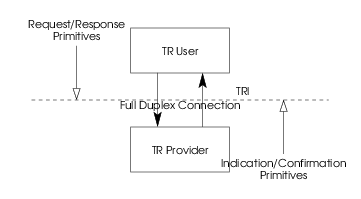
The TRI allows the TR provider to be configured with any transaction sub-layer user (such as the
Transaction Component (TC) Sub-Layer) that also conforms to the TRI. A transaction sub-layer user
can also be a user program that conforms to the TRI and accesses the TR provider via
putmsg(2s) and getmsg(2s) system calls.
STREAMS messages that are used to communicate transaction service primitives between the transaction user and the transaction provider may have one of the following formats:
- A
M_PROTOmessage block followed by zero or moreM_DATAmessage blocks. TheM_PROTOmessage block contains the type of service primitive and all relevant arguments associated with the primitive. TheM_DATAblocks contain user data associated with the service primitive. - One
M_PCPROTOmessage block containing the type of service primitive and all the relevant arguments associated with the primitive. - One or more
M_DATAmessage blocks containing user data.
The following sections describe the service primitives which define both connection-mode and connectionless-mode service.
For both types of service, two types of primitives exist: primitives that originate from the service user and primitives that originate from the service provider. The primitives that originate from the service user make requests to the service provider or response to an event of the service provider. The primitive that originate from the service provider are either confirmations of a request or are indications to the service user that an event has occurred. The primitive types along with the mapping of those primitives to the STREAMS message types and the service primitives of the ISO/IEC xxxxx and service definitions are listed in TRI Primitives. The format of these primitives and the rules governing the use of them are described in Management Primitives, Connection-Oriented Mode Primitives, and Connectionless Mode Primitives.
2.2 TRI Services
The features of the TRI are defined in terms of the services provided by the service provider, and the individual primitives that may flow between the service user and the service provider.
The services supported by the TRI are based on two distinct modes of communication, connection-mode transaction service (COTS) and connectionless transaction service (CLTS). Also, the TRI supports services for local management.
2.2.1 COTS
The main features of the connection mode communication are:
- It is virtual circuit oriented;
- it provides transfer of data via a pre-established path; and,
- it provides reliable data transfer.3
There are three phases to each instance of communication: Transaction Establishment, Data Transfer, and Transaction Release. Units of data arrive at the destination in the same order as they departed their source and the data is protected against duplication or loss of data units within some specified quality of service.
2.2.2 CLTS
The main features of the connectionless mode communication are:
- It is datagram oriented;
- it provides transfer of data in self contained units;
- there is no logical relationship between these units of data; and,
- it is unreliable.
Connectionless mode communication has no separate phases. Each unit of data is transmitted from source to destination independently, appropriate addressing information is included with each unit of data. As the units of data are transmitted independently from source to destination, there are, in general, no guarantees of proper sequence and completeness of the data stream.
2.2.3 Local Management
The TRI specifications also define a set of local management functions that apply to both COTS and CLTS modes of communication. These services have local significance only.
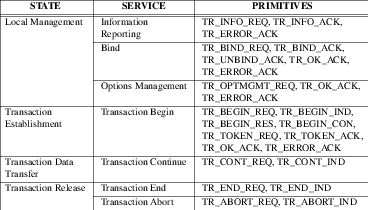
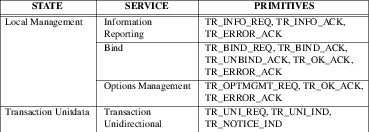
Table 1 and Table 2 summarizes the TRI service primitives by their state and service.
3 TRI Services Definition
This section describes the services of the TRI primitives. Time-sequence diagrams 4 that illustrate the sequence of primitives are used. The format of the primitives will be defined later in this document.
3.1 Local Management Services Definition
The services defined in this section are outside the scope of the international standards. These services apply to both connection-mode as well as connectionless modes of communication. They are involved for the initialization/de-initialization of a stream connected to the TR provider. They are also used to manage options supported by the TR provider and to report information on the supported parameter values.
3.1.1 Transaction Information Reporting Service
This service provides information on the options supported by the TR provider.
-
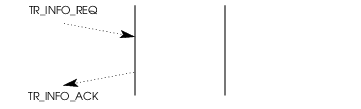
TR_INFO_REQ: This primitive request that the TR provider returns the values of all the supported protocol parameters. This request may be invoked during any phase. -
TR_INFO_ACK: This primitive is in response to the TR_INFO_REQ primitive and returns the values of the supported protocol parameters to the TR user.
The sequence of primitives for transaction information management is shown in Figure 3.1.
3.1.2 TR User Bind Service
This service allows an originating address to be associated with a stream. It allows the TR user to negotiate the number of transaction begin indications that can remain unacknowledged for that TR user (a transaction begin indication is considered unacknowledged while it is awaiting a corresponding transaction response or abort request from the TR user). This service also defines a mechanism that allows a stream (bound to the address of the TR user) to be reserved to handle incoming transactions only. This stream is referred to as the listener stream.
-
TR_BIND_REQ: This primitive request that the TR user be bound to a particular originating address, and negotiate the number of allowable outstanding transaction indications for that address. -
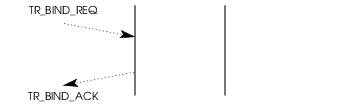
TR_BIND_ACK: This primitive is in response to theTR_BIND_REQprimitive and indicates to the user that the specified TR user has been bound to a protocol address.
The sequence of primitives for the TR user bind service is shown in Figure 3.2.
3.1.3 TR User Unbind Service
This service allows the TR user to be unbound from a protocol address.
-
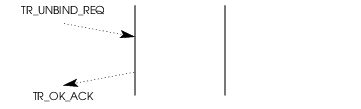
TR_UNBIND_REQ: This primitive requests that the TR user be unbound from the protocol address it had previously been bound to.
The sequence of primitives for the TR user unbind service is shown in Figure 3.3.
3.1.4 Receipt Acknowledgement Service
-
TR_OK_ACK: This primitive indicates to the TR user that the previous TR user originated primitive was received successfully by the TR provider.
An example showing the sequence of primitives for successful receive acknowledgement is depicted in Figure 3.3.
3.1.5 Options Mangement Service
This service allows the TR user to manage the QOS parameter values associated with the TR provider.
-
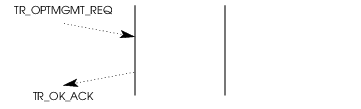
TR_OPTMGMT_REQ: This primitive allows the TR user to select default values for QOS parameters within the range supported by the TR provider, and to indicate the default selection of return option.
Figure 3.4 shows the sequence of primitives for transaction options management.
3.1.6 Error Acknowledgement Service
-
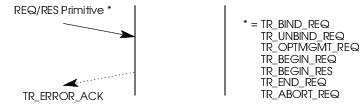
TR_ERROR_ACK: This primitive indicates to the TR user that a non-fatal error has occurred in the last TR user originated request or response primitive (listed in Figure 3.5) on the stream.
Figure 3.5 shows the sequence of primitives for the error management primitive.
3.2 Connection-Oriented Mode Services Definition
This section describes the required transaction service primitives that define the connection mode interface.
The queue model for connection-oriented services are discussed in more detail in ITU-T X.217 and ITU-T Q.771.
The queue model represents the operation of a transaction association in the abstract by a pair of queues linking two transaction users. There is one queue for each direction of data flow. Each queue represents a flow control function in one direction of transfer. The ability of a user to add objects to a queue will be determined by the behaviour of the user removing objects from that queue, and the state of the queue. The pair of queues is considered to be available for each potential transaction association. Objects that are entered or removed from the queue are either as a result of interactions at the two transaction addresses, or as the result of TR provider initiatives.
- A queue is empty until a transaction object has been entered and can be returned to this state, with loss of its contents, by the TR provider.
- Objects may be entered into a queue as a result of the actions of the source TR user, subject to control by the TR provider.
- Objects may also be entered into a queue by the TR provider.
- Objects are removed from the queue under the control of the TR user in the same order as they
were entered except:
- If the object is of type defined to be able to advance ahead of the preceding object (however, no object is defined to be able to advance ahead of another object of the same type), or
- If the following object is defined to be destructive with respect to the preceding object on the queue. If necessary, the last object on the queue will be deleted to allow a destructive object to be entered - they will therefore always be added to the queue. For example, “abort” objects are defined to be destructive with respect to all other objects.
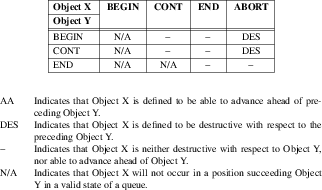
Table 3 shows the ordering relationships among the queue model objects.
3.2.1 Transaction Initiation Phase
A pair of queues is associated with a transaction association between two transaction users when the
TR provider receives a TR_BEGIN_REQ primitive at one of the TR users resulting in a begin
object being entered into the queue. The queues will remain associated with the transaction until a
TR_END_REQ or TR_ABORT_REQ primitive (resulting in an end or abort object) is either
entered or removed from a queue. Similarly, in the queue from the destination TR user, objects can
be entered into the queue only after the begin object associated with the TR_BEGIN_RES has
been entered into the queue. Alternatively, the destination TR user can enter an end or abort
object into the queue instead of the begin object to terminate the transaction.
The transaction establishment procedure will fail if the TR provider is unable to establish a
transaction association, or if the destination TR user is unable to accept the TR_BEGIN_IND
(see Transaction Termination primitive definition in TR_END_IND).
3.2.1.1 User Primitives Successful Transaction Establishment
The following user primitives support COTS Phase I (Transaction Establishment) services:
-
TR_BEGIN_REQ: This primitive requests that the TR provider form a transaction association with the specified destination TR user. -
TR_BEGIN_RES: This primitive requests that the TR provider accept a previous transaction indication.
3.2.1.2 Provider Primitives Successful Transaction Establishment
The following provider primitives support COTS Phase I (Transaction Establishment) services:
-
TR_BEGIN_IND: This primitive indicates to the TR user that a transaction association request has been made by a user at the specified source address. -
TR_BEGIN_CON: This primitive indicates to the TR user that a transaction initiation request has been confirmed on the specified responding address.
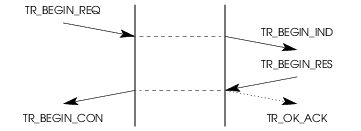
The sequence of primitives in a successful transaction initiation is defined by the time sequence diagrams as shown in Figure 3.6.
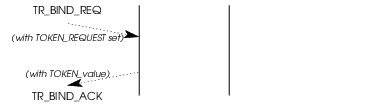
The sequence of primitives for the transaction initiation response token value determination is shown in Figure 3.7 (procedures for transaction initiation response token value determination are discussed in TR_BIND_REQ, and TR_BIND_ACK).
3.2.2 Transaction Data Transfer Phase
Flow control on the transaction association is done by management of the queue capacity, and by allowing objects of certain types to be inserted to the queues, as shown in Table 4.
3.2.2.1 Primitives for Data Transfer
The following primitives support COTS Phase II (Transaction Data Transfer) services:
-
TR_CONT_REQ: This primitive requests that the TR provider transfer the specified user data. -
TR_CONT_IND: This primitive indicates to the TR user that this message contains user data.
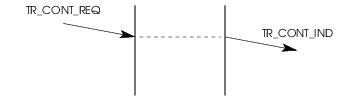
Figure 3.8 shows the sequence of primitives for successful user data transfer. The sequence of
primitives may remain incomplete if a TR_END_REQ, TR_END_IND, TR_ABORT_REQ, or
TR_ABORT_IND primitive occurs.
3.2.3 Transaction Termination Phase
The transaction association procedure is initialized by insertion of an end or abort object
(associated with a TR_END_REQ or TR_ABORT_REQ) into the queue. As shown in Table?,
the termination procedure is destructive with respect to other objects in the queue, and eventually
results in the emptying of queues and termination of the transaction association.
The sequence of primitives depends on the origin of the termination action. The sequence may be:
- invoked by on TR user, with a request from that TR user leading to an indication to the other;
- invoked by both TR users, with a request from each of the TR users;
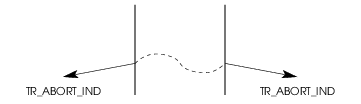
- invoked by the TR provider, with an indication to each of the TR users;
- invoked independently by one TR user and the TR provider, with a request from the originating TR user and an indication to the other.
3.2.3.1 Primitives for Transaction Termination
The following primitives support CONS Phase III (Transaction Termination) services:
-
TR_END_REQ: This primitive requests that the TR provider deny an outstanding request for a transaction association or normal termination of an existing transaction. -
TR_ABORT_REQ: This primitive requests that the TR provider deny an outstanding request for a transaction association or abnormal termination of an existing transaction. -
TR_END_IND: This primitive indicates to the TR user that either a request for transaction initiation has been denied or an existing transaction has been terminated normally. -
TR_ABORT_IND: This primitive indicates to the TR user that either a request for transaction initiation has been denied or an existing transaction has been terminated abnormally.
The sequence of primitives are shown in the time sequence diagrams in the figures that follow:
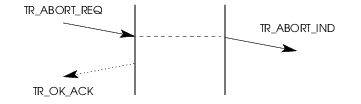
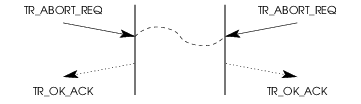
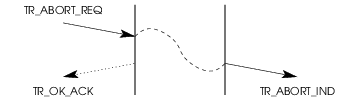
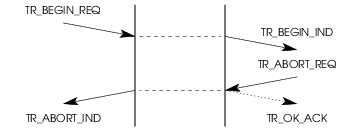
A TR user may reject a transaction initiation attempt by issuing a TR_ABORT_REQ. The
originator parameter in the TR_ABORT_REQ will indicate TR user invoked termination. The
sequence of primitives is shown in Figure 3.13.
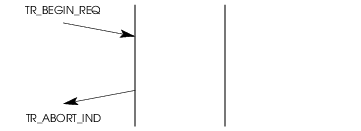
If the TR provider is unable to establish a transaction, it indicates this to the requester by an
TR_ABORT_IND. The originator of the primitive indicates a TR provider invoked release. This
is shown in Figure 3.14.
3.3 Connectionless Mode Services Definition
The connectionless mode service allows for the transfer of transaction user data in one and both directions simultaneously without establishing a transaction dialogue. A set of primitives are defined that carry transaction user data and control information between the TR user and the TR provider entities. The primitives are modelled as requests initiated by the TR user and indications initiated by the TR provider. Indications may be initiated by the TR provider independently from requests by the TR user.
The connectionless mode service consists of one phase.
3.3.1 Request and Response Primitives
-
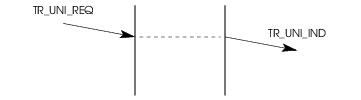
TR_UNI_REQ: This primitive requests that the TR provider send the transaction user data to the specified destination. -
TR_UNI_IND: This primitive indicates to the TR user that a user data sequence has been received from the specified originating address.
Figure 3.15 shows the sequence of primitives for the connectionless mode of transfer.
-
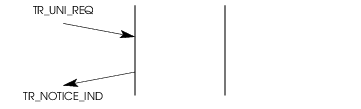
TR_NOTICE_IND: This primitive indicates to the TR user that the user data with the specified destination address and QOS parameters produced an error. This primitive is specific to CLTS.
Figure 3.16 shows the sequence of primitives for the CLTS error management primitive.
4 TRI Primitives
This section describes the format and parameters of the TRI primitives. In addition, it discusses the states in which the primitive is valid, the resulting state, and the acknowledgement that the primitive expects.
The mapping of TRI of TRI primitives to the primitives defined in ITU-T Q.771, ITU-T X.219 and ANSI T1.114 are shown in Mapping TRI Primitives. The state/event tables for these primitives are shown in State/Event Tables. The precedence tables for the TRI primitives are shown in Primitive Precedence Tables.
The following tables provide a summary of the TR primitives and their parameters.
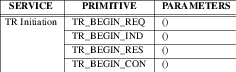

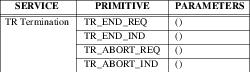
4.1 Management Primitives
These primitives apply to all transaction modes.
4.1.1 Transaction Information
4.1.1.1 Transaction Information Request
TR_INFO_REQ
This primitive request the TR provider to return the values of all supported protocol parameters (see TR_INFO_ACK), and also the current state of the TR provider (as defined in State/Event Tables). This primitive does not affect the state of the TR provider and does not appear in the state tables.
Format
The format of the message is one M_PCPROTO message block and its structure is as follows:
typedef struct TR_info_req {
    ulong PRIM_type;          /* Always TR_INFO_REQ */
} TR_info_req_t;
Parameters
The primitive has the following arguments:
- PRIM_type
Indicates the primitive type. Always
TR_INFO_REQ.
Modes
Both connection-mode and connectionless-mode.
Originator
Transaction user.
Valid States
This primitive is valid in any state where a local acknowledgement is not pending.
New State
The new state remains unchanged.
Rules
For the rules governing the requests made by this primitive, see the TR_INFO_ACK primitive
described in TR_INFO_ACK.
Acknowledgements
This primitive requires the TR provider to generate one of the following acknowledgements upon receipt of the primitive and that the TR user wait for the acknowledgement before issuing any other primitives:
- — Successful: Correct acknowledgement of the primitive is indicated with the
TR_INFO_ACKprimitive described in TR_INFO_ACK. - — Non-fatal Errors: These errors will be indicated with the
TR_ERROR_ACKprimitive described in TR_ERROR_ACK. The allowable errors are as follows:There are no errors associated with the issuance of this primitive.
4.1.1.2 Transaction Information Acknowledgement
TR_INFO_ACK
This primitive indicates to the TR user any relevant protocol-dependent parameters.5 It
should be initiated in response to the TR_INFO_REQ primitive described above under
TR_INFO_REQ.
Format
The format of the message is one M_PCPROTO message block and its structure is as follows:
typedef struct TR_info_ack {
    long PRIM_type;           /* Always TR_INFO_ACK */
    long ASDU_size;           /* maximum ASDU size */
    long EASDU_size;          /* maximum EASDU size */
    long CDATA_size;          /* connect data size */
    long DDATA_size;          /* discon data size */
    long ADDR_size;           /* address size */
    long OPT_size;            /* options size */
    long TIDU_size;           /* transaction i/f data unit size */
    long SERV_type;           /* service type */
    long CURRENT_state;       /* current state */
    long PROVIDER_flag;       /* type of TR provider */
    long TRI_version;         /* version # of tri that is supported */
} TR_info_ack_t;
Parameters
The primitive has the following arguments:
- PRIM_type
Indicates the primitive type. Always
TR_INFO_ACK.- ASDU_size
Indicates the maximum size (in octets) of Transaction Service User Data supported by the TR provider.
- EASDU_size
Indicates the maximum size (in octets) of Expedited Transaction Service User Data supported by the TR provider.
- CDATA_size
Indicates the maximum number of octets of data that may be associated with a transaction initiation primitive.
- DDATA_size
Indicates the maximum number of octets of data that may be associated with a transaction termination primitive.
- ADDR_size
Indicates the maximum size (in decimal digits) of a protocol address.
- OPT_size
Indicates the maximum size (in decimal digits) of the options.
- AIDU_size
Indicates the maximum size (in octets) of a Transaction Interface User Data supported by the TR provider. This is the maximum amount of user data octets that can be trasnfered acros the interface in a single data request primitive.
- SERV_type
Indicates the service type.
- CURRENT_state
Indicates the current interface state.
- PROVIDER_flag
Indicates the transaction provider flags.
- TRI_version
Indicates the TR version. This is Version 1 of the interface specification.
Modes
This primitive is valid in both connection mode and connectionless mode.
Originator
This primitive is issued by the TR provider.
Valid State
This primitive may be issued in response to a TR_INFO_REQ and is valid in any state.
New State
On success, the new state is unchanged; on error, unchanged.
Rules
The following rules apply whey the type is TR_CLTRS:
- — The EASDU_size, CDATA_size and DDATA_size fields should be ‘-2’.
- — The ASDU_size should equal the AIDU_size.
4.1.2 Transaction Protocol Address Management
4.1.2.1 Transaction Bind Request
TR_BIND_REQ
This primitive requests that the TR provider bind a protocol address to the stream, negotiate the number of dialogue indications allowed to be outstanding by the TR provider for the specified protocol address, and activate6 the stream associated with the protocol address.
Format
The format of the message is one M_PROTO message block. The format of the M_PROTO
message block is as follows:7
typedef struct TR_bind_req {
    ulong PRIM_type;          /* Always TR_BIND_REQ */
    ulong ADDR_length;        /* address length */
    ulong ADDR_offset;        /* address offset */
    ulong XACT_number;        /* maximum outstanding transaction reqs. */
    ulong BIND_flags;         /* bind flags */
} TR_bind_req_t;
Parameters
The primitive has the following arguments:
- PRIM_type
Specifies the primitive type. Always
TR_BIND_REQ.- ADDR_length
Specifies the length8 of the protocol address to be bound to the stream.
- ADDR_offset
Specifies the offset from the beginning of the
M_PROTOmessage block where the protocol address begins. The proper alignment of the address in theM_PROTOmessage block is not guaranteed. The address in theM_PROTOmessage block is, however, aligned the same as it was received from the TR user.- XACT_number
9The requested number of dialogue begin indications10 allowed to be outstanding by the TR provider for the specified protocol address. Only one stream per protocol address is allowed to have a XACT_number greater than zero. This indicates to the TR provider that the stream is a listener stream for the TR user. This stream will be used by the TR provider for dialogue “begin” indications for that protocol address, see TR_BEGIN_IND.
- BIND_flags
Unused.
Modes
This primitive is valid both in connection and connectionless modes.
Originator
This primitive is issued by the TR user.
Valid State
This primitive is valid in state TRS_UNBND.
New State
The new state is TRS_WACK_BREQ.
Rules
For the rules governing the requests made by this primitive, see the TR_BIND_ACK primitive
described in TR_BIND_ACK.
Acknowledgements
This primitive requires the TR provider to generate one of the following acknowledgements upon receipt of the primitive:
- — Successful:
Correct acknowledgement of the primitive is indicated with the
TR_BIND_ACKprimitive described in TR_BIND_ACK. - — Non-fatal errors:
These errors will be indicated with the
TR_ERROR_ACKprimitive described in TR_ERROR_ACK. The allowable errors are as follows:[TRBAADDR]Indicates that the protocol address was in an incorrect format or the address contained illegal information. It is not intended to indicate protocol errors.
[TRNOADDR]Indicates that the TR provider could not allocate an address.
[TRACCES]Indicates that the user did not have proper permissions for the use of the requested address.
[TROUTSTATE]The primitive would place the transaction interface out of state for the indicated transaction.
[TRSYSERR]A system error occurred and the UNIX System error is indicated in the primitive.
[TRADDRBUSY]Indicates that the requested address is already in use.
4.1.2.2 Transaction Bind Acknowledgement
TR_BIND_ACK
This primitive indicates to the TR user that the specified protocol address has been bound to the stream, that the specified number of dialogue indications are allowed to be queued by the TR provider for the specified protocol address, and that the stream associated with the specified protocol address has been activated.
Format
The format of the message is one M_PCPROTO message block. The format of the M_PCPROTO
message block is as follows:
typedef struct TR_bind_ack {
    ulong PRIM_type;          /* Always TR_BIND_ACK */
    ulong ADDR_length;        /* address length */
    ulong ADDR_offset;        /* address offset */
    ulong XACT_number;        /* open transactions */
    ulong TOKEN_value;        /* value of "token" assigned to stream */
} TR_bind_ack_t;
Parameters
The primitive has the following arguments:
- PRIM_type
Indicates the primitive type. Always
TR_BIND_ACK.- ADDR_length
Indicates the length of the protocol address that was bound to the stream.
- ADDR_offset
Indicates the offset from the beginning of the
M_PCPROTOmessage block where the protocol address begins. The proper alignment of the address in theM_PCPROTOmessage block is not guaranteed.- XACT_number
11 Indicates the accepted number of dialogue indications allowed to be outstanding by the TR provider for the specified protocol address.
- TOKEN_value
Indicates a token value to be used when accepting dialogues indicated on other streams using this stream.
Modes
This primitive is valid in bidirectional and unidirectional modes.
Originator
This primitive is issued by the TR provider.
Valid State
This primitive is issued in response to a TR_BIND_REQ and is valid in state
TRS_WACK_BREQ.
New State
On success, the new state is TRS_IDLE; on error, TRS_UNBND.
Rules
The following rules apply to the binding of the specified protocol address to the stream:
- — If the ADDR_length field in the
TR_BIND_REQprimitive is zero (0), then the TR provider must assign a protocol address to the user. - — The TR provider is to bind the protocol address as specified in the
TR_BIND_REQprimitive. If the requested protocol address is in use or if the TR provider cannot bind the specified address, it must return an error.
The following rules apply to negotiating the XACT_number argument:
- — The returned value must be less than or equal to the corresponding requested number as
indicated in the
TR_BIND_REQprimitive. - — If the requested value is greater than zero, the returned value must also be greater than zero.
- — Only one stream that is bound to the indicated protocol address any have a negotiated
accepted number of maximum transaction requests greater than zero. If a
TR_BIND_REQprimitive specifies a value greater than zero, but another stream has already bound itself to the given protocol address with a value greater than zero, the TR provider must return an error. - — If a stream with XACT_number greater than zero is used to accept a dialogue (without specifying a TRANS_id), the stream will be found busy during the duration of that connection and no other streams may be bound to that protocol address with a XACT_number greater than zero. This will prevent more than one stream bound to the identical protocol address from accepting dialogue indications. See also TR_BEGIN_RES.
- — A stream requesting a XACT_number of zero should always be legal. This indicates to the TR provider that the stream is to be used to request dialogues only.
- — stream with a negotiated XACT_number greater than zero may generate dialogue requests (see TR_BEGIN_REQ,) or accept dialogue indications (see TR_BEGIN_RES.)
If the above rules result in an error condition, then the TR provider must issue a
TR_ERROR_ACK primitive to the TR user specifying the error as defined in the description of
the TR_BIND_REQ primitive, TR_BIND_REQ.
4.1.2.3 Transaction Unbind Request
TR_UNBIND_REQ
This primitive requests that the TR provider unbind the protocol address previously associated with the stream and deactivate the stream.
Format
The format of the message is one M_PROTO message block structured as follows:
typedef struct TR_unbind_req {
    ulong PRIM_type;          /* Always TR_UNBIND_REQ */
} TR_unbind_req_t;
Parameters
The primitive has the following arguments:
- PRIM_type
Specifies the primitive type. Always
TR_UNBIND_REQ.
Mode
This primitive is valid in both unidirectional and bidirectional modes.
Originator
This primitive is originated by the TR user.
Valid State
This primitive is valid in state TRS_IDLE.
New State
The new state is TRS_WACK_UREQ.
Acknowledgements
This primitive requires the TR provider to generate one of the following acknowledgements upon receipt of the primitive:
- — Successful: Correct acknowledgement of the primitive is indicated with the
TR_OK_ACKprimitive described in TR_OK_ACK. - — Non-fatal errors: These errors will be indicated with the
TR_ERROR_ACKprimitive described in TR_ERROR_ACK. The allowable errors are as follows:[TROUTSTATE]The primitive would place the transaction interface out of state for the indicated transaction.
- TRSYSERR
A system error occurred and the UNIX System error is indicated in the primitive.
4.1.2.4 Transaction Protocol Address Request
TR_ADDR_REQ
This primitive requests that the TR provider return the local protocol address that is bound to the stream and the address of the remote ASE if a transaction association has been established.
Format
The format of the message is one M_PROTO message block structured as follows:
typedef struct TR_addr_req {
    long PRIM_type;           /* always TR_ADDR_REQ */
    ulong TRANS_id;           /* Transaction id */
} TR_addr_req_t;
Parameters
The primitive has the following arguments:
- PRIM_type
Specifies the primitive type. Always
TR_ADDR_REQ.- TRANS_id
Specifies the transaction association identifier for which address service is requested. If address service is requested for local bind address only, then the transaction identifier must be ‘-1’.
Mode
This primitive is valid in both unidirectional and bidirectional modes.
Originator
This primitive is originated by the TR user.
Valid State
This primitive is valid in any state where a local acknowledgement is not pending.
New State
The new state is unchanged.
Rules
For the rules governing the requests made by this primitive, see the
TR_ADDR_ACK primitive described in TR_ADDR_ACK.
Acknowledgements
This primitive requires the TR provider to generate one of the following acknowledgements upon receipt of the primitive:
- — Successful: Correct acknowledgement of the primitive is indicated with the
TR_ADDR_ACKprimitive described in TR_ADDR_ACK. - — Non-fatal errors: These errors will be indicated with the
TR_ERROR_ACKprimitive described in TR_ERROR_ACK. The allowable errors are as follows:[TRBADID]The transaction identifier specified in the primitive was incorrect or invalid.
[TRNOTSUPPORT]This primitive is not supported by the transaction provider.
[TRSYSERR]A system error has occured and the Linux system error is indicated in the primitive.
4.1.2.5 Transaction Protocol Address Acknowledgement
TR_ADDR_ACK
This primitive indicates to the TR user the addresses of the local and remote ASE. The local address is the protocol address that has been bound to the stream. If an transaction association has been established, the remote address is the protocol address of the remote ASE.
Format
The format of the message is one M_PCPROTO message block structured as follows:
typedef struct TR_addr_ack {
    long PRIM_type;           /* always TR_ADDR_ACK */
    long LOCADDR_length;      /* length of local address */
    long LOCADDR_offset;      /* offset of local address */
    long REMADDR_length;      /* length of remote address */
    long REMADDR_offset;      /* offset of remote address */
} TR_addr_ack_t;
Parameters
The primitive has the following arguments:
- PRIM_type
Indicates the primitive type. Always
TR_ADDR_ACK.- LOCADDR_length
Indicates the length of the protocol address that was bound to the stream.
- LOCADDR_offset
Indicates the offset from the beginning of the
M_PCPROTOmessage block where the protocol address begins.- REMADDR_length
Indicates the length of the protocol address of the remote ASE.
- REMADDR_offset
Indicates the offset from the beginning of the
M_PCPROTOmessage block where the protocol address begins.
The proper alignement of the addresses in the M_PCPROTO message block is not guaranteed.
Modes
Both connection-mode and connectionless-mode.
Originator
Transaction provider.
Valid State
This primitive is issued in response to a TR_ADDR_REQ primitive and is valid in any state
where a response is pending to a TR_ADDR_REQ.
New State
The new state remains unchanged.
Rules
The following rules apply:
- — If the requested transaction identifier was ‘-1’ in the corresponding
TR_ADDR_REQprimitive, and the transaction endpoint is not bound to a local address, (i.e. it is in theTRS_UNINITorTRS_UNBNDstate) the LOCADDR_length and LOCADDR_offset fields must be set to ‘0’. - — If the requested transaction exists as identifed in the corresponding
TR_ADDR_REQprimitive, LOCADDR_length and LOCADDR_offset fields will be populated to reflect the local association address for the specified transaction. - — If the requested transaction identifier was ‘-1’ in the corresponding
TR_ADDR_REQprimitive, the REMADDR_length and REMADDR_offset fields must be set to ‘0’. - — If the requested transaction exists as identified in the corresponding
TR_ADDR_REQprimitive, REMADDR_length and REMADDR_offset fields will be populated to reflect the remote association address for the specified transaction.
4.1.3 Transaction Options Management
4.1.3.1 Transaction Options Management Request
TR_OPTMGMT_REQ
This primitive alllows the transaction user to manage the options associated with the stream.
The format of the message is one M_PROTO message block.
Format
The format of the message is one M_PCPROTO message block structured as follows:
typedef struct TR_optmgmt_req {
    ulong PRIM_type;          /* Always TR_OPTMGMT_REQ */
    ulong OPT_length;         /* options length */
    ulong OPT_offset;         /* options offset */
    ulong MGMT_flags;         /* options data flags */
} TR_optmgmt_req_t;
Parameters
The primitive has the following arguments:
- PRIM_type
Specifies the primitive type. Always
TR_OPTMGMT_REQ.- OPT_length
Specifies the length of the protocol options associated with the primitive.
- OPT_offset
Specifies the offset from the beginning of the
M_PROTOmessage block where the options begin.- MGMT_flags
Specifies the management flags which define the request made by the transaction user.
The proper alignment of the options is not guaranteed. The options are, however, aligned the same as received from the transaction user.
Flags
The allowable flags are:
TR_NEGOTIATENegotiate and set the options with the transaction provider.
TR_CHECKCheck the validity of the specified options.
TR_DEFAULTReturn the default options.
TR_CURRENTReturn the currently effective option values.
Modes
This primitive is valid both in unidirectional and bidirectional modes.
Originator
This primitive is originated by the transaction user.
Valid State
This primitive is valid in any state where the transaction user is not expecting a local acknowledgement.
New State
The state remains unchanged.
Rules
For the rules governing the requests made by this primitive, see the TR_OPTMGMT_ACK primitive
described in TR_OPTMGMT_ACK.
Acknowledgements
This primitive requires the TR provider to generate one of the following acknowledgements upon receipt of the primitive, and that the transaction user wait for the acknowledgement before issuing any other primitives:
- — Successful:
Correct acknowledgement is indicated with the
TR_OPTMGMT_ACKprimitive described in TR_OPTMGMT_ACK. - — Non-fatal errors:
These errors will be indicated with the
TR_ERROR_ACKprimitive described in TR_ERROR_ACK. The allowable errors are as follows:[TRACCES]The user did not have proper permissions for the use of the requested options.
[TRBADFLAG]The flags as sepcified were incorrect or invalid.
[TRBADOPT]The options as specified were in an incorrect ofrmat, or they contained invalid information.
[TROUTSTATE]The primitive would place the transaction interface out of state for the indicated transaction.
[TRNOTSUPPORT]This primiitve is not supported by the transaction provider.
[TRSYSERR]A system error occurred and the UNIX System error is indicated in the primitive.
4.1.3.2 Transaction Options Management Acknowledgement
TR_OPTMGMT_ACK
This primitive indicates to the transaction user that the options management request has completed.
Format
The format of the message is one M_PCPROTO message block structured as follows:
typedef struct TR_optmgmt_ack {
    ulong PRIM_type;          /* Always TR_OPTMGMT_ACK */
    ulong OPT_length;         /* options length */
    ulong OPT_offset;         /* options offset */
    ulong MGMT_flags;         /* options data flags */
} TR_optmgmt_ack_t;
Parameters
The primitive has the following arguments:
- PRIM_type
Indicates the primitive type. Always
TR_OPTMGMT_ACK.- OPT_length
Indicates the length of the protocol options associated with the primitive.
- OPT_offset
Indicates the offset from the beginning of the
M_PCPROTOmessage block where the options begin. The proper alignment of the options is not guaranteed.- MGMT_flags
Indicates the management flags in the same form as specified in the
TR_OPTMGMT_REQprimitive, See TR_OPTMGMT_REQ, with any additional flags as specified below.
Flags
The flags returned in MGMT_flags represents the single most severe result of the operation. The flags returned will be one of the following values (in order of decreasing severity):
TR_NOTSUPPORTThis flag indicates that at least one of the options specified in the
TR_OPTMGMT_REQprimitive was not supported by the trasnaction provider at the current privilege level of the requesting user.TR_READONLYThis flag indicates that at least one of the options specified in the
TR_OPTMGMT_REQprimitive is read-only (for the current TRI state). This flag does not apply when the MGMT_flags field in theTR_OPTMGMT_REQprimitive wasT_DEFAULT.TR_FAILUREThis flag indicates that negotiation of at least one of the options specified in the
TR_OPTMGMT_REQprimitive failed. This is not used for illegal format or values. This flag does not apply when the MGMT_flags field in theTR_OPTMGMT_REQprimitive wasT_DEFAULTorT_CURRENT.TR_PARTSUCCESSThis flag indicates that the negotiation of at least one of the options specified in the
TR_OPTMGMT_REQprimitive was negotiated to a value of lesser quality than the value requested. This flag only applies when the MGMT_flags field of theTR_OPGMGMT_REQprimitive wasT_NEGOTIATE.TR_SUCCESSThis flag indicates that all of the specified options were negoitated or returned successfully.
Mode
This primitive is valid in both unidirectional and bidirectional modes.
Originator
This primitive is originated by the TR provider.
Valid State
This primitive is issued in response to a TR_OPTMGMT_REQ primitive and is valid in any state.
New State
The new state remains unchanged.
Rules
The following rules apply to the TR_OPTMGMT_ACK primitive:
- — If the value of MGMT_flags in the
TR_OPTMGMT_REQprimitive isTR_DEFAULT, the provider should return the default provider options without changing the existing options associated with the Stream. - — If the value of MGMT_flags in the
TR_OPTMGMT_REQprimitive isTR_CHECK, the provider should return the options as specified in theTR_OPTMGMT_REQprimitive along with the additional flagsTR_SUCCESSorTR_FAILUREwhich indicate to the user whether the specified options are supportable by the provider. The provider should not change any existing options associated with the Stream. - — If the value of MGMT_flags in the
TR_OPTMGMT_REQprimitive isTR_NEGOTIATE, the provider should set and negotiate the option as specified by the following rules:- - If the OPT_length field of the
TR_OPTMGMT_REQprimitive is zero (‘0’), then the transaction provider is to set and return the default options associated with the Stream in theTR_OPTMGMT_ACKprimitive. - - If options are specified in the
TR_OPTMGMT_REQprimitive, then the transaction provider should negotiate those options, set the negotiated options and return the negotiated options in theTR_OPTMGMT_ACKpirmitive. It is the user’s responsibility to check the negotiated options returned in theTR_OPMGMT_ACKprimitive and take appropriate action.
- - If the OPT_length field of the
- — If the value of MGMT_flags in the
TR_OPTMGMT_REQprimtiive isTR_CURRENT, the provider should return the currently effective option values without changing any existing options associated with the Stream.
Errors
If the above rules result in an error condition, the transaction provider must issue a
TR_ERROR_ACK primitive (see TR_ERROR_ACK) to the transaction user specifying the error as
defined in the description of the TR_OPTMGMT_REQ primitive (see TR_OPTMGMT_REQ).
4.1.4 Transaction Error Management
4.1.4.1 Transaction Successful Receipt Acknowledgement
TR_OK_ACK
This primitive indicates to the TR user that the previous TR-user-originated primitive was received successfully by the TR provider. It does not indicate to the TR user any TR protocol action taken due to the issuance of the last primitive. This may only be initiated as an acknowledgement for those primitives that require one.
Format
The format of the message is one M_PCPROTO message block structured as follows:
typedef struct TR_ok_ack {
    ulong PRIM_type;          /* Always TR_OK_ACK */
    ulong CORRECT_prim;       /* correct primitive */
} TR_ok_ack_t;
Parameters
The primitive has the following arguments:
- PRIM_type
Indicates the primitive type. Always
TR_OK_ACK.- CORRECT_prim
Indicates the primitive type that was successfully received.
Modes
This primitive is valid in all Operations Classes.
Originator
This primitive is issued by the TR provider.
Valid State
Valid in any state where a local acknowledgement requiring TR_OK_ACK response is pending.
New State
Depends on the current state; see State/Event Tables.
4.1.4.2 Transaction Error Acknowledgement
TR_ERROR_ACK
This primitive indicates to the TR user that a non-fatal12 error has occurred in the last TR-user-originated primitive. This may only be initiated as an acknowledgement for those primitives that require one. It also indicates to the TR user that no action was taken on the primitive that cause the error.
Format
The format of the message is one M_PCPROTO message block structured as follows:
typedef struct TR_error_ack {
    ulong PRIM_type;          /* Always TR_ERROR_ACK */
    ulong ERROR_prim;         /* primitive in error */
    ulong TRI_error;          /* TRI error code */
    ulong UNIX_error;         /* UNIX error code */
    ulong TRANS_id;           /* Transaction id */
} TR_error_ack_t;
Parameters
The primitive has the following arguments:
- PRIM_type
Indicates the primitive type. Always
TR_ERROR_ACK.- ERROR_prim
Indicates the primitive type that was in error.
- TRI_error
Indicates the Transaction Sub-Layer Interface error code.
- UNIX_error
Indicates the UNIX System error code. This field is zero (0) unless the TRI_error is equal to
[TRSYSERR].- TRANS_id
Indicaets the transcation identifier for the transaction upon which the primitive caused an error.
Mode
This primitive can be issued in any Operations Class.
Originator
This primitive is originated by the TR provider.
Valid State
This primitive is valid in any state where a local acknowledgement is pending and an error has occurred.
New State
The new state is the state that the interface was in before the primitive in error was issued, see State/Event Tables.
Rules
This primitive may only be issued as an acknowledgement for those primitives that require one. It also indicates to the user that no action was taken on the primtiive that caused the error.
Errors
The TR provider is allowed to return any of the following TR error codes:
[TRBADADDR]Indicates that the protocol address as specified in the primitive was of an incorrect format or the address contained illegal information.
[TRBADOPT]Indicates that the options as specified in the primitive were in an incorrect format, or they contained illegal information.
[TRBADF]Indicates that the stream queue pointer as specified in the primitive was illegal.
[TRNOADDR]Indicates that the TR provider could not allocate a protocol address.
[TRACCES]Indicates that the user did not have proper permissions to use the protocol address or options specified in the primitive.
[TROUTSTATE]Indicates that the primitive would place the interface out of state.
[TRBADSEQ]Indicates that the transaction identifier specified in the primitive was incorrect or illegal.
[TRBADFLAG]Indicates that the flags specified in the primitive were incorrect or illegal.
[TRBADDATA]Indicates that the amount of user data specified was illegal.
[TRSYSERR]Indicates that a system error has occurred and that the UNIX System error is indicated in the primitive.
[TRADDRBUSY]Indicates that the requested address is already in use.
[TRRESADDR]Indicates that the TR provider requires the responding stream be bound to the same protocol address as the stream on which the dialogue “begin” indication (see TR_BEGIN_IND) was received.
[TRNOTSUPPORT]Indicates that the TR provider does not support the requested capability.
4.2 Connection-Oriented Mode Primitives
4.2.1 Transaction Establishment
The transaction begin service provides means to start a transaction between two TR-users. This may
be accompanied by the transfer of TR-user information contained in M_DATA message blocks
accompanying the primitive.
4.2.1.1 Transaction Begin Request
TR_BEGIN_REQ
This primitive requests that the TR provider form an transaction association to the specified destination protocol address.
Format
The format of the message is one M_PROTO message block, followed by zero or more
M_DATA message blocks if any user data is specified by the TR user. The format of the
M_PROTO message block is as follows:
typedef struct TR_begin_req {
    ulong PRIM_type;          /* Always TR_BEGIN_REQ */
    ulong CORR_id;            /* Correlation Id */
    ulong ASSOC_flags;        /* Association flags */
    ulong DEST_length;        /* Destination address length */
    ulong DEST_offset;        /* Destination address offset */
    ulong ORIG_length;        /* Originating address length */
    ulong ORIG_offset;        /* Originating address offset */
    ulong OPT_length;         /* Options structure length */
    ulong OPT_offset;         /* Options structure offset */
} TR_begin_req_t;
Parameters
The primitive has the following arguments:
- PRIM_type
Specifies the primitive type: always
TR_BEGIN_REQ.- CORR_id
Specifies the correlation identifier for the newly formed transaction. The correlation identifier is an identifier chose by the TR user that uniquely identifies this transaction association establishment request from other establishment requests on the same stream. If the CORR_id is zero (0), it specifies that this is the only transaction to be formed on the requesting stream and attempts to form additional transactions before this transaction is complete will fail. The value of CORR_id will be returned in
- ASSOC_flags
Specifies the option flags provided with the primitive. See “Flags” below. Some flags may be provider specific.
- DEST_length
Specifies the length of the protocol address to which to establish an transaction association.
- DEST_offset
Specifies the offset from the beginning of the
M_PROTOmessage block where the protocol address begins.- ORIG_length
Specifies the length of the protocol address from which to establish an transaction association.
- ORIG_offset
Specifies the offset from the beginning of the
M_PROTOmessage block where the protocol address begins.- OPT_length
Specifies the length of the protocol options associated with the transaction.
- OPT_offset
Specifies the offset from the beginning of the
M_PROTOmessage block where the protocol options begin.
Flags
TR_SEQ_ASSURANCEBy setting this flag on the primitive, the originating transaction user can indicate that “sequence assured” service is requested from the underlying network service provider.
TR_NO_PERMISSIONBy setting this flag on the primitive, the originating transaction user can either deny (set) or grant (clear) permission for the transaction peer to terminate the transaction association upon receipt of the corresponding primitive at the peer (see TR_BEGIN_IND). This flag can only be used with transaction provider that support it (see Addendum for ANSI Conformance).
Valid State
This primitive is valid in transaction state TRS_IDLE. This primitive is only valid in
connection-oriented mode.
New State
The new state for the interface is TRS_WACK_CREQ.
Rules
The following rules apply to the specification of parameters to this primitive:
- — When the originating address is not specified, ORIG_length and ORIG_offset must be specified as zero (0).
- — When the ORIG_length and ORIG_offset are zero (0), the originating address is the local address that is implicitly associated with the access point from the local bind service (see TR_BIND_REQ).
- — The destination address must be specified and the TR provider will return error
[TRNOADDR]if the DEST_length and DEST_offset are zero (0).
Acknowledgements
This primitive requires the transaction provider to generate one of the following acknowledgements upon receipt of the primitive:
- — Successful Association Establishment: This is indicated with the
TR_BEGIN_CONprimitive described in TR_BEGIN_REQ. This results in theTRS_DATA_XFERstate for the transaction. Successful establishment and tear down can also be indicated with theTR_END_INDprimitive described in TR_END_IND. This results in theTRS_IDLEstate for the transaction. - — Unsuccessful Association Establishment: This is indicated with the
TR_ABORT_INDprimitive described in TR_ABORT_IND. For example, an association may be rejected because either the called transaction user cannot be reached, or the transaction provider or the called transaction user did not agree on the specified options. This results in theTRS_IDLEstate for the transaction. - — Non-fatal errors: These are indicated with the
TR_ERROR_ACKprimitive. The applicable non-fatal errors are defined as follows:[TRACCES]This indicates that the user did not have proper permissions for the use of the requested protocol address or protocol options.
[TRBADADDR]This indicates that the protocol address was in an incorrect format or the address contained illegal information. It is not intended to indicate protocol connection errors, such as an unreachable destination. Those types of errors are indicated with the
TR_ABORT_INDprimitive described in TR_ABORT_IND.[TRBADOPT]This indicates that the options were in an incorrect format or they contained illegal information.
[TROUTSTATE]The primitive would place the transaction interface out of state.
[TRBADDATA]The amount of user data specified was illegal (see TR_INFO_ACK).
[TRSYSERR]A system error has occured and the UNIX System error is indicated in the primitive.
4.2.1.2 Transaction Begin Indication
TR_BEGIN_IND
This primitive indicates to the destination TR user that a transaction association begin request has been made by the user at the specified source protocol address.
Format
The format of the message is one M_PROTO message block, followed by zero or more
M_DATA message blocks containing user data for the association, structured as follows:
typedef struct TR_begin_ind {
    ulong PRIM_type;          /* Always TR_BEGIN_IND */
    ulong TRANS_id;           /* Transaction id */
    ulong ASSOC_flags;        /* Association flags */
    ulong DEST_length;        /* Destination address length */
    ulong DEST_offset;        /* Destination address offset */
    ulong ORIG_length;        /* Originating address length */
    ulong ORIG_offset;        /* Originating address offset */
    ulong OPT_length;         /* Options structure length */
    ulong OPT_offset;         /* Options structure offset */
} TR_begin_ind_t;
Parameters
The primitive has the following arguments:
- PRIM_type
Indicates the primitive type: always
TR_BEGIN_IND.- TRANS_id
Indicates the transaction identifier associated by the transaction provider with this begin indication.
- ASSOC_flags
Specifies the option flags provided with the primitive. See “Flags” below. Some flags may be provider specific.
- DEST_length
Indicates the length of the protocol address to which a transaction association was requested established by the peer.
- DEST_offset
Indicates the offset from the beginning of the
M_PROTOmessage block where the protocol address begins.- ORIG_length
Indicates the length of the protocol address from which a transaction association was requested established.
- ORIG_offset
Indicates the offset from the beginning of the
M_PROTOmessage block where the protocol address begins.- OPT_length
Indicates the length of the protocol options associated with the transaction begin indication.
- OPT_offset
Indicates the offset from the beginning of the
M_PROTOmessage block where the protocol options begin.
Flags
TR_NO_PERMISSIONThe value of this flag may indicate either that the transaction peer gives permission (clear) to end the transaction association or refuses permission (set) to end the transaction association. This flag is only valid for transaction providers that support it (see Addendum for ANSI Conformance).
Valid State
This primitive is valid in state TRS_IDLE. This primitive is only valid in
connection-oriented mode.
New State
The new state for the identified transaction is TRS_WRES_CIND.
Rules
The following rules apply to the issuance of this primitive by the transaction provider:
- — The transaction identifier provided by the transaction provider uniquely identifies this transaction begin indication within the stream upon which the primitive is issued. This must be a positive, non-zero value. The high bit of the transaction identifier is reserved for exclusive use by the transaction user in generating correlation identifiers.
- — It is not necessary to indicate a destination address in DEST_length, and DEST_offset when the protocol address to which the begin indication corresponds is the same as the local protocol address to which the listening stream is bound. In the case that the destination protocol address is not provided, DEST_length and DEST_offset must both be set to zero (0). When the local protocol address to which the begin indication corresponds is not the same as the bound address for the stream, the transaction provider must indicate the destination protocol address using DEST_length and DEST_offset.
- — The origination protocol address is a mandatory field. The transaction provider must indicate the originating protocol address corresponding to the begin indication using the ORIG_length and ORIG_offset fields.
- — Any indicated options are included in the OPT_length and OPT_offset fields.
- — When the
TR_NO_PERMISSIONflag is set, the transaction user must not issue aTR_END_REQprimitive in response to this indication.
4.2.1.3 Transaction Begin Response
TR_BEGIN_RES
This primitive allows the destination TR user to request that the transaction provider accept a previous transaction association begin indication.
Format
The format of the message is one M_PROTO message block, followed by zero or more
M_DATA message blocks containing user data for the association, structured as follows:
typedef struct TR_begin_res {
    ulong PRIM_type;          /* Always TR_BEGIN_RES */
    ulong TRANS_id;           /* Transaction id */
    ulong ASSOC_flags;        /* Association flags */
    ulong ORIG_length;        /* Originating address length */
    ulong ORIG_offset;        /* Originating address offset */
    ulong OPT_length;         /* Options structure length */
    ulong OPT_offset;         /* Options structure offset */
} TR_begin_res_t;
Parameters
The primitive has the following arguments:
- PRIM_type
Specifies the primitive type: always
TR_BEGIN_RES.- TRANS_id
Specifies the transaction identifier of an outstanding begin indication to which the transaction user is responding.
- ASSOC_flags
Specifies the option flags provided with the primitive. See “Flags” below. Some flags may be provider specific.
- ORIG_length
Specifies the length of the protocol address to be used as the responding address.
- ORIG_offset
Specifies the offset from the beginning of the
M_PROTOmessage block where the protocol address begins.- OPT_length
Specifies the length of the protocol options to be associated with the begin response.
- OPT_offset
Specifies the offset from the beginning of the
M_PROTOmessage block where the protocol options begin.
Flags
TR_SEQ_ASSURANCEBy setting this flag on the primitive, the originating transaction user can indicate that “sequence assured” service is requested from the underlying network service provider.
TR_NO_PERMISSIONBy setting this flag on the primitive, the originating transaction user can either deny (set) or grant (clear) permission for the transaction peer to terminate the transaction association upon receipt of the corresponding primitive at the peer (see TR_BEGIN_IND). This flag can only be used with transaction provider that support it (see Addendum for ANSI Conformance).
Valid State
This primitive is valid in transaction state TRS_WRES_CIND. This primitive is only valid in
connection-oriented mode.
New State
The new state for the specified transaction is TRS_DATA_XFER.
Rules
Acknowledgements
This primitive requires the TR provider to generate one of the following acknowledgements upon receipt of the primitive:
- — Successful: Correct acknowledgement of the primitive is indicated with the
TR_OK_ACKprimitive described in TR_OK_ACK. - — Unsuccessful (Non-fatal errors): These errors will be indicated with the
TR_ERROR_ACKprimitive described in TR_ERROR_ACK. The allowable errors are as follows:[TRBADF]The token specified is not associated with an open stream.
[TRBADOPT]The options were in an incorrect format, or they contained illegal information.
[TRACCES]The user did not have proper permissions for the use of the responding protocol address or protocol options.
[TROUTSTATE]The primitive would place the transaction interface out of state for the indicated transaction.
[TRBADDATA]The amount of user data specified was outside the range supported by the transaction provider.
[TRBADSEQ]The transaction identifier specified in the primitive was incorrect or illegal.
[TRSYSERR]A system error occurred and the UNIX System error is indicated in the primitive.
[TRRESADDR]The transaction provider requires that the responding stream is bound to the same address as the stream on which the transaction association begin indication was received.
[TRBADADDR]This indicates that the protocol address was in an incorrect format or the protocol address contained illegal information.
4.2.1.4 Transaction Begin Confirmation
TR_BEGIN_CON
This primitive indicates to the source transaction user that a previous transaction association begin request has been confirmed on the specified responding protocol address.
Format
The format of the message is one M_PROTO message block, followed by zero or more
M_DATA message blocks containing user data for the association, structured as follows:
typedef struct TR_begin_con {
    ulong PRIM_type;          /* Always TR_BEGIN_CON */
    ulong CORR_id;            /* Correlation Id */
    ulong TRANS_id;           /* Transaction id */
    ulong ASSOC_flags;        /* Association flags */
    ulong ORIG_length;        /* Originating address length */
    ulong ORIG_offset;        /* Originating address offset */
    ulong OPT_length;         /* Options structure length */
    ulong OPT_offset;         /* Options structure offset */
} TR_begin_con_t;
Parameters
The primitive has the following arguments:
- PRIM_type
Indicates the primitive type: always
TR_BEGIN_CON.- CORR_id
Indicates the correlation identifier used by the transport user to uniquely identify the transaction begin request of the stream to which this confirmation corresponds. This is the transaction user assigned transaction identifier of the corresponding
TR_BEGIN_REQthat this message is confirming.- TRANS_id
Indicates the transaction identifier provided by the transport provider to uniquely identify the transaction on this stream.
- ASSOC_flags
Indicates the option flags provided with the primitive. See “Flags” below. Some flags may be provider specific.
- ORIG_length
Indicates the length of the responding protocol address from which the confirmation was received.
- ORIG_offset
Indicates the offset from the beginning of the
M_PROTOmessage block where the responding protocol address begins.- OPT_length
Indicates the length of the confirmed protocol options negotiated by the transaction peer.
- OPT_offset
Indicates the offset from the beginning of the
M_PROTOmessage block where the confirmed protocol options begin.
The proper alignment of the responding address and options in the M_PROTO message block is
not guaranteed.
Flags
The following association flags are defined:
TR_NO_PERMISSIONThe value of this flag may indicate either that the transaction peer gives permission (clear) to end the transaction association or refuses permission (set) to end the transaction association. This flag is only valid for transaction providers that support it (see Addendum for ANSI Conformance).
Mode
This primitive is only valid in connection-oriented mode.
Originator
Transaction provider.
Valid State
This primitive is valid in transaction state TRS_WCON_CREQ.
New State
The new state for the transaction is TRS_DATA_XFER.
Rules
The following rules apply to the issuance of this primitive:
- — It is not always necessary for the transport provider to provide the responding address in the ORIG_length and ORIG_offiset fields. Where the responding protocol address is the same as the destination protocol address for which the transaction initialization was requested, it is not necessary to provide the responding address in the TR_BEGIN_CON. Where the responding protocol address is not provided, the ORIG_length and ORIG_offset fields are set to zero (0).
- — When the
TR_NO_PERMISSIONflag is set, the transaction user must not issue aTR_END_REQprimitive in response to this indication.
4.2.2 Transaction Data Transfer
The data transfer service primitives provide for an exchange of transaction user data known as TSDUs, in either direction or in both directions simultaneously on a transaction association. The transaction service preserves both the sequence and the boundaries of the TSDUs.
4.2.2.1 Transaction Continue Request
TR_CONT_REQ
This user-originated primitive specifies to the transaction provider that this message contains transaction user data. It allows the transfer of transaction user data between transaction users, without modification by the transaction provider.
The transaction user must send an integral number of octets of data greater than zero. In a case
where the size of the TSDU exceeds the TIDU (as specified by the size of the TIDU_size
parameter of the TR_INFO_ACK primitive described in TR_INFO_ACK), the TSDU may be
broken up into more than one TIDU. When a TSDU is broken up into more than one TIDU, the
T_MORE flag will be set on each TIDU except the last one.
Format
The format of the message is one or more M_DATA message blocks. Use of a M_PROTO
message block is optional. The M_PROTO message block is used for two reasons:
- to indicate that the TSDU is broken into more than one TIDU, and that the data carried in the
following
M_DATAmessage block constitutes one TIDU; - to indicate whether receipt confirmation is desired for the TSDU.
message block, followed by zero or more M_DATA message blocks containing user data for the
association, structured as follows:
typedef struct TR_cont_req {
    ulong PRIM_type;          /* Always TR_CONT_REQ */
    ulong TRANS_id;           /* Transaction id */
    ulong ASSOC_flags;        /* Association flags */
    ulong OPT_length;         /* Options structure length */
    ulong OPT_offset;         /* Options structure offset */
} TR_cont_req_t;
Guidelines for use of M_PROTO
The following guidelines must be followed with respect to the user of the M_PROTO message
block:
- The M_PROTO message block need not be present when the TSDU size is less that or equal to
the TIDU size and one of the following is true:
- — receipt confirmation has been negotiated for non-use; or
- — receipt confirmation has been successfully negotiated for use or non-use and the default
selection as specified via the
TR_OPTMGMT_REQprimitive is to be used.
- The M_PROTO message block must be present when:
- — the TSDU size is greater than the TIDU size;
- — receipt confirmation has been successfully negotiated for use and the default selection as
specified with the
TR_OPTMGMT_REQprimitive needs to be overridden.
Parameters
The primitive has the following arguments:
- PRIM_type
Specifies the primitive type: always
TR_CONT_REQ.- TRANS_id
Specifies the transaction identifier previously indicated by the transport provider to uniquely identify the transaction. The transaction identifier must be specified by the transaction user unless there is only one transaction supported by the stream in transaction state
TRS_DATA_XFER. When specified, the transaction identifier must be the same as the transaction identifier that was indicated by the transaction provider in the correspondingTR_BEGIN_INDorTR_BEGIN_CON.- ASSOC_flags
Specifies the option flags provided with the primitive. See “Flags” below. Some flags may be provider specific.
- OPT_length
Specifies the length of the protocol options associated with the user data transfer. Supplying protocol options with the primitive is optional. If the transaction user does not provide protocol options with the primitive, the OPT_length and OPT_offset fields must be set to zero (0) by the transaction user. The format of the protocol options are provider specific.
- OPT_offset
Specifies the offset from the beginning of the
M_PROTOmessage block where the protocol options begin. Alignment of the protocol options in theM_PROTOmessage block is not guaranteed. However, the alignment of the protocol options in theM_PROTOmessage block are the same as was specified by the transport user.
Flags
TR_MORE_DATA_FLAGWhen set, the
MORE_DATA_FLAGindicates that the nextTR_CONT_REQprimitive (TIDU) is also part of this TSDU.TR_RC_FLAGBy setting this flag on the
TR_CONT_REQ, the originating transaction user can request confirmation of receipt of theTR_CONT_REQprimitive.TR_SEQ_ASSURANCEBy setting this flag on the primitive, the originating transaction user can indicate that “sequence assured” service is requested from the underlying network service provider.
TR_NO_PERMISSIONBy setting this flag on the
TR_CONT_REQ, the originating transaction user can either deny (set) or grant (clear) permission for the transaction peer to terminate the transaction association upon receipt of the correspondingTR_CONT_INDprimitive. This flag is only used for transaction providers that support this feature (see Addendum for ANSI Conformance).
Valid State
This primitive is valid in transaction state TRS_DATA_XFER. This primitive is only valid in
connection-oriented mode.
New State
The new state for the transaction remains unchanged.
Acknowledgements
This primitive does not require acknowledgement. If a non-fatal error occurs, it is the
responsibility of the peer ASE to report it within the upper-layer protocol or using the
TR_ABORT_IND primitive (see TR_ABORT_IND). Fatal errors are indicated with the
M_ERROR message type which results in the failure of all operating system service routines on
the stream. The allowable fatal errors are as follows:
[EPROTO]This error indicates on of the following unrecoverable protocol conditions:
- — The transaction interface was found to be in an incorrect state.
- — The amount of transaction user data associated with the primitive is outside the range
supported by the transaction provider (as specified by the TIDU_size parameter of the
TR_INFO_ACKprimitive described in TR_INFO_ACK.) - — The options requested are either not support by the transaction provider or their use is not
specified with the
TR_BEGIN_REQprimitive. - — The
M_PROTOmessage block was not follows by one or moreM_DATAmessage blocks. - — The amount of transaction user data associated with the current NSDU is outside the range
supported by the transaction provider (as specified by the TSDU_size parameter in the
TR_INFO_ACKprimitive described in TR_INFO_ACK.) - — The
TR_RC_FLAGandTR_MORE_DATA_FLAGwere both set in the primitive, or the flags field contained an unknown value.
NOTE: If the interface is in the TRS_IDLE state when the provider receives the
TR_CONT_REQ primitive, then the transaction provider should discard the request without
generating a fatal error.
4.2.2.2 Transaction Continue Indication
TR_CONT_IND
This transaction provider originated primitive indicates to the transaction user that this message
contains transaction user data. As in the TR_CONT_REQ primitive (see TR_CONT_REQ), the
TSDU can eb segmented into more than one TIDU. The TIDUs are assocated with the TSDU by using the
TR_MORE_DATA_FLAG. The TR_RC_FLAG and TR_NO_PERMISSION flags are allowed to be
set only on the last TIDU. Use of the M_PROTO message blocks is optional (see guidelines
describe in see TR_CONT_REQ).
Format
The format of the message is one M_PROTO message block, followed by zero or more
M_DATA message blocks containing user data for the association, structured as follows:
typedef struct TR_cont_ind {
    ulong PRIM_type;          /* Always TR_CONT_IND */
    ulong TRANS_id;           /* Transaction id */
    ulong ASSOC_flags;        /* Association flags */
    ulong OPT_length;         /* Options structure length */
    ulong OPT_offset;         /* Options structure offset */
} TR_cont_ind_t;
Parameters
The primitive has the following arguments:
- PRIM_type
Indicates the primitive type: always
TR_CONT_IND.- TRANS_id
Indicates the transaction identifier previously indicated by the transport provider to uniquely identify the transaction. The transaction identifier must be indicated by the transaction provider. The transaction identifier must be the same as the transaction identifier that was indicated in the corresponding
TR_BEGIN_INDorTR_BEGIN_CON.- ASSOC_flags
Specifies the option flags provided with the primitive. See “Flags” below. Some flags may be provider specific.
- OPT_length
Indicates the length of the protocol options associated with the user data transfer. Protocol options are only indicated by the transaction provider when they were supplied by the underlying protocol. If the transport provider does not indicate protocol options, the OPT_length and OPT_offset fields must be set to zero (0). The format of the protocol options are provider specific.
- OPT_offset
Indicates the offset from the beginning of the
M_PROTOmessage block where the protocol options begin.
Flags
TR_MORE_DATA_FLAGWhen set, indicates taht the next
TR_CONT_INDmessage (TIDU) is part of this TSDU.TR_RC_FLAGThe value of the flag may indicate either that confirmation is requested or that it is not requested. The flag is allowed to be set only if use of the Receipt Confirmation was agreed between both the transaction users and the transaction provider during transaction association establishment. The value of this flag is always identical to that supplied in the corresponding
TR_CONT_REQ.TR_NO_PERMISSIONThe value of this flag may indicate either that the transaction peer gives permission (clear) to end the transaction association or does not give permission (set) to end the transaction association. This flag is only valid for transaction providers that support it (see Addendum for ANSI Conformance).
Valid State
This primitive is valid in transaction state TRS_DATA_XFER. This primitive is only valid in
connection-oriented mode.
New State
The new state for the transaction is unchanged.
Rules
- — When the
TR_NO_PERMISSIONflag is set, the transaction user must not issue aTR_END_REQprimitive in response to this indication.
4.2.3 Transaction Termination
4.2.3.1 Transaction End Request
TR_END_REQ
Format
The format of the message is one M_PROTO message block, followed by zero or more
M_DATA message blocks containing user data for the association, structured as follows:
typedef struct TR_end_req {
    ulong PRIM_type;          /* Always TR_END_REQ */
    ulong TRANS_id;           /* Transaction id */
    ulong TERM_scenario;      /* Termination scenario */
    ulong OPT_length;         /* Options structure length */
    ulong OPT_offset;         /* Options structure offset */
} TR_end_req_t;
Parameters
The primitive has the following arguments:
- PRIM_type
Specifies the primitive type: always
TR_END_REQ.- TRANS_id
Specifies the transaction identifier previously indicated by the transport provider to uniquely identify the transaction. The transaction identifier must be specified by the transaction user unless there is only one transaction supported by the stream in transaction state
TRS_DATA_XFER. When specified, the transaction identifier must be the same as the transaction identifier that was indicated by the transaction provider in the correspondingTR_BEGIN_INDorTR_BEGIN_CON.- TERM_scenario
Specifies the termination scenario. Termination scenarios are provider specific.
- OPT_length
Specifies the length of the protocol options associated with the transaction association termination. Supplying protocol options with the primitive is optional. If the transaction user does not provide protocol options with the primitive, the OPT_length and OPT_offset fields must be set to zero (0) by the transaction user. The format of the protocol options are provider specific.
- OPT_offset
Specifies the offset from the beginning of the
M_PROTOmessage block where the protocol options begin. Alignment of the protocol options in theM_PROTOmessage block is not guaranteed. However, the alignment of the protocol options in theM_PROTOmessage block are the same as was specified by the transport user.
Valid State
This primitive is valid in transaction state TRS_DATA_XFER. This primitive is only valid in
connection-oriented mode.
New State
The new state of the transaction is TRS_IDLE.
Rules
Acknowledgements
This primitive requires the TR provider to generate one of the following acknowledgements upon receipt of the primitive:
- — Successful: Correct acknowledgement of the primitive is indicated with the
TR_OK_ACKprimitive described in TR_OK_ACK. - — Non-fatal errors: These errors will be indicated with the
TR_ERROR_ACKprimitive described in TR_ERROR_ACK. The allowable errors are as follows:[TROUTSTATE]The primitive would place the transaction interface out of state for the indicated transaction.
[TRSYSERR]A system error occurred and the UNIX System error is indicated in the primitive.
4.2.3.2 Transaction End Indication
TR_END_IND
Format
The format of the message is one M_PROTO message block, followed by zero or more
M_DATA message blocks containing user data for the association, structured as follows:
typedef struct TR_end_ind {
    ulong PRIM_type;          /* Always TR_END_IND */
    ulong CORR_id;            /* Correlation id */
    ulong TRANS_id;           /* Transaction id */
    ulong OPT_length;         /* Options structure length */
    ulong OPT_offset;         /* Options structure offset */
} TR_end_ind_t;
Parameters
The primitive has the following arguments:
- PRIM_type
Indicates the primitive type: always
TR_END_IND.- CORR_id
Indicates the correlation identifier previously specified by the transport user to uniquely identify an outstanding transaction request that has not yet received transaction confirmation. For all other cases, this field must be set to zero (0).
- TRANS_id
Indicates the transaction identifier previously indicated by the transport provider to uniquely identify the transaction. The transaction identifier must be indicated by the transaction provider. The transaction identifier must be the same as the transaction identifier that was indicated in the corresponding
TR_BEGIN_INDorTR_BEGIN_CON(if any).- OPT_length
Indicates the length of the protocol options associated with the transaction association termination. Protocol options are only indicated by the transaction provider when they were supplied by the underlying protocol. If the transport provider does not indicate protocol options, the OPT_length and OPT_offset fields must be set to zero (0). The format of the protocol options are provider specific.
- OPT_offset
Indicates the offset from the beginning of the
M_PROTOmessage block where the protocol options begin.
Valid State
This primitive is valid in transaction states TRS_WCON_CREQ or TRS_DATA_XFER. This
primitive is only valid in connection-oriented mode.
New State
The new state for the transaction is TRS_IDLE.
Rules
The following rules apply to the issuance of this primitive:
- — This primitive may be issued in response to a
TR_BEGIN_REQprimitive. When issued in this case, the transaction provider is indicating that a transaction is both confirmed and terminated. - — This primitive may be issued after receiving a
TR_BEGIN_RESor issuing aTR_BEGIN_CON, but before receiving aTR_END_REQorTR_ABORT_REQprimitive, or issuing aTR_UABORT_INDorTR_PABORT_INDprimitive. - — When issued, this primitive indicates the tear-down of the transaction association corresponding to the TRANS_id indicated in the primitive.
4.2.3.3 Transaction User Abort Request
TR_ABORT_REQ
Format
The format of the message is one M_PROTO message block structured as follows:
typedef struct TR_abort_req {
    ulong PRIM_type;          /* Always TR_ABORT_REQ */
    ulong TRANS_id;           /* Transaction id */
    ulong ABORT_cause;        /* Cause of the abort */
    ulong OPT_length;         /* Options structure length */
    ulong OPT_offset;         /* Options structure offset */
} TR_abort_req_t;
Parameters
The primitive has the following arguments:
- PRIM_type
Specifies the primitive type: always
TR_ABORT_REQ.- TRANS_id
Specifies the transaction identifier previously indicated by the transport provider to uniquely identify the association. The transaction identifier must be the same as the transaction identifier that was indicated by the transaction provider in the corresponding
TR_BEGIN_INDorTR_BEGIN_CONprimitive.- ABORT_cause
Specifies the (user) cause for the abort. Abort causes are provider specific.
- OPT_length
Specifies the length of the protocol options associated with the abort. Supplying protocol options with the primitive is optional. If the transaction user does not provide protocol options with the primitive, the OPT_length and OPT_offset fields must be set to zero (0) by the transaction user. The format of the protocol options are provider specific.
- OPT_offset
Specifies the offset from the beginning of the
M_PROTOmessage block where the protocol options begin. Alignment of the protocol options in theM_PROTOmessage block is not guaranteed. However, the alignment of the protocol options in theM_PROTOmessage block are the same as was specified by the transport user.
Modes
This primitive is only valid in connection-oriented mode.
Originator
Transaction user.
Valid State
This primitive is valid in any connection oriented transaction state other than TRS_IDLE.
New State
The new state for the transaction is TRS_IDLE.
Acknowledgements
This primitive requires the TR provider to generate one of the following acknowledgements upon receipt of the primitive:
- — Successful: Correct acknowledgement of the primitive is indicated with the
TR_OK_ACKprimitive described in TR_OK_ACK. - — Non-fatal errors: These errors will be indicated with the
TR_ERROR_ACKprimitive described in TR_ERROR_ACK. The allowable errors are as follows:[TRBADDATA]The amount of user data specified was invalid.
[TRBADID]The transaction identifier specified in the primitive was incorrect or invalid.
[TRNOTSUPPORT]This primitive is not supported by the transaction provider.
[TROUTSTATE]The primitive would place the transaction interface out of state for the indicated transaction.
[TRSYSERR]A system error occurred and the UNIX System error is indicated in the primitive.
The transport provider should not generate an error if it receives this primitive in the
TRS_IDLE state for the transaction.
4.2.3.4 Transaction Abort Indication
TR_ABORT_IND
This primitive indicates to the user that either a request for association has been denied or an existing association has been aborted.
Format
The format of the message is one M_PROTO message block structured as follows:
typedef struct TR_abort_ind {
    ulong PRIM_type;          /* Always TR_ABORT_IND */
    ulong CORR_id;            /* Correlation id */
    ulong TRANS_id;           /* Transaction id */
    ulong OPT_length;         /* Options structure length */
    ulong OPT_offset;         /* Options structure offset */
    ulong ABORT_cause;        /* Cause of the abort */
    ulong ORIGINATOR;         /* Originator P or U */
} TR_abort_ind_t;
Parameters
The primitive has the following arguments:
- PRIM_type
Indicates the primitive type: always
TR_ABORT_IND.- CORR_id
Indicates the correlation identifier previously specified by the transport user to uniquely identify an outstanding transaction request that has not yet received transaction confirmation. For all other cases, this field must be set to zero (0).
- TRANS_id
Indicates the transaction identifier previously indicated by the transport provider to uniquely identify the transaction. The transaction identifier must be indicated by the transaction provider. The transaction identifier must be the same as the transaction identifier that was indicated in the corresponding
TR_BEGIN_INDorTR_BEGIN_CONprimitive (if any).- OPT_length
Indicates the length of the protocol options associated with the transaction association termination. Protocol options are only indicated by the transaction provider when they were supplied by the underlying protocol. If the transport provider does not indicate protocol options, the OPT_length and OPT_offset fields must be set to zero (0). The format of the protocol options are provider specific.
- OPT_offset
Indicates the offset from the beginning of the
M_PROTOmessage block where the protocol options begin.- ABORT_cause
Indicates the cause of the abort. Abort causes are provider specific.
- ORIGINATOR
Indicates the originator of the abort. This field can have values
TR_USERorTR_PROVIDERorTR_UNSPECIFIED.
Modes
This primitive is only valid in connection-oriented mode.
Originator
Transaction provider.
Valid State
This primitive is valid in any connection oriented transaction state other than TRS_IDLE.
New State
The new state for the transaction is TRS_IDLE.
4.3 Connectionless Mode Primitives
4.3.1 Transaction Phase
4.3.1.1 Transaction Unidirectional Request
TR_UNI_REQ
This primitive requests that the TR provider send the specified unidirectional (connectionless) message to the specified destination with the specified options and optional originating protocol address.
Format
The format of the message is one M_PROTO message block, followed by zero or more
M_DATA message blocks containing user data for the association, structured as follows:
typedef struct TR_uni_req {
    ulong PRIM_type;          /* Always TR_UNI_REQ */
    ulong DEST_length;        /* Destination address length */
    ulong DEST_offset;        /* Destination address offset */
    ulong OPT_length;         /* Options structure length */
    ulong OPT_offset;         /* Options structure offset */
    ulong ORIG_length;        /* Originating address length */
    ulong ORIG_offset;        /* Originating address offset */
} TR_uni_req_t;
Parameters
The primitive has the following arguments:
- PRIM_type
Specifies the primitive type: always
TR_UNI_REQ.- DEST_length
Specifies the length of the protocol address to which to send the unidirectional invocation.
- DEST_offset
Specifies the offset from the beginning of the
M_PROTOmessage block where the protocol address begins.- ORIG_length
Specifies the length of the protocol address from which to send the unidirectional invocation. Specification of the originating protocol address (ORIG_length and ORIG_offset) is optional. When not specified the TR provider will implicitly associate the local protocol address used in the bind service (see TR_BIND_REQ) with the primitive as the originating protocol address.
- ORIG_offset
Specifies the offset from the beginning of the
M_PROTOmessage block where the protocol address begins.- OPT_length
Specifies the length of the protocol options associated with the unidirectional invocation.
- OPT_offset
Specifies the offset from the beginning of the
M_PROTOmessage block where the protocol options begin.
Valid State
This primitive is valid in state TRS_IDLE. This primitive is only valid in connectionless
mode.
New State
The new state remains unchanged.
Rules
Acknowledgements
This primitive does not require an acknowledgement.13
If a non-fatal error occurs, it is the responsibility of the TR provider to report it with the
TR_NOTICE_IND indication. Fatal errors are indicated with the M_ERROR message type
which results in the failure of all operating system service routines on the stream. The
allowable fatal errors are as follows:
[EPROTO]This error indicates one of the following unrecoverable protocol conditions:
- — The TR service interface was found to be in an incorrect state.
- — The amount of TR user data associated with the primitive defines an APDU (ACSE Protocol Data Unit) larger than that allowed by the TR provider.
4.3.1.2 Transaction Unidirectional Indication
TR_UNI_IND
This primitive indicates to the TR user that a unidirectional invocation has been received from the specified source address.
Format
The format of the message is one M_PROTO message block, followed by zero or more
M_DATA message blocks containing user data for the association, where each M_DATA
message block contains at least one byte of data, structured as follows:
typedef struct TR_uni_ind {
    ulong PRIM_type;          /* Always TR_UNI_REQ */
    ulong DEST_length;        /* Destination address length */
    ulong DEST_offset;        /* Destination address offset */
    ulong ORIG_length;        /* Originating address length */
    ulong ORIG_offset;        /* Originating address offset */
    ulong OPT_length;         /* Options structure length */
    ulong OPT_offset;         /* Options structure offset */
} TR_uni_ind_t;
Parameters
The primitive has the following arguments:
- PRIM_type
Indicates the primitive type: always
TR_UNI_IND.- DEST_length
Indicates the length of the protocol address to which the message was sent. This is not necessarily the same as the local protocol address to which the stream is bound. The address provided here may contain additional information for some protocols. So, for example, under TCAP, although the stream is bound to an SCCP subsystem, this protocol address may contain the SCCP Global Title.
- DEST_offset
Indicates the offset from the start of the
M_PROTOmessage block where the protocol address begins.- ORIG_length
Indicates the length of the protocol address from which the message was sent.
- ORIG_offset
Indicates the offset from the start of the
M_PROTOmessage block where the protocol address begins.- OPT_length
Indicates the length of the protocol options that were associated with the received message.
- OPT_offset
Indicates the offset from the start of the
M_PROTOmessage block where the protocol options begin.
Valid State
This primitive is only issued in state TRS_IDLE. This primitive is only valid in
connectionless mode.
New State
The new state remains unchanged.
Rules
The proper alignment of the destination address, originating address and protocol options in the
M_PROTO message block is not guaranteed.
4.3.1.3 Transaction Notice Indication
TR_NOTICE_IND
This primtiive indicates to the transaction user that a component of a transaction produced an error.
Format
The format of the message is one M_PCPROTO message block, followed by zero or more
M_DATA message blocks containing user data for the association, structured as follows:
typedef struct TR_notice_ind {
    ulong PRIM_type;          /* Always TR_NOTICE_IND */
    ulong CORR_id;            /* Correlation id */
    ulong TRANS_id;           /* Transaction id */
    ulong REPORT_cause;       /* SCCP return cause */
} TR_notice_ind_t;
Parameters
The primitive has the following arguments:
- PRIM_type
Indicates the primitive type. Always
TR_NOTICE_IND.- CORR_id
Indicates the transaction user assigned transaction identifier.
- TRANS_id
Indicates the transaction provider assigned transaction identifier.
- REPORT_cause
Indicates the defined protocol dependent error code.
Modes
This primitive is only issued in Operations Classes that provide negative acknowledgements.
Originator
This primitive is originated by the TR provider.
Valid State
This primitive is only valid in connectionless mode.
New State
The new state remains unchanged.
Rules
5 Diagnostics Requirements
There are two error handling facilities available to the TR user: one to handle non-fatal errors and one to handle fatal errors.
5.1 Non-Fatal Errors
The non-fatal errors are those that a TR user can correct, and are reported in the form of an error
acknowledgement to the appropriate primitive in error. Only those primitive which require
acknowledgements may generate a non-fatal error acknowledgement. These acknowledgements always
report syntactical error in the specified primitive when the TR provider receives the primitive.
The primitive descriptions14 define those primitive and rules
regarding acknowledgement for each primitive. These errors are reported to the TR user with the
TR_ERROR_ACK primitive, (see TR_ERROR_ACK), and give the TR user the option of reissuing
the TR service primitive that cause the error. The TR_ERROR_ACK primitive also indicates to
the TR user that no action was taken by the TR provider upon receipt of the primitive which cause
the error.
These errors do not change the state of the TR service interface as seen by the TR user. The state
of the interface after the issuance of a TR_ERROR_ACK primitive should be the same as it was
before the TR provider receive the interface primitive that was in error.
The allowable errors that can be reported on the receipt of a TR initiated primitive are presented in the description of the appropriate primitives, see TRI Primitives.
5.2 Fatal Errors
Fatal errors are those that cannot be corrected by the TR user, or those errors that result in an uncorrectable error in the interface or in the TR provider.
The most common of these errors are listed under the appropriate primitives (see TRI Primitives). The transaction provider should issue fatal errors only if the transaction user cannot correct the condition that caused the error or if the transaction provider has no means of reporting a transaction user correctable error. If the transaction provider detects an uncorrectable non-protocol error internal to the transaction provider, the provider should issue a fatal error to the user.
Fatal errors are indicated to the transaction user with the STREAMS message type
M_ERROR with the UNIX System error [EPROTO]. This is the only type of error that the
transaction provider should use to indicate a fatal protocol error to the transaction user. The
message M_ERROR will result in the failure of all the operating system service routines on
the stream. The only way for the user to recover from a fatal error is to ensure that all
processes close the file associated with the stream. Then the user may reopen the file
associated with the stream.
6 Transaction Service Interface Sequence of Primitives
The allowable sequence of primitives are described in the state diagrams and tables for both the connection-oriented and connectionless mode mode transaction services described in State/Event Tables.
6.1 Rules for State Maintenance
6.1.1 General Rules for State Maintenace
The following are rules regarding the maintenance of the state of the interface:
- It is the responsibility of the transaction provider to keep record of the state of the interface as viewed by the transaction user.
- The transaction provider must never issue a primitive that places the interface out of state.
- The uninitialized state of a stream is the initial and final state, and it must be bound (see TR_BIND_REQ) before the transaction provider may view it as an active stream.
- If the transaction provider sends a
M_ERRORupstream, it should also drop any further messages received on its write side of the stream.
6.1.2 Connection-Oriented Transaction Service Rules for State Maintenace
The following rules apply only to the connection-oriented mode transaction services:
- A transaction association end procedure can be initiated at any time during the transaction association establishment or user data transfer phases.
- The state tables for the connection-oriented mode transaction service providers include the
management of the correlation and transaction identifiers when a transaction provider sends multiple
TR_BEGIN_INDindications or accepts multipleTR_BEGIN_REQrequests without waiting for the response or confirmation to the previous indication or request. It is the responsibility of the transaction provider not to change state until all the indications or requests have been responded to or confirmed, therefore the provider should remain in theTRS_WRES_CINDorTRS_WACK_CREQstate while there are any outstanding begin indications or requests pending response or confirmation. The provider should change state appropriately when all the begin indications or requests have been responded to or confirmed. - The only time the state of the transaction service interface of a stream may be
transferred to another stream is when it is indicated in a
TR_BEGIN_RESprimitive. The following rules then apply to the cooperating streams:- — The stream that is to accept the current state of the interface must be bound to an appropriate protocol address and must be in the idle state.15
- — The user transferring the current state of a stream must have the correct permissions for the use of the protocol address bound to the accepting stream.
- — The stream which transfers the state of the transaction interface must be placed into an appropriate state after the completion of the transfer.
6.2 Rules for Precedence of Primitives on a Stream
6.2.1 General Rules for Precedence of Primitives
The following rules apply to the precedence of transaction interface primitives with respect to their position on a stream:16
- The transaction provider has responsibility for determining precedence of its stream write queue, as per the rules defined in Primitive Precedence Tables. The appendix specifies the rules for precedence for both the connection-oriented and connectionless transaction services.
- The transaction user has the responsibility for determining precedence on its stream read queue, as per the rules defined in Primitive Precedence Tables.
- All primitives on the stream are assumed to be placed on the queue in the correct sequence as defined above.
6.2.2 Connection-Oriented Transaction Service Rules for Precedence of Primitives
The following rules apply only to the connection-oriented transaction services:
- There is no guarantee of delivery of user data once a
TR_ABORT_REQprimitive has been issued.
6.3 Rules for Flushing Queues
6.3.1 General Rules for Flushing Queues
The following rules pertain to flushing of stream queues: (No other flushes should be needed to keep the queues in the proper condition.)
- The transaction providers must be aware that they will receive
M_FLUSHmessage from upstream. These flush requests are issued to ensure that the providers receive certain messages and primitives. It is the responsibility of the providers to act appropriately as deemed necessary by the providers. - The transaction provider must send up a
M_FLUSHmessage to flush both the read and write queues after receiving a successfulTR_UNBIND_REQmessage and prior to issuing theTR_OK_ACKprimitive.
6.3.2 Connection-Oriented Transaction Service Rules for Flushing Queues
The following rules apply only to the connection-oriented transaction services:
- If the interface is in the
TRS_DATA_XFER,TRS_WIND_ORDRELorTRS_WACK_ORDRELstate, the transaction provider must send up aM_FLUSHmessage to flush both the read and write queues before sending up aTR_ABORT_IND. - If the interface is in the
TRS_DATA_XFER,TRS_WIND_ORDRELorTRS_WACK_ORDRELstate, the transaction provider must send up aM_FLUSHmessage to flush both the read and write queues after receiving a successfulTR_ABORT_REQprimitive and before issuing theTR_OK_ACKprimitive.
Addendum for ITU-T Conformance
This section describes the formats and rules that are specified to ITU-T Q.771 operation. The addendum must be used along with the generic TRI as defined in the main document when implementing a TR provider that will be configured with the ITU-T Q.771 (TCAP) Transaction Sub-Layer.
Quality of Service: Model and Description
The “Quality of Service” characteristics apply to both connection-oriented and connectionless transaction services.
QoS Overview
QoS (Quality of Service) is described in terms of QoS parameters. There are two types of QoS parameters:
- Those that are “negotiated” on a per-association basis during transaction association establishment.17
- Those that are not “negotiated” and their values are selected or determined by local management methods.
TRI Primitives: Rules for ITU-T Q.771 Conformance
The following rules apply to the TRI primitives for ITU-T Q.771 (TCAP) compatibility:
Addressing
TCAP uses SCCP formatted addresses instead of ISO Presentation Layer addresses.
Address Format
The address format for a TCAP address is as follows:
Options
TCAP Level Options
Application Context Name
User Information
SCCP Level Options
SCCP Quality of Service Options
The TCAP interface uses protocol level T_SS7_SCCP for options at the SCCP level. SCCP QoS
parameters are communicated to the underlying transaction provider using the option name
T_SCCP_QOS. There are three QoS structure that can be used in this fashion as follows:
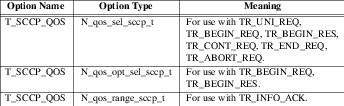
Quality of service struct N_qos_sel_sccp_t has the following fields:
- n_qos_type
This is the NPI Quality of Service structure type and is always set to
N_QOS_SEL_SCCP,N_QOS_OPT_SEL_SCCP, orN_QOS_RANGE_SCCP.- protocol_class
This is the protocol class. The protocol_class field can be one of the following:
-
N_QOS_PCLASS_0(SCCP connectionless protocol class 0), -
N_QOS_PCLASS_1(for SCCP connectionless protocol class 1), -
N_QOS_PCLASS_2(for SCCP connection-oriented protocol class 2), -
N_QOS_PCLASS_3(for SCCP connection-oriented protocol class 3) or -
QOS_UNKNOWN.
N_QOS_PCLASS_2andN_QOS_PCLASS_3are not applicable to TCAP.-
- option_flags
If the options_flags field has bit
N_QOS_OPT_RETERRset then the SCCP will return the PDU on error.- importance
This is the importance of the message for consideration for SCCP flow control. This value is not normally set by the user. It can be any integer number from 0 to 7, or
QOS_UNKNOWN.- sequence_selection
This affects the SLS (Signalling Link Selection) value that will be used for protocol classes
N_QOS_PCLASS_0andN_QOS_PCLASS_1. This value is not normally set by the user and can be an integer value orQOS_UNKNOWN.- message_priority
This affects the MP (Message Priority) value that will be used for specific messages in all protocol classes. This value is not normally set by the use and can be any integer value from 0 to 3 or the value
QOS_UNKNOWN.
Supported Services
Common Transaction Services
Information Service
TR_INFO_REQ
TR_INFO_ACK
Parameters
The following discusses the values which may be returned in a TR_INFO_ACK primitive in
response to a TR_INFO_REQ primitive.
- ASDU_size
Depending on the underlying SCCP layer, TCAP can have effectively no limit to the amount of user data that can be sent in a particular transaction. Protocol variants or versions of SCCP that support XUDT and segmentation-reassembly of protocol class 0 or 1 messages will set ASDU_size to
T_INFINITE(‘-1’). For protocol variants of SCCP or other underlying network providers that do not support segmentation/reassembly of long messages, the provider wills et ASDU_size to the maximum size (number of octets) of user data that can be guaranteed transferred when associated with a singleTR_BEGIN_RESorTR_CONT_REQmessage.- EASDU_size
TCAP has no expedited data service and the value of EASDU_size is set to
T_UNKNOWN(‘-2’).- CDATA_size
TCAP can send user data with the initial Begin (Query) or first Continue (Conversation) package and can also send Application Context and User Information in either package. These messages correspond to TR-BEGIN and the first TR-CONTINUE after receiving a TR-BEGIN and they correspond to
TR_BEGIN_REQandTR_BEGIN_RES. Because the underlying SCCP connectionless network may support unlimited size NSDUs, this value may be set toT_INFINITE(‘-1’) or may be set to the maximum amount of user data (including Application Context, User Information and user data) that can be sent or received in either package. This informs the user as to what size to make data buffers associated with transaction begin indications and confirmations (TR_BEGIN_IND,TR_BEGIN_CON) and how much data can be sent with transaction begin requests and responses (TR_BEGIN_REQ,TR_BEGIN_RES).- DDATA_size
TCAP can send transaction end data (user data) with the final End (Response) package. These messages correspond to the TR-END primitive and the
TR_END_REQorTR_END_IND. Again, because the underlying SCCP connectionless network may support unlimited size NSDUs, this value may be set toT_INFINITE(‘-1’) or may be set to the maximum amount of transaction end data that can be sent or received in the End (Response) package. This informs the user as to what size to make data buffers associated with transaction end indications (TR_END_IND) and how much data can be sent with transaction end requests (TR_END_REQ).- ADDR_size
This is the maximum TCAP address size that can be communicated across the interface. This address size is the maximum size of the defined SCCP address structure (‘sizeof sccp_addr_t’) that also will include address digits up to a maximum of
SCCP_MAX_ADDR_LENGTHoctets of digits. This informs the user as to what size it should reserver for control buffers so as to receive control information without buffer truncation.- OPT_size
This is the maximum size of the options field used in any TRI message (see TRI Primitives) and is the sum of the maximum option sizes of one of each of the options that can occur together. This informs the user as to what size it should reserve for control buffers to ensure that received control messages that include options cna be contained within the buffer without truncation.
- TIDU_size
Although a TCAP provider can support unlimited ASDU size, it cannot normally support unlimited TIDU size. This is because the underlying SCCP NSDU may be limited in size. The TCAP provider is not responsible for segmenting user data sequences offered to the provider from the user in an
M_DATAmessage chain. This is the maximum size of the TIDU which corresponds to the maximum size of the underlying NSDU. Because the underlying SCCP provider may have no limit on the NSDU size (i.e, it supports segmentation of connectionless NSDUs) this may be more in the manner of a optimal recommendation to the user rather than an absolute maximum. Because of this, a given TCAP provider might not reject TIDUs which are larger than this value.- SERV_type
There are two service types supported by a transaction provider: connection-oriented transaction service (COTS) and connectionless transaction service (CLTS). CLTS is a connectionless unidirectional transaction service with no error notification. COTS is a connection-oriented transaction services with or without error notification. The value reflected here is dependent on the setting of option
T_ACSE_PCLASSorT_TCAP_OCLASS.- CURRENT_state
Provides the current state of the transaction interface. TCAP providers use the same states as other TRI providers.
- PROVIDER_flag
Unused.
- TRI_version
Set to the current version.
Address service
TR_ADDR_REQ
TR_ADDR_ACK
Bind Service
TR_BIND_REQ
TR_BIND_ACK
Options Management Service
TR_OPTMGMT_REQ
TR_OPTMGMT_ACK
Connection-Oriented Transaction Services
Transaction Begin
TR_BEGIN_REQ
TR_BEGIN_IND
TR_BEGIN_RES
TR_BEGIN_CON
Transaction Continue
TR_CONT_REQ
TR_CONT_IND
Transaction End
TR_ABORT_REQ
TR_ABORT_IND
TR_END_REQ
TR_END_IND
Connectionless Transaction Services
TR_UNI_REQ
TR_UNI_IND
TR_NOTICE_IND
Addendum for ANSI Conformance
This section describes the formats and rules that are specified to ANSI T1.114 operation. The addendum must be used along with the generic TRI as defined in the main document when implementing a TR provider that will be configured with the ANSI T1.114 (TCAP) Transaction Sub-Layer.18
Quality of Service: Model and Description
The “Quality of Service” characteristics apply to both connection-oriented and connectionless transaction services.
QoS Overview
QoS (Quality of Service) is described in terms of QoS parameters. There are two types of QoS parameters:
- Those that are “negotiated” on a per-association basis during transaction association establishment.19
- Those that are not “negotiated” and their values are selected or determined by local management methods.
TRI Primitives: Rules for ANSI T1.114 Conformance
The following rules apply to the TRI primitives for ANSI T1.114 (TCAP) compatibility:
Addressing
TCAP uses SCCP formatted addresses instead of ISO Presentation Layer addresses.
Address Format
The address format for a TCAP address is as follows:
Options
TCAP Level Options
Application Context Name
User Information
SCCP Level Options
SCCP Quality of Service Options
The TCAP interface uses protocol level T_SS7_SCCP for options at the SCCP level. SCCP QoS
parameters are communicated to the underlying transaction provider using the option name
T_SCCP_QOS. There are three QoS structure that can be used in this fashion as follows:
Quality of service struct N_qos_sel_sccp_t has the following fields:
- n_qos_type
This is the NPI Quality of Service structure type and is always set to
N_QOS_SEL_SCCP,N_QOS_OPT_SEL_SCCP, orN_QOS_RANGE_SCCP.- protocol_class
This is the protocol class. The protocol_class field can be one of the following:
-
N_QOS_PCLASS_0(SCCP connectionless protocol class 0), -
N_QOS_PCLASS_1(for SCCP connectionless protocol class 1), -
N_QOS_PCLASS_2(for SCCP connection-oriented protocol class 2), -
N_QOS_PCLASS_3(for SCCP connection-oriented protocol class 3) or -
QOS_UNKNOWN.
N_QOS_PCLASS_2andN_QOS_PCLASS_3are not applicable to TCAP.-
- option_flags
If the options_flags field has bit
N_QOS_OPT_RETERRset then the SCCP will return the PDU on error.- importance
This is the importance of the message for consideration for SCCP flow control. This value is not normally set by the user. It can be any integer number from 0 to 7, or
QOS_UNKNOWN.- sequence_selection
This affects the SLS (Signalling Link Selection) value that will be used for protocol classes
N_QOS_PCLASS_0andN_QOS_PCLASS_1. This value is not normally set by the user and can be an integer value orQOS_UNKNOWN.- message_priority
This affects the MP (Message Priority) value that will be used for specific messages in all protocol classes. This value is not normally set by the use and can be any integer value from 0 to 3 or the value
QOS_UNKNOWN.
Supported Services
Common Transaction Services
Information Service
TR_INFO_REQ
TR_INFO_ACK
Parameters
The following discusses the values which may be returned in a TR_INFO_ACK
primitive in response to a TR_INFO_REQ primitive.
- ASDU_size
Depending on the underlying SCCP layer, TCAP can have effectively no limit to the amount of user data that can be sent in a particular transaction. Protocol variants or versions of SCCP that support XUDT and segmentation-reassembly of protocol class 0 or 1 messages will set ASDU_size to
T_INFINITE(‘-1’). For protocol variants of SCCP or other underlying network providers that do not support segmentation/reassembly of long messages, the provider wills et ASDU_size to the maximum size (number of octets) of user data that can be guaranteed transferred when associated with a singleTR_BEGIN_RESorTR_CONT_REQmessage.- EASDU_size
TCAP has no expedited data service and the value of EASDU_size is set to
T_UNKNOWN(‘-2’).- CDATA_size
TCAP can send user data with the initial Begin (Query) or first Continue (Conversation) package and can also send Application Context and User Information in either package. These messages correspond to TR-BEGIN and the first TR-CONTINUE after receiving a TR-BEGIN and they correspond to
TR_BEGIN_REQandTR_BEGIN_RES. Because the underlying SCCP connectionless network may support unlimited size NSDUs, this value may be set toT_INFINITE(‘-1’) or may be set to the maximum amount of user data (including Application Context, User Information and user data) that can be sent or received in either package. This informs the user as to what size to make data buffers associated with transaction begin indications and confirmations (TR_BEGIN_IND,TR_BEGIN_CON) and how much data can be sent with transaction begin requests and responses (TR_BEGIN_REQ,TR_BEGIN_RES).- DDATA_size
TCAP can send transaction end data (user data) with the final End (Response) package. These messages correspond to the TR-END primitive and the
TR_END_REQorTR_END_IND. Again, because the underlying SCCP connectionless network may support unlimited size NSDUs, this value may be set toT_INFINITE(‘-1’) or may be set to the maximum amount of transaction end data that can be sent or received in the End (Response) package. This informs the user as to what size to make data buffers associated with transaction end indications (TR_END_IND) and how much data can be sent with transaction end requests (TR_END_REQ).- ADDR_size
This is the maximum TCAP address size that can be communicated across the interface. This address size is the maximum size of the defined SCCP address structure (‘sizeof sccp_addr_t’) that also will include address digits up to a maximum of
SCCP_MAX_ADDR_LENGTHoctets of digits. This informs the user as to what size it should reserver for control buffers so as to receive control information without buffer truncation.- OPT_size
This is the maximum size of the options field used in any TRI message (see TRI Primitives) and is the sum of the maximum option sizes of one of each of the options that can occur together. This informs the user as to what size it should reserve for control buffers to ensure that received control messages that include options cna be contained within the buffer without truncation.
- TIDU_size
Although a TCAP provider can support unlimited ASDU size, it cannot normally support unlimited TIDU size. This is because the underlying SCCP NSDU may be limited in size. The TCAP provider is not responsible for segmenting user data sequences offered to the provider from the user in an
M_DATAmessage chain. This is the maximum size of the TIDU which corresponds to the maximum size of the underlying NSDU. Because the underlying SCCP provider may have no limit on the NSDU size (i.e, it supports segmentation of connectionless NSDUs) this may be more in the manner of a optimal recommendation to the user rather than an absolute maximum. Because of this, a given TCAP provider might not reject TIDUs which are larger than this value.- SERV_type
There are two service types supported by a transaction provider: connection-oriented transaction service (COTS) and connectionless transaction service (CLTS). CLTS is a connectionless unidirectional transaction service with no error notification. COTS is a connection-oriented transaction services with or without error notification. The value reflected here is dependent on the setting of option
T_ACSE_PCLASSorT_TCAP_OCLASS.- CURRENT_state
Provides the current state of the transaction interface. TCAP providers use the same states as other TRI providers.
- PROVIDER_flag
Unused.
- TRI_version
Set to the current version.
Address service
TR_ADDR_REQ
TR_ADDR_ACK
Bind Service
TR_BIND_REQ
TR_BIND_ACK
Options Management Service
TR_OPTMGMT_REQ
TR_OPTMGMT_ACK
Connection-Oriented Transaction Services
Transaction Begin
TR_BEGIN_REQ
TR_BEGIN_IND
TR_BEGIN_RES
TR_BEGIN_CON
Transaction Continue
TR_CONT_REQ
TR_CONT_IND
Transaction End
TR_ABORT_REQ
TR_ABORT_IND
TR_END_REQ
TR_END_IND
Connectionless Transaction Services
TR_UNI_REQ
TR_UNI_IND
TR_NOTICE_IND
Addendum for ETSI Conformance
ETSI Quality of Service Model and Description
QoS Overview
TRI Primitives: Rules for ETSI ETS 300 287 Conformance
Addressing
Address Format
Options
TCAP Level Options
SCCP Level Options
ETSI Supported Services
Common Transaction Services
Information service
TR_INFO_REQ
TR_INFO_ACK
Address service
TR_ADDR_REQ
TR_ADDR_ACK
Bind Service
TR_BIND_REQ
TR_BIND_ACK
Options Management Service
TR_OPTMGMT_REQ
TR_OPTMGMT_ACK
Connection-Oriented Transaction Services
Transaction Begin
TR_BEGIN_REQ
TR_BEGIN_IND
TR_BEGIN_RES
TR_BEGIN_CON
Transaction Continue
TR_CONT_REQ
TR_CONT_IND
Transaction End
TR_ABORT_REQ
TR_ABORT_IND
TR_END_REQ
TR_END_IND
Connectionless Transaction Services
TR_UNI_REQ
TR_UNI_IND
TR_NOTICE_IND
Appendix A Mapping TRI Primitives
A.1 Mapping TRI Primitives to ITU-T Q.771
A.2 Mapping TRI Primitives to ANSI T1.114
A.3 Mapping TRI Primitives to ITU-T X.219
A.3.1 State Mapping
A.3.2 Primitive Mapping
A.3.2.1 A-ASSOCIATE
Request
Indication
Response
Confirm
A.3.2.2 A-RELEASE
Request
Indication
Response
Confirm
A.3.2.3 A-ABORT
Request
Indication
A.3.2.4 A-P-ABORT
Indication
A.3.2.5 A-UNIT-DATA
Request
Indication
A.3.3 Parameter Mapping
Application Context Name
Calling AP Title
Calling AE Qualifier
Calling AP Invocation-identifier
Calling AE Invocation-identifier
Called AP Title
Called AE Qualifier
Called AP Invocation-identifier
Called AE Invocation-identifier
Responding AP Title
Responding AE Qualifier
Responding AP Invocation-identifier
Responding AE Invocation-identifier
User Information
Result
Result Source
Diagnostic
Calling Presentation Address
Called Presentation Address
Responding Presentation Address
Presentation Context Definition List
Presentation Context Definition Result List
Default Presentation Context Name
Default Presentation Context Result
Quality of Service
Session Requirements
Initial Sycnhronization Point Serial Number
Initial Assignment of Tokens
Session-connection Identifier
Reason
User Information
Result
Abort Source
User Information
Provider Reason
Authentication
Authentication-mechanism name
Authentication-value
ACSE Requriements
Diagnostic
Application Context Identifier
Application Context Name List
Appendix B State/Event Tables
Appendix C Primitive Precedence Tables
Appendix D TRI Header File Listing
#ifndef __SS7_TR_H__
#define __SS7_TR_H__
#define TR_INFO_REQ 1 /* Information request */
#define TR_BIND_REQ 2 /* Bind to network address */
#define TR_UNBIND_REQ 3 /* Unbind from network address */
#define TR_OPTMGMT_REQ 4 /* Options management request */
#define TR_UNI_REQ 5 /* Unidirectional request */
#define TR_BEGIN_REQ 6 /* Begin transaction request */
#define TR_BEGIN_RES 7 /* Begin transaction response */
#define TR_CONT_REQ 8 /* Continue transaction request */
#define TR_END_REQ 9 /* End transaction request */
#define TR_ABORT_REQ 10 /* Abort transaction request */
#define TR_ADDR_REQ 11 /* Address request */
#define TR_CAPABILITY_REQ 12 /* Capability request */
#define TR_INFO_ACK 13 /* Information acknowledgement */
#define TR_BIND_ACK 14 /* Bound to network address */
#define TR_OK_ACK 15 /* Success acknowledgement */
#define TR_ERROR_ACK 16 /* Error acknowledgement */
#define TR_OPTMGMT_ACK 17 /* Options management acknowledgement */
#define TR_UNI_IND 18 /* Unidirectional indication */
#define TR_BEGIN_IND 19 /* Begin transaction indication */
#define TR_BEGIN_CON 20 /* Begin transaction confirmation */
#define TR_CONT_IND 21 /* Continue transaction indication */
#define TR_END_IND 22 /* End transaction indication */
#define TR_ABORT_IND 23 /* Abort transaction indication */
#define TR_NOTICE_IND 24 /* Error indication */
#define TR_ADDR_ACK 25 /* Address acknowledgement */
#define TR_CAPABILITY_ACK 26 /* Capability acknowledgement */
#define TR_COORD_REQ 35 /* coordinated withdrawal request */
#define TR_COORD_RES 36 /* coordinated withdrawal response */
#define TR_COORD_IND 37 /* coordinated withdrawal indication */
#define TR_COORD_CON 38 /* coordinated withdrawal confirmation */
#define TR_STATE_REQ 39 /* subsystem state request */
#define TR_STATE_IND 40 /* subsystem state indication */
#define TR_PCSTATE_IND 41 /* pointcode state indication */
#define TR_TRAFFIC_IND 42 /* traffic mix indication */
#define TR_QOS_SEL1 0x0501
typedef struct {
t_scalar_t type; /* Always TR_QOS_SEL1 */
t_scalar_t flags; /* Return option */
t_scalar_t seq_ctrl; /* Sequence Control */
t_scalar_t priority; /* Message priority */
} TR_qos_sel1_t;
/*
* TRPI interface states
*/
#define TRS_UNBND 0 /**< Unbound. */
#define TRS_WACK_BREQ 1 /**< Waiting for TR_BIND_REQ ack. */
#define TRS_WACK_UREQ 2 /**< Waiting for TR_UNBIND_REQ ack. */
#define TRS_IDLE 3 /**< Idle. */
#define TRS_WACK_OPTREQ 4 /**< Waiting for TR_OPTMGMT_REQ ack. */
#define TRS_WACK_CREQ 5 /**< Waiting for TR_BEGIN_REQ ack. */
#define TRS_WCON_CREQ 6 /**< Waiting for TR_BEGIN_REQ confirmation. */
#define TRS_WRES_CIND 7 /**< Waiting for TR_BEGIN_IND response. */
#define TRS_WACK_CRES 8 /**< Waiting for TR_BEGIN_RES ack. */
#define TRS_DATA_XFER 9 /**< Data transfer. */
#define TRS_WACK_DREQ6 10 /**< Waiting for TR_END_REQ/TR_ABORT_REQ ack. */
#define TRS_WACK_DREQ7 11 /**< Waiting for TR_END_REQ/TR_ABORT_REQ ack. */
#define TRS_WACK_DREQ9 12 /**< Waiting for TR_END_REQ/TR_ABORT_REQ ack. */
#define TRS_NOSTATES 13
/*
* TR_ERROR_ACK error return code values
*/
#define TRBADADDR 1 /* Incorrect address format/illegal address information */
#define TRBADOPT 2 /* Options in incorrect format or contain illegal information */
#define TRACCESS 3 /* User did not have proper permissions */
#define TRNOADDR 5 /* TR Provider could not allocate address */
#define TROUTSTATE 6 /* Primitive was issues in wrong sequence */
#define TRBADSEQ 7 /* Sequence number in primitive was incorrect/illegal */
#define TRSYSERR 8 /* UNIX system error occurred */
#define TRBADDATA 10 /* User data spec. outside range supported by TR provider */
#define TRBADFLAG 16 /* Flags specified in primitive were illegal/incorrect */
#define TRNOTSUPPORT 18 /* Primitive type not supported by the TR provider */
#define TRBOUND 19 /* Illegal second attempt to bind listener or default listener */
#define TRBADQOSPARAM 20 /* QOS values specified are outside the range supported by the TR provider */
#define TRBADQOSTYPE 21 /* QOS structure type specified is not supported by the TR provider */
#define TRBADTOKEN 22 /* Token used is not associated with an open stream */
#define TRNOPROTOID 23 /* Protocol id could not be allocated */
/*
* ASSOC_flags - association flags
*/
#define TR_PERMISSION (1<<0) /* permission to respond */
/*
* TR_INFO_REQ:- one M_PROTO or M_PCPROTO message block.
*/
typedef struct TR_info_req {
t_scalar_t PRIM_type; /* Always TR_INFO_REQ */
} TR_info_req_t;
/*
* TR_INFO_ACK:- one M_PCPROTO message block.
*/
typedef struct TR_info_ack {
t_scalar_t PRIM_type; /* Always TR_INFO_ACK */
t_scalar_t TSDU_size; /* maximum TR_CONT_REQ data size */
t_scalar_t ETSDU_size; /* maximum TR_UNI_REQ data size */
t_scalar_t CDATA_size; /* maximum TR_BEGIN_REQ data size */
t_scalar_t DDATA_size; /* maximum TR_END_REQ data size */
t_scalar_t ADDR_size; /* address size */
t_scalar_t OPT_size; /* maximum options size */
t_scalar_t TIDU_size; /* maximum SCCP-fragment data size */
t_scalar_t SERV_type; /* service type */
t_scalar_t CURRENT_state; /* current state */
t_scalar_t PROVIDER_flag; /* type of TR provider */
t_scalar_t TRPI_version; /* version # of trpi that is supported */
} TR_info_ack_t;
/*
* SERV_type - service type
*/
#define TR_STRUCTURED (1<<0) /* structured dialogues */
#define TR_UNSTRUCTURED (1<<1) /* unstructured dialogues */
/*
* PROVIDER_flag - provider flags
*/
#define TR_ITUT (1<<9) /* ITU-T based APPLICATION TCAP */
#define TR_ANSI (1<<10) /* ANSI based PRIVATE TCAP */
/*
* TR_BIND_REQ:- one M_PROTO message block.
*/
typedef struct TR_bind_req {
t_scalar_t PRIM_type; /* Always TR_BIND_REQ */
t_scalar_t ADDR_length; /* address length */
t_scalar_t ADDR_offset; /* address offset */
t_uscalar_t XACT_number; /* maximum outstanding transaction reqs. */
t_scalar_t BIND_flags; /* bind flags */
} TR_bind_req_t;
/*
* TR_BIND_ACK:- one M_PCPROTO message block.
*/
typedef struct TR_bind_ack {
t_scalar_t PRIM_type; /* Always TR_BIND_ACK */
t_scalar_t ADDR_length; /* address length */
t_scalar_t ADDR_offset; /* address offset */
t_uscalar_t XACT_number; /* open transactions */
t_uscalar_t TOKEN_value; /* value of "token" assigned to stream */
} TR_bind_ack_t;
/*
* TR_ADDR_REQ:- one M_PROTO or M_PCPROTO message block.
*/
typedef struct TR_addr_req {
t_scalar_t PRIM_type; /* Always TR_ADDR_REQ */
t_scalar_t TRANS_id; /* Transaction id */
} TR_addr_req_t;
/*
* TR_ADDR_ACK:- one M_PCPROTO or M_PCPROTO message block.
*/
typedef struct TR_addr_ack {
t_scalar_t PRIM_type; /* Always TR_ADDR_ACK */
t_scalar_t LOCADDR_length; /* local address length */
t_scalar_t LOCADDR_offset; /* local address offset */
t_scalar_t REMADDR_length; /* remote address length */
t_scalar_t REMADDR_offset; /* remote address offset */
t_scalar_t TRANS_id; /* Transaction id */
} TR_addr_ack_t;
/*
* TR_CAPABILITY_REQ:- one M_PROTO or M_PCPROTO message block.
*/
typedef struct TR_capability_req {
t_scalar_t PRIM_type; /* Always TR_CAPABILITY_REQ */
t_uscalar_t CAP_bits1; /* Capability bits 1 */
} TR_capability_req_t;
/*
* TR_CAPABILITY_ACK:- of one M_PROTO or M_PCPROTO message block.
*
* Note that TRANS_id returns a spare transaction id that will not be allocated for
* some period of time in the future and can be used within a reasonable period by
* the caller.
*/
typedef struct TR_capability_ack {
t_scalar_t PRIM_type; /* Always TR_CAPABILITY_ACK */
t_uscalar_t CAP_bits1; /* Capability bits #1 */
struct TR_info_ack INFO_ack; /* Info acknowledgement. */
t_uscalar_t TOKEN_value; /* Accept token value. */
t_uscalar_t TRANS_id; /* Transaction id. */
} TR_capability_ack_t;
#define TRC1_INFO (1<<0) /* Request/contains TR_info_ack. */
#define TRC1_TOKEN (1<<1) /* Request/contains acceptor token. */
#define TRC1_TRANS_ID (1<<1) /* Request/contains TRANS_id. */
#define TRC1_CAP_BITS2 (1<<31) /* Contains extensions (unused). */
/*
* TR_UNBIND_REQ:- one M_PROTO message block.
*/
typedef struct TR_unbind_req {
t_scalar_t PRIM_type; /* Always TR_UNBIND_REQ */
} TR_unbind_req_t;
/*
* TR_OPTMGMT_REQ:- one M_PROTO or M_PCPROTO message block.
*/
typedef struct TR_optmgmt_req {
t_scalar_t PRIM_type; /* Always T_OPTMGMT_REQ */
t_scalar_t OPT_length; /* options length */
t_scalar_t OPT_offset; /* options offset */
t_scalar_t MGMT_flags; /* options data flags */
} TR_optmgmt_req_t;
/*
* TR_OPTMGMT_ACK:- one M_PCPROTO message block.
*/
typedef struct TR_optmgmt_ack {
t_scalar_t PRIM_type; /* Always T_OPTMGMT_ACK */
t_scalar_t OPT_length; /* options length */
t_scalar_t OPT_offset; /* options offset */
t_scalar_t MGMT_flags; /* options data flags */
} TR_optmgmt_ack_t;
/*
* TR_OK_ACK:- one M_PCPROTO message block.
*/
typedef struct TR_ok_ack {
t_scalar_t PRIM_type; /* Always T_OK_ACK */
t_scalar_t CORRECT_prim; /* correct primitive */
} TR_ok_ack_t;
/*
* TR_ERROR_ACK:- one M_PCPROTO message block.
*/
typedef struct TR_error_ack {
t_scalar_t PRIM_type; /* Always T_ERROR_ACK */
t_scalar_t ERROR_prim; /* primitive in error */
t_scalar_t TRPI_error; /* TRPI error code */
t_scalar_t UNIX_error; /* UNIX error code */
} TR_error_ack_t;
/*
* TR_UNI_REQ. This primitive consists of one M_PROTO message block followed
* by one or more M_DATA blocks containing the dialogue portion and component
* sequence for the message.
*/
typedef struct TR_uni_req {
t_scalar_t PRIM_type; /* Always TR_UNI_REQ */
t_scalar_t DEST_length; /* Destination address length */
t_scalar_t DEST_offset; /* Destination address offset */
t_scalar_t ORIG_length; /* Originating address length */
t_scalar_t ORIG_offset; /* Originating address offset */
t_scalar_t OPT_length; /* Options structure length */
t_scalar_t OPT_offset; /* Options structure offset */
} TR_uni_req_t;
/*
* TR_UNI_IND. This primitive consists of one M_PROTO message block followed
* by one or more M_DATA blocks containing the dialogue portion and component
* sequence for the message. Options may contain SCCP quality of service options
* and TCAP protocol variant.
*/
typedef struct TR_uni_ind {
t_scalar_t PRIM_type; /* Always TR_UNI_REQ */
t_scalar_t TRANS_id; /* Transaction id */
t_scalar_t DEST_length; /* Destination address length */
t_scalar_t DEST_offset; /* Destination address offset */
t_scalar_t ORIG_length; /* Originating address length */
t_scalar_t ORIG_offset; /* Originating address offset */
t_scalar_t OPT_length; /* Options structure length */
t_scalar_t OPT_offset; /* Options structure offset */
} TR_uni_ind_t;
/*
* TR_BEGIN_REQ. This primitive consists of one M_PROTO message block followed by
* zero or more M_DATA blocks containing the dialogue portion and component sequence
* of the transaction. Options may contain SCCP quality of service parameters and
* TCAP protocol variant.
*/
typedef struct TR_begin_req {
t_scalar_t PRIM_type; /* Always TR_BEGIN_REQ */
t_scalar_t TRANS_id; /* Transaction id */
t_scalar_t DEST_length; /* Destination address length */
t_scalar_t DEST_offset; /* Destination address offset */
t_scalar_t ORIG_length; /* Originating address length */
t_scalar_t ORIG_offset; /* Originating address offset */
t_scalar_t OPT_length; /* Options structure length */
t_scalar_t OPT_offset; /* Options structure offset */
t_scalar_t ASSOC_flags; /* Association flags */
} TR_begin_req_t;
/*
* TR_BEGIN_IND:- one M_PROTO message block followed by one or more M_DATA message
* blocks containing the dialogue portion and component sequence for the
* transaction. Options may contain SCCP quality of service parameters and TCAP
* protocol variant.
*/
typedef struct TR_begin_ind {
t_scalar_t PRIM_type; /* Always TR_BEGIN_IND */
t_scalar_t TRANS_id; /* Transaction id */
t_scalar_t DEST_length; /* Destination address length */
t_scalar_t DEST_offset; /* Destination address offset */
t_scalar_t ORIG_length; /* Originating address length */
t_scalar_t ORIG_offset; /* Originating address offset */
t_scalar_t OPT_length; /* Options structure length */
t_scalar_t OPT_offset; /* Options structure offset */
t_scalar_t ASSOC_flags; /* Association flags */
} TR_begin_ind_t;
/*
* TR_BEGIN_RES:- one M_PROTO message block followed by one or more M_DATA message
* blocks containing the dialogue portion and component sequence for the
* transaction. Options may contain SCCP quality of service parameters.
*
* This primitive represents the first TR-CONTINUE response to a TR-BEGIN
* indication.
*/
typedef struct TR_begin_res {
t_scalar_t PRIM_type; /* Always TR_BEGIN_RES */
t_scalar_t TRANS_id; /* Transaction id */
t_scalar_t ORIG_length; /* Originating address length */
t_scalar_t ORIG_offset; /* Originating address offset */
t_scalar_t OPT_length; /* Options structure length */
t_scalar_t OPT_offset; /* Options structure offset */
t_scalar_t ASSOC_flags; /* Association flags */
t_scalar_t ACCEPTOR_id; /* Token of accepting stream */
} TR_begin_res_t;
/*
* TR_BEGIN_CON: - one M_PROTO message block followed by one or more M_DATA message
* blocks containing the dialogue portion and component sequence for the
* transaction. Options may contain SCCP quality of service parameters.
*
* This primitive represents the first TR-CONTINUE configuration of a
* TR-BEGIN request.
*/
typedef struct TR_begin_con {
t_scalar_t PRIM_type; /* Always TR_BEGIN_CON */
t_scalar_t TRANS_id; /* Transaction id */
t_scalar_t ORIG_length; /* Originating address length */
t_scalar_t ORIG_offset; /* Originating address offset */
t_scalar_t OPT_length; /* Options structure length */
t_scalar_t OPT_offset; /* Options structure offset */
t_scalar_t ASSOC_flags; /* Association flags */
} TR_begin_con_t;
/*
* TR_CONT_REQ: - one M_PROTO message block followed by one or more M_DATA message
* blocks containing the dialogue portion and component sequence for the
* transaction. Options may contain SCCP quality of service parameters.
*/
typedef struct TR_cont_req {
t_scalar_t PRIM_type; /* Always TR_CONT_REQ */
t_scalar_t TRANS_id; /* Transaction id */
t_scalar_t OPT_length; /* Options structure length */
t_scalar_t OPT_offset; /* Options structure offset */
t_scalar_t ASSOC_flags; /* Association flags */
} TR_cont_req_t;
/*
* TR_CONT_IND:- one M_PROTO message block followed by one or more M_DATA message
* blocks contianing the dialogue oprtion and component sequence for the
* transaction. Options may contain SCCP quality of service parameters.
*/
typedef struct TR_cont_ind {
t_scalar_t PRIM_type; /* Always TR_CONT_IND */
t_scalar_t TRANS_id; /* Transaction id */
t_scalar_t OPT_length; /* Options structure length */
t_scalar_t OPT_offset; /* Options structure offset */
t_scalar_t ASSOC_flags; /* Association flags */
} TR_cont_ind_t;
/*
* TR_END_REQ:- one M_PROTO message block followed by zero or more M_DATA message
* blocks containing the dialogue portion and component sequence for the
* transaction. Options may contain SCCP quality of service parameters. Attached
* M_DATA message blocks and SCCP QoS parameters are ignored for prearranged
* termination scenarios.
*/
typedef struct TR_end_req {
t_scalar_t PRIM_type; /* Always TR_END_REQ */
t_scalar_t TRANS_id; /* Transaction id */
t_scalar_t TERM_scenario; /* Termination scenario */
t_scalar_t OPT_length; /* Options structure length */
t_scalar_t OPT_offset; /* Options structure offset */
} TR_end_req_t;
/*
* TERM_scenario - termination scenarios
*/
#define TR_TERM_UNSPECIFIED 0 /* termination unspecified */
#define TR_TERM_BASIC 1 /* termination basic */
#define TR_TERM_PREARRANGED 2 /* termination prearranged */
/*
* TR_END_IND:- one M_PROTO message block followed by zero or more M_DATA message
* blocks containing the dialogue portion and component sequence for the
* transaction. Options may contain SCCP quality of service parameters.
*/
typedef struct TR_end_ind {
t_scalar_t PRIM_type; /* Always TR_END_IND */
t_scalar_t TRANS_id; /* Transaction id */
t_scalar_t ORIG_length; /* Originating address length */
t_scalar_t ORIG_offset; /* Originating address offset */
t_scalar_t OPT_length; /* Options structure length */
t_scalar_t OPT_offset; /* Options structure offset */
} TR_end_ind_t;
/*
* TR_ABORT_REQ
*/
typedef struct TR_abort_req {
t_scalar_t PRIM_type; /* Always TR_ABORT_REQ */
t_scalar_t TRANS_id; /* Transaction id */
t_scalar_t ABORT_cause; /* Cause of the abort */
t_scalar_t OPT_length; /* Options structure length */
t_scalar_t OPT_offset; /* Options structure offset */
} TR_abort_req_t;
/*
* TR_ABORT_IND.
*/
typedef struct TR_abort_ind {
t_scalar_t PRIM_type; /* Always TR_ABORT_IND */
t_scalar_t TRANS_id; /* Transaction id */
t_scalar_t OPT_length; /* Options structure length */
t_scalar_t OPT_offset; /* Options structure offset */
t_scalar_t ABORT_cause; /* Cause of the abort */
t_scalar_t ORIGINATOR; /* Originator P or U */
} TR_abort_ind_t;
/*
* ABORT_cause - abort causes
*/
/* [APPLICATION 10] IMPLICIT INTEGER (0x4a01xx) */
#define TR_A_UNREC_MSG_TYPE 0x00 /* unrecognized message type */
#define TR_A_UNREC_TRANS_ID 0x01 /* unrecognized xact id */
#define TR_A_BAD_XACT_PORTION 0x02 /* badly formatted xact portion */
#define TR_A_INCORRECT_XACT_PORTION 0x03 /* incorrect xact portion */
#define TR_A_RESOURCE_LIMITATION 0x04 /* resource limitation */
/* [PRIVATE 27] IMPLICIT INTEGER (0xd701xx) */
#define TR_P_UNREC_PKG_TYPE 0x01 /* unrecognized package type */
#define TR_P_INCORRECT_XACT_PORTION 0x02 /* incorrect xact portion */
#define TR_P_BAD_XACT_PORTION 0x03 /* badly structured xact portion */
#define TR_P_UNASSIGNED_RESP_TRANS_ID 0x04 /* unassigned responding xact id */
#define TR_P_PERM_TO_RELEASE_PROB 0x05 /* permission to release problem */
#define TR_P_RESOURCE_UNAVAIL 0x06 /* resource unavailable */
#define TR_P_UNREC_DIALOG_PORTION_ID 0x07 /* unrecognized dialog portion id */
#define TR_P_BAD_DIALOG_PORTION 0x08 /* badly structured dialog portion */
#define TR_P_MISSING_DIALOG_PORTION 0x09 /* missing dialog portion */
#define TR_P_INCONSIST_DIALOG_PORTION 0x0a /* inconsistent dialog portion */
/*
* ORIGINATOR - originator of abort
*/
#define TR_UNKNOWN 0x00 /* originator unknown */
#define TR_USER 0x01 /* remote user */
#define TR_PROVIDER 0x02 /* local or remote provider */
/*
* TR_NOTICE_IND.
*/
typedef struct TR_notice_ind {
t_scalar_t PRIM_type; /* Always TR_NOTICE_IND */
t_scalar_t TRANS_id; /* Transaction id */
t_scalar_t DEST_length; /* Destination address length */
t_scalar_t DEST_offset; /* Destination address offset */
t_scalar_t ORIG_length; /* Originating address length */
t_scalar_t ORIG_offset; /* Originating address offset */
t_scalar_t REPORT_cause; /* SCCP return cause */
} TR_notice_ind_t;
/*
* REPORT_cause - report causes
*
* These constants have the same value as the NPI-SCCP ERROR_types for N_UDERROR_IND and
* N_NOTICE_IND.
*/
#define TR_RC_NO_ADDRESS_TYPE_TRANSLATION 0x2000
#define TR_RC_NO_ADDRESS_TRANSLATION 0x2001
#define TR_RC_SUBSYSTEM_CONGESTION 0x2002
#define TR_RC_SUBSYSTEM_FAILURE 0x2003
#define TR_RC_UNEQUIPPED_USER 0x2004
#define TR_RC_MTP_FAILURE 0x2005
#define TR_RC_NETWORK_CONGESTION 0x2006
#define TR_RC_UNQUALIFIED 0x2007
#define TR_RC_MESSAGE_TRANSPORT_ERROR 0x2008
#define TR_RC_LOCAL_PROCESSING_ERROR 0x2009
#define TR_RC_NO_REASSEMBLY_AT_DESTINATION 0x200a
#define TR_RC_SCCP_FAILURE 0x200b
#define TR_RC_SCCP_HOP_COUNTER_VIOLATION 0x200c
#define TR_RC_SEGMENTATION_NOT_SUPPORTED 0x200d
#define TR_RC_SEGMENTATION_FAILURE 0x200e
#define TR_RC_MESSAGE_CHANGE_FAILURE 0x20f7
#define TR_RC_INVALID_INS_ROUTING_REQUEST 0x20f8
#define TR_RC_INVALID_INSI_ROUTING_REQUEST 0x20f9
#define TR_RC_UNAUTHORIZED_MESSAGE 0x20fa
#define TR_RC_MESSAGE_INCOMPATIBILITY 0x20fb
#define TR_RC_CANNOT_PERFORM_ISNI_CONSTRAINED_ROUTING 0x20fc
#define TR_RC_REDUNDANT_ISNI_CONSTRAINED_ROUTING_INFO 0x20fd
#define TR_RC_UNABLE_TO_PERFORM_ISNI_IDENTIFICATION 0x20fe
/*
* TR_COORD_REQ.
*/
typedef struct TR_coord_req {
t_scalar_t PRIM_type; /* alwyas TR_COORD_REQ */
t_scalar_t ADDR_length; /* affected subsystem */
t_scalar_t ADDR_offset;
} TR_coord_req_t;
/*
* TR_COORD_RES.
*/
typedef struct TR_coord_res {
t_scalar_t PRIM_type; /* always TR_COORD_RES */
t_scalar_t ADDR_length; /* affected subsystem */
t_scalar_t ADDR_offset;
} TR_coord_res_t;
/*
* TR_COORD_IND.
*/
typedef struct TR_coord_ind {
t_scalar_t PRIM_type; /* alwyas TR_COORD_IND */
t_scalar_t ADDR_length; /* affected subsystem */
t_scalar_t ADDR_offset;
t_scalar_t SMI; /* subsystem multiplicity indicator */
} TR_coord_ind_t;
/*
* TR_COORD_CON.
*/
typedef struct TR_coord_con {
t_scalar_t PRIM_type; /* always TR_COORD_CON */
t_scalar_t ADDR_length; /* affected subsystem */
t_scalar_t ADDR_offset;
t_scalar_t SMI; /* subsystem multiplicity indicator */
} TR_coord_con_t;
/*
* TR_STATE_REQ.
*/
typedef struct TR_state_req {
t_scalar_t PRIM_type; /* always TR_STATE_REQ */
t_scalar_t ADDR_length; /* affected subsystem */
t_scalar_t ADDR_offset;
t_scalar_t STATUS; /* user status */
} TR_state_req_t;
/*
* TR_STATE_IND.
*/
typedef struct TR_state_ind {
t_scalar_t PRIM_type; /* always TR_STATE_IND */
t_scalar_t ADDR_length; /* affected subsystem */
t_scalar_t ADDR_offset;
t_scalar_t STATUS; /* user status */
t_scalar_t SMI; /* subsystem multiplicity indicator */
} TR_state_ind_t;
/*
* SMI - subsystem multiplicity indicator
*
* These constants are the same as the values of the protocol field in ITU-T Rec. Q.713 (2001)
* and ANSI T1.112/2000.
*/
#define TR_SMI_MULTIPLICITY_UNKNOWN 0
#define TR_SMI_SOLITARY 1
#define TR_SMI_DUPLICATED 2
/*
* TR_PCSTATE_IND.
*/
typedef struct TR_pcstate_ind {
t_scalar_t PRIM_type; /* always TR_PCSTATE_IND */
t_scalar_t ADDR_length; /* affected point code */
t_scalar_t ADDR_offset;
t_scalar_t STATUS; /* status */
} TR_pcstate_ind_t;
/*
* STATUS - subsystem status for use in TR_STATE and TR_PCSTATE primitives.
*
* These constants and macros are the same as used by SCCP in N_UDERROR_IND reports. In the
* macros, the argument "cong" is a congestion status or restricted importance level from 0 to
* 8.
*/
/* these two are application only to TR_STATE primitives */
#define TR_STATUS_USER_IN_SERVICE 1
#define TR_STATUS_USER_OUT_OF_SERVICE 2
/* the following are applicable to TR_PCSTATE primitives */
#define TR_STATUS_REMOTE_SCCP_AVAILABLE 3
#define TR_STATUS_REMOTE_SCCP_UNAVAILABLE 4
#define TR_STATUS_REMOTE_SCCP_UNEQUIPPED 5
#define TR_STATUS_REMOTE_SCCP_INACCESSIBLE 6
#define TR_STATUS_REMOTE_SCCP_CONGESTED(cong) (7 + cong)
#define TR_STATUS_SIGNALLING_POINT_INACCESSIBLE 16
#define TR_STATUS_SIGNALLING_POINT_CONGESTED(cong) (17 + cong)
#define TR_STATUS_SIGNALLING_POINT_ACCESSIBLE 26
/*
* TR_TRAFFIC_IND
*/
typedef struct TR_traffic_ind {
t_scalar_t PRIM_type; /* always TR_TRAFFIC_IND */
t_scalar_t ADDR_length; /* affected user */
t_scalar_t ADDR_offset;
t_scalar_t TRAFFIC_mix; /* traffic mix */
} TR_traffic_ind_t;
/*
* TRAFFIC_mix - offered traffic mix
*
* These constants and macros are the same as used by NPI-SCCP in N_TRAFFIC_IND primitives.
*/
#define TR_TMIX_ALL_PREFFERED_NO_BACKUP 1
#define TR_TMIX_ALL_PREFERRED_SOME_BACKUP 2
#define TR_TMIX_ALL_PREFERRED_ALL_BACKUP 3
#define TR_TMIX_SOME_PREFERRED_NO_BACKUP 4
#define TR_TMIX_SOME_PREFERRED_SOME_BACKUP 5
#define TR_TMIX_NO_PREFERRED_NO_BACKUP 6
#define TR_TMIX_ALL 7
#define TR_TMIX_SOME 8
#define TR_TMIX_NONE 9
union TR_primitives {
t_scalar_t type;
struct TR_info_req info_req;
struct TR_bind_req bind_req;
struct TR_unbind_req unbind_req;
struct TR_optmgmt_req optmgmt_req;
struct TR_uni_req uni_req;
struct TR_begin_req begin_req;
struct TR_begin_res begin_res;
struct TR_cont_req cont_req;
struct TR_end_req end_req;
struct TR_abort_req abort_req;
struct TR_addr_req addr_req;
struct TR_capability_req capability_req;
struct TR_info_ack info_ack;
struct TR_bind_ack bind_ack;
struct TR_ok_ack ok_ack;
struct TR_error_ack error_ack;
struct TR_optmgmt_ack optmgmt_ack;
struct TR_uni_ind uni_ind;
struct TR_begin_ind begin_ind;
struct TR_begin_con begin_con;
struct TR_cont_ind cont_ind;
struct TR_end_ind end_ind;
struct TR_abort_ind abort_ind;
struct TR_notice_ind notice_ind;
struct TR_addr_ack addr_ack;
struct TR_capability_ack capability_ack;
struct TR_coord_req coord_req;
struct TR_coord_res coord_res;
struct TR_coord_ind coord_ind;
struct TR_coord_con coord_con;
struct TR_state_req state_req;
struct TR_state_ind state_ind;
struct TR_pcstate_ind pcstate_ind;
struct TR_traffic_ind traffic_ind;
};
#endif /* __SS7_TR_H__ */
Glossary
- Signalling Data Link Service Data Unit
-
A grouping of SDL user data whose boundaries are preserved from one end of the signalling data link connection to the other.
- Data transfer
-
The phase in connection and connectionless modes that supports the transfer of data between to signalling data link users.
- SDL provider
-
The signalling data link layer protocol that provides the services of the signalling data link interface.
- SDL user
-
The user-level application or user-level or kernel-level protocol that accesses the services of the signalling data link layer.
- Local management
-
The phase in connection and connectionless modes in which a SDL user initializes a Stream and attaches a PPA address to the Stream. Primitives in this phase generate local operations only.
- PPA
-
The point at which a system attaches itself to a physical communications medium.
- PPA identifier
-
An identifier of a particular physical medium over which communication transpires.
Acronyms
| ITU-T | International Telecommunications Union - Telecom Sector |
| PPA | Physical Point of Attachment |
| SDLI | Signalling Data Link Interface |
| SDL SDU | Signalling Data Link Service Data Unit |
| SDL | Signalling Data Link |
References
- ITU-T Recommendation X.210, (Geneva, 1993), “Information Technology — Open Systems Interconnection — Basic reference model: Conventions for the definition of OSI services,” ISO/IEC 10731:1994.
- ITU-T Recommendation X.217, (Geneva, 1995), “Information Technology — Open Systems Interconnection — Service definition for the Association Control Service Element,” ISO/IEC 8649:1996.
- ITU-T Recommendation X.227, (Geneva, 1995), “Information Technology — Open Systems Interconnection — Connection-oriented protocol for the Association Control Service Element: Protocol Specification,” ISO/IEC 8650-1.
- ITU-T Recommendation X.237, (Geneva, 1995), “Information Technology — Open Systems Interconnection — Connectionless protocol for the Association Control Service Element: Protocol Specification,” ISO/IEC 10035-1 : 1995.
- ITU-T Recommendation X.216, (Geneva, 1994), “Information Technology — Open Systems Interconnection — Presentation service definition,” ISO/IEC 8822:1994.
- ITU-T Recommendation X.226, (Geneva, 1994), “Information Technology — Open Systems Interconnection — Connection-oriented presentation protocol: Protocol specification,” ISO/IEC 8823-1:1994.
- ITU-T Recommendation X.236, (Geneva, 1995), “Information Technology — Open Systems Interconnection — Connectionless presentation protocol: Protocol specification,” ISO/IEC 9576-1:1995.
- ITU-T Recommendation X.215, (Geneva, 1995), “Information Technology — Open Systems Interconnection — Session service definition,” ISO/IEC 8326:1996.
- ITU-T Recommendation X.225, (Geneva, 1995), “Information Technology — Open Systems Interconnection — Connection-oriented session protocol: Protocol specification,” ISO/IEC 8327-1:1996.
- ITU-T Recommendation X.235, (Geneva, 1995), “Information Technology — Open Systems Interconnection — Connectionless session protocol: Protocol specification,” ISO/IEC 9548-1:1995.
- ITU-T Recommendation X.214, (Geneva, 1995), “Information Technology — Open Systems Interconnection — Transport service definition,” ISO/IEC 8072:1996.
- ITU-T Recommendation X.224
- ITU-T Recommendation Q.700
- ITU-T Recommendation Q.701
- ITU-T Recommendation Q.702
- ITU-T Recommendation Q.703
- ITU-T Recommendation Q.704
- Geoffrey Gerrien, “CDI - Application Program Interface Guide,” Gcom, Inc., March 1999.
- ITU-T Recommendation Q.771, (Geneva, 1993), “Signalling System No. 7 — Functional description of transaction capabilities,” (White Book).
Licenses
All code presented in this manual is licensed under the GNU Affero General Public License. The text of this manual is licensed under the GNU Free Documentation License, with no invariant sections, no front-cover texts and no back-cover texts. Please note, however, that it is just plain wrong to modify statements of, or attribute statements to, the Author or OpenSS7 Corporation.
GNU Affero General Public License
Copyright © 2007 Free Software Foundation, Inc. http://fsf.org/

Everyone is permitted to copy and distribute verbatim copies of this
license document, but changing it is not allowed.
Preamble
The GNU Affero General Public License is a free, copyleft license for software and other kinds of works, specifically designed to ensure cooperation with the community in the case of network server software.
The licenses for most software and other practical works are designed to take away your freedom to share and change the works. By contrast, our General Public Licenses are intended to guarantee your freedom to share and change all versions of a program–to make sure it remains free software for all its users.
When we speak of free software, we are referring to freedom, not price. Our General Public Licenses are designed to make sure that you have the freedom to distribute copies of free software (and charge for them if you wish), that you receive source code or can get it if you want it, that you can change the software or use pieces of it in new free programs, and that you know you can do these things.
Developers that use our General Public Licenses protect your rights with two steps: (1) assert copyright on the software, and (2) offer you this License which gives you legal permission to copy, distribute and/or modify the software.
A secondary benefit of defending all users’ freedom is that improvements made in alternate versions of the program, if they receive widespread use, become available for other developers to incorporate. Many developers of free software are heartened and encouraged by the resulting cooperation. However, in the case of software used on network servers, this result may fail to come about. The GNU General Public License permits making a modified version and letting the public access it on a server without ever releasing its source code to the public.
The GNU Affero General Public License is designed specifically to ensure that, in such cases, the modified source code becomes available to the community. It requires the operator of a network server to provide the source code of the modified version running there to the users of that server. Therefore, public use of a modified version, on a publicly accessible server, gives the public access to the source code of the modified version.
An older license, called the Affero General Public License and published by Affero, was designed to accomplish similar goals. This is a different license, not a version of the Affero GPL, but Affero has released a new version of the Affero GPL which permits relicensing under this license.
The precise terms and conditions for copying, distribution and modification follow.
- Definitions.
“This License” refers to version 3 of the GNU Affero General Public License.
“Copyright” also means copyright-like laws that apply to other kinds of works, such as semiconductor masks.
“The Program” refers to any copyrightable work licensed under this License. Each licensee is addressed as “you”. “Licensees” and “recipients” may be individuals or organizations.
To “modify” a work means to copy from or adapt all or part of the work in a fashion requiring copyright permission, other than the making of an exact copy. The resulting work is called a “modified version” of the earlier work or a work “based on” the earlier work.
A “covered work” means either the unmodified Program or a work based on the Program.
To “propagate” a work means to do anything with it that, without permission, would make you directly or secondarily liable for infringement under applicable copyright law, except executing it on a computer or modifying a private copy. Propagation includes copying, distribution (with or without modification), making available to the public, and in some countries other activities as well.
To “convey” a work means any kind of propagation that enables other parties to make or receive copies. Mere interaction with a user through a computer network, with no transfer of a copy, is not conveying.
An interactive user interface displays “Appropriate Legal Notices” to the extent that it includes a convenient and prominently visible feature that (1) displays an appropriate copyright notice, and (2) tells the user that there is no warranty for the work (except to the extent that warranties are provided), that licensees may convey the work under this License, and how to view a copy of this License. If the interface presents a list of user commands or options, such as a menu, a prominent item in the list meets this criterion.
- Source Code.
The “source code” for a work means the preferred form of the work for making modifications to it. “Object code” means any non-source form of a work.
A “Standard Interface” means an interface that either is an official standard defined by a recognized standards body, or, in the case of interfaces specified for a particular programming language, one that is widely used among developers working in that language.
The “System Libraries” of an executable work include anything, other than the work as a whole, that (a) is included in the normal form of packaging a Major Component, but which is not part of that Major Component, and (b) serves only to enable use of the work with that Major Component, or to implement a Standard Interface for which an implementation is available to the public in source code form. A “Major Component”, in this context, means a major essential component (kernel, window system, and so on) of the specific operating system (if any) on which the executable work runs, or a compiler used to produce the work, or an object code interpreter used to run it.
The “Corresponding Source” for a work in object code form means all the source code needed to generate, install, and (for an executable work) run the object code and to modify the work, including scripts to control those activities. However, it does not include the work’s System Libraries, or general-purpose tools or generally available free programs which are used unmodified in performing those activities but which are not part of the work. For example, Corresponding Source includes interface definition files associated with source files for the work, and the source code for shared libraries and dynamically linked subprograms that the work is specifically designed to require, such as by intimate data communication or control flow between those subprograms and other parts of the work.
The Corresponding Source need not include anything that users can regenerate automatically from other parts of the Corresponding Source.
The Corresponding Source for a work in source code form is that same work.
- Basic Permissions.
All rights granted under this License are granted for the term of copyright on the Program, and are irrevocable provided the stated conditions are met. This License explicitly affirms your unlimited permission to run the unmodified Program. The output from running a covered work is covered by this License only if the output, given its content, constitutes a covered work. This License acknowledges your rights of fair use or other equivalent, as provided by copyright law.
You may make, run and propagate covered works that you do not convey, without conditions so long as your license otherwise remains in force. You may convey covered works to others for the sole purpose of having them make modifications exclusively for you, or provide you with facilities for running those works, provided that you comply with the terms of this License in conveying all material for which you do not control copyright. Those thus making or running the covered works for you must do so exclusively on your behalf, under your direction and control, on terms that prohibit them from making any copies of your copyrighted material outside their relationship with you.
Conveying under any other circumstances is permitted solely under the conditions stated below. Sublicensing is not allowed; section 10 makes it unnecessary.
- Protecting Users’ Legal Rights From Anti-Circumvention Law.
No covered work shall be deemed part of an effective technological measure under any applicable law fulfilling obligations under article 11 of the WIPO copyright treaty adopted on 20 December 1996, or similar laws prohibiting or restricting circumvention of such measures.
When you convey a covered work, you waive any legal power to forbid circumvention of technological measures to the extent such circumvention is effected by exercising rights under this License with respect to the covered work, and you disclaim any intention to limit operation or modification of the work as a means of enforcing, against the work’s users, your or third parties’ legal rights to forbid circumvention of technological measures.
- Conveying Verbatim Copies.
You may convey verbatim copies of the Program’s source code as you receive it, in any medium, provided that you conspicuously and appropriately publish on each copy an appropriate copyright notice; keep intact all notices stating that this License and any non-permissive terms added in accord with section 7 apply to the code; keep intact all notices of the absence of any warranty; and give all recipients a copy of this License along with the Program.
You may charge any price or no price for each copy that you convey, and you may offer support or warranty protection for a fee.
- Conveying Modified Source Versions.
You may convey a work based on the Program, or the modifications to produce it from the Program, in the form of source code under the terms of section 4, provided that you also meet all of these conditions:
- The work must carry prominent notices stating that you modified it, and giving a relevant date.
- The work must carry prominent notices stating that it is released under this License and any conditions added under section 7. This requirement modifies the requirement in section 4 to “keep intact all notices”.
- You must license the entire work, as a whole, under this License to anyone who comes into possession of a copy. This License will therefore apply, along with any applicable section 7 additional terms, to the whole of the work, and all its parts, regardless of how they are packaged. This License gives no permission to license the work in any other way, but it does not invalidate such permission if you have separately received it.
- If the work has interactive user interfaces, each must display Appropriate Legal Notices; however, if the Program has interactive interfaces that do not display Appropriate Legal Notices, your work need not make them do so.
A compilation of a covered work with other separate and independent works, which are not by their nature extensions of the covered work, and which are not combined with it such as to form a larger program, in or on a volume of a storage or distribution medium, is called an “aggregate” if the compilation and its resulting copyright are not used to limit the access or legal rights of the compilation’s users beyond what the individual works permit. Inclusion of a covered work in an aggregate does not cause this License to apply to the other parts of the aggregate.
- Conveying Non-Source Forms.
You may convey a covered work in object code form under the terms of sections 4 and 5, provided that you also convey the machine-readable Corresponding Source under the terms of this License, in one of these ways:
- Convey the object code in, or embodied in, a physical product (including a physical distribution medium), accompanied by the Corresponding Source fixed on a durable physical medium customarily used for software interchange.
- Convey the object code in, or embodied in, a physical product (including a physical distribution medium), accompanied by a written offer, valid for at least three years and valid for as long as you offer spare parts or customer support for that product model, to give anyone who possesses the object code either (1) a copy of the Corresponding Source for all the software in the product that is covered by this License, on a durable physical medium customarily used for software interchange, for a price no more than your reasonable cost of physically performing this conveying of source, or (2) access to copy the Corresponding Source from a network server at no charge.
- Convey individual copies of the object code with a copy of the written offer to provide the Corresponding Source. This alternative is allowed only occasionally and noncommercially, and only if you received the object code with such an offer, in accord with subsection 6b.
- Convey the object code by offering access from a designated place (gratis or for a charge), and offer equivalent access to the Corresponding Source in the same way through the same place at no further charge. You need not require recipients to copy the Corresponding Source along with the object code. If the place to copy the object code is a network server, the Corresponding Source may be on a different server (operated by you or a third party) that supports equivalent copying facilities, provided you maintain clear directions next to the object code saying where to find the Corresponding Source. Regardless of what server hosts the Corresponding Source, you remain obligated to ensure that it is available for as long as needed to satisfy these requirements.
- Convey the object code using peer-to-peer transmission, provided you inform other peers where the object code and Corresponding Source of the work are being offered to the general public at no charge under subsection 6d.
A separable portion of the object code, whose source code is excluded from the Corresponding Source as a System Library, need not be included in conveying the object code work.
A “User Product” is either (1) a “consumer product”, which means any tangible personal property which is normally used for personal, family, or household purposes, or (2) anything designed or sold for incorporation into a dwelling. In determining whether a product is a consumer product, doubtful cases shall be resolved in favor of coverage. For a particular product received by a particular user, “normally used” refers to a typical or common use of that class of product, regardless of the status of the particular user or of the way in which the particular user actually uses, or expects or is expected to use, the product. A product is a consumer product regardless of whether the product has substantial commercial, industrial or non-consumer uses, unless such uses represent the only significant mode of use of the product.
“Installation Information” for a User Product means any methods, procedures, authorization keys, or other information required to install and execute modified versions of a covered work in that User Product from a modified version of its Corresponding Source. The information must suffice to ensure that the continued functioning of the modified object code is in no case prevented or interfered with solely because modification has been made.
If you convey an object code work under this section in, or with, or specifically for use in, a User Product, and the conveying occurs as part of a transaction in which the right of possession and use of the User Product is transferred to the recipient in perpetuity or for a fixed term (regardless of how the transaction is characterized), the Corresponding Source conveyed under this section must be accompanied by the Installation Information. But this requirement does not apply if neither you nor any third party retains the ability to install modified object code on the User Product (for example, the work has been installed in ROM).
The requirement to provide Installation Information does not include a requirement to continue to provide support service, warranty, or updates for a work that has been modified or installed by the recipient, or for the User Product in which it has been modified or installed. Access to a network may be denied when the modification itself materially and adversely affects the operation of the network or violates the rules and protocols for communication across the network.
Corresponding Source conveyed, and Installation Information provided, in accord with this section must be in a format that is publicly documented (and with an implementation available to the public in source code form), and must require no special password or key for unpacking, reading or copying.
- Additional Terms.
“Additional permissions” are terms that supplement the terms of this License by making exceptions from one or more of its conditions. Additional permissions that are applicable to the entire Program shall be treated as though they were included in this License, to the extent that they are valid under applicable law. If additional permissions apply only to part of the Program, that part may be used separately under those permissions, but the entire Program remains governed by this License without regard to the additional permissions.
When you convey a copy of a covered work, you may at your option remove any additional permissions from that copy, or from any part of it. (Additional permissions may be written to require their own removal in certain cases when you modify the work.) You may place additional permissions on material, added by you to a covered work, for which you have or can give appropriate copyright permission.
Notwithstanding any other provision of this License, for material you add to a covered work, you may (if authorized by the copyright holders of that material) supplement the terms of this License with terms:
- Disclaiming warranty or limiting liability differently from the terms of sections 15 and 16 of this License; or
- Requiring preservation of specified reasonable legal notices or author attributions in that material or in the Appropriate Legal Notices displayed by works containing it; or
- Prohibiting misrepresentation of the origin of that material, or requiring that modified versions of such material be marked in reasonable ways as different from the original version; or
- Limiting the use for publicity purposes of names of licensors or authors of the material; or
- Declining to grant rights under trademark law for use of some trade names, trademarks, or service marks; or
- Requiring indemnification of licensors and authors of that material by anyone who conveys the material (or modified versions of it) with contractual assumptions of liability to the recipient, for any liability that these contractual assumptions directly impose on those licensors and authors.
All other non-permissive additional terms are considered “further restrictions” within the meaning of section 10. If the Program as you received it, or any part of it, contains a notice stating that it is governed by this License along with a term that is a further restriction, you may remove that term. If a license document contains a further restriction but permits relicensing or conveying under this License, you may add to a covered work material governed by the terms of that license document, provided that the further restriction does not survive such relicensing or conveying.
If you add terms to a covered work in accord with this section, you must place, in the relevant source files, a statement of the additional terms that apply to those files, or a notice indicating where to find the applicable terms.
Additional terms, permissive or non-permissive, may be stated in the form of a separately written license, or stated as exceptions; the above requirements apply either way.
- Termination.
You may not propagate or modify a covered work except as expressly provided under this License. Any attempt otherwise to propagate or modify it is void, and will automatically terminate your rights under this License (including any patent licenses granted under the third paragraph of section 11).
However, if you cease all violation of this License, then your license from a particular copyright holder is reinstated (a) provisionally, unless and until the copyright holder explicitly and finally terminates your license, and (b) permanently, if the copyright holder fails to notify you of the violation by some reasonable means prior to 60 days after the cessation.
Moreover, your license from a particular copyright holder is reinstated permanently if the copyright holder notifies you of the violation by some reasonable means, this is the first time you have received notice of violation of this License (for any work) from that copyright holder, and you cure the violation prior to 30 days after your receipt of the notice.
Termination of your rights under this section does not terminate the licenses of parties who have received copies or rights from you under this License. If your rights have been terminated and not permanently reinstated, you do not qualify to receive new licenses for the same material under section 10.
- Acceptance Not Required for Having Copies.
You are not required to accept this License in order to receive or run a copy of the Program. Ancillary propagation of a covered work occurring solely as a consequence of using peer-to-peer transmission to receive a copy likewise does not require acceptance. However, nothing other than this License grants you permission to propagate or modify any covered work. These actions infringe copyright if you do not accept this License. Therefore, by modifying or propagating a covered work, you indicate your acceptance of this License to do so.
- Automatic Licensing of Downstream Recipients.
Each time you convey a covered work, the recipient automatically receives a license from the original licensors, to run, modify and propagate that work, subject to this License. You are not responsible for enforcing compliance by third parties with this License.
An “entity transaction” is a transaction transferring control of an organization, or substantially all assets of one, or subdividing an organization, or merging organizations. If propagation of a covered work results from an entity transaction, each party to that transaction who receives a copy of the work also receives whatever licenses to the work the party’s predecessor in interest had or could give under the previous paragraph, plus a right to possession of the Corresponding Source of the work from the predecessor in interest, if the predecessor has it or can get it with reasonable efforts.
You may not impose any further restrictions on the exercise of the rights granted or affirmed under this License. For example, you may not impose a license fee, royalty, or other charge for exercise of rights granted under this License, and you may not initiate litigation (including a cross-claim or counterclaim in a lawsuit) alleging that any patent claim is infringed by making, using, selling, offering for sale, or importing the Program or any portion of it.
- Patents.
A “contributor” is a copyright holder who authorizes use under this License of the Program or a work on which the Program is based. The work thus licensed is called the contributor’s “contributor version”.
A contributor’s “essential patent claims” are all patent claims owned or controlled by the contributor, whether already acquired or hereafter acquired, that would be infringed by some manner, permitted by this License, of making, using, or selling its contributor version, but do not include claims that would be infringed only as a consequence of further modification of the contributor version. For purposes of this definition, “control” includes the right to grant patent sublicenses in a manner consistent with the requirements of this License.
Each contributor grants you a non-exclusive, worldwide, royalty-free patent license under the contributor’s essential patent claims, to make, use, sell, offer for sale, import and otherwise run, modify and propagate the contents of its contributor version.
In the following three paragraphs, a “patent license” is any express agreement or commitment, however denominated, not to enforce a patent (such as an express permission to practice a patent or covenant not to sue for patent infringement). To “grant” such a patent license to a party means to make such an agreement or commitment not to enforce a patent against the party.
If you convey a covered work, knowingly relying on a patent license, and the Corresponding Source of the work is not available for anyone to copy, free of charge and under the terms of this License, through a publicly available network server or other readily accessible means, then you must either (1) cause the Corresponding Source to be so available, or (2) arrange to deprive yourself of the benefit of the patent license for this particular work, or (3) arrange, in a manner consistent with the requirements of this License, to extend the patent license to downstream recipients. “Knowingly relying” means you have actual knowledge that, but for the patent license, your conveying the covered work in a country, or your recipient’s use of the covered work in a country, would infringe one or more identifiable patents in that country that you have reason to believe are valid.
If, pursuant to or in connection with a single transaction or arrangement, you convey, or propagate by procuring conveyance of, a covered work, and grant a patent license to some of the parties receiving the covered work authorizing them to use, propagate, modify or convey a specific copy of the covered work, then the patent license you grant is automatically extended to all recipients of the covered work and works based on it.
A patent license is “discriminatory” if it does not include within the scope of its coverage, prohibits the exercise of, or is conditioned on the non-exercise of one or more of the rights that are specifically granted under this License. You may not convey a covered work if you are a party to an arrangement with a third party that is in the business of distributing software, under which you make payment to the third party based on the extent of your activity of conveying the work, and under which the third party grants, to any of the parties who would receive the covered work from you, a discriminatory patent license (a) in connection with copies of the covered work conveyed by you (or copies made from those copies), or (b) primarily for and in connection with specific products or compilations that contain the covered work, unless you entered into that arrangement, or that patent license was granted, prior to 28 March 2007.
Nothing in this License shall be construed as excluding or limiting any implied license or other defenses to infringement that may otherwise be available to you under applicable patent law.
- No Surrender of Others’ Freedom.
If conditions are imposed on you (whether by court order, agreement or otherwise) that contradict the conditions of this License, they do not excuse you from the conditions of this License. If you cannot convey a covered work so as to satisfy simultaneously your obligations under this License and any other pertinent obligations, then as a consequence you may not convey it at all. For example, if you agree to terms that obligate you to collect a royalty for further conveying from those to whom you convey the Program, the only way you could satisfy both those terms and this License would be to refrain entirely from conveying the Program.
- Remote Network Interaction; Use with the GNU General Public License.
Notwithstanding any other provision of this License, if you modify the Program, your modified version must prominently offer all users interacting with it remotely through a network (if your version supports such interaction) an opportunity to receive the Corresponding Source of your version by providing access to the Corresponding Source from a network server at no charge, through some standard or customary means of facilitating copying of software. This Corresponding Source shall include the Corresponding Source for any work covered by version 3 of the GNU General Public License that is incorporated pursuant to the following paragraph.
Notwithstanding any other provision of this License, you have permission to link or combine any covered work with a work licensed under version 3 of the GNU General Public License into a single combined work, and to convey the resulting work. The terms of this License will continue to apply to the part which is the covered work, but the work with which it is combined will remain governed by version 3 of the GNU General Public License.
- Revised Versions of this License.
The Free Software Foundation may publish revised and/or new versions of the GNU Affero General Public License from time to time. Such new versions will be similar in spirit to the present version, but may differ in detail to address new problems or concerns.
Each version is given a distinguishing version number. If the Program specifies that a certain numbered version of the GNU Affero General Public License “or any later version” applies to it, you have the option of following the terms and conditions either of that numbered version or of any later version published by the Free Software Foundation. If the Program does not specify a version number of the GNU Affero General Public License, you may choose any version ever published by the Free Software Foundation.
If the Program specifies that a proxy can decide which future versions of the GNU Affero General Public License can be used, that proxy’s public statement of acceptance of a version permanently authorizes you to choose that version for the Program.
Later license versions may give you additional or different permissions. However, no additional obligations are imposed on any author or copyright holder as a result of your choosing to follow a later version.
- Disclaimer of Warranty.
THERE IS NO WARRANTY FOR THE PROGRAM, TO THE EXTENT PERMITTED BY APPLICABLE LAW. EXCEPT WHEN OTHERWISE STATED IN WRITING THE COPYRIGHT HOLDERS AND/OR OTHER PARTIES PROVIDE THE PROGRAM “AS IS” WITHOUT WARRANTY OF ANY KIND, EITHER EXPRESSED OR IMPLIED, INCLUDING, BUT NOT LIMITED TO, THE IMPLIED WARRANTIES OF MERCHANTABILITY AND FITNESS FOR A PARTICULAR PURPOSE. THE ENTIRE RISK AS TO THE QUALITY AND PERFORMANCE OF THE PROGRAM IS WITH YOU. SHOULD THE PROGRAM PROVE DEFECTIVE, YOU ASSUME THE COST OF ALL NECESSARY SERVICING, REPAIR OR CORRECTION.
- Limitation of Liability.
IN NO EVENT UNLESS REQUIRED BY APPLICABLE LAW OR AGREED TO IN WRITING WILL ANY COPYRIGHT HOLDER, OR ANY OTHER PARTY WHO MODIFIES AND/OR CONVEYS THE PROGRAM AS PERMITTED ABOVE, BE LIABLE TO YOU FOR DAMAGES, INCLUDING ANY GENERAL, SPECIAL, INCIDENTAL OR CONSEQUENTIAL DAMAGES ARISING OUT OF THE USE OR INABILITY TO USE THE PROGRAM (INCLUDING BUT NOT LIMITED TO LOSS OF DATA OR DATA BEING RENDERED INACCURATE OR LOSSES SUSTAINED BY YOU OR THIRD PARTIES OR A FAILURE OF THE PROGRAM TO OPERATE WITH ANY OTHER PROGRAMS), EVEN IF SUCH HOLDER OR OTHER PARTY HAS BEEN ADVISED OF THE POSSIBILITY OF SUCH DAMAGES.
- Interpretation of Sections 15 and 16.
If the disclaimer of warranty and limitation of liability provided above cannot be given local legal effect according to their terms, reviewing courts shall apply local law that most closely approximates an absolute waiver of all civil liability in connection with the Program, unless a warranty or assumption of liability accompanies a copy of the Program in return for a fee.
How to Apply These Terms to Your New Programs
If you develop a new program, and you want it to be of the greatest possible use to the public, the best way to achieve this is to make it free software which everyone can redistribute and change under these terms.
To do so, attach the following notices to the program. It is safest to attach them to the start of each source file to most effectively state the exclusion of warranty; and each file should have at least the “copyright” line and a pointer to where the full notice is found.
one line to give the program's name and a brief idea of what it does.
Copyright (C) year name of author

This program is free software: you can redistribute it and/or modify
it under the terms of the GNU Affero General Public License as published by
the Free Software Foundation, either version 3 of the License, or (at
your option) any later version.

This program is distributed in the hope that it will be useful, but
WITHOUT ANY WARRANTY; without even the implied warranty of
MERCHANTABILITY or FITNESS FOR A PARTICULAR PURPOSE.  See the GNU
Affero General Public License for more details.

You should have received a copy of the GNU Affero General Public License
along with this program.  If not, see http://www.gnu.org/licenses/.
Also add information on how to contact you by electronic and paper mail.
If your software can interact with users remotely through a network, you should also make sure that it provides a way for users to get its source. For example, if your program is a web application, its interface could display a “Source” link that leads users to an archive of the code. There are many ways you could offer source, and different solutions will be better for different programs; see section 13 for the specific requirements.
You should also get your employer (if you work as a programmer) or school, if any, to sign a “copyright disclaimer” for the program, if necessary. For more information on this, and how to apply and follow the GNU AGPL, see http://www.gnu.org/licenses/.
GNU Free Documentation License
Copyright © 2000, 2001, 2002, 2007, 2008 Free Software Foundation, Inc.
http://fsf.org/

Everyone is permitted to copy and distribute verbatim copies
of this license document, but changing it is not allowed.
- PREAMBLE
The purpose of this License is to make a manual, textbook, or other functional and useful document free in the sense of freedom: to assure everyone the effective freedom to copy and redistribute it, with or without modifying it, either commercially or noncommercially. Secondarily, this License preserves for the author and publisher a way to get credit for their work, while not being considered responsible for modifications made by others.
This License is a kind of “copyleft”, which means that derivative works of the document must themselves be free in the same sense. It complements the GNU General Public License, which is a copyleft license designed for free software.
We have designed this License in order to use it for manuals for free software, because free software needs free documentation: a free program should come with manuals providing the same freedoms that the software does. But this License is not limited to software manuals; it can be used for any textual work, regardless of subject matter or whether it is published as a printed book. We recommend this License principally for works whose purpose is instruction or reference.
- APPLICABILITY AND DEFINITIONS
This License applies to any manual or other work, in any medium, that contains a notice placed by the copyright holder saying it can be distributed under the terms of this License. Such a notice grants a world-wide, royalty-free license, unlimited in duration, to use that work under the conditions stated herein. The “Document”, below, refers to any such manual or work. Any member of the public is a licensee, and is addressed as “you”. You accept the license if you copy, modify or distribute the work in a way requiring permission under copyright law.
A “Modified Version” of the Document means any work containing the Document or a portion of it, either copied verbatim, or with modifications and/or translated into another language.
A “Secondary Section” is a named appendix or a front-matter section of the Document that deals exclusively with the relationship of the publishers or authors of the Document to the Document’s overall subject (or to related matters) and contains nothing that could fall directly within that overall subject. (Thus, if the Document is in part a textbook of mathematics, a Secondary Section may not explain any mathematics.) The relationship could be a matter of historical connection with the subject or with related matters, or of legal, commercial, philosophical, ethical or political position regarding them.
The “Invariant Sections” are certain Secondary Sections whose titles are designated, as being those of Invariant Sections, in the notice that says that the Document is released under this License. If a section does not fit the above definition of Secondary then it is not allowed to be designated as Invariant. The Document may contain zero Invariant Sections. If the Document does not identify any Invariant Sections then there are none.
The “Cover Texts” are certain short passages of text that are listed, as Front-Cover Texts or Back-Cover Texts, in the notice that says that the Document is released under this License. A Front-Cover Text may be at most 5 words, and a Back-Cover Text may be at most 25 words.
A “Transparent” copy of the Document means a machine-readable copy, represented in a format whose specification is available to the general public, that is suitable for revising the document straightforwardly with generic text editors or (for images composed of pixels) generic paint programs or (for drawings) some widely available drawing editor, and that is suitable for input to text formatters or for automatic translation to a variety of formats suitable for input to text formatters. A copy made in an otherwise Transparent file format whose markup, or absence of markup, has been arranged to thwart or discourage subsequent modification by readers is not Transparent. An image format is not Transparent if used for any substantial amount of text. A copy that is not “Transparent” is called “Opaque”.
Examples of suitable formats for Transparent copies include plain ASCII without markup, Texinfo input format, LaTeX input format, SGML or XML using a publicly available DTD, and standard-conforming simple HTML, PostScript or PDF designed for human modification. Examples of transparent image formats include PNG, XCF and JPG. Opaque formats include proprietary formats that can be read and edited only by proprietary word processors, SGML or XML for which the DTD and/or processing tools are not generally available, and the machine-generated HTML, PostScript or PDF produced by some word processors for output purposes only.
The “Title Page” means, for a printed book, the title page itself, plus such following pages as are needed to hold, legibly, the material this License requires to appear in the title page. For works in formats which do not have any title page as such, “Title Page” means the text near the most prominent appearance of the work’s title, preceding the beginning of the body of the text.
The “publisher” means any person or entity that distributes copies of the Document to the public.
A section “Entitled XYZ” means a named subunit of the Document whose title either is precisely XYZ or contains XYZ in parentheses following text that translates XYZ in another language. (Here XYZ stands for a specific section name mentioned below, such as “Acknowledgements”, “Dedications”, “Endorsements”, or “History”.) To “Preserve the Title” of such a section when you modify the Document means that it remains a section “Entitled XYZ” according to this definition.
The Document may include Warranty Disclaimers next to the notice which states that this License applies to the Document. These Warranty Disclaimers are considered to be included by reference in this License, but only as regards disclaiming warranties: any other implication that these Warranty Disclaimers may have is void and has no effect on the meaning of this License.
- VERBATIM COPYING
You may copy and distribute the Document in any medium, either commercially or noncommercially, provided that this License, the copyright notices, and the license notice saying this License applies to the Document are reproduced in all copies, and that you add no other conditions whatsoever to those of this License. You may not use technical measures to obstruct or control the reading or further copying of the copies you make or distribute. However, you may accept compensation in exchange for copies. If you distribute a large enough number of copies you must also follow the conditions in section 3.
You may also lend copies, under the same conditions stated above, and you may publicly display copies.
- COPYING IN QUANTITY
If you publish printed copies (or copies in media that commonly have printed covers) of the Document, numbering more than 100, and the Document’s license notice requires Cover Texts, you must enclose the copies in covers that carry, clearly and legibly, all these Cover Texts: Front-Cover Texts on the front cover, and Back-Cover Texts on the back cover. Both covers must also clearly and legibly identify you as the publisher of these copies. The front cover must present the full title with all words of the title equally prominent and visible. You may add other material on the covers in addition. Copying with changes limited to the covers, as long as they preserve the title of the Document and satisfy these conditions, can be treated as verbatim copying in other respects.
If the required texts for either cover are too voluminous to fit legibly, you should put the first ones listed (as many as fit reasonably) on the actual cover, and continue the rest onto adjacent pages.
If you publish or distribute Opaque copies of the Document numbering more than 100, you must either include a machine-readable Transparent copy along with each Opaque copy, or state in or with each Opaque copy a computer-network location from which the general network-using public has access to download using public-standard network protocols a complete Transparent copy of the Document, free of added material. If you use the latter option, you must take reasonably prudent steps, when you begin distribution of Opaque copies in quantity, to ensure that this Transparent copy will remain thus accessible at the stated location until at least one year after the last time you distribute an Opaque copy (directly or through your agents or retailers) of that edition to the public.
It is requested, but not required, that you contact the authors of the Document well before redistributing any large number of copies, to give them a chance to provide you with an updated version of the Document.
- MODIFICATIONS
You may copy and distribute a Modified Version of the Document under the conditions of sections 2 and 3 above, provided that you release the Modified Version under precisely this License, with the Modified Version filling the role of the Document, thus licensing distribution and modification of the Modified Version to whoever possesses a copy of it. In addition, you must do these things in the Modified Version:
- Use in the Title Page (and on the covers, if any) a title distinct from that of the Document, and from those of previous versions (which should, if there were any, be listed in the History section of the Document). You may use the same title as a previous version if the original publisher of that version gives permission.
- List on the Title Page, as authors, one or more persons or entities responsible for authorship of the modifications in the Modified Version, together with at least five of the principal authors of the Document (all of its principal authors, if it has fewer than five), unless they release you from this requirement.
- State on the Title page the name of the publisher of the Modified Version, as the publisher.
- Preserve all the copyright notices of the Document.
- Add an appropriate copyright notice for your modifications adjacent to the other copyright notices.
- Include, immediately after the copyright notices, a license notice giving the public permission to use the Modified Version under the terms of this License, in the form shown in the Addendum below.
- Preserve in that license notice the full lists of Invariant Sections and required Cover Texts given in the Document’s license notice.
- Include an unaltered copy of this License.
- Preserve the section Entitled “History”, Preserve its Title, and add to it an item stating at least the title, year, new authors, and publisher of the Modified Version as given on the Title Page. If there is no section Entitled “History” in the Document, create one stating the title, year, authors, and publisher of the Document as given on its Title Page, then add an item describing the Modified Version as stated in the previous sentence.
- Preserve the network location, if any, given in the Document for public access to a Transparent copy of the Document, and likewise the network locations given in the Document for previous versions it was based on. These may be placed in the “History” section. You may omit a network location for a work that was published at least four years before the Document itself, or if the original publisher of the version it refers to gives permission.
- For any section Entitled “Acknowledgements” or “Dedications”, Preserve the Title of the section, and preserve in the section all the substance and tone of each of the contributor acknowledgements and/or dedications given therein.
- Preserve all the Invariant Sections of the Document, unaltered in their text and in their titles. Section numbers or the equivalent are not considered part of the section titles.
- Delete any section Entitled “Endorsements”. Such a section may not be included in the Modified Version.
- Do not retitle any existing section to be Entitled “Endorsements” or to conflict in title with any Invariant Section.
- Preserve any Warranty Disclaimers.
If the Modified Version includes new front-matter sections or appendices that qualify as Secondary Sections and contain no material copied from the Document, you may at your option designate some or all of these sections as invariant. To do this, add their titles to the list of Invariant Sections in the Modified Version’s license notice. These titles must be distinct from any other section titles.
You may add a section Entitled “Endorsements”, provided it contains nothing but endorsements of your Modified Version by various parties—for example, statements of peer review or that the text has been approved by an organization as the authoritative definition of a standard.
You may add a passage of up to five words as a Front-Cover Text, and a passage of up to 25 words as a Back-Cover Text, to the end of the list of Cover Texts in the Modified Version. Only one passage of Front-Cover Text and one of Back-Cover Text may be added by (or through arrangements made by) any one entity. If the Document already includes a cover text for the same cover, previously added by you or by arrangement made by the same entity you are acting on behalf of, you may not add another; but you may replace the old one, on explicit permission from the previous publisher that added the old one.
The author(s) and publisher(s) of the Document do not by this License give permission to use their names for publicity for or to assert or imply endorsement of any Modified Version.
- COMBINING DOCUMENTS
You may combine the Document with other documents released under this License, under the terms defined in section 4 above for modified versions, provided that you include in the combination all of the Invariant Sections of all of the original documents, unmodified, and list them all as Invariant Sections of your combined work in its license notice, and that you preserve all their Warranty Disclaimers.
The combined work need only contain one copy of this License, and multiple identical Invariant Sections may be replaced with a single copy. If there are multiple Invariant Sections with the same name but different contents, make the title of each such section unique by adding at the end of it, in parentheses, the name of the original author or publisher of that section if known, or else a unique number. Make the same adjustment to the section titles in the list of Invariant Sections in the license notice of the combined work.
In the combination, you must combine any sections Entitled “History” in the various original documents, forming one section Entitled “History”; likewise combine any sections Entitled “Acknowledgements”, and any sections Entitled “Dedications”. You must delete all sections Entitled “Endorsements.”
- COLLECTIONS OF DOCUMENTS
You may make a collection consisting of the Document and other documents released under this License, and replace the individual copies of this License in the various documents with a single copy that is included in the collection, provided that you follow the rules of this License for verbatim copying of each of the documents in all other respects.
You may extract a single document from such a collection, and distribute it individually under this License, provided you insert a copy of this License into the extracted document, and follow this License in all other respects regarding verbatim copying of that document.
- AGGREGATION WITH INDEPENDENT WORKS
A compilation of the Document or its derivatives with other separate and independent documents or works, in or on a volume of a storage or distribution medium, is called an “aggregate” if the copyright resulting from the compilation is not used to limit the legal rights of the compilation’s users beyond what the individual works permit. When the Document is included in an aggregate, this License does not apply to the other works in the aggregate which are not themselves derivative works of the Document.
If the Cover Text requirement of section 3 is applicable to these copies of the Document, then if the Document is less than one half of the entire aggregate, the Document’s Cover Texts may be placed on covers that bracket the Document within the aggregate, or the electronic equivalent of covers if the Document is in electronic form. Otherwise they must appear on printed covers that bracket the whole aggregate.
- TRANSLATION
Translation is considered a kind of modification, so you may distribute translations of the Document under the terms of section 4. Replacing Invariant Sections with translations requires special permission from their copyright holders, but you may include translations of some or all Invariant Sections in addition to the original versions of these Invariant Sections. You may include a translation of this License, and all the license notices in the Document, and any Warranty Disclaimers, provided that you also include the original English version of this License and the original versions of those notices and disclaimers. In case of a disagreement between the translation and the original version of this License or a notice or disclaimer, the original version will prevail.
If a section in the Document is Entitled “Acknowledgements”, “Dedications”, or “History”, the requirement (section 4) to Preserve its Title (section 1) will typically require changing the actual title.
- TERMINATION
You may not copy, modify, sublicense, or distribute the Document except as expressly provided under this License. Any attempt otherwise to copy, modify, sublicense, or distribute it is void, and will automatically terminate your rights under this License.
However, if you cease all violation of this License, then your license from a particular copyright holder is reinstated (a) provisionally, unless and until the copyright holder explicitly and finally terminates your license, and (b) permanently, if the copyright holder fails to notify you of the violation by some reasonable means prior to 60 days after the cessation.
Moreover, your license from a particular copyright holder is reinstated permanently if the copyright holder notifies you of the violation by some reasonable means, this is the first time you have received notice of violation of this License (for any work) from that copyright holder, and you cure the violation prior to 30 days after your receipt of the notice.
Termination of your rights under this section does not terminate the licenses of parties who have received copies or rights from you under this License. If your rights have been terminated and not permanently reinstated, receipt of a copy of some or all of the same material does not give you any rights to use it.
- FUTURE REVISIONS OF THIS LICENSE
The Free Software Foundation may publish new, revised versions of the GNU Free Documentation License from time to time. Such new versions will be similar in spirit to the present version, but may differ in detail to address new problems or concerns. See http://www.gnu.org/copyleft/.
Each version of the License is given a distinguishing version number. If the Document specifies that a particular numbered version of this License “or any later version” applies to it, you have the option of following the terms and conditions either of that specified version or of any later version that has been published (not as a draft) by the Free Software Foundation. If the Document does not specify a version number of this License, you may choose any version ever published (not as a draft) by the Free Software Foundation. If the Document specifies that a proxy can decide which future versions of this License can be used, that proxy’s public statement of acceptance of a version permanently authorizes you to choose that version for the Document.
- RELICENSING
“Massive Multiauthor Collaboration Site” (or “MMC Site”) means any World Wide Web server that publishes copyrightable works and also provides prominent facilities for anybody to edit those works. A public wiki that anybody can edit is an example of such a server. A “Massive Multiauthor Collaboration” (or “MMC”) contained in the site means any set of copyrightable works thus published on the MMC site.
“CC-BY-SA” means the Creative Commons Attribution-Share Alike 3.0 license published by Creative Commons Corporation, a not-for-profit corporation with a principal place of business in San Francisco, California, as well as future copyleft versions of that license published by that same organization.
“Incorporate” means to publish or republish a Document, in whole or in part, as part of another Document.
An MMC is “eligible for relicensing” if it is licensed under this License, and if all works that were first published under this License somewhere other than this MMC, and subsequently incorporated in whole or in part into the MMC, (1) had no cover texts or invariant sections, and (2) were thus incorporated prior to November 1, 2008.
The operator of an MMC Site may republish an MMC contained in the site under CC-BY-SA on the same site at any time before August 1, 2009, provided the MMC is eligible for relicensing.
ADDENDUM: How to use this License for your documents
To use this License in a document you have written, include a copy of the License in the document and put the following copyright and license notices just after the title page:
  Copyright (C)  year  your name.
  Permission is granted to copy, distribute and/or modify this document
  under the terms of the GNU Free Documentation License, Version 1.3
  or any later version published by the Free Software Foundation;
  with no Invariant Sections, no Front-Cover Texts, and no Back-Cover
  Texts.  A copy of the license is included in the section entitled ``GNU
  Free Documentation License''.
If you have Invariant Sections, Front-Cover Texts and Back-Cover Texts, replace the “with…Texts.” line with this:
    with the Invariant Sections being list their titles, with
    the Front-Cover Texts being list, and with the Back-Cover Texts
    being list.
If you have Invariant Sections without Cover Texts, or some other combination of the three, merge those two alternatives to suit the situation.
If your document contains nontrivial examples of program code, we recommend releasing these examples in parallel under your choice of free software license, such as the GNU General Public License, to permit their use in free software.
Index
| Jump to: | L S T |
|---|
| Jump to: | L S T |
|---|
Short Table of Contents
- Preface
- 1 Introduction
- 2 The Transaction Sub-Layer
- 3 TRI Services Definition
- 4 TRI Primitives
- 5 Diagnostics Requirements
- 6 Transaction Service Interface Sequence of Primitives
- Addendum for ITU-T Conformance
- Addendum for ANSI Conformance
- Addendum for ETSI Conformance
- Appendix A Mapping TRI Primitives
- Appendix B State/Event Tables
- Appendix C Primitive Precedence Tables
- Appendix D TRI Header File Listing
- Glossary
- Acronyms
- References
- Licenses
- Index
Table of Contents
- Preface
- 1 Introduction
- 2 The Transaction Sub-Layer
- 3 TRI Services Definition
- 4 TRI Primitives
- 4.1 Management Primitives
- 4.2 Connection-Oriented Mode Primitives
- 4.3 Connectionless Mode Primitives
- 5 Diagnostics Requirements
- 6 Transaction Service Interface Sequence of Primitives
- Addendum for ITU-T Conformance
- Addendum for ANSI Conformance
- Addendum for ETSI Conformance
- Appendix A Mapping TRI Primitives
- Appendix B State/Event Tables
- Appendix C Primitive Precedence Tables
- Appendix D TRI Header File Listing
- Glossary
- Acronyms
- References
- Licenses
- Index
Footnotes
(1)
http://www.openss7.org/repos/tarballs/openss7-1.1.7.20141001.tar.bz2
(2)
For an alternative interface, see Introduction in Transaction Component Interface, or Introduction in Using XTI for TCAP.
(3)
That is, it supports TCAP
operation classes 1, 2, and 3; ROSE operation classes 1, 2, 3 and 4.
(4)
Conventions for the time-sequence diagrams are defined in ITU-T X.210, ISO/IEC 10731:1994.
(5)
(6)
A stream is viewed as active when the transaction provider may receive and transmit APDUs (ACSE protocol data units) associated with the stream.
(7)
The format of the TR_BIND_REQ primitive is chosen to be
as consistent as possible with the equivalent TPI and NPI primitives.
(8)
All lengths, offsets and sizes in all structures refer to the number of octets.
(9)
This field should be ignored by TR providers providing only a unidirectional (TCAP operation class 4, ROSE operation class 5) service.
(10)
If the number of outstanding “begin” indications equals XACT_number, the TR provider need not discard further incoming “begin” indications, but may choose to queue them internally until the number of outstanding “begin” indications dropts below XACT_number.
(11)
This field does not apply to unidirectional TR providers.
(12)
For an overview of the error handling capabilities available to the TR provider, see Diagnostics Requirements.
(13)
This is a TCAP operations class 4 or a ROSE operations class 5 transaction that requires neither a positive or negative acknowledgement.
(14)
See TRI Primitives.
(15)
This is not really true for either TRI or TPI. The accepting stream can be bound or unbound, and for some protocols may be bound to an address different or the same as the stream upon which the begin indication was issued.
(16)
The stream queue which contains a transaction user initiated primitives is referred to as the stream write queue. The stream queue which contains the transaction provider initiated primitives is referred to as the stream read queue.
(17)
The connectionless transaction services do not support end-to-end QoS parameter negotiation.
(18)
It should be noted that ANSI T1.114 does not provide a distinction between the TC and TR Sub-Layers of TCAP, and do not specify a TC-User or TR-User interface at all. However, as it is still based on ITU-T Recommendation X.219, there can exist an identifiable TR Sub-Layer interface within ANSI TCAP.
(19)
The connectionless transaction services do not support end-to-end QoS parameter negotiation.
Copyright © 2014 OpenSS7 Corporation All Rights Reserved.